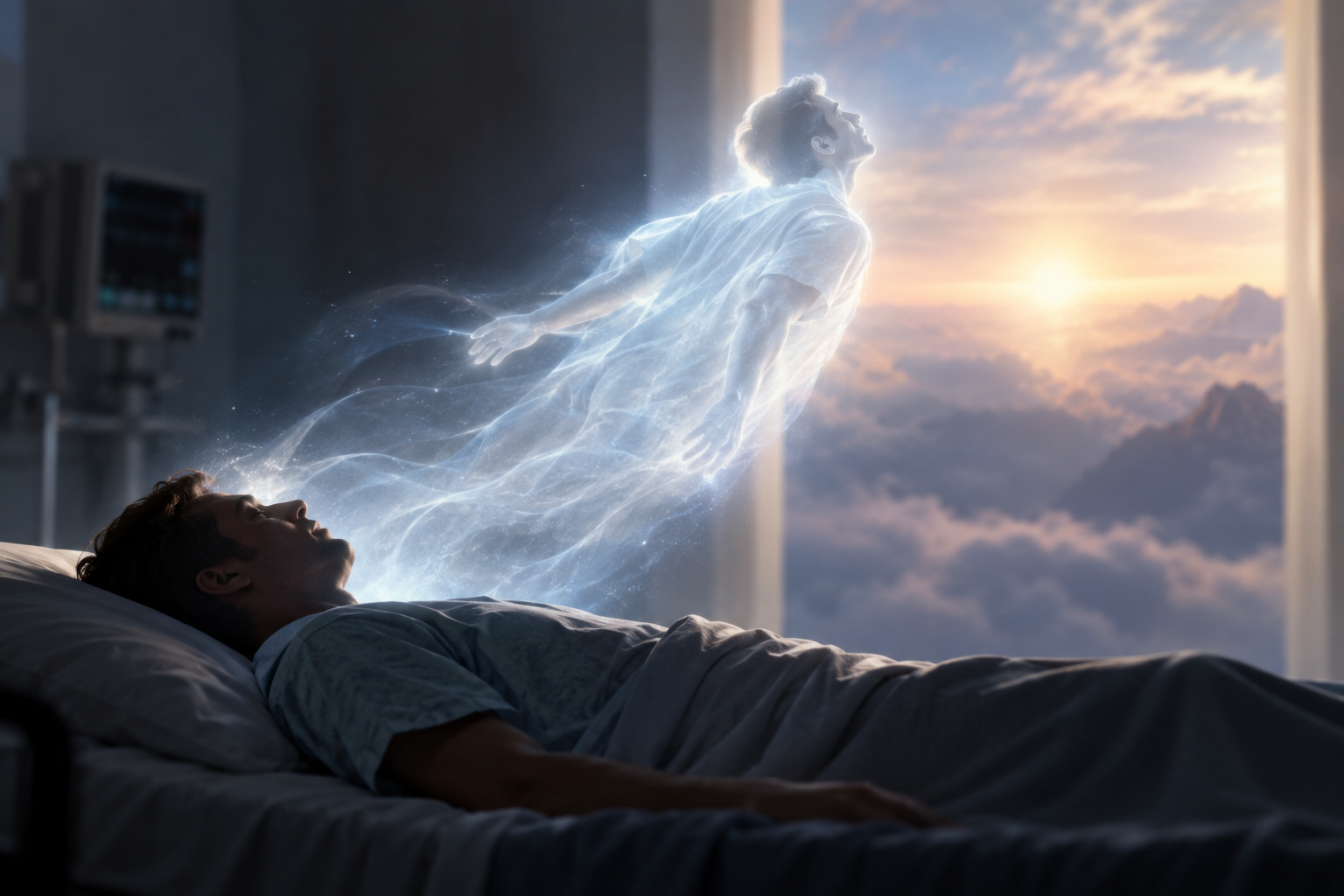

A cardiac arrest patient reports watching a medical team work on a body from above. Later, they describe a piece of equipment, a conversation, or an action they could not have seen from the hospital bed. The details are checked. They hold up. That is where the question stops being a comforting religious abstraction and becomes an evidentiary problem.
Do near death experiences prove afterlife? If by “prove” we mean a laboratory demonstration that forces every skeptic to surrender, no single category of human evidence does that. But if we mean whether the cumulative record makes survival of consciousness the most reasonable explanation, then the answer is yes. Near-death experiences present a serious, recurring, and deeply inconvenient challenge to the claim that the brain creates consciousness and extinguishes it at death.
Do Near Death Experiences Prove Afterlife?
The word prove makes people nervous because it is often used as a trap. Materialists demand mathematical certainty from NDE research, then quietly accept far weaker assumptions about the mind as settled fact. They cannot point to a thought, a memory, a self, or an act of awareness under a microscope. Yet they insist these things are nothing more than brain activity.
That is not science speaking with certainty. It is a philosophical commitment called materialism.
An investigation works differently. Intelligence analysts do not wait for one cinematic piece of evidence that solves every question. They assess patterns, sources, corroboration, alternative explanations, and whether a hypothesis survives contact with the full record. On that standard, NDEs are not a random pile of dreamy anecdotes. They are a body of testimony with repeated features, reported across cultures and decades, often under conditions when normal consciousness should be severely compromised.
The afterlife case is strongest where the experience includes information the person should not have known. These cases are called veridical perceptions. They do not merely involve a tunnel, a beautiful light, or a feeling of peace. They involve observations that can be compared with external facts.
A person may report events in another room, identify who arrived after they lost consciousness, or accurately recount emergency procedures from a vantage point that makes no physical sense. Not every case is equally documented. That matters. A serious investigator should reject loose retellings and demand timelines, medical records, independent witnesses, and details recorded before memory can be shaped by later conversations.
But weak cases do not erase strong ones. In any field, evidence is judged by its best verified examples, not by pretending every report carries the same weight.
The Pattern Is Bigger Than One Strange Story
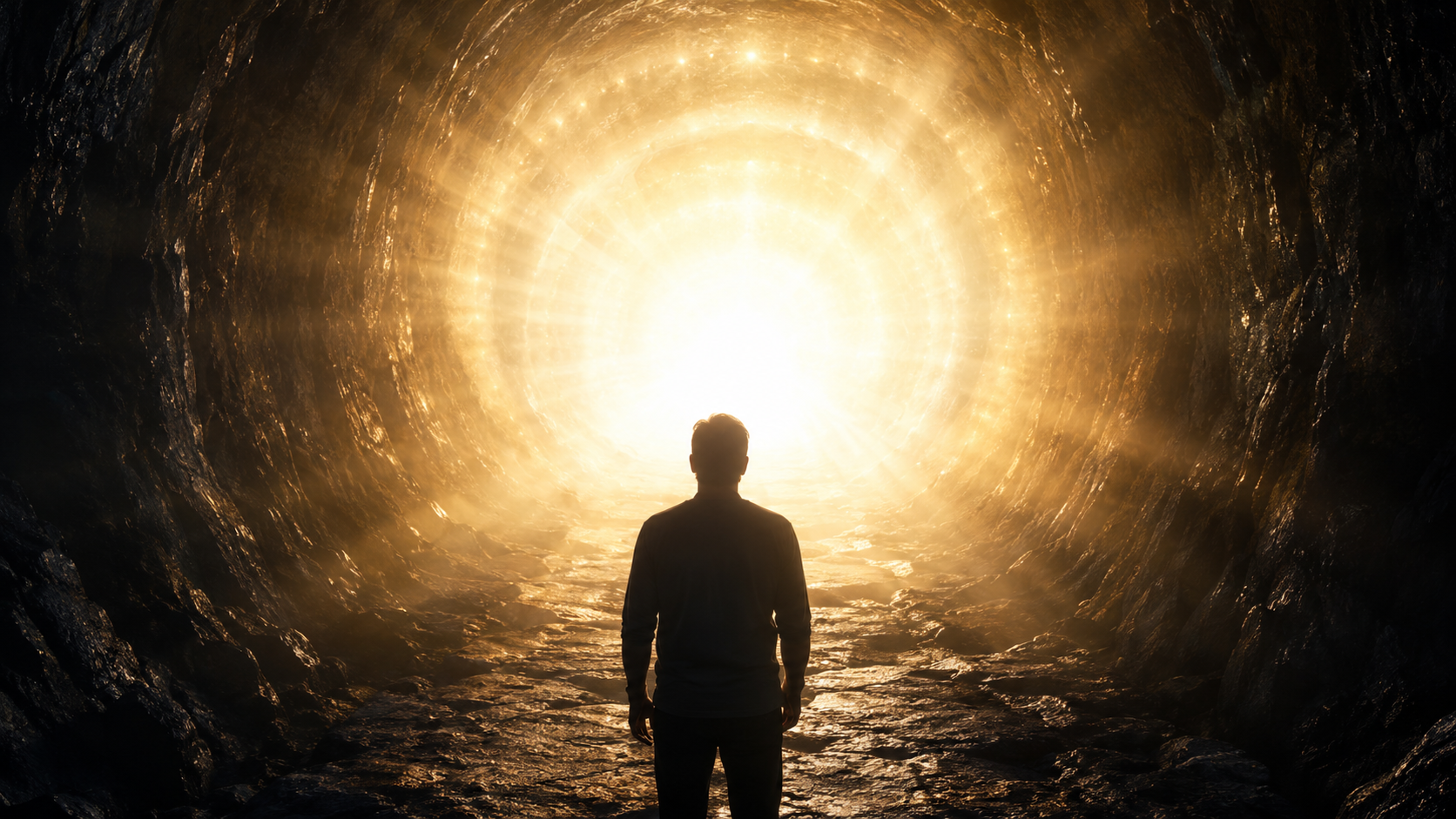
The skeptical response often treats every NDE as an isolated hallucination. That move fails because the accounts show an extraordinary degree of structural consistency. People commonly describe leaving the body, heightened awareness, an encounter with deceased relatives or other beings, a life review, a boundary, and a reluctant return.
The details vary, as they should. A person brings language, culture, memory, and expectations to any experience they try to describe. A combat veteran, a child, a Christian grandmother, and a Hindu physician will not use identical symbols. Yet the underlying architecture repeatedly appears: separation from the body, expanded consciousness, meaningful encounter, moral insight, and continuation beyond physical death.
That consistency matters because hallucinations are usually fragmented, unstable, and heavily shaped by immediate physiology or expectation. NDEs are often remembered as more real than ordinary life, sometimes for decades. They frequently produce durable changes: less fear of death, reduced materialism, greater compassion, and a pronounced sense that love and responsibility matter.
A hallucination can be vivid. It does not usually reorganize a life with that kind of clarity and permanence.
The Brain-Only Explanations Have a Timing Problem
Skeptics commonly cite oxygen deprivation, carbon dioxide changes, anesthesia, seizure activity, REM intrusion, or the brain’s release of chemicals under stress. These mechanisms can produce altered states. Nobody disputes that a distressed brain can generate confusion, visions, distorted time, or dreamlike imagery.
But explaining that altered states exist is not the same as explaining NDEs.
The central problem is timing. Many compelling NDEs occur during cardiac arrest or profound medical crisis, when brain function is severely disrupted and organized conscious experience should be diminished, not amplified. Yet experiencers often report lucid thinking, panoramic memory, coherent sequence, and perceptions that later match events in the physical world.
The standard materialist model predicts the opposite. As the brain fails, consciousness should become dimmer, more chaotic, and finally absent. NDE reports often describe consciousness becoming sharper, wider, and less dependent on the body. That does not fit the model. Calling the mismatch “brain chemistry” is not an explanation. It is a label pasted over an anomaly.
Some critics argue that an NDE could occur in the moments before or after the period of unconsciousness, with the brain constructing a false memory afterward. That possibility must be considered case by case. It also has limits. It cannot account for accurately reported details from periods the person could not normally observe. And it asks us to believe that a disorganized, recovering brain somehow manufactures a coherent experience containing correct information it never received.
That is not parsimonious. It is an increasingly elaborate rescue operation for a failing theory.
What NDEs Can and Cannot Tell Us
NDE evidence supports the survival of consciousness. It does not give us a complete tourist map of the next world.
That distinction protects the subject from both cynical dismissal and reckless fantasy. An NDE can strongly indicate that awareness is not produced by the brain in the simple way materialism claims. It can also suggest that relationships, moral choices, and love carry consequences beyond death. It cannot reliably settle every denominational dispute, predict the mechanics of heaven, or tell us exactly how individual judgment unfolds.
Experiencers disagree on some imagery and interpretation. This is not fatal to the evidence. Eyewitnesses to the same event can describe different angles while agreeing on the central occurrence. The relevant question is whether the core signals recur and whether the best cases contain independently confirmable information. They do.
The common phrase “lack of proof” also conceals a double standard. We do not dismiss all historical events because no one can recreate them in a laboratory. We weigh testimony, records, context, and corroboration. Death is not an ordinary laboratory condition, and consciousness is not a beaker of liquid. The demand for a repeatable afterlife experiment often functions less as scientific rigor than as a way to ensure no evidence can ever count.
Why This Evidence Is Personally Significant
For someone grieving a spouse, facing a diagnosis, or waking at 3 a.m. terrified of oblivion, this question is not academic. The fear is real. So is the temptation to accept a cheap answer simply because it hurts less.
The case for survival does not require blind belief. It asks for intellectual honesty. Look at the verified perception cases. Look at the recurring structure of thousands of accounts. Look at the timing problem for brain-only theories. Then ask which explanation accounts for the evidence with fewer evasions.
The brain may be less like a generator of consciousness and more like a receiver or filter. Damage the radio and the music becomes distorted, but that does not prove the radio created the broadcast. When the body fails, the signal may not end. The receiver may simply no longer be the place from which consciousness is heard.
You do not have to force certainty before you are ready. But you also do not have to let a materialist assumption masquerade as the final word on death. The evidence points toward continuity, and for those carrying fear or loss, that is not wishful thinking. It is a rational reason to leave the door open to a reality far larger than the body.
Want to go deeper? Don Winner brings decades of intelligence and investigative experience to the biggest question there is: what happens when we die.
In You’re Going to Die Someday, Right? Near-Death Experiences Reveal What Happens Next, he examines the evidence from thousands of near-death experiences to find out what they actually tell us about consciousness, the soul, God, and the afterlife.
In Hell Exists, But Only for the Living, he investigates where our idea of hell came from and who built it, tracing the doctrine back to its human sources.
Get your copy of You’re Going to Die Someday, Right? or Hell Exists, But Only for the Living.