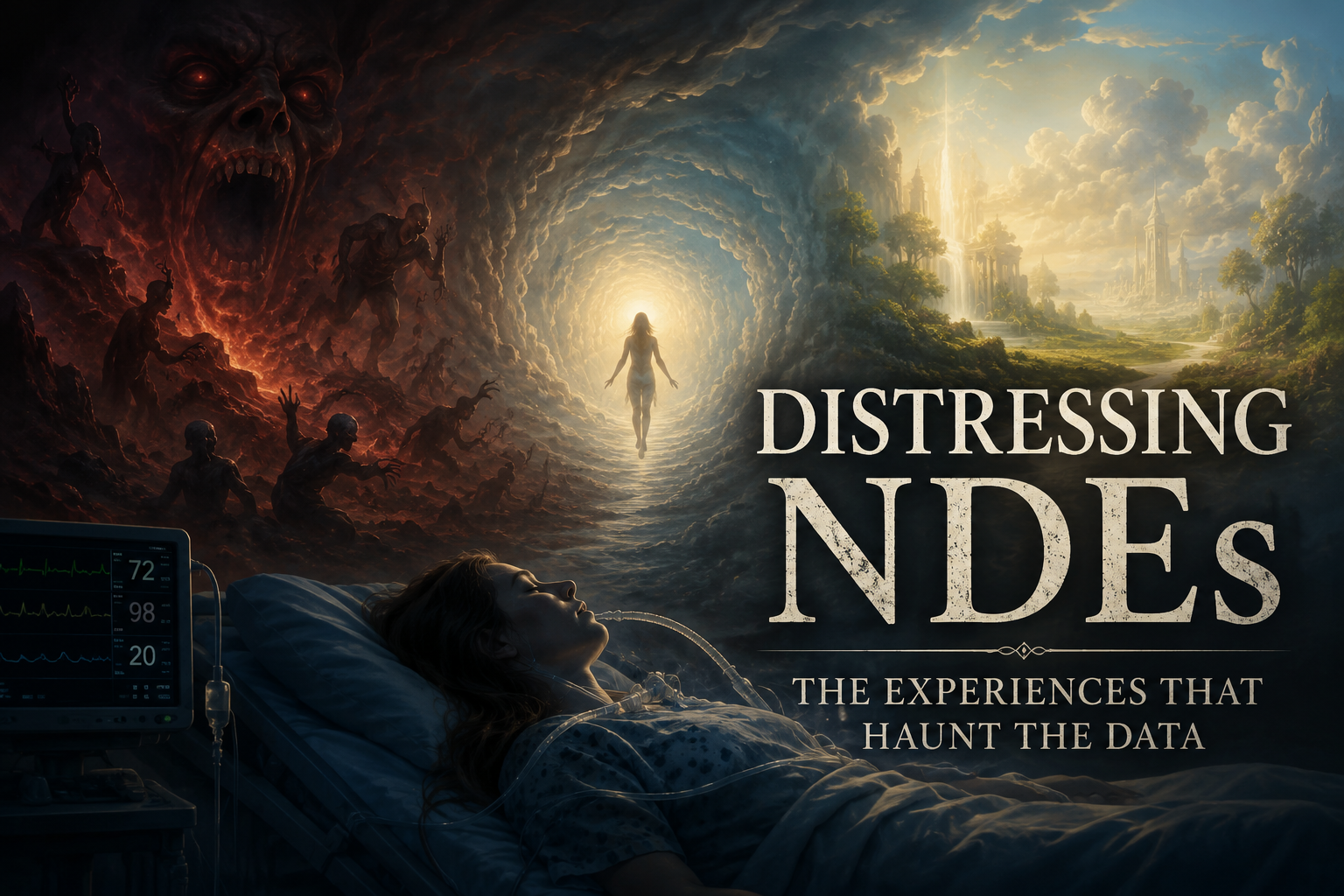
Some of the scariest near-death stories on record don’t stay scary.
They start in terror. Darkness. Menacing figures. Nightmare places. And then, right in the middle, everything flips. The fear drains away. Light pours in. Peace, love, the whole beautiful thing, straight through to coming back.
Researchers have a name for these. They call them “conversions.” What they don’t have is an explanation. For more than thirty years, they’ve stared at these stories and asked the same question: how does one experience turn from hell into heaven halfway through?
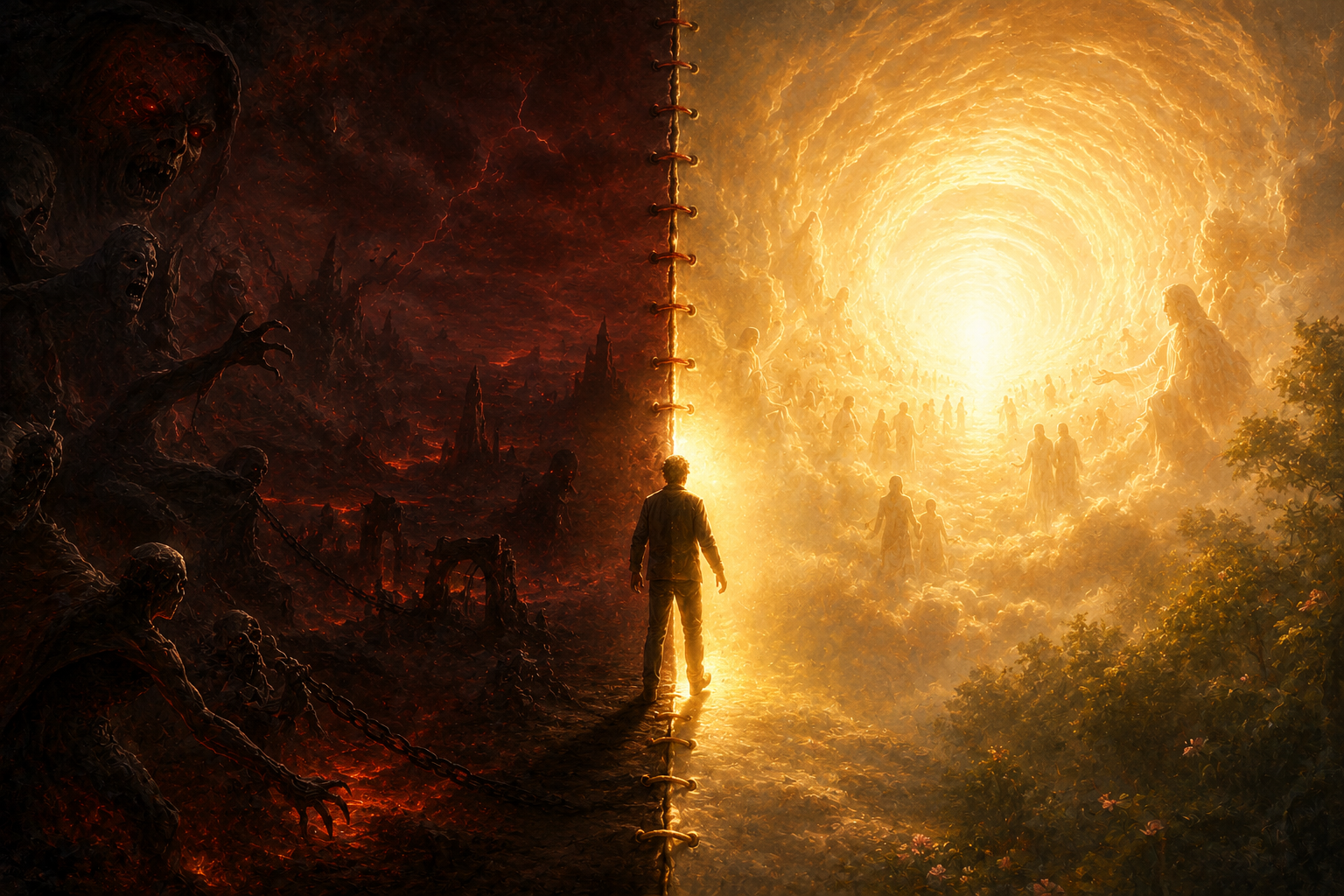
Here’s the answer. It doesn’t. What you’re looking at isn’t one experience. It’s two — and nobody noticed the seam where they meet.
Table of Contents
The Puzzle Nobody Could Solve
These stories are right there in the research. Back in 1992, Dr. Bruce Greyson and Nancy Evans Bush wrote the foundational study on distressing near-death experiences. They spelled it out plainly: sometimes a frightening experience turns peaceful partway through. And it often flips at one specific moment — when the person stops fighting, gives up, or cries out for help.
The most famous case is a man named Howard Storm. Paris, 1985. He was an art professor, a hard atheist, and he was dying — a hole had opened in his stomach and his body was shutting down. His experience started in darkness. Voices lured him in, then turned vicious. It’s one of the most terrifying accounts ever recorded.
Then, at his lowest point, this lifelong atheist called out for help.
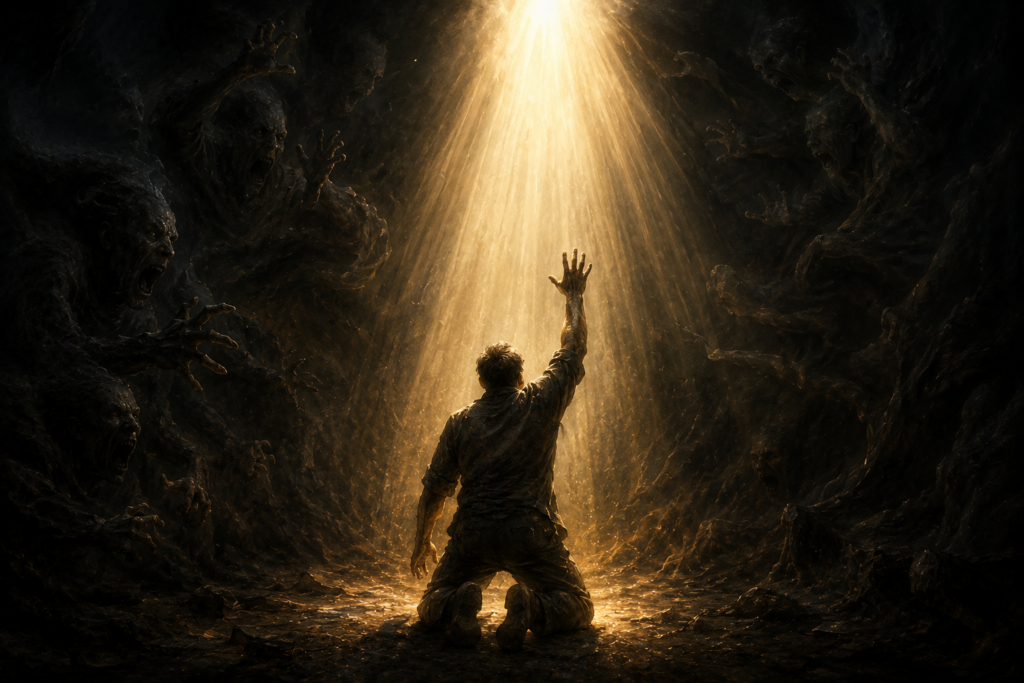
And it flipped. Light. Rescue. A wave of love so total that Storm came back and rebuilt his whole life around it.
For thirty years, people have explained that flip in one of two lazy ways. The skeptics shrug and say “brain chemistry.” The preachers say “a soul yanked back from the edge of hell.” Both miss the same simple fact: nothing else in near-death experiences works like this. Real NDEs are astonishingly consistent. Same story, same feeling, every country, every century. They don’t flip. So when one appears to flip, something unusual is going on — and it’s worth looking at hard.
Two Things, Not One
In my last article, I showed you a mistake that has muddied fifty years of research. Two completely different things have been getting stuffed into one box labeled “distressing NDE.”
Here’s the short version, in case you’re just joining.
A living brain under stress — drugged, feverish, poisoned by illness — can perceive terrifying things. That’s not death. That’s a body in trouble. The real near-death experience is a separate event that happens at the actual moment of death.
The case I used last time was a woman put into a coma for twelve days. Early on, she had hellish visions. Later, after her body actually gave out, she had a beautiful, textbook near-death experience. In her memory it all blurred into one story. But it was two events, stitched together by a brain that had no way to keep time.
Now take that idea and lay it over the “conversions.” Watch the thirty-year mystery fall apart.
A conversion isn’t one experience changing its mood. It’s one thing ending and a different thing beginning — and the person is describing the exact moment they cross over from one to the other.
Think of it like a seam in a piece of cloth. Two separate panels, sewn together so smoothly you’d swear it was one piece. The scary part is the first panel. The beautiful part is the second panel. The “flip” everyone puzzles over is just the stitch line where they join.
Two Kinds of Scary — and Neither One Is the NDE
Before we go further, I need to split that first panel in two, because there are actually two different reasons the pre-death part can be terrifying. This matters, so stay with me. Both are simple.
Kind one: your body’s alarm system, screaming.
You are built to survive. When death comes at you, your brain doesn’t go quiet. It goes berserk — in a useful way. It floods you with every worst-case scenario at once, fast, so you can find the one move that saves you. Fight the animal. Run for the gap. Swing the pipe. Your heart pounds. Pain fades so you can keep going. This is a survival engine that kept your ancestors alive on the African savanna, and you inherited it because the ones who had it lived and the ones who didn’t got eaten.
That engine can throw terrifying pictures at you in your final moments. Monsters. Being chased. Being torn apart. It’s not a preview of the afterlife. It’s your survival system doing its job right up to the last second — trying to save a life that can’t be saved this time.
Kind two: a drugged or sick brain seeing things.
Certain drugs and certain sicknesses can tune your perception to strange places. I’ve written before about DMT and a Chinese mushroom called Lanmaoa asiatica — take them, and people reliably see entities, strange landscapes, little people. Hospital drugs can do their own version of this. That’s what I call frequency shifting, and it’s a whole topic of its own.
Here’s the key point about both kinds. Neither one is the near-death experience. Both happen while you’re still alive. One is your alarm system firing. The other is a chemically altered brain. Scary? Absolutely. But it’s the stuff that happens before the door opens — not what’s on the other side.
The Rabbit in My Hands
Let me tell you the moment this became real to me. It involves a baby rabbit and a beagle named Rex.
Years ago I lived in Panama. My wife brought home baby rabbits — pets for our three-year-old. Cute idea. One problem: our beagle, Rex the Wonder Dog. Beagles are born to hunt rabbits. It’s in the blood. The second those rabbits came in the house, Rex had exactly one mission in life, and it wasn’t friendship.
My wife built a pen on the deck. Rex treated it like a puzzle to solve. On maybe his fifth break-in, I ran up and pulled him off a rabbit he’d nearly caught. That was it — experiment over, rabbits going to a new home, today.
So I went to box them up. The first one I picked up was pure terror. Eyes shut tight. Shaking so hard I could feel it in my palms. Every cell in that little body was screaming that death had arrived — and honestly, from its point of view, the snapping dog had just been swapped for a 220-pound giant. Baby rabbits are basically nature’s chicken nuggets. Everything wants to eat them, and their bodies have spent millions of years bracing for this exact moment.
I held it gently. Stroked its face. Talked soft. Let it feel that I meant no harm — I’d just eaten a sandwich, and raw rabbit wasn’t on the menu.
Then something happened that I’ve never forgotten.
The rabbit went limp. The shaking stopped. Its face let go of the fear. It surrendered — completely, all the way down. And I swear I felt peace flood through its body while I held it. This is a real, known thing in prey animals. When death seems certain, the struggle switches off, and a strange calm takes over. The letting-go comes built in. The peace is part of the design.

Then one eye cracked open and looked right at me. Then the other. And slowly it worked out that the giant wasn’t going to eat it after all. It went back to being a normal, calm little rabbit, and I set it in the box.
That rabbit went through the whole thing — terror, surrender, peace — right up to the edge of death. And then death didn’t come. So it came back.
That is a “conversion,” seen from the outside. The terror is the alarm system. The surrender is the moment the fight ends. The peace is what waits on the far side of the fight. My rabbit reached the seam — and got pulled back before crossing it. People whose hearts are restarted on a table do the same thing: they reach the seam, get yanked back, and come home describing the flip. People who actually die keep going, through the seam, into the light.
The surrender doesn’t create the peace. The surrender is just the moment the scary part ends and the door opens.
Storm fits this perfectly. A man dying of a stomach wound is being poisoned by his own body — a brain in deep chaos. The terrifying part belongs to that dying, still-alive body. His cry for help came right at the end of it. And what followed was the same beautiful NDE everyone else describes. Notice: once it flipped, it never flipped back. It never does. Real NDEs don’t turn scary. Only the stuff before them does.
Pack It in a Box and Label It
So here’s where this leaves us, and it’s bigger than one puzzle solved.
There’s no such thing as a “distressing NDE.” There’s fear, and adrenaline, and a screaming survival alarm, and sometimes a drugged or sick brain seeing things — and all of it happens before the near-death experience even starts.
Take all of that. Put it in boxes. Label them. Slide them onto the shelf where they belong: before death.
Because when the actual near-death experience arrives, it comes through clean. Every time. Love, light, peace, the people you’ve lost, the feeling of coming home. The scary stuff never makes it through the door. It can’t. It belongs to the living body, and the body is exactly what you leave behind.
The near-death experience itself stays pure. Untouched. It always has been. We were just looking at the mess in the hallway and blaming the room.
There’s one more kind of “hellish” account I haven’t touched — the people who feel like they’re in hell during what really is the death event itself. That one’s real, it’s common, and it’s a completely different animal. It has to do with the life review. That’s the next brick.
Stay tuned. The seam was just the beginning.
P.S. — Did you go through something like this? A terrifying stretch during a medical crisis that suddenly turned peaceful? I want to hear about it. Your story might be exactly the data this research needs. Email me or reach me through winnernde.com.
Want to go deeper? Don Winner brings decades of intelligence and investigative experience to the biggest question there is: what happens when we die.
In You’re Going to Die Someday, Right? Near-Death Experiences Reveal What Happens Next, he examines the evidence from thousands of near-death experiences to find out what they actually tell us about consciousness, the soul, God, and the afterlife.
In Hell Exists, But Only for the Living, he investigates where our idea of hell came from and who built it, tracing the doctrine back to its human sources.
Get your copy of You’re Going to Die Someday, Right? or Hell Exists, But Only for the Living.