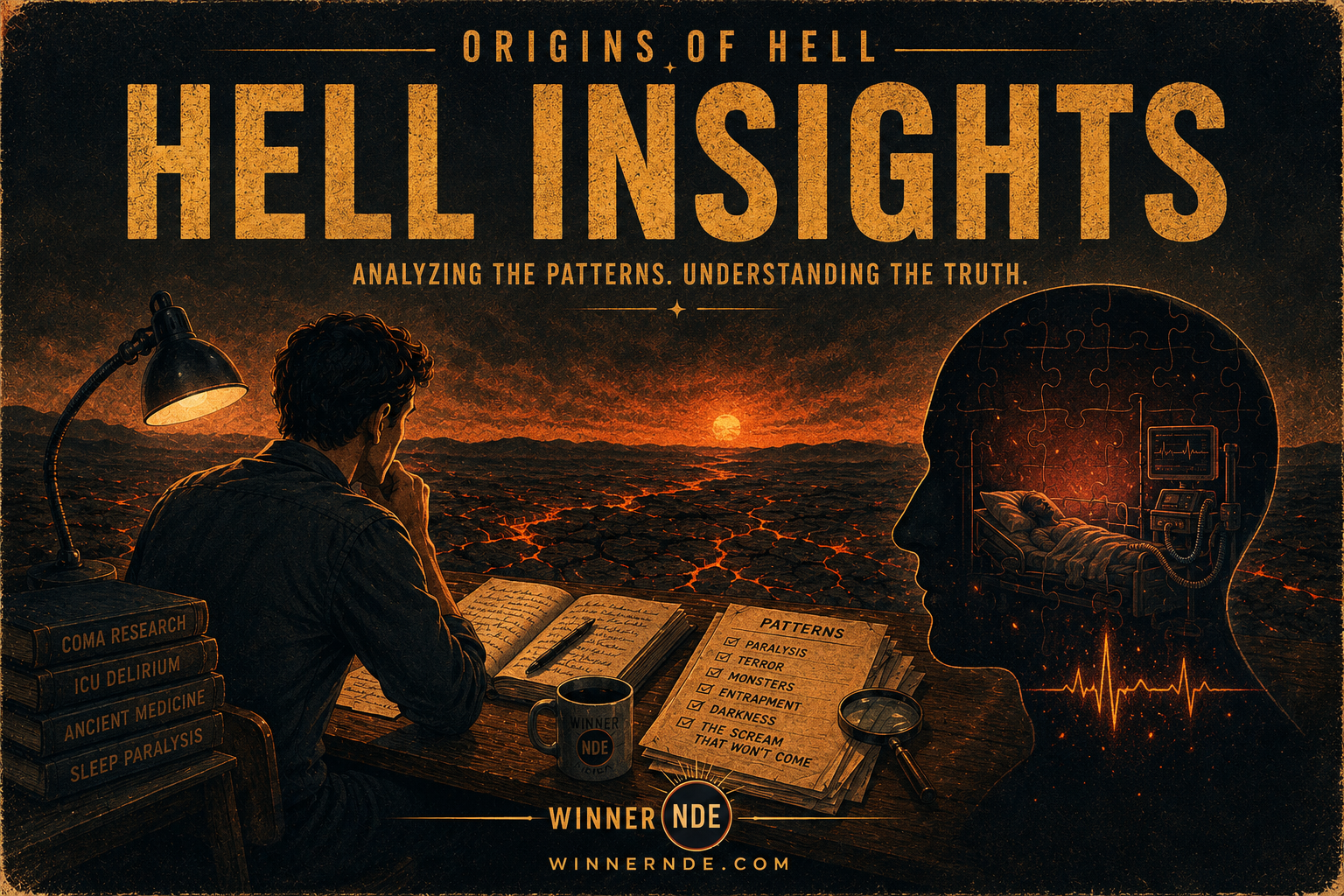

You already know what hell looks like. Just close your eyes and picture “hell.”
The dark. The fire. Something in there with you. Torment with no way out and no door. Being pursued with no means of escape. Torture. Pain. And more than anything else – fear. You could describe it right now without thinking about it, and so could a stranger on the other side of the planet who grew up in a different language and a different faith. You knew it before anyone taught it to you.
Ask where it came from and almost everyone gives the same answer. Religion. Scripture, sermons, painted ceilings, carved warnings. The institution that carried the idea is wrapped so tightly around it that we assume the institution made it.
That’s the part I think is backwards.
Where this started
In my first book, You’re Going to Die Someday, Right?, I worked from a clean data set. One hard rule: no account got in without a clear clinical death. Flatline. Cold. No doubt about it. I quickly identified a clear subset in the NDE data. There were many accounts that started with some sort of a kinetic, traumatic medical event, like a bad car crash for example. And then the person giving the account simply proclaims “and then my NDE started.” Lacking was a clearly defined identification or description of a clinical death. Just a leap from medical crisis straight to “my NDE.”
What’s more, very often the detailed description of what the person saw or experienced during their “NDE” was completely and totally different from everything I had encountered in authentic or “normal” NDEs. The imagery in those accounts didn’t match anything else in the other, massive pile of data. Something was wrong, but at the time I did not fully understand what it was.
That decision held up. Authentic near-death experiences don’t contain hell scape imagery. The only place hell shows up at all during an authentic NDE is when someone describes it in the context of a life review, and that’s a different thing entirely. Very often when people have led either dramatic or traumatic lives, their life review process can be extremely troubling. “I was it hell” or “It was like going through hell…” That sort of thing. But no one – and I mean no one – talked about fire, brimstone, devils, demons, pitchforks, and the like. It’s simply not there in the data, at all.
And what’s more – there’s no judgement on the other side. There’s a chapter in my first book Judgement Is The Opposite Of Love. The concept of St. Peter standing guard at the “pearly gates” directing people to either heaven or hell did not appear, even once. No First Testament vengeful God condemning you to hell because you ate one too many Klondike bars, or you had too much fun in the closet with a copy of Playboy when you were a teenager. Stuff like that was nowhere to be found.
So I said it plainly. According to the NDE data, hell does not exist. In the book, on podcasts, and on this website.
The pushback came back fast and all pointed the same direction. What about the distressing accounts? Howard Storm. Bill Wiese. The people who say they went to hell and came back.
That’s a fair challenge, and the kind an intelligence analyst doesn’t get to wave off. So I went back and opened the quarantined pile — the accounts I’d set aside years earlier and never looked at again.
They weren’t garbage. They were something else. Something important.
Two facts nobody had put in the same room
The first one comes out of modern hospitals. Living patients in coma-like states come back reporting experiences of overwhelming terror. Pursued. Trapped. Held down. Tortured by things that shouldn’t exist. This isn’t a handful of odd cases — a 2024 meta-synthesis pulled fourteen studies and nearly eight hundred patients and found the same categories repeating across countries and decades. Delirium alone hits up to eighty percent of ventilated patients.
The second comes out of biology. A coma needs no hospital. It needs a head injury, a fever, blood loss, infection, drowning, starvation — and those have been standing next to human beings since there were human beings. Many ancient victims died. Not all of them. A steady trickle survived, nursed by kin who kept them warm and watered and guarded until they opened their eyes.
Now put those two facts together.
If terrifying coma experiences are a feature of human physiology rather than modern medicine, and if coma survivors have been waking up and walking back into their families for a hundred thousand years, what happened to the stories those people told?
They told them. To people who had known them since birth and had no reason on earth to doubt a word of it.
Hell didn’t need a prophet. It didn’t need to travel. It regenerated on its own, everywhere humans lived, every time a brain went into catastrophe and the body came back. It isn’t a doctrine that spread from a source. It’s a description that kept getting rediscovered.
The line that names the book
There’s a piece I’m not going to put in an article, because it’s the load-bearing beam of the whole thing and it took most of a book to earn.
What I’ll tell you is where it leads.
A terror experience in a living brain and a genuine near-death experience cannot be the same event. They cannot even be happening at the same time. That sounds like a technicality. It isn’t. It’s what resolves every distressing account I quarantined years ago, and it’s what gave this book its title.
The witnesses are honest. What they went through was real, and it was worse than most people can imagine. But the sequence they’re describing is not the sequence they lived — and once you can see where the seam is, you can’t unsee it.
If you’re dead, you can’t go to hell.
You need a body to get there. That’s a biological fact. You’ll see…
What’s in it
Twenty-one chapters. The clinical literature on coma and what survivors bring back. The word coma traced backward through Greek, Egyptian, Mesopotamian, and Chinese medicine to the point where the documentary trail runs out. Why fear specifically, and what the freeze response does when the release mechanism is smashed and the tension is still in it. The Epic of Gilgamesh, where Enkidu’s dream of the House of Dust turns out — read closely — to be something other than the first written description of the afterlife. And the distressing accounts themselves, taken apart one at a time.
271 pages. Paperback and eBook.
Forty-five years of separating signal from noise: Air Force linguist, NSA analyst, Special Operations, investigative journalist. I’ve never had a near-death experience. I came at this the way I’ve come at everything else — follow the evidence and go where it goes, including when it goes somewhere you weren’t expecting.
It went somewhere nobody had published. Ever. Anywhere.
Part of Origins: God, Hell, and Religion. See the full series.
Want to go deeper? Don Winner brings decades of intelligence and investigative experience to the biggest question there is: what happens when we die.
In You’re Going to Die Someday, Right? Near-Death Experiences Reveal What Happens Next, he examines the evidence from thousands of near-death experiences to find out what they actually tell us about consciousness, the soul, God, and the afterlife.
In Hell Exists, But Only for the Living, he investigates where our idea of hell came from and who built it, tracing the doctrine back to its human sources.
Get your copy of You’re Going to Die Someday, Right? or Hell Exists, But Only for the Living.