A Tool for Identifying a Fear Coma Experience
Introducing the Winner FCE Scale.
For decades, the field of near-death studies has had a measuring stick. In 1983, Dr. Bruce Greyson built a simple questionnaire that could take a person’s account of what happened to them at the edge of death and return a number, a score that answered a single question: was this an authentic Near-Death Experience? The Greyson Scale became the standard. It gave researchers, clinicians, and experiencers themselves a common instrument, a shared way to say “yes, this was the real thing,” or “no, this was something else.”
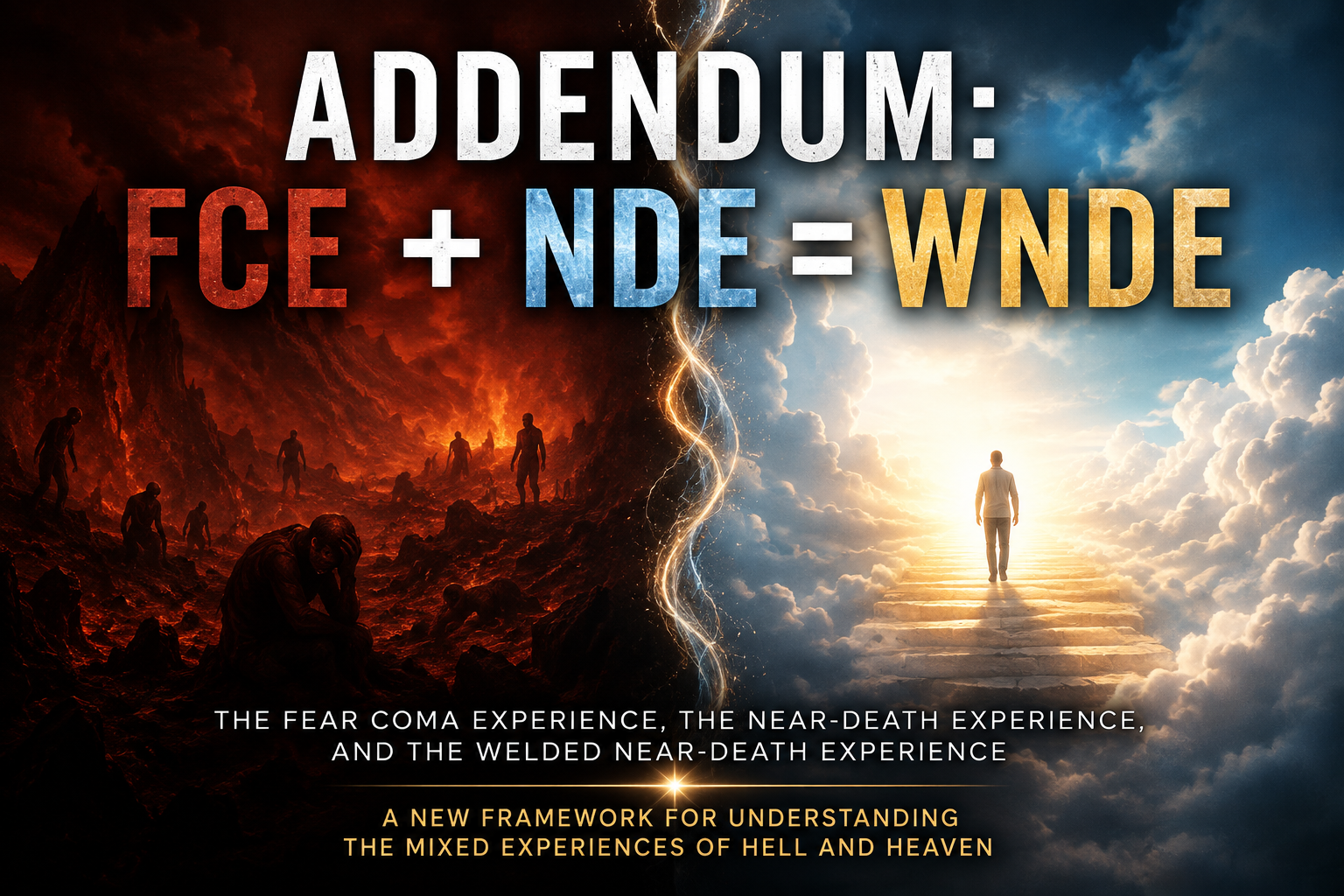
But the Greyson Scale only measures one half of what can happen to a person who comes close to death. It measures the crossing, the peace, the light, the life review, the journey to the other side. It has no way to measure the other thing that happens to people at that same threshold, the thing that is far more common than most people realize and almost never talked about honestly: the terror.
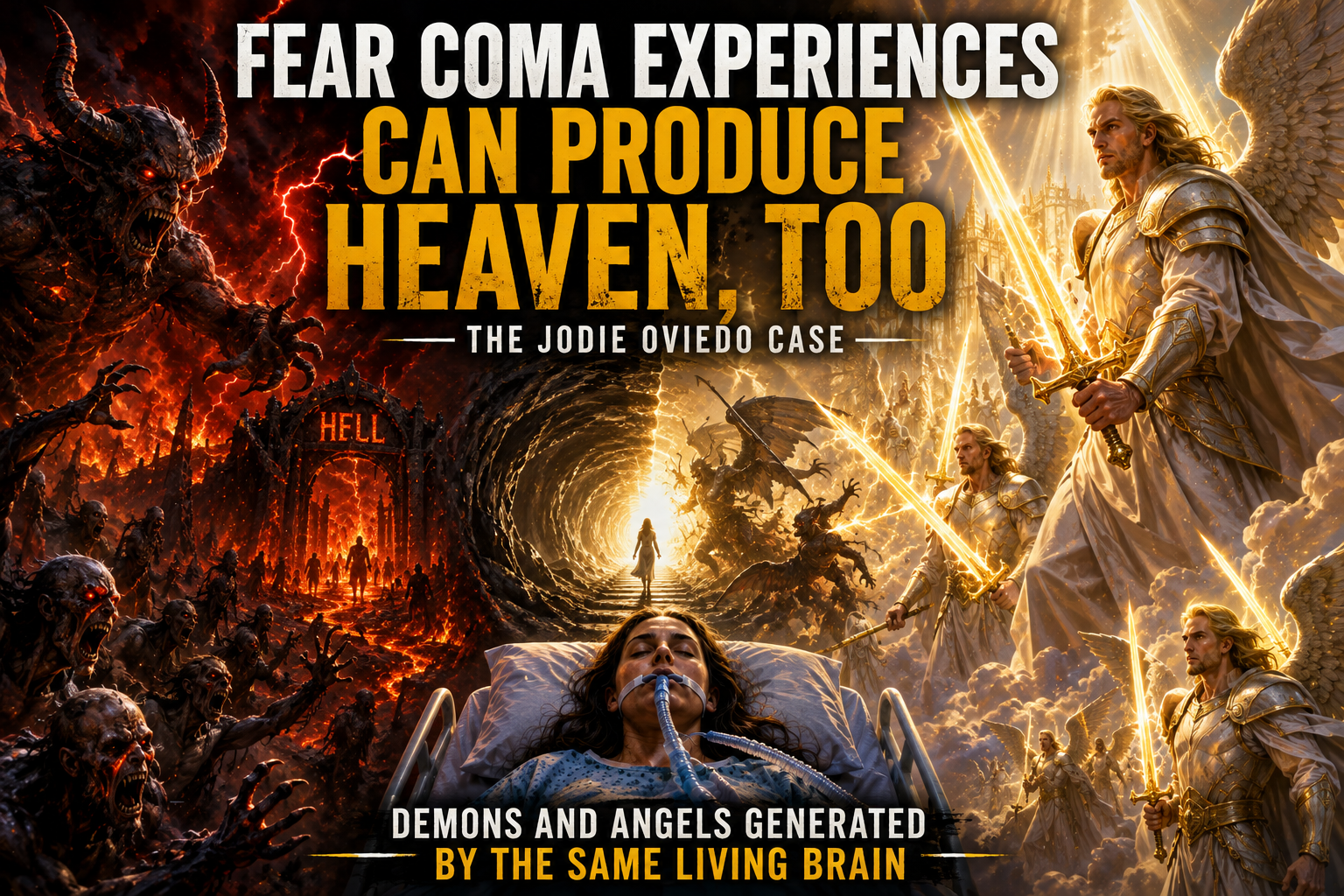
Some people do not cross over into peace. Some people, in the depths of a coma brought on by catastrophic injury or illness, descend instead into a hell of their own brain’s making. They experience overwhelming fear, entrapment, the certainty of death or damnation, imagery so dark and so real that they come back wounded and cannot speak of it for years. This is not a Near-Death Experience. It is something else, something with its own distinct cause, its own signature, and its own aftermath. It is a Fear Coma Experience, an FCE.
Until now there has been no instrument to measure it. No scale, no questionnaire, no way for a person who lived through one to look at their own experience and understand what it was. This article introduces that instrument. It is called the Winner FCE Scale, and it is the direct counterpart to the Greyson Scale, a mirror for the other half of the near-death threshold.
What a Fear Coma Experience Actually Is
To use the scale, it helps to understand what it is measuring, because a Fear Coma Experience is not a spiritual event and it is not a punishment. It is biology.
Every animal on Earth carries the same ancient survival system, the fight-or-flight response, hardwired into the nervous system by hundreds of millions of years of evolution. Its job is singular: when the brain detects that death is near, it floods the body with terror and one command. Move. Run, fight, do something, right now, or you will not survive. This is the system that makes a deer bolt and a person leap back from a cliff edge. It has kept our ancestors alive since long before they were human.
A Fear Coma Experience is what happens when that system fires at full strength into a body that cannot answer. When a catastrophic injury or illness drops a person into a coma, the survival system does not switch off. If anything, sensing mortal danger, it screams louder. It commands the body to move, to escape, to fight for its life, and the body, offline and unresponsive, cannot obey. So the command has nowhere to go, and it escalates. The brain ramps the terror higher and higher, generating more and more frightening imagery in a desperate attempt to force a response it can never get. The result, from the inside, is hell: a mind drowning in maximum terror, trapped in a body it cannot move, convinced it is dying, for what may feel like an eternity.
This is the Fear Coma Experience. And because the terror is generated by a living, frightened brain and experienced as completely real, it leaves the person marked, often for years, in a way a peaceful crossing never does.
The Winner FCE Scale is built to detect this experience, to measure how completely its signature is present in a person’s account, and to distinguish it cleanly from the peaceful Near-Death Experience it is so often confused with.
How to Use the Scale
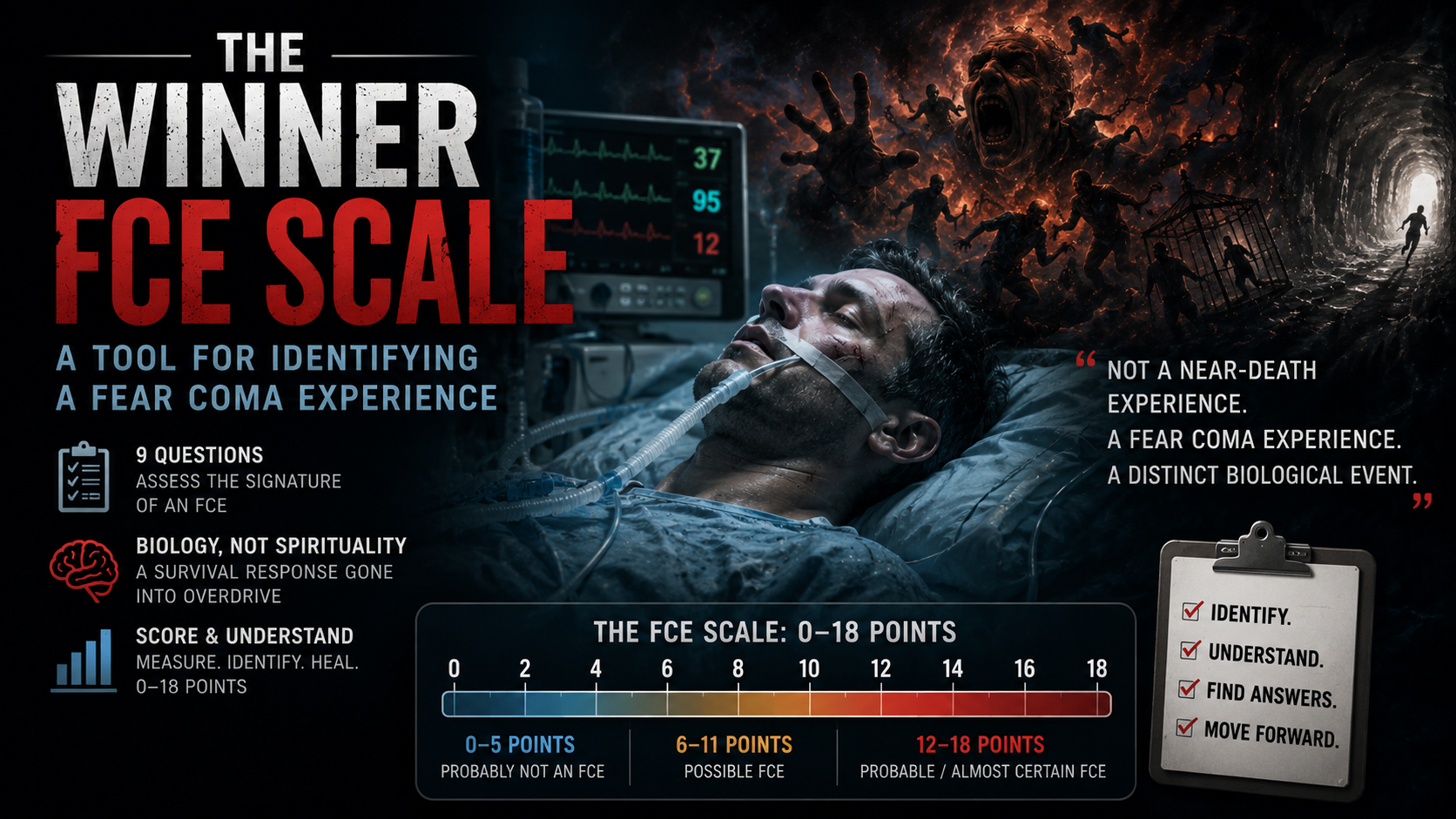
The scale is made up of nine questions. Answer each one as honestly as you can, choosing the response that best fits your own experience. Most questions are scored from 0 to 2 points.
A few questions offer an “Unknown” option. These cover things you may genuinely not be able to answer on your own, either because you were unconscious at the time or because the information sits in a medical record you have not yet obtained. Answering “Unknown” does not count against you. Instead, it flags something worth going to find out, a number in a chart or an account from someone who was at your bedside, that could confirm your experience.
When you have answered all nine, add up your points and compare your total to the scoring key at the end.
The Winner FCE Scale
1. Were you unconscious, in a coma or a comatose state, during the experience?
- 2 — Yes. I was in a documented coma, or I was unconscious and unresponsive for an extended period (hours or days) and could not be woken.
- 1 — Partly. I was in and out, heavily sedated, or unconscious for a shorter stretch, and I have large gaps of “lost time” I can’t account for.
- 0 — No. I was awake and aware the whole time.
2. If you were in a coma, were you assessed on the Glasgow Coma Scale, and what was your score?
The Glasgow Coma Scale runs from 3 to 15. A score of 8 or below is the medical definition of a coma. A lower number indicates a deeper coma. If you were seriously injured or critically ill, this number is likely in your medical records.
- 2 — I have a documented GCS of 8 or below (a true coma). A lower number indicates a deeper coma.
- 1 — I was scored in the 9 to 12 range, or I know I was assessed but don’t yet know the number.
- 0 — My GCS was 13 or higher, or I was never in a state that warranted a coma assessment.
- Unknown — I don’t have my records yet. (Does not score against you. Flags a number worth retrieving.)
3. As the coma or unconsciousness set in, were you already in a state of fear?
- 2 — Yes, intensely. In the moments before I lost consciousness I was in real fear or panic. I knew I was in danger, that something was badly wrong, or that I might be dying. I went under afraid.
- 1 — Somewhat. There was fear or alarm, or a strong sense something was wrong, but not full terror, or it happened fast.
- 0 — No. I went under calmly, with no fear, under planned anesthesia, in my sleep, or without any sense of danger.
- Unknown — I have no memory of the moments before I went under. (Does not score against you.)
4. What kind of imagery do you remember from the experience?
- 2 — Overwhelmingly dark, frightening, or hellish. A dark, cold, or oppressive place, a void, a cave, a warehouse, a barren wasteland, an enclosure I couldn’t escape. Threatening or suffering figures. Fire, burning, being consumed. A pervasive sense of dread, wrongness, or evil. Fear was the dominant tone of everything I saw.
- 1 — Mixed or unsettling. Some frightening imagery, but not wall-to-wall terror, disturbing in places, with neutral or confusing stretches too.
- 0 — Peaceful, beautiful, or neutral. Light, warmth, gardens, loved ones, calm and safety. Nothing frightening.
5. Did you feel trapped, unable to move, unable to escape, unable to make it stop?
- 2 — Yes, completely. I felt trapped, paralyzed, or held with no way out. I needed to escape and could not. I may have felt pursued, cornered, or hunted, something was coming and I could not get away. There was no way to make it stop.
- 1 — In part. There was a sense of being stuck, confined, or unable to act, but not the full paralyzed, no-exit, being-pursued feeling.
- 0 — No. I could move freely, leave, or stop what was happening, or I never needed to.
6. How would you rate the sheer intensity of the terror, how bad did it get?
- 2 — The worst imaginable. The most terrifying experience of my life, beyond anything I had ever felt or thought possible. Total, consuming terror, and it often kept escalating. Every time I thought it couldn’t get worse, it did. I was certain I was in hell, or that I was about to die.
- 1 — Severe, but not beyond all limits. Genuinely frightening, among the worst experiences of my life, but not total, world-ending terror.
- 0 — Mild or moderate. Unsettling or unpleasant, but not deeply terrifying.
7. Did you later learn that your body was thrashing, fighting, or had to be restrained during the experience?
- 2 — Yes. I was told I was thrashing, fighting, trying to get out of bed, or that I had to be restrained or watched by a sitter to keep me safe.
- 1 — Something like it. I was told I was restless, agitated, or hard to manage, but not the full fighting-to-escape picture.
- 0 — No. I was calm and still throughout, or I’ve been told nothing to suggest otherwise.
- Unknown — I haven’t yet asked anyone who was there. (Does not score against you. Worth asking about.)
8. In the time since, how has the experience stayed with you?
- 2 — It has never let go. It remains as vivid now as the day it happened, not faded like a dream, but sharp and real years later, and it left lasting damage: fear, nightmares, flashbacks, anxiety, or PTSD. I did not want to look at it or talk about it, sometimes for years, and I may have numbed myself to keep it away.
- 1 — It stayed with me for a while. Vivid and disturbing, and it marked me, but the grip has loosened and I have mostly worked through it.
- 0 — It faded, or it left me at peace. It dimmed the way ordinary memories do, or I came back calmer and less afraid of death, carrying no lasting fear or trauma.
9. Afterward, was there a stretch of time you simply cannot account for, lost hours or days that are just a blank?
- 2 — Yes. Lost hours or days I cannot account for at all, a complete blank. No reliable sense of how long the experience or the unconsciousness lasted; it could have been minutes or a week.
- 1 — Partly. My sense of time is fuzzy or unreliable around the event, with gaps, but not a total blank.
- 0 — No. A clear, continuous sense of time throughout, with no missing stretch.
Scoring
Add up your points. The maximum possible score is 18.
Any questions you answered “Unknown” do not count for or against you. A person can score high with one or two questions still open, and those open questions simply point to information, a medical record or a witness account, that could complete the picture.
12 to 18 — Probable, almost certain FCE. The great majority of the fear-coma signature is present and clean. This was a Fear Coma Experience.
6 to 11 — Possible FCE. Real fear-coma elements are present, but with gaps or ambiguity. This is worth investigating further, and worth retrieving any records or witness accounts that could resolve the open questions.
0 to 5 — Probably not an FCE. Too few of the core elements are present to indicate a Fear Coma Experience. If your experience was peaceful rather than terrifying, it may belong to the other half of the near-death threshold, and the Greyson Scale is the instrument built to measure that.
The Scale in Action: A Worked Example
To see how the scale works on a real account, consider the case of Michelle Ledbetter, a hospice nurse who suffered a catastrophic car accident in 2019, breaking her spine and sustaining a severe traumatic brain injury. She has told the story of what happened to her during the days that followed in more than a dozen public interviews. Scoring her account against the Winner FCE Scale, using only her own words, produces the following.
Question 1, coma: 2. She was unconscious and unresponsive in intensive care for roughly five days, unable to be woken.
Question 2, GCS: Unknown. She was never told her Glasgow Coma Scale number and has not yet obtained her records. This question does not score, but it points directly at the one document that would confirm the depth of her coma.
Question 3, fear going in: 2. She was driving at night through a blizzard on an unfamiliar mountain road, following a stranger’s taillights blind, and her last conscious thought was “I think I might be in trouble.” She went under afraid.
Question 4, imagery: 2. A dark, cold warehouse; a barren wasteland; a light she was certain was fire coming to burn her; the conviction that she was in hell.
Question 5, trapped: 2. She could not open the door, could not get out, and experienced the whole ordeal as an enclosure she was desperate to escape and could not.
Question 6, intensity: 2. By her own description the most frightening experience she could imagine, one that kept escalating, carrying the certainty of hell.
Question 7, acting it out: 2. Because her brain injury meant she could not be sedated, she fought the hospital staff, tried to climb from the bed after spinal surgery, and had to have a sitter posted at her bedside to keep her safe.
Question 8, aftermath: 2. She carried post-traumatic stress for roughly two years, numbing it with alcohol and medication, unable to look at what had happened, while the experience itself remained more vivid to her than ordinary reality.
Question 9, lost time: 2. Time was “elusive”; she cannot sequence the roughly five-day window or say how long any part of it lasted.
Michelle Ledbetter’s score: 16, with one Unknown.
Eight of the nine questions score the maximum. The single non-scoring answer is not a fear element at all, it is the Glasgow Coma Scale number she does not yet have, a figure sitting in a medical file that, if anything, would only push her toward a perfect 18. Of the questions she can answer without her chart, she scores 16 out of 16, a flawless Fear Coma Experience. Every element of the signature is present and clean: the coma, the fear at the threshold, the hellscape, the entrapment, the maximum terror, the witnessed struggle, the lasting trauma, and the lost time.
Her account sits deep in the “almost certain” band. It is about as complete a Fear Coma Experience as the scale can register.
A Final Note
The Winner FCE Scale exists because a whole category of human experience has gone unmeasured and unnamed. People who descend into terror at the edge of death have had no framework for what happened to them, no instrument to hold their experience up against, no way to understand that what they went through has a cause, a name, and a shape shared by others. Many have carried it in silence, ashamed, believing they were sent to hell.
They were not sent anywhere. They experienced the oldest survival mechanism in the living world, running at full power in a body that could not answer it. That is the Fear Coma Experience, and it is now something that can be identified, measured, and understood.
If your score placed you in the range of a probable FCE, know that you are not alone, that what happened to you was real, and that it was not a verdict on your soul. It was your own brain, fighting with everything it had to keep you alive.
Want to go deeper? Don Winner brings decades of intelligence and investigative experience to the biggest question there is: what happens when we die.
In You’re Going to Die Someday, Right? Near-Death Experiences Reveal What Happens Next, he examines the evidence from thousands of near-death experiences to find out what they actually tell us about consciousness, the soul, God, and the afterlife.
In Hell Exists, But Only for the Living, he investigates where our idea of hell came from and who built it, tracing the doctrine back to its human sources.
Get your copy of You’re Going to Die Someday, Right? or Hell Exists, But Only for the Living.