
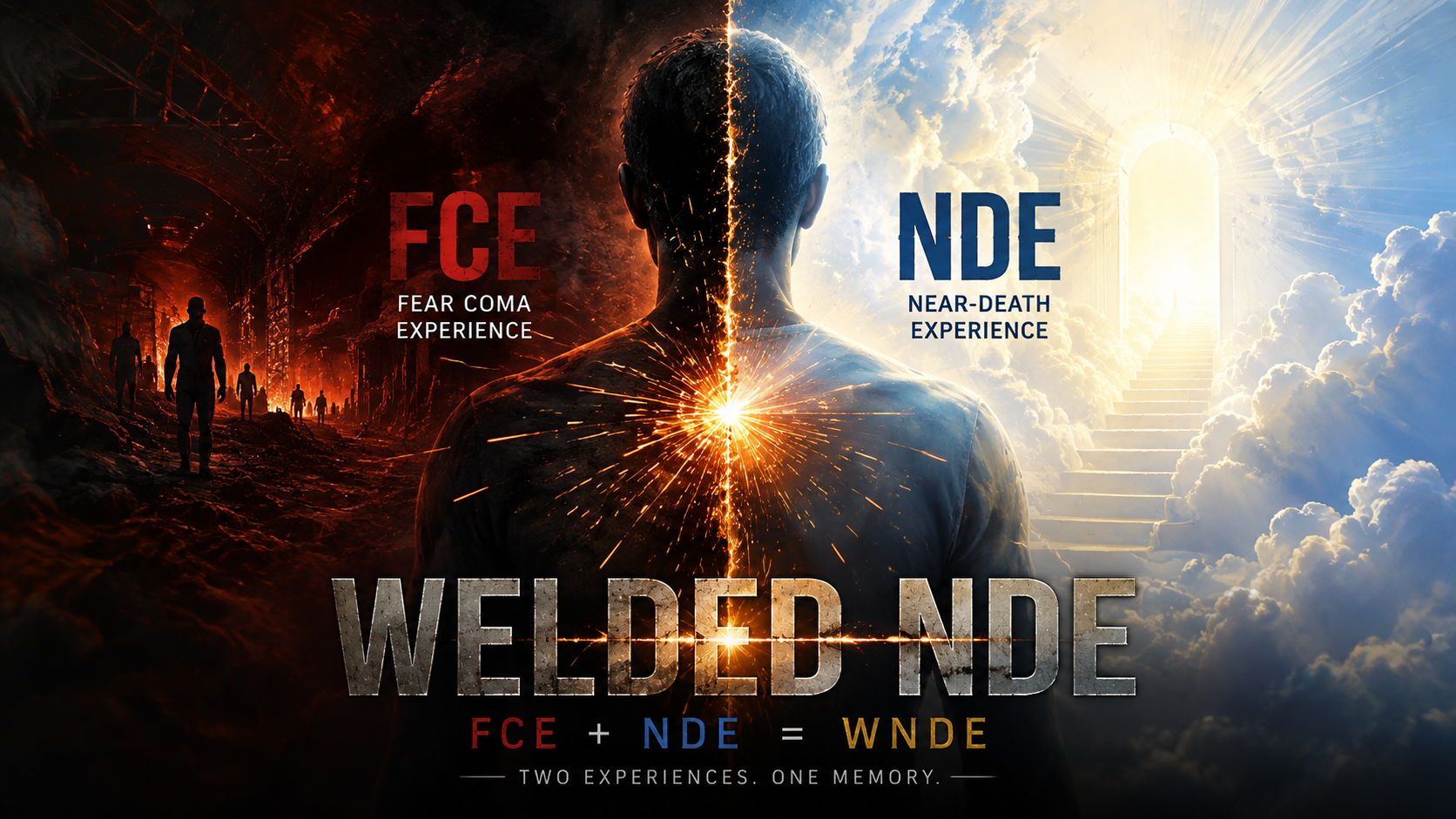
Yesterday, in the first article of this series, we did something no one had done with Michelle Ledbetter’s account before. We separated it. For years Michelle has told the story of what happened to her after a catastrophic car accident in 2019 as a single experience, one continuous stretch of terror and light that she, and everyone who interviewed her, simply called a near-death experience. But it was never one thing. It was two things, welded so tightly together that no one, including Michelle, could tell them apart. It was a Welded Near-Death Experience, an FCE and an NDE fused into a single unbroken memory.
Yesterday’s article pulled out one half of that weld: the authentic Near-Death Experience. I went through all fourteen of Michelle’s public tellings, across podcasts and conference talks and her own recordings, and we identified every element in her account that belongs only to a genuine NDE, the things a dying brain cannot manufacture. The telepathy. The reciprocal life review. The colors that do not exist in this world. The timelessness. The information download. The guide. We ran her own words against the Greyson scale, the field’s standard instrument for measuring a near-death experience, and she cleared the threshold two to three times over. The conclusion was clear: at some point during that accident and the days that followed, Michelle Ledbetter really did cross over. She really was there.
But that was only half of what happened to her, and it was the gentler half. Today we turn to the other one.
This article is about the Fear Coma Experience, the FCE, and only the FCE. Everything we identified yesterday as belonging to the NDE, the crossing, the light, the review, the peace, is set aside here completely. What remains is the part of Michelle’s ordeal that had nothing to do with crossing over and everything to do with a living, injured brain generating terror while trapped in a body it could no longer move. This is the hell she was in before she ever died, and the hell she returned to every time she came back. It is the part of her account that reads not as a spiritual journey but as a biological emergency, the oldest survival system on Earth running at full power with no way to shut off. It is, we will argue, the real and original source of the entire human concept of hell.
Where the NDE half of Michelle’s story is about what waits on the other side, the FCE half is about what the human brain does in the face of death while it is still on this one. It begins not in the hospital, and not even in the coma, but earlier, on a dark mountain road, in a blizzard, with the fear already climbing before the accident had even begun.
The Fear Pump Was Already Running
The Fear Coma Experience did not start when Michelle lost consciousness. It started on the road, in the minutes before, and by the time the lights went out the fear was already at full throttle. Picture what she was actually driving through. It is night, full dark, late February in the mountains. A blizzard has come in so hard the snow is not falling but blowing sideways across the road, and she cannot see the edges of it. She is in unfamiliar territory, alone except for her little dog, hundreds of miles from anywhere she knows, running on a full day behind the wheel and a growing sense that something is wrong. She has passed the warning signs and pushed past them. The only thing keeping her on the road at all is a set of red taillights ahead of her, a stranger’s truck she is following blind because she has nothing else to steer by. And then, in her own words, right at the end: “I think I might be in trouble.” Then the lights went out.
Hold onto that, because it matters enormously for what comes next. A person does not go into a coma from a neutral, resting state and only then start generating fear. Michelle went under with the fear pump already primed to maximum. Every ingredient of terror was present and active in her conscious mind at the instant she lost consciousness: darkness, disorientation, helplessness, the certainty that she was in danger, the dread of what was about to happen. That fear did not switch off when she went under. It carried straight across the threshold, from the conscious crash into the unconscious coma, and it became the fuel. This is how a Fear Coma Experience gets its charge. The brain does not invent terror out of nothing in the quiet of a coma. It takes the fear that was already burning at the moment of the injury and runs with it, amplifies it, builds a whole world out of it. Michelle handed her coma a running start, and it took off.
She Fought So Hard They Had To Restrain Her
Here is the part almost no one asks about, and it may be the most important physical evidence in the entire account. While Michelle was unconscious, moving through the terror her brain was generating, her body was not lying still. She was fighting. She was thrashing in the bed, trying to climb out of it, trying to run, so violent in her struggle that the hospital could not leave her alone. They had to post a person at her bedside, a sitter, whose entire job was to keep her from tearing loose and hurting herself. And remember what had just been done to her body. Her spine had been rebuilt with hardware, two rods, and she was fighting so hard to escape the bed that the staff had to physically hold her in it. She was acting out, in the real world, in real time, the exact terror she was living on the inside.
This is what makes the Fear Coma Experience different from a dream, and it is why it cannot be waved away as just a bad memory. A dream does not do this. A person having a nightmare lies still. Michelle’s fear was so total, so real to her, that it drove her body to fight for its life against people who were trying to save it. The terror was not a picture playing behind her eyes. It was a full-body emergency, and everyone in that room could see it. The nurses saw it. The sitter saw it. Whatever was happening to Michelle on the inside was violent enough to require physical restraint on the outside, and that is not something a living brain does over a pleasant vision or a neutral one. It does it over hell.
And Michelle, of all people, understands exactly what this looked like from the outside, because she has stood on the other side of it. As a hospice nurse she has watched dying patients do the very same thing, thrash and pick at the air and fight some invisible battle in their final hours, the thing the field calls terminal agitation. She used to medicate it without fully knowing what it was. Now she believes she knows, because she has been inside it. What the staff saw when they looked at her fighting the bed is what she had seen a hundred times looking down at her own patients: a human being in the grip of a Fear Coma Experience, battling something no one else in the room can see.
She Thought God Was Lava Coming To Kill Her
To understand how deep a Fear Coma Experience can run, how completely it can own a human mind, you have to sit with this one moment, because there is nothing else in Michelle’s account that shows it so clearly. At the very end of the terror, something began to happen above her. The ceiling of that dark place started to crack. Tiles began to lift. And through the cracks, a light started to come, a light she would later describe as the most beautiful thing she had ever seen, a brilliant white with a hue of gold and orange, pouring in not like ordinary light but flowing, almost liquid. We know now what that light was. It was the thing at the center of every near-death account, the source, the divine, what most people simply call God. It was the single most benevolent presence a human being can encounter. It had come for her.
And Michelle looked up at it and was certain it was lava, and that it was going to burn her alive.
Read that again, because it is almost too much to take in. The most loving force in existence arrived to lift her out of her suffering, and she was so consumed by fear that she could not see it for what it was. Her brain, still generating terror at full volume, took the most beautiful thing she would ever encounter and rendered it as molten rock coming to sear the flesh from her bones. She did not think, at last, rescue. She thought, this is the end, this is how I die, I am in hell and now I burn. That is the power of a Fear Coma Experience. It does not merely frighten. It corrupts perception itself, so thoroughly that heaven arrives and reads as execution.
And then comes the detail that breaks your heart, the one that tells you everything about what she believed was happening to her. She did not scream. She did not beg. She did what a person does when they have run out of hope and simply want the pain to be over. She grabbed her head, she bent over to brace for it, and she said, please, just make this quick. That is not the sound of someone fighting. That is the sound of someone who has already lost, who believes with total certainty that she is about to be burned alive and has stopped hoping for anything except that it not take long. It is acceptance of the worst possible end. It is a human being, at what she thought was the last second of her life, asking only that her execution be fast.
There is nothing more human than that, and there is nothing that shows the reality of the FCE more completely. Because think about what it takes to produce that response. You cannot be mildly uneasy and beg for a quick death. You cannot be having an unpleasant dream and brace your body to be seared. The only way a person arrives at please make this quick is if the terror is total, if it is indistinguishable from real dying, if every part of the mind is convinced beyond argument that the end has come. That is what her living brain had built. Not a scare. Not a bad trip. A complete and airtight certainty of imminent, agonizing death, so convincing that she surrendered to it.
And here is why this single moment is the foundation for understanding the whole thing. This is the exact seam, the precise instant where the Fear Coma Experience ends and the Near-Death Experience begins, and Michelle could not tell. She was standing at the most important threshold a human being ever crosses, the border between her manufactured hell and the genuine presence of the divine, and the fear was so overwhelming that she experienced the crossing itself as terror. The light that marked the end of her suffering was read as the instrument of it. She was moving from the FCE into the NDE, from the hell her brain made into the reality her death opened, and the handoff was so seamless, so buried under fear, that in the moment she had no idea anything had changed for the better. She thought it was getting worse. She thought it was the end.
That is what a Welded Near-Death Experience does to the person living it. The two halves are fused so tightly that the most important transition imaginable, the shift from fear to love, from hell to God, passed by unrecognized, felt only as more fear. She would need years, and prayer, and the long work of looking back, before she could understand that the lava was the light, that the thing she braced to be killed by was the thing that saved her. In the moment, she had none of that. In the moment, she had only the terror her brain gave her, and a whispered request that the burning be fast.
And that is the truest measure of the Fear Coma Experience. Not that it frightened her, but that it was strong enough to make her mistake God for lava, and rescue for execution, at the single most sacred instant of her life.
Waking Up Screaming – The Fear Coma Ends
When Michelle finally came out of it, she came out screaming. Awake, in the ICU, with excruciating pain tearing through her rebuilt back, screaming. And that detail, the scream, is not incidental. It is the whole thing. Because for the entire time she was under, through every second of the terror her brain was manufacturing, she could not make a sound. She could not scream. She could not move, could not run, could not lift a hand to defend herself. Her body had been knocked offline by the traumatic brain injury, switched off at the exact moment her mind needed it most. So the scream that finally came when she woke was the sound of a dam breaking, the first physical release of a terror that had been building with nowhere to go for days. She had been screaming on the inside the whole time. When she surfaced, it finally reached the air.
To understand why this matters, you have to understand what a Fear Coma Experience actually is, at the level of biology, because it is not mystical and it is not random. It is the oldest survival system on Earth, running with the volume jammed to maximum in a body that can no longer respond to it.
Every animal has it. You can spook a horse, and it bolts. A chipmunk hears a hawk’s shadow and it is gone before you can blink. A deer freezes, then explodes into motion. This is the fear response, the fight-or-flight system, and it is not a feeling so much as a piece of machinery, hardwired into the nervous system of every mammal by hundreds of millions of years of evolution. Its entire purpose is singular and brutal: when the brain detects that death is near, it floods the body with terror and one command. Move. Move or die. Run, fight, do something, right now, or you will not survive the next few seconds. That system does not care about your comfort. It is not interested in your peace. It has exactly one job, to hurl the body into motion in the face of mortal danger, and it has kept our ancestors alive since long before they were human.
Now put Michelle inside that machinery and watch what happens. The fear pump was already primed before the crash, the blizzard, the darkness, the unfamiliar road, the taillights she was following blind, the growing certainty that she was in trouble. Her survival system was already spun up and screaming before anything even happened. And then the accident came. Her eyes and her brain took in every terrifying second of it, the loss of control, the car leaving the road, the impact, the injury, all of it recorded in real time by a brain doing exactly what it evolved to do, sounding every alarm it has. And then the traumatic brain injury knocked her body offline.
This is the trap. This is the FCE in one sentence. The survival system was screaming move or die, and the body could not move. The most powerful biological command a human brain can issue, the one that has saved the species a billion times over, was firing at full strength into a body that had been switched off. Michelle’s brain was shrieking at her to run, to fight, to save herself, and there was no way to obey. The command had nowhere to go. So it did not stop. It could not stop. It just kept escalating, ramping the terror higher and higher, generating more and more fear imagery in a desperate attempt to force a response, and the body lay still and silent and could not answer. The brain screaming MOVE OR DIE, and the body offline, and no way to close the loop. For days.
That is the hell she was in. Not a place. A biological emergency with no exit, a survival system howling into a paralyzed body, unable to complete the one action it exists to trigger. And her mind, trapped in the middle of it, did what a mind does when it is drowning in that much raw fear: it built a world to match, a warehouse of terror, imagery of abandonment and suffering, the certainty of hell, because that is what a maximum fear signal feels like from the inside when it has nothing to attach to. The horror was the felt sensation of her own survival machinery running with no off switch.
And then the coma ended, and the body came back online, and the very first thing it did was the thing it had been unable to do the entire time. It screamed. The circuit finally closed. The command that had been trapped for days, move, react, get out, finally reached a body that could execute it, and out it came as a scream and a lunge toward escape. That is why she woke the way she did. It was not new fear. It was all of it, all at once, the whole backlog of a survival system that had been firing into the void, finally reaching a body that could respond.
This is the moment the Fear Coma Experience ends. Not with peace, not with understanding, but with a scream, the sound of a human being escaping the hell her own brain had been building for her since before the crash. And it left a mark. You do not run that system at maximum for days and walk away clean. Michelle carried severe PTSD for two years afterward, and of course she did. Her brain had spent days convinced she was dying, screaming at her to save herself, and no reassurance after the fact can fully undo that. The body remembers. That is the signature of the FCE, and it is how you spot one. Not the imagery, which varies from person to person, but this: a living brain, faced with what it reads as certain death, running its oldest survival program at full power into a body that cannot answer, and the lasting wound it leaves behind.
She Went To Hell More Times Than Anyone Alive
Michelle says, in nearly every telling, that she knew she was in hell. And people hear that and assume she means one thing, one place, one stretch of suffering. But that is not what happened to her, and the truth is far stranger and far more revealing. Michelle did not go to hell once. She went to hell over and over, back and forth, crossing between two completely different kinds of hell that her welded experience had fused into one seamless nightmare. By the time it was over she had probably spent more time in hell, and more kinds of hell, than almost any human being who has ever lived to describe it.
To see why, you have to understand that there are two entirely different things being called “hell” in her account, and they come from opposite sources.
The first is the hell of the Fear Coma Experience. This is the hell of the living. It is what her brain manufactured while she was alive and comatose, the survival system screaming into a paralyzed body, generating terror with no floor and no exit. This hell is made of raw fear. It has no lesson in it, no meaning, no structure. It is just the felt sensation of a mind convinced it is dying, running its oldest alarm at maximum with nowhere to discharge. When Michelle was in this hell, she was alive. Her heart was beating, her injured brain was firing, and it was torturing her with manufactured horror because that is what a brain in mortal terror does.
The second is the hell of the Life Review, and this is something else entirely. This is the hell of the dead. It happens on the far side of the line, inside a genuine Near-Death Experience, and it is not manufactured fear at all. It is the searching, deliberate, meaningful process of being made to look at the hardest moments of a life and feel them fully. For someone like Michelle, whose life held real trauma, that review was agony. But it was a different agony. It had purpose. It was not her brain screaming move or die. It was her soul being walked back through everything that shaped her, as either the one who was hurt or the one who did the hurting. People come out of difficult life reviews reaching for the word “hell” all the time, and they mean it, but it is the hell of hard truth, not the hell of animal terror. When Michelle was in this hell, she was, by every indication, dead.
Now hold both of those in your mind at once, and watch what her experience actually did. It did not go to one hell and stay there. It moved between them.
Think about the sequence a Welded Near-Death Experience implies. The coma begins, and she drops into the first hell, the FCE, alive and terrified, the brain screaming. Then, at some point, she flatlines, and she crosses into the second hell, the Life Review, dead and being walked through her own pain. Then the NDE ends, and she comes back into her body, back into the FCE, alive again and back into the manufactured terror. That is already three passages through hell, of two different kinds, and there is no reason to assume it happened only once. If she flatlined and was revived more than once during that long window, and the internal bleeding and the emergency surgery and the days of instability make that entirely possible, then she crossed back and forth even more times than that. FCE, then NDE, then FCE, then perhaps NDE again, then FCE again. Hell of the living, hell of the dead, hell of the living, over and over, with no way for her to tell which was which because they had all been welded into one unbroken ribbon of suffering.
So when Michelle says she knew she was in hell, of course she did. She was in hell almost the entire time, in one form or the other. Whenever she was alive in that coma, the FCE had her. Whenever she crossed over, the Life Review had her. There was barely a moment in that whole stretch when she was not in one hell or the other. She was either dead and reviewing the worst of her life, or alive and being tortured by a brain that thought it was dying. Back and forth, hell to hell, for days. There was no neutral ground. There was no rest. There was just the constant crossing between the two.
This is what makes her account so extraordinary and so confusing at the same time. Most people who report a distressing experience have one hell to describe, from one source. Michelle has two, braided together, and she experienced them as a single continuous thing because that is exactly what a WNDE is, the welding of the living brain’s terror to the dead soul’s review until they cannot be pulled apart from the inside. She could not tell you where the FCE hell ended and the NDE hell began, because to her they never did end and begin. They just flowed into each other, again and again.
And this is the key that separates the two forever, the thing to hold onto. The hell of the FCE is the hell of a brain that is still alive and screaming to survive. The hell of the Life Review is the hell of a soul that has already crossed over and is being shown the truth. One is manufactured terror with no meaning. The other is meaningful anguish with no terror in the animal sense, only the weight of a life examined. Michelle lived both, probably several times each, in a single event. That is not a woman who went to hell. That is a woman who went to hell, came back, went to a different hell, came back, and did it again, until the two became one in her memory. Almost no one alive has been where Michelle has been, because almost no one has been to both hells at all, let alone crossed between them again and again in a single night.
The Fingerprint – PTSD And The Oldest Word For Hell
Here is the fact that settles it, the single cleanest line between the two halves of what happened to Michelle. Nobody comes back from an authentic Near-Death Experience carrying PTSD. That is not a small observation. People who genuinely cross over and return come back transformed in a very specific direction: unafraid of death, lit up, at peace, changed for the better in ways that last the rest of their lives. That is the near-universal signature of the real thing. Whatever else an NDE does to a person, it does not leave them traumatized. It leaves them freed.
But people come back from a Fear Coma Experience with PTSD all the time. Not occasionally. All the time. And this is not some fringe claim that has to be argued for, it is established, documented, thoroughly studied medicine. Go and look at the research on ICU survivors, on patients who have been through prolonged comas, on people who have surfaced from critical illness and traumatic injury. Post-intensive-care PTSD is a well-known, well-mapped phenomenon. A significant share of people who come out of these states carry lasting trauma out with them, nightmares, flashbacks, hypervigilance, the whole clinical picture, and the medical field has known this for a long time. The emergency rooms know it. The ICUs know it. It is in the literature. When a human brain spends days in a state it reads as mortal terror, it leaves a wound, and that wound has a name, and it is treated as a recognized condition.
So the two outcomes could not be more different, and that difference is diagnostic. The NDE leaves peace. The FCE leaves trauma. One returnee comes back unafraid to die. The other comes back haunted. And when you understand that, the whole framework snaps into focus, because now you have a way to tell, from the far side, which experience a person actually had. You look at what they carried out.
Michelle carried out two years of PTSD
Two years. Two years of being unable to look at what happened, of numbing it with alcohol and pain medication, of coping skills that had collapsed, of a fear she could not name sitting on top of everything. That is not the aftermath of a peaceful crossing. No one is traumatized for two years by an encounter with unconditional love. That two years of suffering is the fingerprint of the FCE, the proof, written in her own recovery, that the terror was not a story or a symbol but a real experienced event that damaged her the way real terror damages people. Her PTSD is not a flaw in her account or a reason to doubt the NDE. It is the opposite. It is the hard clinical evidence that the fear half genuinely happened, that she really was in that hell, because that is exactly the mark that hell leaves.
And here is the connection that no one has made before, the thing this entire body of work exists to say out loud. That well-documented, well-studied, medically ordinary phenomenon, post-coma PTSD, the trauma that pours out of ICUs and emergency rooms every day, is the same thing human beings have been calling hell since the beginning of time. Not a metaphor for hell. Not something like hell. The actual, original, experiential source of the entire human concept of hell. For all of human history, some small percentage of people who came close to death and survived came back describing a place of unbearable terror and suffering, and every culture that ever existed took those accounts and built them into a doctrine, a destination, a place the wicked are sent. But it was never a place. It was this. It was a living brain, injured and comatose, running its survival machinery at maximum into a body that could not respond, generating terror so complete that the person who lived through it could find no other word for it than hell. The medicine has been documenting the mechanism for decades without naming what it was. The religions named it thousands of years ago without understanding the mechanism. This work is simply the first to put the two together and say: they are describing the same thing.
And that is what makes Michelle’s story, in the end, not a story about damnation but a story about survival. Because she came back. She survived the crash and the broken spine and the shattered skull. She survived the surgery. She survived days in a hell her own brain built, crossing back and forth into the hell of her own life review. And then she survived the aftermath, too, the two years when the FCE was still with her, still running underneath everything, still trying to convince her she was in danger. She did the long, hard work of taking her life back from it. She climbed out of the PTSD the same way she had, without knowing it, climbed out of the coma, one hard step at a time, until the fear finally loosened its grip and the peace that had been buried underneath it all along could finally come up. She went to hell, in both of its forms, more times than almost anyone alive. And she found her way back out. That is not a story about the fire. That is a story about the person who walked through it and lived.

Want to go deeper? Don Winner brings decades of intelligence and investigative experience to the biggest question there is: what happens when we die.
In You’re Going to Die Someday, Right? Near-Death Experiences Reveal What Happens Next, he examines the evidence from thousands of near-death experiences to find out what they actually tell us about consciousness, the soul, God, and the afterlife.
In Hell Exists, But Only for the Living, he investigates where our idea of hell came from and who built it, tracing the doctrine back to its human sources.
Get your copy of You’re Going to Die Someday, Right? or Hell Exists, But Only for the Living.