Introduction
What you are about to read is a new chapter in Hell Exists, But Only for the Living. The book was originally published about a month ago without this material. I have now added this chapter to the revised edition, and I am publishing it here on Winner NDE at the same time, essentially unchanged and freely available to anyone who wants to read it.
The book was finished. The research wasn’t.
After Hell Exists, But Only for the Living was completed and published, I continued testing the ideas developed in its final chapters against real-world cases. The fundamental conclusions did not change. The frightening experiences examined throughout the book still originate in the living brain, and the underlying explanation for how those experiences contributed to humanity’s concept of Hell remains intact.
What changed was my understanding of how these experiences can interact with authentic near-death experiences. Detailed analysis of additional cases produced a more precise framework, new terminology and a way to explain some experiences that previously appeared to contain contradictory elements of both Hell and Heaven.
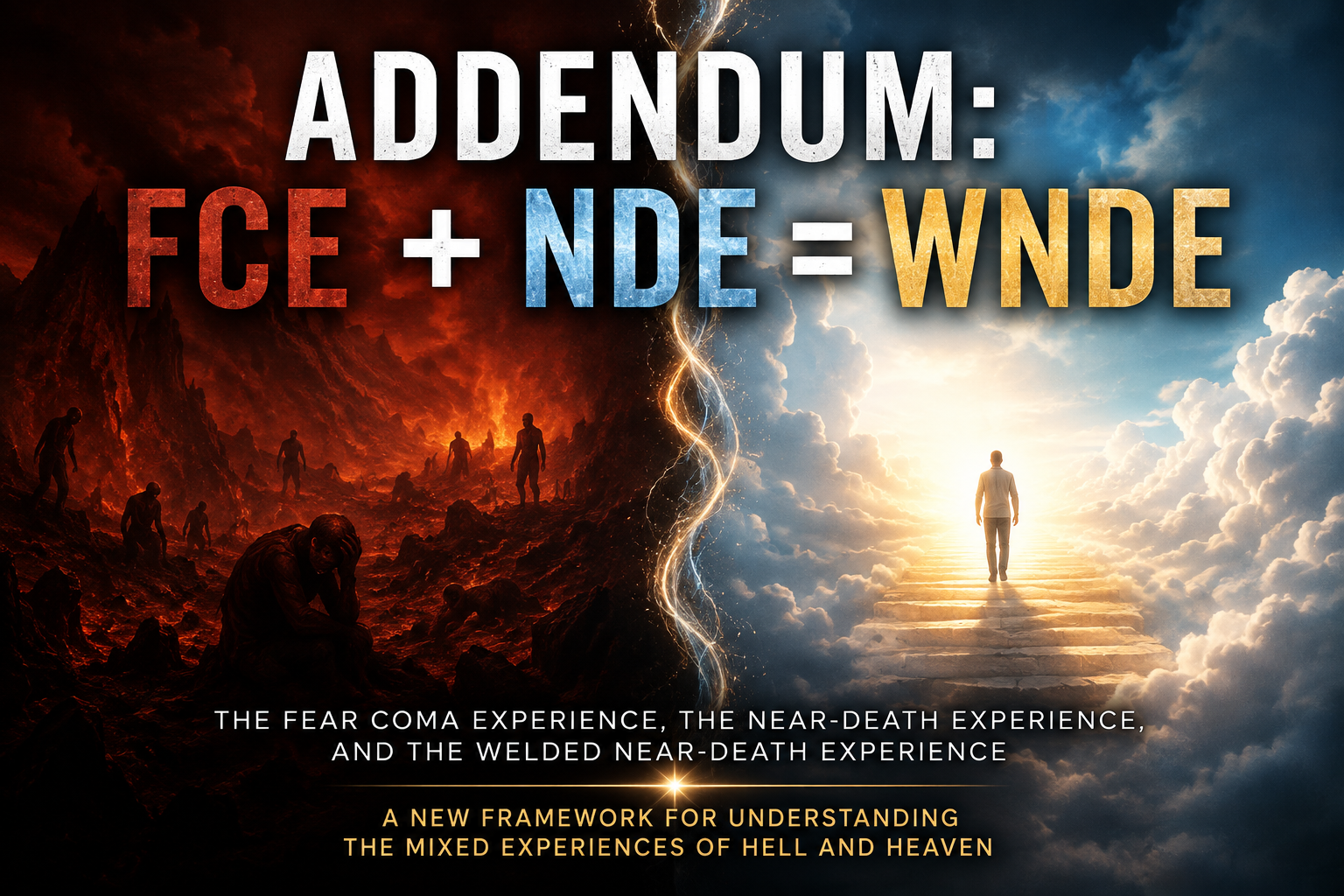
That work produced the Fear Coma Experience, the Welded NDE, and the model FCE + NDE = WNDE.
None of that existed in its finished form when the book was first published. It does now. Research does not stop because a book has gone to print. This chapter documents what happened next, what I learned from testing the original framework, and how that work developed into the model presented here.
The Distressing NDE Problem
Near-death experiences are not always pleasant. Some people report frightening experiences involving darkness, isolation, threatening entities, fire, torment or environments they interpret as Hell. These accounts have been studied for decades and are commonly described as distressing NDEs, negative NDEs or, more dramatically, hellish NDEs. The terminology makes intuitive sense. A person nearly dies, survives, and reports a terrifying supernatural experience. Therefore, the person had a terrifying near-death experience.
That classification works only if the frightening experience actually occurred during the near-death portion of the medical crisis. Once I began testing the Fear Coma Experience (FCE) model against individual cases, that assumption became increasingly difficult to make. Many serious medical emergencies do not consist of a person collapsing, nearly dying and immediately waking up. A patient may suffer cardiac arrest for several minutes, be resuscitated, remain critically ill and unconscious for several days, and only later regain normal awareness. Everything the patient remembers from that period may eventually be described as something that happened while they were “dead,” even though the medical crisis contained several very different physiological states.
That distinction becomes extremely important when studying frightening experiences. A patient may have been unconscious because of traumatic brain injury, infection, organ failure, metabolic abnormalities, medications, anesthesia, hypoxia or some combination of factors. The patient may move through cardiac arrest, resuscitation, deep unconsciousness, coma, sedation, delirium and gradual recovery without ever experiencing a clean return to normal waking consciousness between those states. From the outside, doctors can construct at least part of that medical timeline. From inside it, the patient may have no meaningful sense of time at all.
This creates a fundamental classification problem. Suppose a patient suffers cardiac arrest for five minutes, is successfully resuscitated and remains unconscious for four days. When she finally wakes up, she reports spending what seemed like hours in a terrifying environment filled with fire and threatening creatures. When did that experience occur? During the five minutes of cardiac arrest? Ten minutes after circulation was restored? Six hours later? During the second night? While emerging from sedation on the fourth day? The fact that she nearly died tells us almost nothing about where that particular experience belongs on the timeline.
Yet the dramatic medical event naturally becomes the anchor for the story. The patient knows she nearly died because doctors and family members tell her what happened. She remembers an extraordinary experience from somewhere within the same period of disrupted consciousness. Those two facts are easily connected afterward: I nearly died, and while I was unconscious I experienced Hell, therefore I went to Hell when I nearly died. The conclusion is understandable, but the chronology has not actually been established.
This became increasingly obvious as I began examining individual cases rather than treating “distressing NDE” as a settled category. Some accounts contained experiences that looked remarkably similar to the fear-based coma phenomena examined throughout this book. Others contained features commonly associated with NDEs alongside elaborate fear-based experiences that looked very different. Calling all of them hellish NDEs simply because the patient had experienced a life-threatening medical crisis risked putting fundamentally different phenomena into the same basket.
The problem is not whether the experiencer is telling the truth. Someone can accurately describe an experience exactly as they remember it and still have no way of knowing when it occurred during several days of unconsciousness. Memory can preserve the experience without providing a timestamp. The researcher therefore has to separate two questions that are easily confused: what did this person experience, and when did this person experience it?
That distinction became the first major challenge produced by testing the Fear Coma Experience model against real-world cases. Before deciding whether a frightening experience was an NDE, an FCE or something more complicated, I needed to stop assuming that the most dramatic moment in the patient’s medical crisis was automatically the moment when the experience occurred. The medical timeline had to come first, because without establishing timing as closely as the available evidence allows, the label placed on the experience may already contain an assumption we have never actually proved.
The Timing Problem
Timing turned out to be one of the most important variables in separating a Fear Coma Experience from a near-death experience. Medical events occur on a timeline. Cardiac arrest begins at a particular point. Resuscitation starts. Circulation may be restored. The patient may be intubated, sedated, transferred to intensive care and remain unconscious for hours or days. Eventually the patient begins responding and returns to normal waking consciousness. Medical records can often reconstruct much of that sequence with considerable precision.
The subjective experience is different. It doesn’t arrive with a timestamp attached. A patient can wake after three days and remember an experience that seemed to last minutes, hours or considerably longer. The person may remember exactly what happened within the experience while having absolutely no idea where those memories belong within the three days that just disappeared from ordinary consciousness.
Consider a simple example. A patient suffers cardiac arrest at 2:00 in the afternoon. Resuscitation begins immediately, and spontaneous circulation returns at 2:06. The patient survives but remains unconscious for the next three days. When she finally wakes, she remembers an elaborate experience involving darkness, fire, threatening beings and what she interprets as Hell. We now have approximately 72 hours of severely disrupted consciousness containing a six-minute cardiac arrest. Unless something within the experience can independently anchor it to those six minutes, there is no reason to assume that is when it happened.
That sounds obvious once the timeline is laid out, but the cardiac arrest dominates the story because it is the most dramatic event. The patient may later say, “I died and went to Hell.” An interviewer may introduce the story by saying that the person visited Hell while clinically dead. A podcast title may call it a hellish NDE. With enough repetition, the timing begins to sound like an established fact even though nobody has actually demonstrated when the experience occurred.
Language can make the problem worse. Patients commonly say they “died,” “coded,” “flatlined” or were “dead for several minutes.” Those descriptions can refer to very different medical circumstances, and ordinary conversation does not require the precision necessary for analyzing an experience. A cardiac arrest is not the same thing as a coma. Being unconscious is not the same thing as having no heartbeat. Being critically ill for four days does not mean someone was clinically dead for four days. When these states are compressed into a single statement such as “I was dead,” important distinctions disappear.
The same problem occurs in the opposite direction. Someone may actually have experienced a cardiac arrest during a prolonged period of unconsciousness, but that does not automatically make every remembered event an NDE. The cardiac arrest may be extremely important, and the person may genuinely have had an NDE associated with it. The mistake is assuming that every other experience remembered from the surrounding period must therefore have occurred during the cardiac arrest as well.
There are circumstances in which timing can be narrowed considerably. An experiencer might report observing something during resuscitation that can later be matched to a specific event. A conversation, procedure, unusual object or sequence of actions could potentially provide a temporal anchor. Medical records can also establish when particular interventions occurred, when medications were administered and when the patient’s neurological condition changed. None of this automatically proves the nature of the experience, but it gives us something much more useful than simply assuming that everything happened during the moment the person came closest to death.
The longer the period of unconsciousness, the more important this problem becomes. A five-minute cardiac arrest surrounded by five minutes of unconsciousness presents a very different analytical problem from a five-minute cardiac arrest followed by five days in a coma. In the second case, there is an enormous period during which a severely compromised brain could potentially generate experiences. Assigning every remembered event to the five minutes of cardiac arrest ignores almost the entire available timeline.
This was the point where the existing terminology became inadequate for what I was finding. If a frightening experience could occur during coma, delirium or another period of profound neurological disruption rather than during the actual near-death event, calling it a “distressing NDE” already assumed something the evidence had not established. I needed a term that described the experience itself without automatically assigning it to death or an afterlife. That need led directly to the Fear Coma Experience.
The Fear Coma Experience
The timing problem created a classification problem. If a person could suffer cardiac arrest, be successfully resuscitated, remain unconscious for several days and experience frightening imagery somewhere during that extended period, calling the entire experience a “distressing NDE” assumed that the frightening material occurred during the near-death event. In many cases, there was simply no evidence establishing that connection. I needed a way to describe these experiences without building an unsupported conclusion into the name itself.
That led to the Fear Coma Experience, or FCE. An FCE is a vivid, often highly structured experience occurring during coma or another period of severely disrupted brain function in which fear, danger or threat becomes the dominant organizing force. The experience can contain complete environments, people, creatures, conversations, physical sensations, religious figures and extended narratives. To the person experiencing it, none of this necessarily feels like a dream or hallucination. It can feel completely real.
The underlying biology is not new. Much of this book has already examined what can happen to the brain during severe illness, injury and prolonged unconsciousness. Hypoxia, traumatic brain injury, infection, fever, organ failure, metabolic abnormalities, medications, anesthesia, ICU delirium and other profound physiological disturbances can radically alter perception and cognition. The FCE framework does not require us to invent a new neurological phenomenon. It gives us a more precise way to identify and analyze one particular type of experience that can emerge from those conditions.
Fear is the critical component. The human brain evolved first and foremost to keep its owner alive, and it has an enormous inventory of threats available to accomplish that job. Fire can kill you. Predators can eat you. Darkness can conceal something waiting to attack. Falling can kill you. Suffocation can kill you. Being trapped prevents escape. Being restrained prevents you from fighting back. Hostile humans can injure or kill you. When normal brain function becomes severely disrupted, those ancient threats provide plenty of raw material from which a frightening perceived reality can be constructed.
An FCE does not have to consist of disconnected flashes of frightening imagery. The brain can build an entire world around the threat. Someone can find himself trapped in a burning building, chased through darkness, attacked by creatures, imprisoned somewhere he cannot escape or surrounded by people trying to hurt him. Conversations can occur. Characters can appear and disappear. Events can follow one another in an apparently logical sequence. The resulting experience can have a beginning, middle and end, even though the person experiencing it is lying unconscious in a hospital bed.
This distinction is particularly important because an FCE is not defined by how close the person was to death. Someone having an FCE may genuinely be critically ill and may actually come close to dying. The person might even suffer cardiac arrest somewhere during the same medical crisis. None of that automatically tells us what produced a particular remembered experience. The classification describes the experience and the physiological circumstances capable of producing it rather than assuming that proximity to death makes every extraordinary experience an NDE.
This was the important development that emerged after Hell Exists, But Only for the Living was completed. The underlying mechanism explored throughout this book remained intact. Severely compromised living brains can generate elaborate fear-based realities, and those experiences provide a plausible biological source for many of the frightening themes humans have associated with Hell. What changed was the precision with which I could now identify and analyze those experiences when testing the model against individual cases.
The next problem appeared almost immediately. Human brains do not contain only ancient biological fears. They contain memories, childhood experiences, movies, stories, cultural expectations and religious beliefs accumulated across an entire lifetime. A Christian raised with images of Satan, demons, angels, Jesus and Hell brings very different material into a medical crisis than someone raised in a completely different religious culture. Once that became apparent in the cases I examined, another part of the FCE framework came into focus: when a compromised brain constructs a frightening reality, it uses whatever it already has available.
The Brain Uses What It Has
Fear may provide the foundation for an FCE, but it does not determine exactly what the person will see. The human brain has two enormous sources of material available when constructing a frightening experience. The first comes from our evolutionary history. Fire, darkness, predators, falling, suffocation, entrapment, hostile humans and an inability to escape represent threats that require no religious education whatsoever. Humans were afraid of things that could kill them long before anyone invented a word for Hell.
The second source is personal. By the time an adult ends up unconscious in an intensive care unit, that brain has accumulated decades of memories, beliefs, fears, stories and images. Religion contributes material. So do parents, childhood experiences, books, television, movies, traumatic events and stories heard decades earlier and seemingly forgotten. All of that information remains available to a brain trying to construct some kind of perceived reality while its normal systems are severely disrupted.
This helps explain why two people can experience the same fundamental emotion while reporting completely different imagery. A Christian who has spent a lifetime hearing about Satan, demons, angels, Jesus and Hell already has an elaborate supernatural vocabulary available for fear. Someone raised in another religious tradition has a different collection of supernatural characters and places. Someone with little religious background may experience threatening animals, attackers, imprisonment, war, medical personnel trying to kill them or some other scenario constructed from material familiar to that individual. The characters change, but the underlying threat remains recognizable.
This does not mean the person consciously invents any of it. Someone lying unconscious in a hospital bed is not directing a movie and deciding which character should enter the next scene. The brain simply has access to information accumulated across a lifetime, including information the person may not have consciously thought about for years. Dreams demonstrate the basic principle every night. People, places and events from different periods of our lives can suddenly appear together without any deliberate effort on our part.
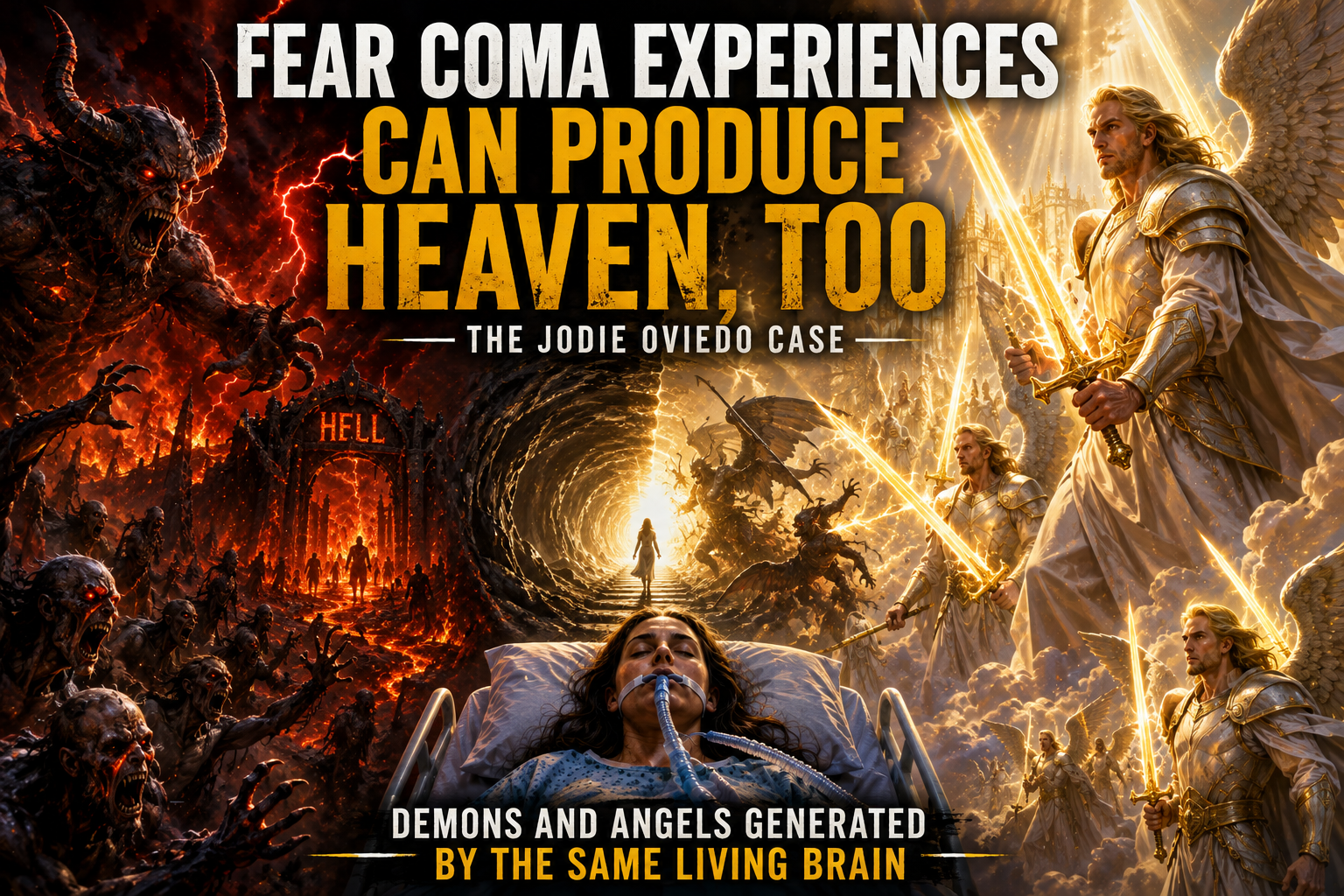
Jodie Oviedo provided an unusually clear example when I examined her case after this book was published. Long before the medical crisis that produced her frightening experience, Jodie’s mental and religious world already contained God, Jesus, angels, demons, witches and threatening supernatural creatures. She described earlier incidents that she interpreted as encounters with supernatural forces, including hearing what she believed were witches circling a house while cackling and laughing. On another occasion, she reported seeing a strange muscular dog with shiny skin and lime-green eyes that she thought looked like a demon. Whether those earlier events actually had supernatural causes is irrelevant to this analysis. What matters is that Jodie believed supernatural beings could manifest themselves in the physical world, and those concepts were already firmly available to her brain.
When she later became critically ill and unconscious, many of the same categories appeared inside the experience. She encountered dark angelic beings, including one she identified as the Angel of Death. She saw demons and eventually what she understood to be the gates of Hell. The environment included intense darkness, sulfur, screams, fire, enormous pits and something she interpreted as the biblical Lake of Fire. None of those concepts had to be created from scratch during the medical crisis. Her brain already knew exactly what demons, angels and Hell were supposed to mean.
One detail from her account illustrates how broadly the brain can draw from stored information. Jodie described a demonic creature behind the gates of Hell that she later compared to Venom, the monstrous comic-book character. She said she did not recognize the character as Venom during the experience and made that connection only later after seeing the character in a movie. Whatever the precise source of the resemblance, the larger point remains the same. Human brains contain an enormous collection of visual material, much of which can become incorporated into an experience without the person consciously selecting it.
This cultural and personal preloading also offers a straightforward explanation for why frightening supernatural experiences can vary across individuals while still sharing recognizable structural elements. The biological brain supplies fear. The individual’s accumulated experience supplies much of the scenery. Fire can remain fire because every human understands the threat. A threatening presence, however, can become a demon, witch, monster, hostile spirit, dangerous animal or human attacker depending upon what that particular brain already knows.
Jodie’s case revealed something else that became important to the developing FCE framework. Her brain did not contain only frightening religious imagery. The same lifetime that gave her demons, Hell and an Angel of Death also gave her God, Jesus, Gabriel and powerful protective angels. When her experience became threatening, those figures appeared too. The result was not a simple journey through uninterrupted terror, but an elaborate world containing both supernatural danger and supernatural protection. That raised the next question I needed to address: if fear organizes the experience, what happens when the same brain also contains powerful images of something capable of protecting the person from that fear?
Fear And Protection Can Exist Together
Jodie’s case forced another refinement of the FCE framework. A Fear Coma Experience does not have to be frightening from beginning to end. Fear can drive the experience while the brain simultaneously generates people, beings or forces capable of protecting the person from whatever is threatening them. In fact, once we recognize that the brain is drawing from material accumulated across an entire lifetime, the appearance of both sides makes perfect sense.
Jodie’s experience begins with an obvious threat. She is critically ill and unconscious when she finds herself surrounded by dark angelic beings, including one she identifies as the Angel of Death. These figures appear dangerous, and she understands them as something she needs protection from. Then the experience changes. Three enormous angels appear, roughly ten feet tall, wearing white robes with golden sashes and carrying huge golden swords. They don’t simply stand nearby and provide reassurance. They actively confront the threatening figures and fight them.
The result is essentially a supernatural battle taking place around her. On one side are dark beings associated with death and danger. On the other are enormous protective angels armed with golden swords. Jodie remains at the center while the two sides fight over her. If we looked only at the threatening figures, we might describe the experience as frightening or hellish. If we looked only at the enormous angels protecting her, we might describe the same experience as comforting religious imagery. Looking at the entire sequence reveals something more interesting. Her brain contains both the threat and the solution to the threat.
The pattern continues when Gabriel appears. Jodie describes him as a man wearing white medical scrubs, something immediately familiar to her because of her nursing background. His skin appears bronze or golden, and he identifies himself as a “traveling nurse sent from heaven.” He tells her not to be afraid, says God sends him to people who are extremely sick, assures her that she will feel no pain and explains that he has been sent to protect her. He even carries a piece of gold luggage containing what Jodie describes as tools from heaven associated with spiritual surgery.
The imagery is remarkably specific to the person experiencing it. Jodie has a medical background, so her supernatural protector appears as a nurse. She has a strong Christian belief system, so the nurse comes from heaven and is sent by God. When she looks for his name tag, the letters G-A-B-R-I-E-L appear on his scrubs. The threatening side of her existing worldview supplied demons, dark angels and the Angel of Death. The protective side supplied God, enormous guardian angels and Gabriel. Her brain had access to all of it.
This matters because fear itself naturally creates a demand for protection. A frightened child doesn’t merely imagine the monster under the bed. The child calls for a parent capable of defeating it. Adults do more sophisticated versions of the same thing. When we perceive a threat, we look for escape, weapons, allies, shelter or someone more powerful than whatever is threatening us. A brain constructing a fear-based reality has no obvious reason to abandon that basic response simply because the body containing it happens to be unconscious.
Religious belief can provide especially powerful protective imagery because many religions explicitly teach that supernatural threats have supernatural opponents. Demons are opposed by angels. Satan is opposed by God. Evil is opposed by good. A person who believes threatening supernatural beings exist may also believe that benevolent supernatural beings can intervene against them. Both concepts occupy the same mental world, so both can become available during an FCE.
This is why the presence of comforting or protective imagery does not automatically transform a Fear Coma Experience into something else. An FCE can contain fear, relief, protection, reassurance and periods of calm. The important question is what is organizing the narrative. In Jodie’s case, the protective figures appear because there is something to be protected from. Gabriel’s repeated assurances that she should not be afraid make sense precisely because the experience has already established danger.
The mixed imagery also demonstrates why classifying extraordinary experiences solely by their individual components can create problems. Demons and Hell can push an account toward the “distressing NDE” category. Angels, divine protection and a heavenly guide can push the same account toward a conventional NDE interpretation. The FCE framework allows both sets of imagery to exist within the same experience without requiring us to divide the narrative according to whether a particular character appears benevolent or frightening.
Recognizing this does not tell us that Jodie deliberately created any of these figures, nor does it tell us that she was consciously assembling religious imagery while unconscious. It tells us that her brain possessed all of the necessary material before the medical crisis occurred and that the resulting experience drew from both sides of that existing mental world. That distinction becomes particularly important when analyzing testimony like hers, because explaining how an experience may have been generated is very different from claiming that the person describing it did not genuinely experience it.
The Experiencer Is Telling The Truth
The FCE framework begins from a simple position: the experiencer is telling the truth about what they experienced. When Jodie says she encountered dark angelic beings, enormous protective angels, Gabriel, demons and the gates of Hell, I accept that these are her memories of what happened. She experienced those events as a perceived reality, and nothing about the FCE framework requires us to dismiss or diminish that testimony.
The important distinction comes between the experience itself and the explanation for what produced it. “I experienced Gabriel leading me toward the gates of Hell” describes the experience. “Therefore, Gabriel actually took me to a supernatural place called Hell” is an interpretation of what caused that experience. The first statement can be completely true without automatically establishing the second.
We make this distinction constantly in ordinary life without questioning anyone’s sincerity. A person can awaken from an extraordinarily vivid nightmare with a racing heart, covered in sweat and carrying detailed memories of being chased by someone trying to kill them. The terror was real. The memory is real. The person genuinely experienced being chased. What requires explanation is the source of the perceived reality, not whether the person experienced it.
An FCE can be considerably more powerful than an ordinary dream because it occurs while the brain and body are undergoing a profound physiological crisis. The person may experience complete environments, conversations, physical sensations, movement, fear, pain, recognizable people and elaborate sequences of events. They are not standing outside the experience watching it unfold. They are inside it, responding to events that appear to be happening around them.
When normal consciousness eventually returns, those events can survive as autobiographical memories. The person remembers being somewhere. They remember meeting someone. They remember what was said. They remember being frightened, protected, attacked or rescued. Years later, the memory may remain every bit as significant as memories of events that occurred in ordinary waking life because the brain encoded the experience as something that happened to them.
This is why the FCE framework does not depend upon deception, exaggeration or faulty character. Quite the opposite. The model works perfectly well when the experiencer provides a completely sincere account. What we are investigating is the mechanism capable of producing the experience they accurately remember.
That approach also allows us to treat these accounts as evidence rather than arguments about belief. We can document what the person remembers, examine the medical circumstances surrounding the experience, compare the reported imagery with information already available to that person’s brain and reconstruct the medical timeline as closely as possible. We can then ask what explanation best accounts for all of those observations without first deciding that the experiencer either visited a supernatural realm or imagined something insignificant.
This distinction became particularly important as I continued testing the FCE framework against real-world cases. Accepting the remembered experience as genuine did not mean I had to assume that every component of that memory occurred during the same physiological state. A person could accurately remember everything they experienced while still having no way to know where each part belonged within several hours or days of disrupted consciousness.
That realization opened another door. Some accounts contained extended fear-based material that fit the FCE framework remarkably well, but they also contained elements that looked very much like conventional near-death experiences. If the experiencer was accurately reporting both, there was no reason to force one set of observations into the other category. The possibility I needed to consider was that both experiences had actually occurred, but at different points during the same medical crisis.
Then We Found The Seam
The FCE framework worked well when an account contained the kind of extended fear-based experience we had been examining. The problem came when I encountered cases containing something else as well. Parts of the reported experience looked like an FCE, but other parts contained features strongly associated with conventional near-death experiences. Trying to classify the entire account as one phenomenon required ignoring evidence pointing toward the other.
That suggested another possibility. What if both parts of the account were exactly what they appeared to be? The person could have experienced an NDE during the period when they were actually near death and an FCE during a different period of the same medical crisis. If normal waking consciousness never returned between those events, the experiencer would have no obvious reason to remember them as separate experiences.
Consider the medical timeline again. A patient suffers cardiac arrest and is resuscitated several minutes later. During that period, the person experiences recognizable NDE phenomena. Perhaps there is an out-of-body experience, a deceased relative, overwhelming love, a brilliant light or some combination of the features repeatedly reported in NDE accounts. Circulation is restored, but the patient does not wake up. Instead, the person remains unconscious for another two or three days while the brain and body recover from whatever caused the original crisis.
Somewhere during those following days, the same person has an FCE. The experience is completely different. Instead of overwhelming love, there is terror. Instead of deceased relatives, there are threatening beings. The person is trapped, pursued, attacked or unable to escape. Fire, demons, monsters, darkness or other fear-based imagery may appear. Eventually the patient regains normal consciousness and remembers both experiences.
From the patient’s perspective, there may be nothing separating them. There was no Tuesday afternoon, Tuesday night, Wednesday morning and Thursday afternoon. Ordinary time disappeared when consciousness was lost and returned when the patient awakened. Two experiences separated by hours or even days in the hospital could therefore sit directly beside each other in memory.
That possibility changed the way I began looking at these accounts. Instead of asking whether the entire experience was an NDE or an FCE, I began looking for a point where the nature of the experience changed. I started looking for the seam.
The seam is the point within the remembered narrative where one type of experience may have ended and another begun. Sometimes it may be relatively obvious. A peaceful experience abruptly becomes terrifying. A person moves from an environment dominated by love, light or deceased relatives into one dominated by threat, fire, imprisonment or hostile beings. The narrative structure changes. The emotional character changes. The kinds of entities encountered change. What appears to be one continuous supernatural journey may actually contain a transition between two fundamentally different experiences.
The sequence does not necessarily have to run from pleasant to frightening. An FCE could occur first during one period of severe neurological disruption, followed later by an NDE during a subsequent near-death event. A critically ill patient can deteriorate, improve and deteriorate again. Someone can suffer more than one cardiac arrest during the same hospitalization. The order matters far less than recognizing that a prolonged medical crisis can contain multiple physiological states capable of producing different experiences.
The seam also does not have to be obvious. Memory is not a video recording, and a person emerging from prolonged unconsciousness is not handed a chronological index explaining when each remembered event occurred. The brain can connect experiences into a coherent sequence because that is how the person remembers them. Years of retelling may strengthen that continuity until the entire episode becomes a single established autobiographical memory.
This possibility allowed me to stop forcing contradictory evidence into one category. If part of an account strongly resembled an NDE and another part strongly resembled an FCE, perhaps neither observation was wrong. Perhaps the classification problem existed because I was assuming there had been only one experience.
Once I allowed for two experiences occurring during different portions of the same medical crisis, the apparent contradiction disappeared. The NDE could remain an NDE. The FCE could remain an FCE. The remaining problem was explaining why the experiencer remembered both as one continuous event. That was the point where the next piece of the framework emerged: the Welded NDE.
Finding The Weld
A Welded NDE creates an unusual analytical problem because the underlying physiological states may be completely separate while the memories of those states are not. An FCE and an authentic NDE cannot occur simultaneously within this framework. The FCE requires the living, compromised brain. The authentic NDE occurs after clinical death, when the soul leaves the body. Resuscitation ends that NDE, and if the patient remains comatose, the living brain can resume generating an FCE. The physiology provides a clean break even when the experiencer’s eventual account does not.
That distinction is critical because there is no video recorder running inside someone’s head. The only direct access we have to the subjective experience is what the person tells us afterward. Someone who spends several days or weeks in a coma does not return with timestamps attached to individual memories. If that person experiences an FCE, clinically dies, experiences an NDE, is resuscitated back into the coma and resumes the FCE, the memories may eventually be recalled as one continuous experience.
The experiencer therefore cannot reasonably be expected to tell us, “This part happened while I was alive, then my heart stopped and this next part was my NDE, then they resuscitated me and I returned to the FCE.” They didn’t have access to the medical chart while any of this was happening. They may not even know they suffered cardiac arrest until someone tells them afterward. What they possess are memories of extraordinary experiences occurring during a period when ordinary waking consciousness and normal timekeeping were absent.
That means we cannot simply accept the experiencer’s classification of the entire event as the analytical conclusion. We can accept the experience exactly as they remember it while separately examining what each component most likely represents. The experiencer tells us what they experienced. Analysis attempts to determine where those individual elements came from.
Jodie Oviedo’s use of the word “tunnel” demonstrates why this matters. Taken by itself, the word immediately sounds familiar to anyone who studies NDEs. Millions of NDE accounts contain descriptions of movement through darkness, a void or something interpreted as a tunnel toward a distant light. If classification consisted of checking boxes for particular words, Jodie’s use of “tunnel” could easily be counted as another NDE marker.
But that isn’t what she actually described. Jodie was being led by the hand through her tunnel by Gabriel, who appeared as a celestial traveling nurse. He wore medical clothing familiar from her own nursing background, carried a golden suitcase containing heavenly medical tools and was leading her toward the gates of Hell. Once the surrounding details are restored, the similarity created by the single word “tunnel” largely disappears. The context identifies an elaborate narrative assembled from precisely the kind of personal, religious and fear-based material predicted by the FCE framework.
Now change the facts. Suppose Jodie had reported leaving her physical body and observing events around it that she could not normally have perceived. She then entered a dark void and saw a distant point of light. As she moved toward it, something resembling a tunnel appeared around the light. The light became impossibly brilliant without hurting her eyes, followed by an encounter with God, deceased relatives and a life review. Those elements would create a very different analytical problem because they correspond much more closely with the recurring phenomenology reported across large numbers of authentic NDE accounts.
If those elements appeared inside Jodie’s otherwise obvious FCE, I would not simply stretch the FCE category until it swallowed them too. I would start looking for a weld. Did she suffer cardiac arrest somewhere during the medical crisis? Can the medical timeline establish when? Are there veridical perceptions capable of anchoring part of the experience to a specific event? Does the emotional character abruptly change? Do the environment, entities and structure suddenly begin behaving like an NDE before later returning to the fear-based narrative?
Jodie never reported that sequence. Her tunnel remains embedded within the same FCE architecture as Gabriel the traveling nurse, the golden medical suitcase, demons and the gates of Hell. There is therefore no reason to manufacture an NDE simply because one familiar word appears inside the account. Context matters more than vocabulary.
Finding the weld requires taking the experience apart rather than treating the complete story as an indivisible unit. Individual elements can be compared with the characteristics repeatedly observed in NDE accounts and with the characteristics emerging from FCE cases. The person’s medical condition can be examined alongside them. Cardiac arrest, resuscitation, duration of coma, medications, metabolic abnormalities, traumatic brain injury, infection, hypoxia and other available medical information can help establish what physiological states existed during the period in question.
Veridical perceptions can be particularly valuable because they may provide something the subjective memory normally lacks: a temporal anchor. If an experiencer accurately describes an unusual event occurring in an ambulance, operating room or ICU and independent witnesses confirm it, we may be able to locate at least that portion of the experience within the external medical timeline. The Italian case discussed earlier becomes especially interesting for precisely this reason. Two corroborated perceptions occurred in two physically separate locations during a prolonged period of unconsciousness, creating potential anchor points within an otherwise extraordinarily complicated collection of memories.
The process is therefore closer to reconstructing an event than simply assigning a score to a questionnaire. We have the experiencer’s testimony, the medical chronology, the phenomenology, any available corroboration and the person’s existing cultural and religious material. Each piece provides information. The objective is to determine which explanation accounts for the greatest amount of evidence while requiring the fewest unsupported assumptions.
Some cases will remain ambiguous. There may be no complete medical records, no corroborated perceptions and no obvious transition between phenomenological states. Even excellent records cannot tell us exactly what someone was experiencing inside their head at a particular second. The framework does not eliminate those limitations. It gives us a structured way to work with the evidence we actually have.
The final classification therefore remains an analytical judgment based on the available data. An account may be best explained as an FCE. Another may contain strong evidence of an authentic NDE. A third may contain characteristics of both, separated by physiological events that make a WNDE the best explanation. As additional cases are examined, those criteria can be tested, challenged and refined.
The experiencer remains the primary witness throughout that process. They tell us what they remember and how they remember it. Our job is not to rewrite their testimony until it fits a preferred category. Our job is to examine the individual components, compare them with the available evidence and determine what most likely happened.
That is ultimately what the FCE and WNDE frameworks are: models designed to explain observations. They should stand or fall according to how well they account for the evidence. If another model eventually explains the same cases more completely, with fewer contradictions and better predictive power, then use the better model. Until then, the apparent jumble of Heaven and Hell inside some reported experiences no longer requires us to assume that both occurred at the same time. The physiology can remain cleanly separated even when memory welds everything together.
What This Does To The “Hellish NDE” Category
Once the FCE and WNDE frameworks are applied, the traditional category of the “distressing NDE” becomes much harder to defend as a single type of experience. The problem is not that frightening experiences do not occur. They clearly do. The problem is that experiences produced under fundamentally different conditions have been placed into the same basket because they happened somewhere around a medical crisis and contained frightening or supernatural imagery.
That classification often starts with the conclusion. A person becomes critically ill, spends some period unconscious and later reports demons, darkness, fire, torment or Hell. Because the medical event was serious and the experience was extraordinary, it gets called a distressing or hellish NDE. But proximity to death is not death, and frightening supernatural imagery is not sufficient evidence of an authentic near-death experience. Before applying the label, we need to know what actually happened to the person and examine the individual components of what they remember.
The development of this framework did not happen all at once. It emerged case by case. Each detailed analysis exposed something I had not fully appreciated in the previous one. Each forced me to refine the model before moving on to the next. The order matters because it shows how the pieces gradually came together.
The first Welded NDE I identified involved a 25-year-old Italian woman whose case had been published in a peer-reviewed psychiatric journal. She suffered catastrophic injuries in a high-speed automobile accident and arrived with a Glasgow Coma Scale score of 3. She was intubated, placed into a pharmacologically induced coma and remained in that coma for twenty days. When she eventually emerged, she reported frightening experiences from that period, but she also reported extraordinary perceptions that belonged in a completely different category.
She described two separate out-of-body observations of events occurring around her physical body. The first occurred during ambulance transport, when she reported witnessing an argument between a doctor and a paramedic that resulted in an injury to the paramedic’s nose. The event was corroborated. The second occurred later in the operating theater, where she accurately described details of the surgical environment, instruments, medical personnel and portions of conversations. Those observations were also corroborated. Two sets of veridical perceptions occurred in two physically separate locations during the same prolonged medical ordeal.
The published report does not document cardiac arrest, so I cannot establish from the psychiatric paper alone exactly when she clinically died. My prediction remains that the complete ambulance, emergency and surgical records would reveal those events. What the published evidence does establish is that her experience contained far more than fear-coma imagery. She scored 28 out of 32 on the Greyson NDE Scale. An out-of-body experience represents only one item on that sixteen-item scale. A score of 28 requires a rich, multidimensional NDE containing many additional features that the short psychiatric report simply did not describe in detail.
That case produced the first major insight. I was looking at both things. There was extensive frightening material produced during a twenty-day coma, but embedded within the same remembered ordeal was powerful evidence of an authentic NDE. The two did not have to be forced into one category. They could have occurred separately and later become fused in memory because the experiencer had no internal clock capable of separating them. That was the first time I gave the phenomenon a name: the Welded NDE.
The Italian case also immediately suggested that a WNDE could be more complicated than one FCE followed by one NDE. Her two geographically separated veridical observations raise the possibility of two separate clinical deaths during the same prolonged coma. If that prediction is eventually confirmed by the complete medical record, her experience may have followed an FCE, NDE, FCE, NDE, FCE sequence. She could have moved from Hell to Heaven, back to Hell, back to Heaven and finally back into the FCE before eventually awakening, with no ordinary waking consciousness separating any of it.
Michelle Ledbetter became the next major test of the model. Her case provided a much larger body of testimony spread across numerous public interviews and appearances. Instead of working from a short psychiatric case report, I could compare repeated descriptions of the same experience, isolate individual components and examine how consistently they appeared across different tellings. Her account contained extensive fear-based material, but it also contained a recognizable authentic NDE. The two sets of elements were fundamentally different, yet both were present within the same medical ordeal.
Michelle’s case moved the WNDE from an explanation for one extraordinary medical report toward a repeatable analytical framework. Instead of asking whether the entire experience was heavenly or hellish, I could separate the components and examine them independently. Her case demonstrated that the same method used with the Italian woman could work against a much larger narrative. Michelle Ledbetter’s experience is a clear WNDE.
Matthew Botsford came next, and his case taught me something different. If the Italian case revealed that two phenomena could exist within one medical ordeal, and Michelle demonstrated that they could be systematically separated through detailed analysis, Matthew showed me what the boundary between them could actually look like.
Matthew had been shot in the head and remained in a coma for twenty-seven days. Most of his remembered experience is extraordinarily strong FCE material. He described chains, darkness, demons, condemnation, physical torture, lava, helplessness and an overwhelming certainty that his suffering would never end. When I analyzed those elements individually, his experience scored 15 out of 16 on the Winner FCE Scale. Almost everything about the extended experience pointed in the same direction.
Then it stopped.
The demons disappeared. The fear disappeared. Matthew suddenly experienced upward movement. A benevolent hand appeared. Brilliant white light replaced the darkness. Music appeared. He continued moving upward and encountered a powerful voice telling him that it was not his time. When I isolated that short portion from the surrounding FCE and scored it independently, it produced a 14 on the Greyson NDE Scale, twice the traditional threshold for identifying an NDE.
Matthew’s case revealed the seam with unusual clarity. Roughly ninety percent of his remembered experience was FCE material, followed by a short segment containing completely different phenomenology. The change was not simply a scary story becoming less scary. The architecture of the experience changed. One recognizable phenomenon stopped and another recognizable phenomenon began. Matthew Botsford’s experience is a clear WNDE, and his case helped establish what I should be looking for when trying to find the boundary between the two states.
Kathy McDaniel came next. By then I was no longer approaching these cases with only a hypothesis that two experiences might become joined in memory. I had a defined WNDE structure and an increasingly systematic method for examining one. Kathy’s account again contained extensive fear-coma material together with a separate authentic NDE occurring within the same larger medical ordeal. Applying the framework produced the same result. Kathy McDaniel’s experience is another clear WNDE.
That fourth case mattered because repetition matters. One unusual case can produce an interesting hypothesis. The next case tests it. Additional independent cases tell us whether the method continues to explain what we are observing. With each analysis, I became better able to distinguish the imagery of the living brain from the phenomenology associated with authentic NDEs, while also becoming more aware of how completely those memories can become entangled by the time the experiencer tells the story.
Only after that progression did I analyze Jodie Oviedo. By then the framework had become developed enough to do something equally important: tell me when an apparent hellish NDE was not a WNDE at all.
Jodie’s account initially looks like it should be filled with NDE material. She reports God, Jesus, Gabriel, angels, demons, an Angel of Death, Hell and even a tunnel. If I simply searched the transcript for familiar religious words and NDE terminology, I could easily manufacture an impressive collection of apparent NDE markers. But once each element is examined in context, the supposed NDE disappears.
Her tunnel is the clearest example. Jodie is being led by the hand through it by Gabriel, who appears as a celestial traveling nurse wearing medical clothing familiar from her own nursing background and carrying a golden suitcase containing heavenly medical tools. He is taking her toward the gates of Hell. That bears little resemblance to the recurring tunnel phenomenology found across authentic NDE accounts. The resemblance exists primarily because Jodie happens to use the same word.
The rest of her account behaves the same way. Her threatening entities, protective angels, Gabriel, demons, Hell and religious imagery can all be understood within the FCE framework and traced against concepts already available to her living brain. There is no sudden appearance of a separate cluster containing the phenomenology that would force me to conclude that an authentic NDE had occurred somewhere inside the larger experience. There is no weld to find because there is nothing that needs to be welded.
Jodie’s case therefore produced an important negative result. It is a clear FCE containing an enormous amount of religious imagery. That imagery does not turn it into an NDE, and the word “tunnel” does not turn it into a WNDE. By the time I analyzed her experience, the previous WNDE cases had taught me enough to recognize the difference.
That progression is important because the FCE framework cannot simply become another oversized basket replacing the old one. If every frightening account becomes an FCE, we have accomplished nothing. The framework has to discriminate. The Italian woman, Michelle Ledbetter, Matthew Botsford and Kathy McDaniel are clear WNDEs because their accounts contain evidence of both phenomena. Jodie Oviedo is a clear FCE because her account does not.
The same principle applies to individual elements. A tunnel is not automatically the NDE tunnel. A bright figure is not automatically the being of light. An angel is not automatically evidence of an NDE. A deceased person appearing inside an experience does not automatically establish contact with the dead. Each element has to be examined in context. What happened immediately before it? What happened afterward? What did the person already believe? What medical state existed at the time, if we can determine it? Does the element actually behave like the same phenomenon repeatedly described across authentic NDEs, or does the resemblance disappear as soon as we examine the surrounding details?
The hard physiological distinction remains underneath all of this. An FCE and an authentic NDE cannot occur simultaneously. The FCE belongs to the living brain. The authentic NDE begins at clinical death. Resuscitation ends the NDE, and if the patient remains unconscious under conditions capable of generating an FCE, the FCE can resume. The physiology does not overlap. The memories can.
That is why the experiencer can truthfully report what sounds like an impossible mixture of Heaven and Hell. They are reporting the memories available to them after awakening. They do not know which hospital minute belongs to which experience. They cannot be expected to separate events that occurred during different physiological states when normal waking consciousness never existed between them. That separation is the job of analysis.
The classification therefore remains a judgment based on evidence. We have testimony, medical chronology, phenomenology, corroborated perceptions when available, known preloading and an expanding body of cases against which individual elements can be compared. We take the account apart, examine the pieces and reconstruct the explanation that best fits the available data.
That is very different from beginning with “this person went to Hell” and working backward. It is also very different from beginning with “this was all a hallucination” and working backward. Both approaches decide the answer before doing the analysis. The FCE and WNDE frameworks instead make predictions that can be tested against individual cases, and the framework itself can continue to change as new cases expose weaknesses or reveal something we have not seen before.
That is exactly what happened here. The first Italian case produced the Welded NDE. Michelle helped turn the concept into a method. Matthew exposed the seam with extraordinary clarity. Kathy provided another independent test of the developing framework. Jodie then demonstrated that once the framework became sufficiently refined, it could distinguish a heavily religious FCE from a WNDE instead of being fooled by familiar words and imagery.
None of those conclusions existed when this book was originally completed. They emerged because the investigation continued, one case at a time. The detailed analysis did not undermine the underlying Fear Coma Experience model. It forced that model to become considerably more precise.
The Investigation Continues
A book has to end somewhere. Research does not. When I completed Hell Exists, But Only for the Living, I had taken the evidence as far as I could take it at that point. Much of the foundation described in this addendum was already present in the final chapters. I had identified the fundamental difference between frightening experiences generated during coma and the experiences reported by people who actually cross the boundary of clinical death. I had even recognized what I described as a seam between apparently different portions of some experiences. What I did not yet have was the terminology or the complete analytical structure described in this addendum.
Publication froze the manuscript at one particular moment in the investigation. It did not freeze the investigation. Once the book was finished, I continued doing exactly what I had been doing while writing it: finding cases, breaking them apart, comparing individual elements, reconstructing medical timelines and looking for explanations that fit the available evidence. More importantly, I started deliberately testing the developing model against cases that might break it. If the central argument of this book was correct, it needed to survive contact with complicated real-world experiences that did not fit neatly into anyone’s existing categories.
That process produced the terminology that was missing when the original manuscript went to print. The frightening coma phenomenon became formally defined as the Fear Coma Experience, or FCE. The apparent mixture of FCE and authentic NDE material within a single remembered account became the Welded NDE, or WNDE. The seam I had already recognized became something more useful: a potential boundary between experiences produced under fundamentally different physiological conditions. Eventually, the relationship became simple enough to express as an equation: FCE + NDE = WNDE.
The simplicity of that equation should not obscure what it took to get there. Each case added something. The 25-year-old Italian woman’s case first showed me that what appeared to be one extraordinary experience could contain evidence of fundamentally different phenomena. Michelle Ledbetter gave me enough repeated testimony and individual elements to begin separating those phenomena systematically. Matthew Botsford showed me an unusually sharp seam, with an extended FCE abruptly giving way to a short experience containing strong NDE characteristics. Kathy McDaniel provided another independent case against which the developing structure could be tested. Each analysis increased the resolution of the model.
Then came Jodie Oviedo. By that point, the framework had developed enough that I could use it not only to identify another WNDE, but to determine that there wasn’t one. Jodie’s experience contained an extraordinary amount of religious imagery. She encountered angels, demons, Gabriel, God, Hell and even described a tunnel. Yet detailed analysis showed no authentic NDE buried inside the experience. The religious material remained internally consistent with an FCE generated by a living brain using information already available to it. That negative result was important. A framework that identifies a WNDE every time someone mentions Heaven or Hell isn’t much of a framework.
The progression also clarified the hard boundary underlying the title of this book. Hell Exists, But Only for the Living is not merely a provocative title. Within the model developed here, it is a literal distinction. An FCE requires a living brain capable of generating the experience. An authentic NDE requires clinical death and the separation of the soul from the body. The two cannot occur simultaneously. One ends before the other begins. If clinical death interrupts an ongoing FCE, the FCE stops and the NDE begins. If the patient is resuscitated but remains comatose, the NDE ends and the FCE can resume.
What creates the appearance of overlap is memory. The experiencer eventually wakes with memories generated during different portions of a medical crisis but without the ordinary waking consciousness that would normally keep those memories separated in time. The physiology can be cleanly divided while the resulting story is not. That is why detailed analysis of individual elements matters so much. The experiencer tells us the truth about what they remember. Our job is to determine where those memories most likely came from.
None of this overturns the underlying argument developed in the preceding chapters. It grew directly out of it. The biological foundation for the frightening coma experiences examined throughout this book remains where it was. What changed was my ability to classify those experiences more precisely and to recognize what happens when an authentic NDE occurs somewhere inside a much longer period of coma-generated experience. The original observations produced a hypothesis. Testing that hypothesis against individual cases produced a better model.
I also do not regard the model presented here as finished. That would contradict the process that produced it. The next case may reveal something I have not considered. A better medical record may challenge one of my assumptions. Another researcher may identify a weakness I missed. A future experience may contain a combination of elements that does not fit any of the categories I am currently using. If that happens, the correct response is not to protect the model. The correct response is to change it.
That is how this framework developed in the first place. I did not begin with FCE + NDE = WNDE and search for stories that would support it. The terminology emerged because the cases forced increasingly precise distinctions. Every time the evidence created a problem, I had to account for it. The resulting framework should be treated the same way. Test it. Try to break it. Find cases it cannot explain. If another explanation accounts for the same evidence with fewer assumptions and greater predictive power, then that explanation deserves serious consideration.
The timing of this addendum is therefore deliberate. In a matter of days, I will be attending the International Association for Near-Death Studies conference. IANDS has been central to the modern investigation of near-death experiences, and I will have the opportunity to discuss this work with researchers who helped establish the field itself. Before walking into those conversations, I wanted the published version of Hell Exists, But Only for the Living to reflect where this investigation actually stands today.
Those conversations may confirm parts of the framework. They may challenge parts of it. Someone may point me toward a case I have never seen. Someone may identify a problem I have overlooked. That is exactly what I want. The objective is not to defend terminology I invented. The objective is to understand what is actually happening to these people.
This addendum therefore represents another point on the research timeline, not its endpoint. The first edition of this book documented what I understood when that manuscript was completed. This revised edition incorporates what I learned by continuing to test those ideas against real people and real cases after publication. If the evidence continues to move the investigation forward, there may eventually be another update.
The book had to end. The investigation never did.

Want to go deeper? Don Winner brings decades of intelligence and investigative experience to the biggest question there is: what happens when we die.
In You’re Going to Die Someday, Right? Near-Death Experiences Reveal What Happens Next, he examines the evidence from thousands of near-death experiences to find out what they actually tell us about consciousness, the soul, God, and the afterlife.
In Hell Exists, But Only for the Living, he investigates where our idea of hell came from and who built it, tracing the doctrine back to its human sources.
Get your copy of You’re Going to Die Someday, Right? or Hell Exists, But Only for the Living.