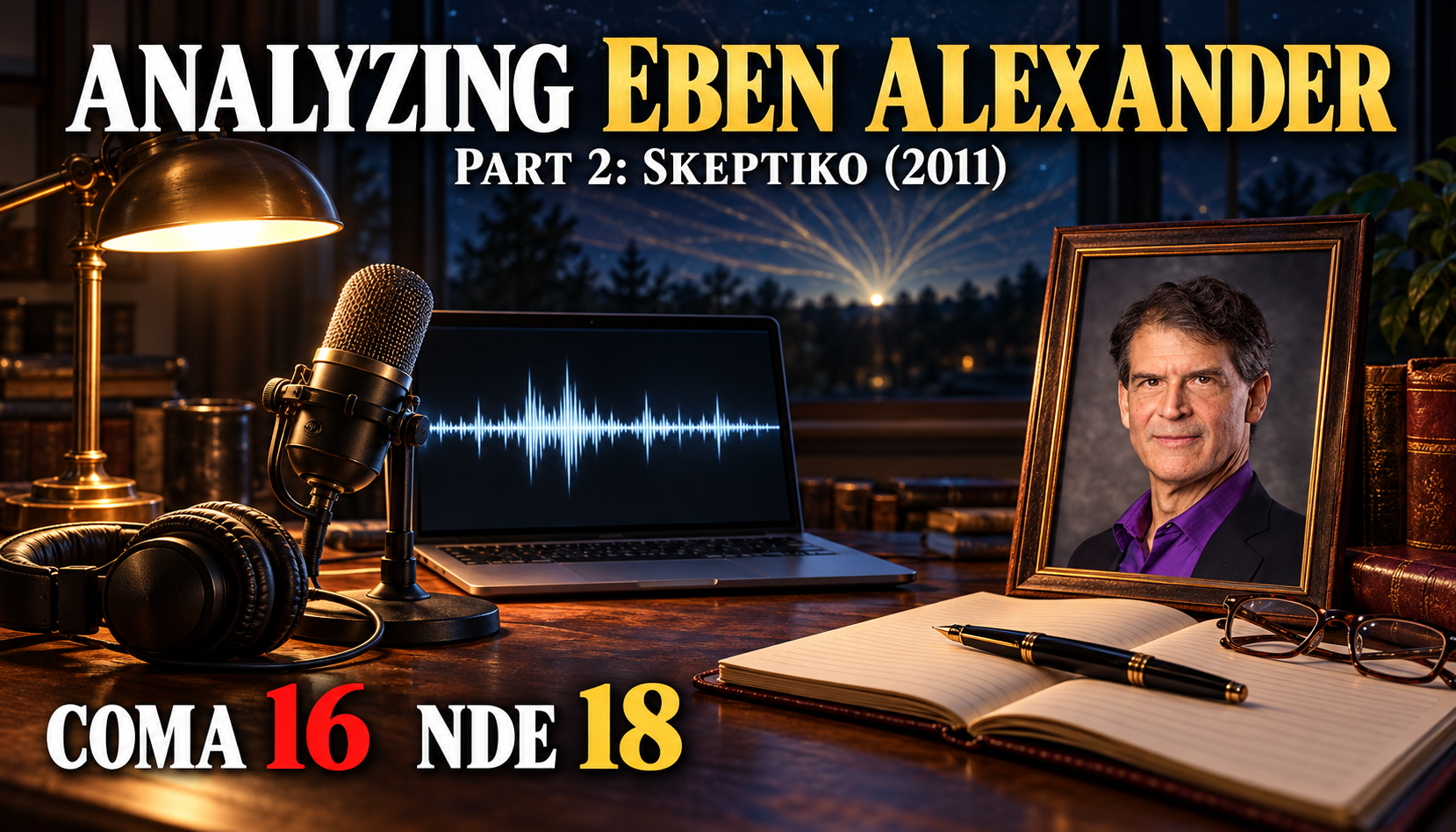
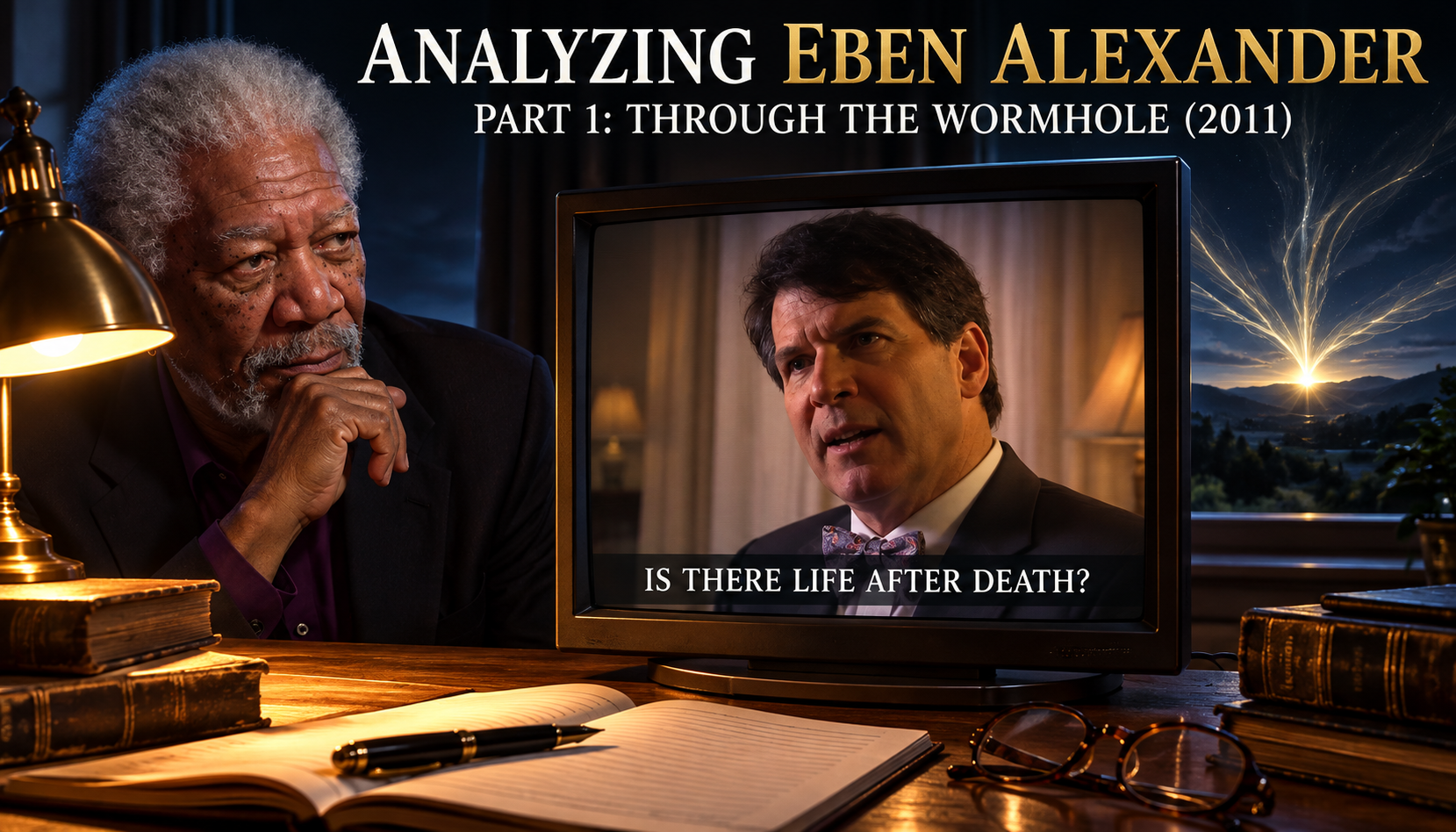
On May 28, 2011, the Science Channel aired Season 2, Episode 1 of Through the Wormhole with Morgan Freeman. The episode was titled “Is There Life After Death?“
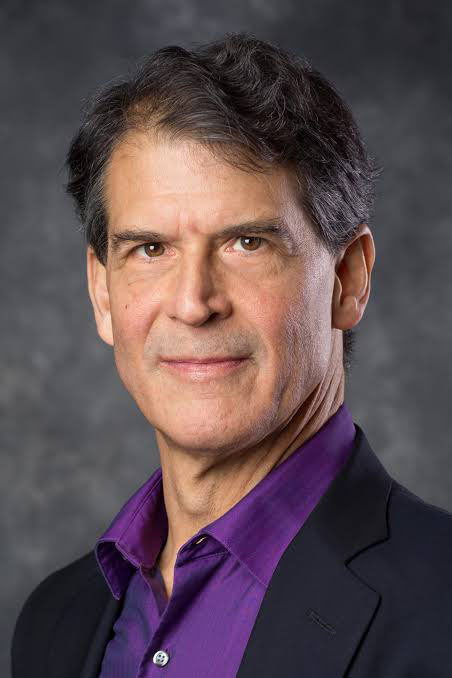
Eben Alexander first appears on camera 2:47 into the program and tells his story. My analysis in this article is based on a transcript of this video. As you’ll see later, I’m breaking down Eben Alexander’s own words, line by line. You’ll see why in a minute.
This is the earliest recorded telling of Eben Alexander’s near-death experience I’ve been able to identify so far. His appearance is short, a few minutes of a one-hour program, but it matters more than its length suggests. As I explained when I announced this project, in Analyzing Eben Alexander: The Project Begins, I’m working through his public tellings in chronological order, oldest first, and moving forward from there. This is where the record starts.
Eben Alexander also gave two presentations before this early television appearance. The first was on November 8, 2010, at the Lynchburg Academy of Medicine, and the second on November 16, 2010, at UVA’s Division of Perceptual Studies. I emailed both institutions earlier today, asking whether they have any records of those presentations.
What He Said – Verbatim Transcript
Here are the words of Eben Alexander, as he said them, in a transcript taken from the video:
Narrator (Morgan Freeman): This is something many believe in their hearts, but is there a way to prove it or disprove it scientifically? Eben Alexander taught and performed neurosurgery at the Harvard Medical School for 15 years. In 2008, his career took an unexpected turn, one that would give him profound insight into the possibility of life after death. He contracted an extremely rare form of bacterial meningitis and fell into a deep coma.
Eben Alexander: I think if you were trying to come up with an experimental model that would best approach human death, meningitis is perfect, because what it does is it attacks the entire outer surface of the brain. These are horizontal images taken through my skull, and you can see the entire outer surface of the brain was coated with pus. These bacteria had gotten rid of all the glucose, and now the only thing left to consume were my brain cells. And so my entire neocortex, that part of the brain that makes us human, was completely shut down.
Narrator: After seven days of virtual brain death, Alexander emerged from the coma. Miraculously, within a month, he was back to normal. But something happened to him while he was away.
Eben Alexander: My first recollection from deep inside the coma was that I was what I sometimes call the earthworm eye view of the world. Everything was kind of murky, brown, red, dark. I literally remember roots over my head, and I seemed to be there for a very, very long time. I had no memory whatsoever of my life. No words. My language was gone. I was certainly not aware of anything going on around me in the ICU room. And then, in the midst of that, there was a little melody that was spinning in front of me, and it just started spinning and expanded, and it ended up clearing away all that ugly, foreboding, gross, muddy realm, and all of a sudden I was coming up into this beautiful meadow. I had no body awareness. I had no arms, legs, or anything. But I was aware that I was a speck on a butterfly wing, absolutely beautiful butterfly, and there were millions of other colorful butterflies looping and swirling all around us, all in this beautiful formation of flying. And then we left this universe and went out into what I now call the Core. At first, it seemed infinitely huge and dark, although I was there with that beautiful, warm awareness of the divine, which was clearly what we would call God, in this place outside the universe. Basically, I recall the whole multiverse being out in front of me. It was very clear that love was a huge part of the constituent of that whole multiverse.
Narrator: Alexander had faced something that tens of thousands of people have reported, a near-death experience. Nearly all claim something that science has so far been unable to prove, that there is another existence beyond the one we know.
Eben Alexander: This was something that was very difficult for me to explain from a neuroscientific standpoint, and the scientific side of me could not see how that could be. And yet it was a very, very powerful, very powerful memory. I came up with several models having to do with neurophysiology and neuroanatomy, and the problem is none of those models sufficiently explain the very powerful memories that I brought back with me from this experience. And I ended up at a point where I do not believe that there is a good neurophysiologic explanation for what happened to me.
Narrator: Eben Alexander’s experience was profound and life-altering, but it is by no means unique.
[The program moves on to other researchers and returns to Alexander near the end.]
Eben Alexander: I have great belief and knowledge that there is a wonderful existence for our souls outside of this earthly realm, and that is our true reality. And we all find that out when we leave this earth.
Narrator: Ultimately, every one of us will discover the truth.
(End of transcript)
Read it once straight through. It flows. It sounds like one continuous journey, from the dark to the light to God. That smooth flow is exactly the problem.
The Difficulty of a Welded NDE
Eben Alexander fell into a coma in November 2008, caused by bacterial meningitis. The program describes it as seven days of virtual brain death. By the time this episode aired, he’d had about two and a half years to think about what happened to him, to go over it in his mind, and to put it into words.
Two and a half years of reflection doesn’t help him sort it out. Nothing would. His account contains material from two different sources. Some of it comes from a near-death experience, the crossing over that millions of people across every culture describe in the same terms. Some of it comes from a coma experience, imagery generated by a living brain, badly damaged, cut off from the outside world, pulling from its own stored memories. When both happen during the same medical event, the result is what I call a Welded NDE. The person wakes up with both experiences fused into a single memory.
There are no timestamps. Nothing in his memory says “this part happened while your brain was generating images in the coma” and “this part happened after you crossed over.” He remembers one journey, so he tells one journey. He moves from coma material to NDE material and back, often inside the same sentence, with no pause and no awareness he’s doing it. He isn’t lying. He’s telling the truth exactly as he remembers it. He simply has no way to separate the two sources. Nobody in his position would.
I want to stop here for a second to emphasize this fact. People who survive a coma and also have a near-death experience in the same event make terrible witnesses. Every time. It’s the one constant, and it’s predictable as hell. If you’re reading or listening to an account labeled a “distressing NDE” or a “hellish NDE,” or whatever label the podcaster or interviewer applied, it’s almost always coming from a coma. Very often there are no near-death experience markers in it at all. If there are both Fear Coma markers and NDE markers, then it’s a Welded NDE (WNDE).
So the work falls to the analyst. I take his testimony apart element by element, sometimes a few words at a time, and make a call on each piece based on the framework. Because this is a relatively short and limited account, three standards guide the calls in this analysis.
The first is touch. Anything felt through the senses of the skin comes from the coma. There are millions of near-death experience accounts to compare against, and references to physical touch are absent from them. A living body has nerve endings. A soul does not. The only time people talk about “feelings” during an NDE is in relation to emotions, during a life review, for example: how they felt, emotionally, facing some of the most dramatic or traumatic moments of their lives. Nobody talks about physical sensations.
The second is sound. In an authentic near-death experience, all communication is telepathic. A soul has no eardrum, no auditory nerve, and no brain to process sound. People in NDEs often report being told things, or having conversations with deceased loved ones, but it’s never a physical conversation with mouths and ears. It’s always telepathic.
The third is time, or any reference to the passage of time. Time does not exist in an authentic near-death experience. Experiencers often say something like, “It might have been weeks, months, or even years. I have no idea, because time doesn’t matter at all on the other side.” That’s a typical NDE reference to time.
Now compare that to the Fear Coma Experience (FCE). Those three elements, physical sensation, sound, and the passing of time, are almost always present in an FCE. Look at the account of Matthew Botsford, for example, another Welded NDE. His inventive and very alive coma brain created demons and monsters who took great delight in ripping the flesh from his backside as torture, flesh which then grew back so they could do it again. He heard the wailing of the other people in hell with him. And he makes references to the passage of time. None of this is NDE material. It’s all pure FCE.
So, generally speaking, anything you hear with physical ears, including music, comes from the coma. Anything you feel through the nerve endings of a living body comes from the coma. The same goes for any reference to the passage of time. None of these are NDE markers. All of them are clear Fear Coma Experience markers.
Beyond those three standards, the test is simple. Near-death experiences converge. People describe the same core elements in the same way, across cultures and centuries, because they’re describing the same place. Coma imagery diverges from the NDE markers. It’s earthly, personal, and built from the life the person lived before. Every element in his account carries the fingerprint of where it came from.
I’ll start with the coma material, then move to the near-death experience.
Fear Coma Experience Elements
The Earthworm’s Eye View – “What I sometimes call the earthworm eye view of the world.” His first memory places him underground, looking up from inside the dirt, the way an earthworm would. This is a physical, earthly location, generated by a living brain in a coma.
Murky Earth Colors and Roots Overhead – “Everything was kind of murky, brown, red… I literally remember roots over my head.” Brown and red murk. Plant roots hanging above him. Soil, mud, and the underside of the ground. This is earthly imagery, built by a living brain from the world it already knew.
A Very, Very Long Time – “I seemed to be there for a very, very long time.” He says he stayed in the underground place for a long time. In a near-death experience, time does not exist. Experiencers report again and again that time stopped mattering, or that there was no time at all. A sense of time passing, or of staying in one place for a long stretch, belongs to the coma. Time exists for a living brain in a hospital bed. It doesn’t exist on the other side.
The Neurosurgeon Diagnoses Himself – “I had no memory whatsoever of my life. No words. My language was gone.” Listen to how he says this. He isn’t describing something he saw or felt. He’s explaining his condition the way a doctor explains a patient’s chart. A neurosurgeon knows meningitis attacks the parts of the brain responsible for memory and language, so after the fact, he applies his medical training to his own memory and explains it in clinical terms.
Nobody inside a coma, or on the other side, keeps a running inventory of which brain functions are working. This statement comes from Eben Alexander the neurosurgeon, looking back at Eben Alexander the patient, reconstructing the experience through the lens of his profession. His medical training doesn’t make him a better witness to his own experience. It makes him a worse one. He fills the gaps in his memory with a diagnosis, and the diagnosis sounds like testimony. Everything about this statement points to a living brain in a coma, interpreted years later by the doctor who owned it.
Ugly and Foreboding – “All that ugly, foreboding…” Foreboding is a sense of dread, something bad about to happen. This is the emotional tone of the coma, the fear generated by a brain under severe stress. It’s the same fear people report coming out of comas every day.
Gross and Muddy – “…gross, muddy realm.” Gross and muddy are qualities you feel. Slime. Wet earth. Something unpleasant against the skin. By his own account, he had no body at this point. A soul with no nerve endings feels nothing. The sensation of mud came from the living body in the ICU bed, reported through a brain in a coma.
The Melody – “There was a little melody that was spinning in front of me.” A melody is heard. Hearing requires an ear, a nerve, and a brain to process the sound. The music is coma material. Watch this sentence closely, though, because he packs something else into it. I’ll return to it in the next section.
The Butterfly Wing – “I was aware that I was a speck on a butterfly wing.” He rides on the wing of a butterfly, carried along on a physical surface. A butterfly is an earthly insect, and riding on one is a scene only a living brain would assemble. This is almost certainly coma imagery.
Millions of Butterflies – “Absolutely beautiful butterfly, and there were millions of other colorful butterflies looping and swirling all around us, all in this beautiful formation of flying.” Millions of colorful butterflies flying in formation. Beautiful, vivid, and earthly. A brain in a coma doesn’t only produce fear. It also produces comfort and beauty, built from the same stored material. This is a living brain generating a beautiful scene.
Near-Death Experience Elements
The Meadow – “All of a sudden I was coming up into this beautiful meadow.” People who cross over often describe arriving in a garden or meadow: open green space, beauty beyond anything on earth, a peaceful landscape on the other side. It’s one of the recurring places in clean near-death experience accounts, reported across cultures. His beautiful meadow sits in that same position, right after he rises out of the dark. This is the garden, and it belongs to the near-death experience.
One side note: the meadow appears right alongside the millions of butterflies and Eben Alexander riding on a butterfly’s wing. If the beautiful meadow, the typical “garden” of NDE accounts, is NDE material, then it’s mixed together with FCE material like a soup salad. This is a good example of why WNDE experiencers make terrible witnesses.
Out of the Body – “I had no body awareness. I had no arms, legs, or anything, but I was aware that I was a speck.” No body. No arms, no legs. A point of awareness with no physical form. This is the out-of-body experience, one of the most consistent elements reported in near-death experiences around the world.
The Void – “Dark.” “At first, it seemed infinitely huge and dark.” Twice in this short telling, he describes darkness. The first time, the word “dark” closes out a sentence otherwise full of coma imagery: murky, brown, red, dark. The second time, he describes the Core as infinitely huge and dark. An endless, dark space is the void, the first stop for many people after they leave the body. He never uses the word “void,” but he describes it. The most typical NDE progression starts with the out-of-body experience (OBE), then moves into the void. A light appears and forms a tunnel, and you meet the bright white light we now call God.
The Light Appears – “Spinning in front of me, and it just started spinning and expanded, and it ended up clearing away all that… and all of a sudden I was coming up.” Here is the sentence I flagged earlier. Strip away the melody, and look at what the thing does. It appears in the darkness. It spins. It expands. It clears the darkness away. And it carries him upward. This is the light, doing exactly what the light does in clean near-death experience accounts. He doesn’t use the word “light” in this telling. He calls it a melody. The perception is the near-death experience. The music is the coma’s label on it.
Leaving This Universe – “And then we left this universe.” He leaves the physical universe entirely and goes somewhere outside it. People who have crossed over describe this departure in the same terms: leaving this world and arriving somewhere beyond it. Other NDE accounts cover this same territory in nearly identical words, zooming out and leaving the universe behind. Pure NDE material.
The Presence of God – “I was there with that beautiful, warm awareness of the divine, which was clearly what we would call God, in this place outside the universe.” He’s in the presence of the divine, which he identifies as God. The word “warm” here describes an awareness, and awareness has no temperature. This is the warmth of love every clean account reports, felt as emotion, not heat on skin. Contact with the Source, the all-loving presence most experiencers call God, sits at the center of the near-death experience. These are clear NDE references.
Seeing Everything – “I recall the whole multiverse being out in front of me.” He sees everything at once, the whole of existence laid out in front of him. “Multiverse” is his own label, a physics term he applied afterward. The experience underneath it, seeing all of creation at once, is a near-death experience element.
Love in Everything – “It was very clear that love was a huge part of the constituent of that whole multiverse.” Love as the substance of everything. Experiencers return from the other side and report this again and again: everything is made of love, and everything is connected. This is oneness, and it’s pure near-death experience.
What This Telling Shows
In this short appearance from 2011, Eben Alexander describes nine elements from a living brain in a coma and eight elements from a near-death experience. The coma material is earthly and physical: dirt, roots, mud, butterflies, music, dread, the passing of time, and a neurosurgeon’s after-the-fact diagnosis of his own brain. These kinds of references are common among people who survive comas, where the condition is labeled ICU psychosis or ICU delirium. It often comes with a heavy dose of PTSD, which can remain for years or even decades.
The near-death experience material is the same core reported by millions of people who have crossed over: the garden, out of the body, the void, the light, departure from this universe, the presence of God, seeing everything, and love in everything.
Both sources are present in a single account. By definition, an account containing both coma elements and near-death experience elements is a Welded NDE.
So based on this one telling, the earliest I’ve found so far, Eben Alexander had a Welded NDE.
One telling isn’t the whole record. He has told this story many times in the years since, and I’m going to examine every telling I can find, in order, until there’s nothing left. Next up is the next telling on the calendar.
Want to go deeper? Don Winner brings decades of intelligence and investigative experience to the biggest question there is: what happens when we die.
In You’re Going to Die Someday, Right? Near-Death Experiences Reveal What Happens Next, he examines the evidence from thousands of near-death experiences to find out what they actually tell us about consciousness, the soul, God, and the afterlife.
In Hell Exists, But Only for the Living, he investigates where our idea of hell came from and who built it, tracing the doctrine back to its human sources.
Get your copy of You’re Going to Die Someday, Right? or Hell Exists, But Only for the Living.