
Introduction
To my complete surprise, I ran into another Welded NDE. This began, as several of these investigations have, with a search for a mislabel.
Part of the work of building a new framework is insisting that things be called what they actually are. The field has a category it calls the “distressing near-death experience,” and into that category it sweeps a great many accounts that, on close examination, are not near-death experiences at all. They are Fear Coma Experiences: episodes of terror manufactured by an injured, comatose, but living brain, mistaken for glimpses of an afterlife because “near-death experience” is the only vocabulary the culture has handed people to describe them. A central aim of this project is to separate those two things, to pull the fear comas out of the NDE bin and give them their own name and their own honest accounting.
So I came to the Matthew Botsford case the way I come to many of them: looking at it as a probable FCE, an account of hell that had most likely been mislabeled as a distressing NDE. What I did not expect was to find, buried inside it, the genuine article. Not the whole of it, and not most of it, but real, authentic near-death material welded onto the end of the fear coma. I went in hunting a mislabel and came out with another Welded NDE. That surprise is worth stating plainly at the outset, because it is the finding.
A word about where these accounts come from and how they are framed. Almost all of the Botsford material lives inside religious programming, or is told through a religious lens. The tellings lean hard on a conversion arc: Matthew and his wife Nancy were both, by their own description, non-believers before the shooting, and both became deeply religious as a direct result of what happened. That frame shapes everything, and nowhere more than in the enormous emphasis placed on the hell imagery, on how much of it there is, how vividly it is dwelt upon, and how each detail is presented and interpreted. As we work through the material, that framing will be visible at every turn, and part of the task is reading the raw experience underneath it.
The account itself was assembled from more than half a dozen separate sources, spanning some fifteen years, including multiple filmed interviews and a first-person written narrative. From each of them the same thing was extracted: the details of the experience as Matthew Botsford describes them, in his own words, set side by side so that what is stable and load-bearing can be told apart from what merely drifts.
Here are the results of that investigation.
Shot, Down, and Instantly There
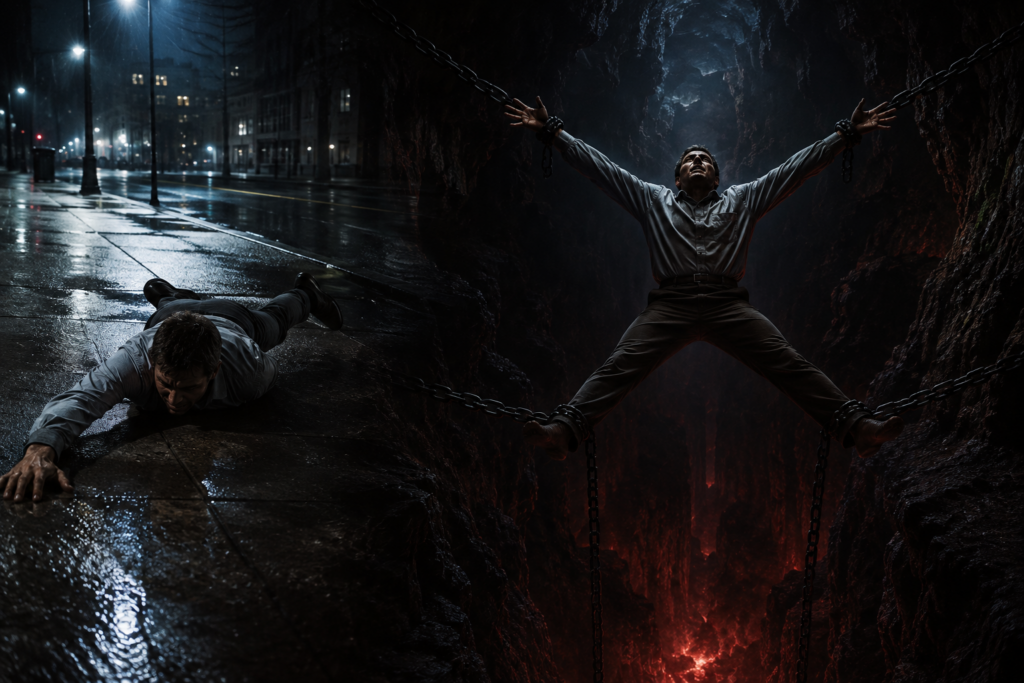
Ask Matthew Botsford what happened and he tells it as one unbroken motion. A hot pierce at the top of his head, the bullet entering from behind. His body crushed to the sidewalk. “Instantly dead,” he says, “all my life left me.” And then, with no gap, no pause, no passage in between, he was already there, chained in the place he would come to call hell. There was no interval between the pavement and the terror. The one became the other in an instant.
This is how it began, and the suddenness is the first thing worth noting. Botsford does not describe a slow fade, a drift, a sense of traveling. He describes being struck and then, immediately, being somewhere else entirely, a somewhere that was waiting for him the moment the shooting took him down. One instant he was on a street in Atlanta waiting for a taxi. The next he was chained over an abyss. Nothing carried him from one to the other that he can describe. It was there as fast as the bullet was.
Chained Over the Abyss
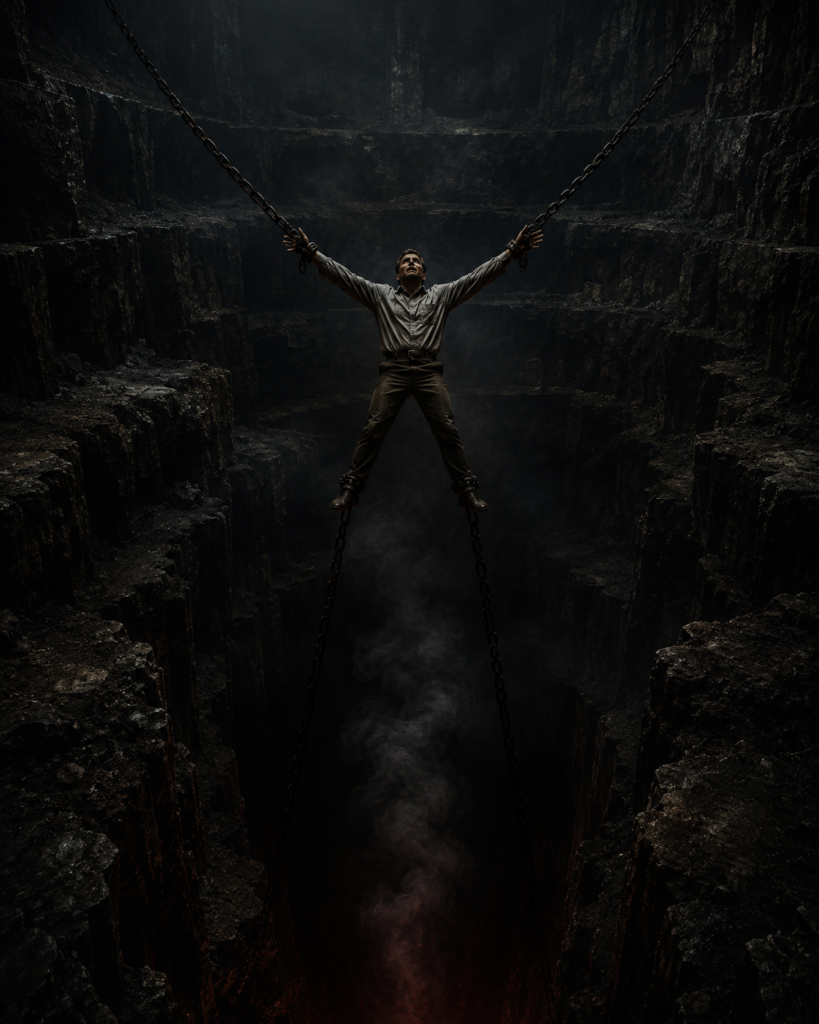
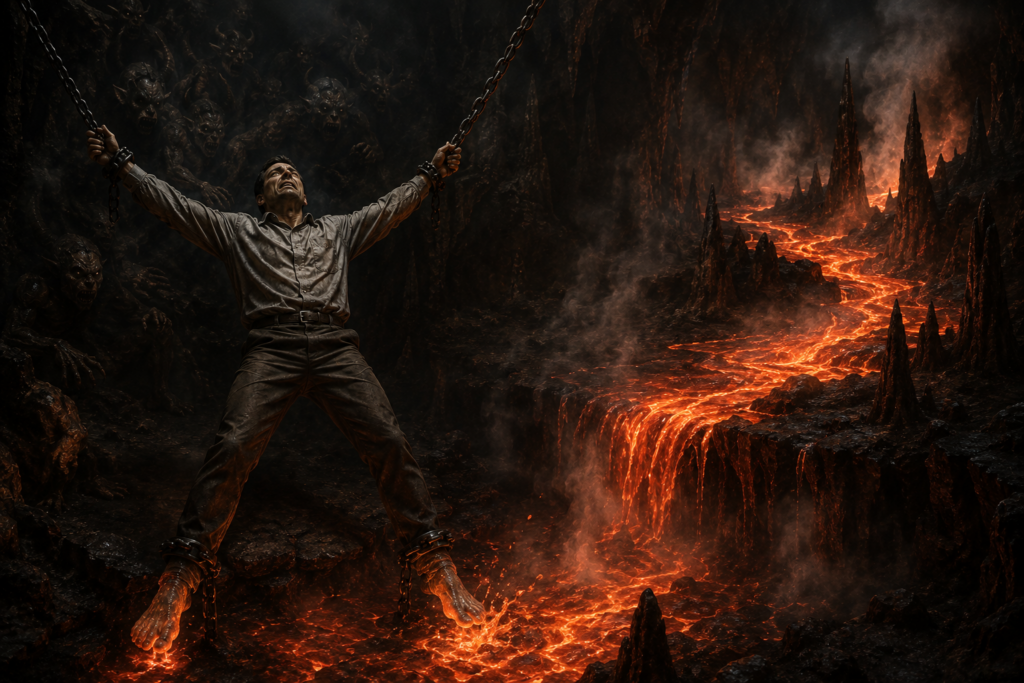
When Botsford arrives, he is not standing on any ground. He is chained, crucifixion-style, arms out, suspended over a vast, deep abyss, a bottomless pit dropping away beneath him. This is the first thing he becomes aware of in that place: that he is bound, held fast, hanging over an emptiness with no floor. He cannot free himself. He cannot climb out. He is fixed in position over the drop, and there is nothing he can do about it.
Below and around him the place reveals itself. It is a massive cavern, and he somehow knows he is underground, knows it the way you know things in that state without being told. He can see shelf-like levels in the rock face of the cavern, tier after tier receding into the dark. Smoke rises up before him from somewhere far below. And out of that depth come sounds: screams, what he calls “horrendous screams,” rising up through the smoke from a distance he cannot measure. He hangs there in the middle of it, chained, suspended, listening to the screaming come up out of the pit.
Everything about the setting is enclosure and restraint. He is not walking through hell, not moving from place to place. He is held in one spot, chained over the abyss, unable to move, unable to fall, unable to rise, made to hang there and take in what surrounds him. The imagery is not fire and it is not chaos. It is a cold, dark, cavernous depth, and a man fixed in the center of it against his will.
Cold, Dark, and Icy
The popular picture of hell is fire. Botsford’s setting was the opposite. The place was cold, he says, and dark, very dark. The ambient state of it was not heat but chill, a cold, cavernous depth with no warmth in it anywhere.
And it was dark. He knew, without being able to say how, that he was underground, deep beneath something, sealed in the earth. The darkness was not the ordinary absence of light. It was total, a blackness he calls utter, the kind that presses. Against that dark he could still somehow see the cavern, the shelved rock walls, the smoke rising, his own bound body, but the ambient state of the place was lightless, cold, and buried. A cavern with no sky, no warmth, no exit upward. Cold, dark, and underground, with no way out and no way up.
The burning, when it came, did not come from the air. It came from the lava, and he felt it as real heat on his flesh, but that belongs to its own part of the account. The place itself, the space he hung in, was cold.
A Bath of Evil
Beyond the cold and the dark and the chains, there was something in the atmosphere of the place itself, and this is the part Botsford strains hardest to convey. It was not just that frightening things were happening to him. It was that evil was present as a substance, a pressure, something with weight and texture that pressed in on him from all sides continuously. He reaches for a comparison and lands on immersion: it was as if he had stepped into a liquid bath of evilness, the wrongness of the place enveloping his body the way water envelops a body lowered into it. Total contact. Nowhere untouched.
And it carried a knowledge with it. Inside that pressing evil he knew things, flatly and without doubt. He knew there was nothing good. He knew nothing good was coming to him, that nothing good would ever come. And he knew, about himself, that there was nothing good in him either. That certainty was part of the atmosphere, not a thought he arrived at but a fact the place pressed into him: no good here, none coming, none in you. Bleakness, hopelessness, a complete absence of anything but the evil itself, closed over him and held.
Utterly Alone
If the evil was what filled the place, loneliness was what the place had taken away. Botsford was alone there, and the aloneness itself was one of the worst things about it. He is careful to say this was not ordinary loneliness, not the feeling of being by yourself in an empty house or a strange city. It was something beyond the natural, a profound isolation deeper than anything he had ever felt or could have imagined, nothing he had ever read about or heard described. He was cut off, completely, from every other living thing, and he knew it in his bones.
He makes a point about this that clearly matters to him. People say, he notes, that they will just keep living the way they always have, keep partying, and if they end up in hell, so be it, they will carry on there the same as here. He wants people to understand that it does not work that way. There is no carrying on. There is no company, no crowd, no shared misery. There is you, alone, and the knowledge that you are alone, and that alone is terrifying by itself, before anything else in the place even touches you. The isolation was total, and it was one of the defining horrors of the experience.
Stripped of Everything
In that place Botsford was in his body, he could see himself, without clothes, and he says the nakedness itself did not particularly bother him, because it was the least of what had been taken. Something far more total had been stripped away. He had no memory of being married. No memory of his accomplishments, the life he had built, the things he had done. No thoughts of any future, because there was no future there to think about. Everything that made him a person with a history and a life had simply been removed, and he was left with none of it. It’s important to note he clearly reports being inside of his own body. That will be important later.
What remained was existence stripped to its barest point: him, in that place, in the here and now, with nothing behind him and nothing ahead of him. No past to draw on, no identity to hold onto, no forward direction to hope toward. Just raw, present being, in a body, in the dark, chained over the pit. He had been reduced to the fact of his own existence and nothing more, and that existence was held in terror. Everything a person carries that tells them who they are had been pulled away, and what was left was aware, and afraid, and alone.
And whatever it was, it was not a dream. Asked directly whether any of it felt like an illusion, a dream he might wake from, he rejects the idea flatly. It was not a dream. It was, in his words, pure reality, as solid and as present as anything he has ever been awake for. Whatever else can be said about the place, he is certain he was really there.
No End to It
Bound up in everything else was a certainty about time, or rather the absence of it. Botsford knew, in that place, that this was not going to stop. He knew he was outside the temporal realm, that ordinary time did not run there, and that what he was in was an eternal existence. Not a long time. Not a stretch he would eventually get through. Eternal, with no end anywhere in it.
This was not a conclusion he reasoned his way to. It was part of the fabric of the experience, known the same way he knew he was underground and knew there was nothing good: flatly, immediately, without doubt. There was no clock, no sense of duration, no waiting-it-out, because there was nothing to wait for. The place had no exit in time any more than it had an exit in space. He was chained over the abyss, stripped, alone, in the cold and the dark, and it was forever. The horror was not only where he was. It was that where he was had no end.
Pressed, years later, to put an outside number on it, he and his wife arrived at a rough estimate: something shy of a full day, perhaps twenty-three hours. Part of how they landed there is that his wife, in another state, felt a disconnect during a window when, as she put it, she could no longer feel him. But that clock is the view from the outside, measured against her sense of his absence and the medical timeline. From the inside, where Botsford actually was, there was no such measure. Inside, it was eternal, and the gap between those two things, a single day on the outside and an eternity on the inside, is itself part of what he is trying to describe.
The Creatures Had Rank
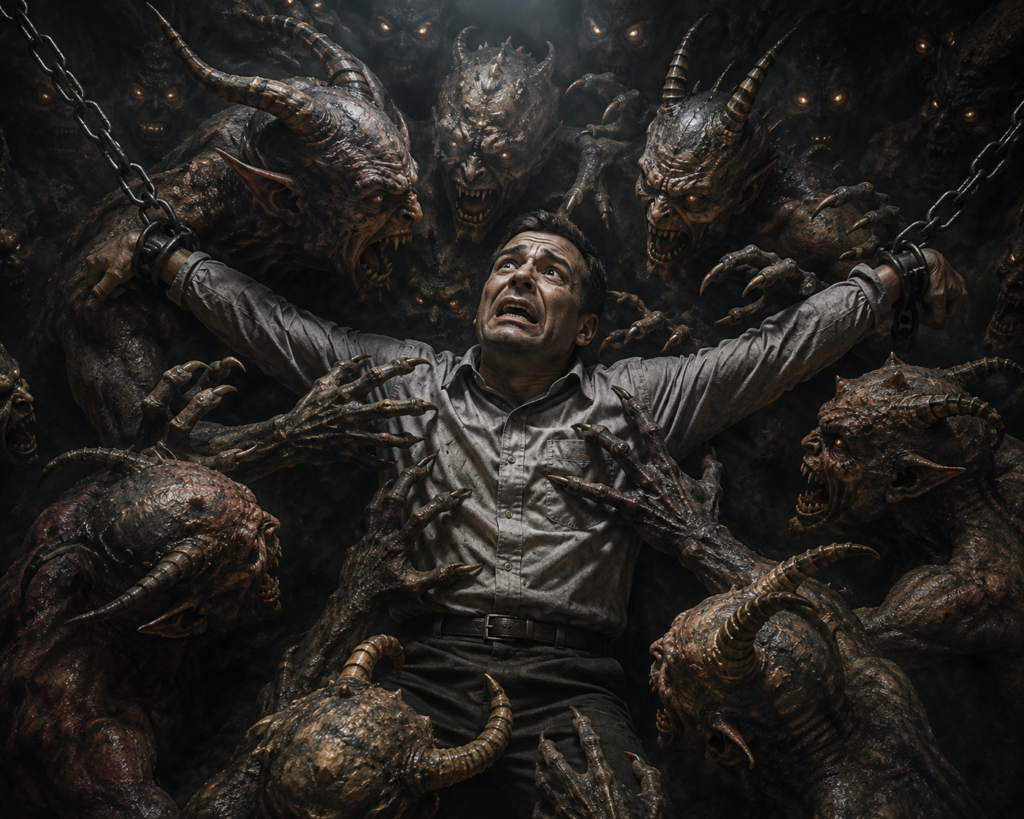
Matthew was not alone in the pit, but the company was its own torment. Out of the blackness, things came at him. At first it was eyes, pairs of eyes appearing in the dark and coming at him from various directions. He came to understand that each eye was its own demon, and that they moved in pairs, two by two. They moved at lightning speed, shooting toward him and stopping short right in front of his face, while others hung back at a distance, and some came on tauntingly slow. At times the demons pressed in so close around him that they were like a black cloak drawn over everything, constricting his whole view and existence down to a cell, a chamber with no floor or ceiling or walls, just a closing-in of palpable blackness like liquid ink, icy cold and evil in look and feel.
Close up, he could see some of their faces and bodies: short and stout, covered in scales, with talon-ed hands that shot out at him from the dark and vanished again. He could see teeth in some of the wicked mouths, teeth of various sizes and sharpness, black lines ingrained from base to tip, and in some of those gaping mouths, remnants of what looked like flesh and bone. And they carried a smell, a stench like rotten carcasses that reached him every time they came near.
The torment came at him from two directions, and he divides it cleanly. From behind, they went to work on his body. He could not see them there, but he could feel their gaze on his back, and then the peeling of his skin, the flesh coming off him in ribbons, and he heard it, the sound of his own skin being ripped away. When it was gone, the flesh reformed, and they stripped it again, over and over, a punishment with no completion, because the damage never stayed done long enough to end. From the front, they did something different. They taunted him, mocked him, judged him, and condemned him. And underneath all of it was a hatred he could feel coming off them. They hated him, hated the fact of who he was, and though there were no words to it, he sensed it plainly. Later he came to believe what they hated was the good in him, the love in his heart, the goodness in his soul, and that they hated it precisely because it was the one thing in that place that did not belong to them. Physical torture behind, and in front of his face, the jeering, the verdict, and the hate.
And there was an order to them. Matthew could read a hierarchy in the creatures themselves, marked out on their heads: horns, of varying numbers and sizes and lengths, some with more, some with taller, each denoting a level of authority in the realm. He could tell rank by the horns, a chain of authority running down through the demonic order, each level answering to the one above it. Not one of them, he noticed, ever bore seven horns, the number that would denote a perfect and complete authority. What he was looking at was not chaos. It was a structure, organized and ranked, and he had been delivered into the bottom of it.
They Knew Everything He’d Done
Before the lava, before the worst of the physical torment, the creatures did something else to him: they read him. He could feel their eyes on him, piercing eyes that gazed right into his being as if they were reading his whole life story, and he understood that they knew, knew all of it, every wrong thing he had ever done, down to the smallest and most forgotten. He puts it plainly, and he names things: the things you did wrong as a kid, the dollar you stole here or there, the pornography, the places he had gone astray. They knew that. They knew everything, and none of it was hidden from them.
And having read him, they judged him, and they did it without stopping. He describes it as continual, the same verdict brought back to his remembrance and pronounced over him again and again and again. This was not a single sentence handed down once. It was condemnation on a loop, his whole past dragged back up and held against him over and over, with no end to the judging any more than there was an end to the place. And there was something he found strange about it even in the moment: these were demonic things, cast into hell themselves, and yet here they were sitting in judgment over him. He came to understand the logic of where he was. Because he had no relationship with Jesus, as he frames it, he was held there by right, bound and kept in a holding cell to await a final day of judgment still to come. The evil of evils was condemning him for his past, continually, while he waited for a sentence that had not even fully fallen yet.
There Was a Line They Couldn’t Cross
For all the terror the creatures brought, Matthew is careful to mark one boundary they never crossed, and he says plainly that he thinks it matters. The demons could come at him, frighten him, strip his flesh, taunt and judge and condemn him, but they could not take him. They had no dominion over him. There was, he says, still a line between him and them, a limit on what they were permitted to do, and they stayed on their side of it. They could torment. They could not possess. They could not claim him outright and drag him into themselves.
He does not, in the moment, explain why the line was there or who drew it. He only knows it was real, that in the middle of a place with no good in it and no exit from it, there was still this one boundary the evil could not step over. Everything else about the place said he belonged to it. This one fact said something held them back.
The Lava
The flesh-stripping was not the only thing being done to him. Off to the upper right, Matthew saw a flow begin, lava, or the closest word he has for it. Red magma, a red-red-red molten liquid, something searingly hot, made of sulfur and brimstone, moving down toward a precipice in front of where he was held. It flowed through the cavern and around the bases of the stalagmites, rising up some of them to the very tip, and where it ran, black and grey smoke billowed up off it. When it reached the edge and dropped over into the abyss beneath him, it broke apart, and globules of it splashed off and came down onto him. Lower legs, feet, shins. Wherever they landed, they burned the flesh off, down to the bone. He could see his own bones, clean of flesh and blood. He could smell his own flesh searing away. He says he has never been on fire, cannot imagine what that would be for the people who have, but whatever he felt there, he thinks the pain was the same.
And then, the same as before, the flesh reformed, so the lava could burn it away again. He could feel all of it. Not a memory of pain, not the idea of burning, but the burning itself, and then the reforming, and then the burning again, a continual and eternal thing with no point at which it finished.
That was the shape of the place. Between the creatures at his back and the lava at his legs, nothing that happened to him was allowed to stay done. Every injury undid itself only so it could be inflicted a second time, and a hundredth, with no reason to think it would ever stop.
He Was Not the Only One
For all his isolation, Matthew was not the only one suffering in that place, and he could see the others. Around the cavern, four-legged creatures scurried, hunched over, in agony of their own. He describes them as beings that looked as though they could have stood upright on their hind limbs, but whose torment had driven them down onto all fours, bent to the ground by it. They moved through the cavern trying to keep clear of the flowing lava. Some managed it. Others did not, and he watched them boil in the lava to their own agonizing end.
And there were the screams. They came up out of the depths, out of the very flow itself, carried on the black and grey smoke that billowed off the lava, smoke that seemed to him to be carrying the souls of the lost. None of the screaming was words. It was just sound, loss and pain and anguish with no language to it, some of it low and guttural, some of it high and piercing, all of it torment. By the sheer number of the screams, he knew he was not down there alone. And yet the company changed nothing. He was surrounded by suffering and still entirely isolated inside his own. Others were there, screaming, boiling, scurrying, dying, and none of it reached him or relieved him. He hung in the middle of a crowded torment and was as alone in it as if the place had been empty.
The Seam: Where Hell (FCE) Ends And The NDE Starts
Everything to this point, the abyss, the chains, the cold, the bath of evil, the creatures and their rank, the reading and the condemnation, the lava, the isolation, the stripped identity, the no-end dread, is the fear coma. It is sustained, elaborated, and multi-sensory, and it is the overwhelming bulk of what Matthew describes.
Then, in a single breath, he marks the moment it ends and something else begins:
“All the demons fled, fear disappeared, and I just felt this upward movement.”
That sentence is the seam. Read it in order: all the demons fled, fear disappeared, the fear coma terminates. And I just felt this upward movement, the near-death experience begins. The hell state and its exit are named in one continuous line, with the hinge falling squarely between the two clauses. Everything before it belongs to the fear coma. Everything after it belongs to what came next.
The Hand
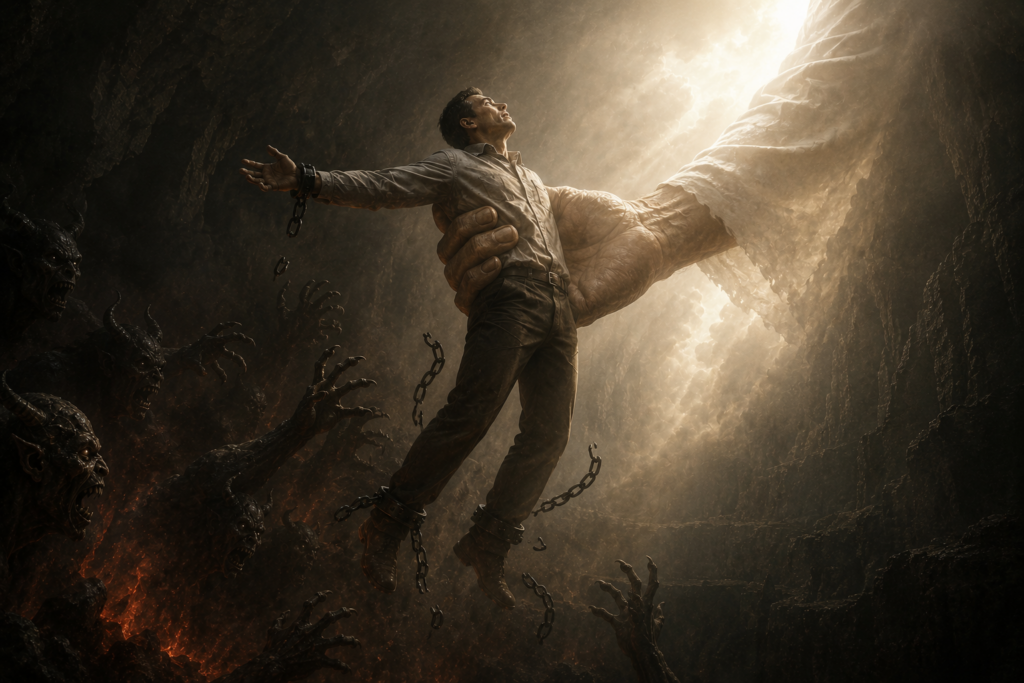
It started as a protrusion. Matthew describes it the way you’d describe a finger pushing through a black plastic garbage bag from the other side, the surface straining, then giving. Something was pressing through into that place from outside it. And then it came through, and it was a hand. A man’s hand, the right hand, and it looked ancient, the skin cracked and weathered and old. If he reached for the language he knew, he says, he would call it the Ancient of Days. He believes, without hesitation, that it was the hand of God. And unlike everything else in that place, it was full of life.
The hand came toward him. He was still shackled, arms held out, and the hand came around his waist. And the moment it took hold of him, the place broke. The shackles fell off. The demonic creatures vanished. He describes it as a war that happened without a war ever being fought, because there was nothing in that place that could stand against this hand. It simply arrived, and took him, and everything that had held him was undone in an instant.
The Music and the Light
With the hand came the first good thing that had reached him down there. Sound, real sound, beautiful sound. He heard music, orchestral music, the first thing that was not a scream since he had arrived. And with it came white: fine white feathers, brilliant white light, pouring into a place that until that moment had been nothing but darkness and evil, a place where nothing good was and nothing good came. Now it was full of music and feathers and light.
Then the movement. The hand around his waist, he was lifted, carried straight up, an ascent he compares to an elevator rising, out of the pit and away from everything in it. Up out of the cold and the dark and the eternal condemnation, pulled upward by the hand into the light and the sound.
“It’s Not Your Time”
And then the voice. It came, he says, out of everywhere at once, from all directions, filling everything. He reaches for comparisons big enough to hold it and stacks them one on another: a thunderclap, a bolt of lightning, Niagara Falls, all of it wound together into a single mighty sound. And what that voice said was simple, four words: “It’s not your time.”
That was the turning point of the whole thing, the sentence that sent him back. Not a sentence of condemnation this time but its exact opposite, a reprieve, a return. He felt himself lifted upward, out of the pit, and as he rose, the pain went with it. All of it, gone. The burning, the stripping, the cold, the pressing evil, all of it fell away at the lift, and what was left was the upward motion and the light and the music carrying him out.
He had been instantly dead on an Atlanta sidewalk, and he had been through the pit, and now a voice out of everywhere told him it was not his time. What came next, on the other side of that lift, was the coma, the month of darkness his body spent healing before he woke into a hospital room in horrible pain, ninety pounds lighter, left side paralyzed, a hole in his throat, coming up out of the dark into a life he would have to relearn from the beginning. But he came back. The voice had said it was not his time, and it wasn’t.
Summary and Findings
Two instruments were used to evaluate this account, and both point in the same direction.
The first is an internal diagnostic tool we maintain for our own purposes: a 0-to-100 scoring model that lets us quickly screen any account marketed as a “distressing near-death experience” and flag whether it has been mislabeled. It exists to do fast, consistent triage, to separate accounts that are genuinely near-death phenomena from those that are something else wearing that name, and to mark the ones that warrant a closer look. Run against that model, Matthew Botsford’s account scores a 93 out of a possible 100.
The second is the Winner FCE Scale, the published nine-question instrument for identifying a Fear Coma Experience. On that scale, Botsford scores a 15 out of a possible 16, with the one remaining item being an open medical record rather than a missing element. That places him firmly in the range the scale defines as a probable, almost certain Fear Coma Experience.
Both numbers say the same thing, and the conclusion is not in doubt: a Fear Coma Experience certainly occurred. The account carries the full signature. A documented clinical death, multiple times over. A twenty-seven-day coma from a gunshot wound to the head. An overwhelming, sustained hellscape of terror, entrapment, and torment, held stable and unchanging across more than six separate tellings and a first-person written narrative spanning fifteen years. This is not a borderline case or a judgment call. By both instruments, the fear coma is real, and it is nearly complete.
But that is only one half of what Botsford brought back.
At the very end of the experience, after the abyss and the chains and the demons and the lava, the account turns. A hand descends, a man’s hand, ancient and cracked, that he takes to be the hand of God. It brings brilliant white light into a place that had been nothing but darkness, and glistening white feathers, and music where there had been only screaming. It closes around his waist, the shackles fall away, the demons flee, and he is lifted upward and out. A voice like thunder and rushing water tells him, “It’s not your time.” That sequence, brief as it is, is not fear-coma material. It is the classic architecture of a near-death experience: the being of light, the benevolent presence, the upward movement toward it, the command to return.
Measured against the Greyson NDE Scale, the field’s standard instrument, that ending scores a 14 out of a possible 32, comfortably above the threshold of 7 that indicates an authentic near-death experience. It clears the bar, and it clears it on genuine markers rather than borrowed ones.
The proportion is the striking part. Of everything Botsford describes, roughly ninety percent is Fear Coma Experience and only about ten percent is near-death experience. The hell is the overwhelming bulk of it, elaborated across every telling in exhaustive sensory detail, while the NDE is compressed almost entirely into the final rescue. But that ten percent is real. It is present, it is stable across the tellings, and it passes muster by the Greyson Scale’s own standard. However small a fraction of the whole it occupies, the near-death experience is genuinely there, welded onto the end of the fear coma, and it counts.
Conclusion
This is a Welded Near-Death Experience, and I am classifying it as such.
The two halves are both real, and they are not the same kind of thing. Almost everything Matthew Botsford describes, the abyss, the chains, the cold and the dark, the bath of evil, the paired-eye demons and their ranks of horns, the reading and the condemnation, the flesh stripped away and reformed, the lava, the isolation, the certainty of no end, was generated by his own living brain. Every bit of it. Not one speck of that hellscape came to him while he was dead.
This is the point that has to be understood clearly, because everything turns on it. Botsford was shot in the head. A bullet tore into his skull and came to rest in his right frontal lobe, where it remains to this day. His brain was catastrophically injured, his body was shut down into a twenty-seven-day coma, and somewhere in that ruin his mind produced the most terrifying experience a human being can have. That is what a fear coma is: a damaged, offline brain, running its oldest and most primitive alarm at maximum volume, manufacturing terror and hurling it against a body that cannot answer. The hell Botsford visited was manufactured in the dark by an injured brain with a bullet in it. It was vivid beyond anything in ordinary life, it was real to him in every sense that matters, and it was, from first to last, a product of the living.
He was certainly in hell. He was also alive the entire time he was there.
The only portion of this account that belongs to the far side of death, the only material that was truly after life, is the sparse handful of near-death elements welded onto the very end: the hand, the light, the feathers, the music, the upward lift, the voice. That fraction, and only that fraction, carries the fingerprint of an actual crossing. Everything before it, the entire long descent into torment, is the fear coma, and the fear coma is an event in the living body. It is biology, not the beyond.
So what happened to Matthew Botsford was two experiences, back to back, fused in a single memory that cannot tell the seam from the whole. First a fear coma, generated by his own brain while he was catastrophically injured but alive. Then, at the end, a brief and genuine near-death experience as he was pulled back. The hell was his brain’s. The light was not. Together they make the rare, welded thing this entire body of work exists to identify.
FCE + NDE = WNDE.
Want to go deeper? Don Winner brings decades of intelligence and investigative experience to the biggest question there is: what happens when we die.
In You’re Going to Die Someday, Right? Near-Death Experiences Reveal What Happens Next, he examines the evidence from thousands of near-death experiences to find out what they actually tell us about consciousness, the soul, God, and the afterlife.
In Hell Exists, But Only for the Living, he investigates where our idea of hell came from and who built it, tracing the doctrine back to its human sources.
Get your copy of You’re Going to Die Someday, Right? or Hell Exists, But Only for the Living.