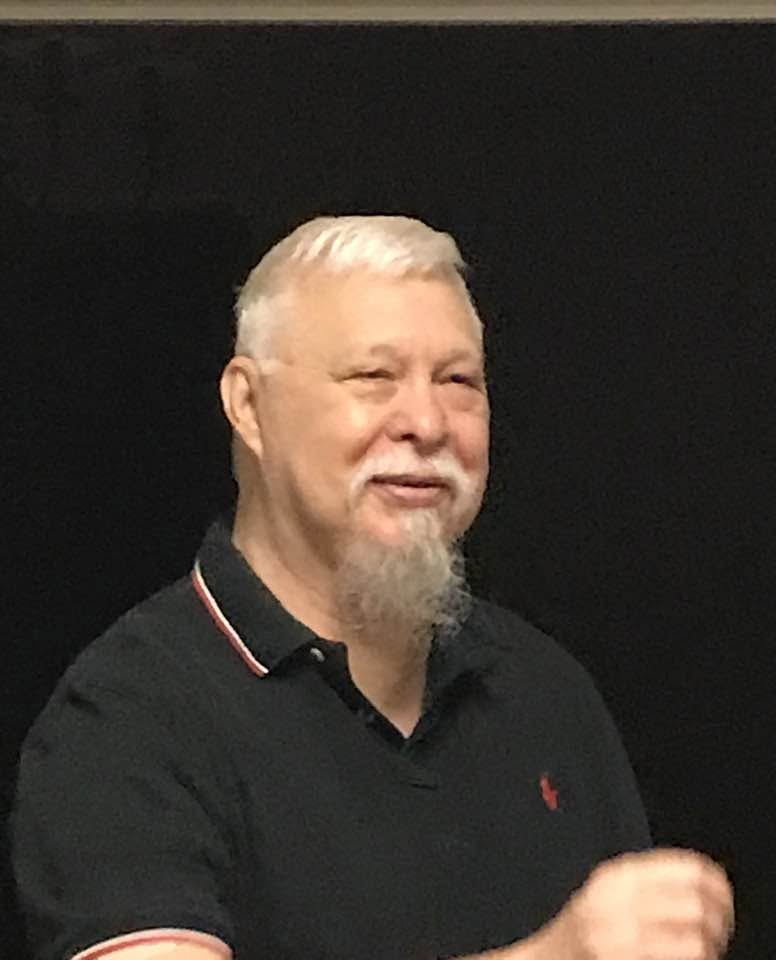
Sam’s Story
In 1985, a man named Sam DeLoach spent four days in a coma, and during that Fear Coma Experience (FCE) he went to hell. He has told the story more than thirty years later, still shaken by it, and he believes to this day that what he saw was real. This is an examination of what actually happened to him, because his account turns out to be one of the clearest examples on record of a particular kind of experience, one that has nothing to do with the afterlife and everything to do with what the human brain does when the body is dying.
How Sam got to that hospital bed matters, so it is worth telling briefly. Sam was a diabetic. He was also, in that season of his life, a man on fire with a religious burden. After a stirring sermon on hell, he began praying to feel more deeply for those he believed were bound for it, and he decided to fast in order to intensify that prayer. He had read that Jesus fasted for forty days, and though he knew he could not do anything like that, he resolved to go five days without eating or drinking anything at all.
He did not know that a body cannot survive roughly three days without water, and that for a diabetic the danger arrives faster and harder than that. As the days passed his lips cracked and his tongue stuck to the roof of his mouth, until he finally had to break down and drink. But the damage was already underway. He grew violently ill, unable to keep anything down, throwing up through the night while a desperate thirst drove him to keep drinking water he could not hold. By the time a few days had passed he could barely see. His family loaded him up and got him to a hospital, and a doctor leaned over him and said he was going to give him something to settle his stomach.
Sam never heard the end of the sentence. That is where his experience begins.
The Drop
The last thing Sam heard from the living world was a doctor trying to help him. He had made it to the hospital barely able to see, his body days into a crisis it could no longer manage, and a physician stood over him and said he was going to give him something to settle his stomach. Sam never heard the end of it. As the doctor was still speaking, mid-sentence, Sam slipped into a coma. He would not surface for four days.
What happened in that instant is the hinge of this entire account, so it is worth being precise about it. Sam did not fall asleep, and he did not die. His heart never stopped. There was no flatline, no team working to bring him back, no crossing to any far shore. His body, poisoned by days without water and the runaway chemistry of diabetic ketoacidosis, simply shut his conscious mind off and dropped it into the dark. This is the coma-state, and it is the necessary ground for everything that follows. His brain did not go quiet when the lights went out. It went to work.
And the place it built was not gentle. Sam describes it as being dropped into a whole different realm, something he says he could never have imagined, and the sensation of hitting the ground when he arrived. There was no easing into it. One moment a doctor was speaking to him in an emergency room, and the next he was on the floor of somewhere else entirely.
The first thing he saw there was violence. One figure struck another so hard that Sam watched the imprint of the fist come through the other man’s back, and he remembers the blood. And beneath the violence there was a sound, a tone that rose and fell and rose again like a wave, over and over. As it climbed toward each peak, he felt something climb with it: a swelling hatred, a crescendo of rage, a compulsion pushing him to do violence to anyone he could find. He says he did not act on it himself, but he watched others driven by it, and he felt it pulling at him the whole time.
Hold onto that detail, because it is not a random horror. It is the first clear fingerprint of what a Fear Coma Experience actually is, and we will come back to what that rising tone and that manufactured rage are really telling us. For now, understand only this: Sam was not somewhere. Sam was in the dark inside his own shutting-down body, and his brain had already begun building.
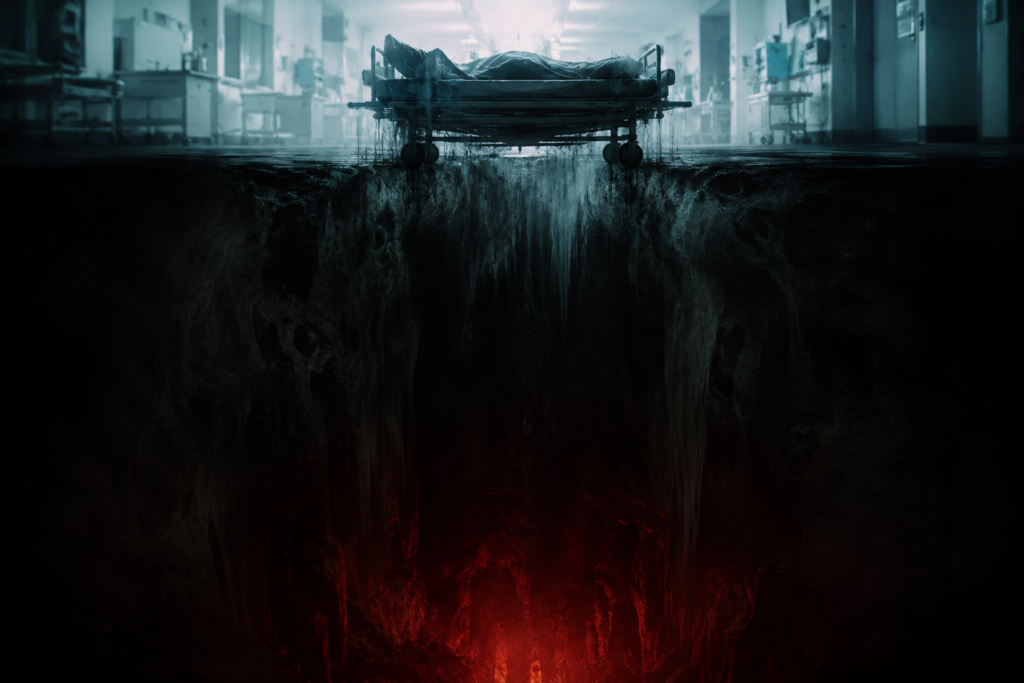
The Red Glow And The Lava
As Sam took in where he was, the place resolved into something he could describe, and every piece of it belongs to the oldest human picture of hell. It was dark, lit by a dull red glow that hung over everything. There was lava. And there were people, suffering, in a landscape built for suffering.
One detail here is worth pausing on, because it tells you something about how the mind assembles these places. Sam says he could see the lava, but he did not feel its heat, and he is grateful for that, because he does not believe he could have endured it if he had. Think about what that means. A brain building a hellscape reaches for the most iconic image of torment it has, fire and molten rock, and paints the scene with it. But Sam’s body was lying still in a hospital bed. It had no burns to report, no heat to transmit, and so the lava is there to be seen but not to be felt. The imagery is drawn from what the mind already knows hell is supposed to look like, assembled from cultural memory rather than from anything actually happening to his body. That is exactly how a Fear Coma Experience is built.
Only once in that place was Sam touched. It came when he broke down and begged for mercy, and mercy was refused. The single moment of contact in the entire landscape was the moment his plea was denied. He came to believe afterward that it was meant to show him how it felt to be there, the vulnerability of pleading and being met with nothing, at the same time that the place itself was flooding him with the anger and the urge to lash out that he had felt from the first moment. Helpless and enraged at once, begging and refused. It is a portrait of total powerlessness, and powerlessness is the emotional core of the coma-state, where the mind cries out and the body cannot answer.
Everything Sam saw here, the red glow, the lava, the tormented figures, the refused mercy, is describable. It is frightening, but it is familiar. It is built entirely out of images a person raised on sermons about hell already carries. And that familiarity is not a weakness in his account. It is the tell. A Fear Coma Experience assembles its terrors from the world the brain already knows, which is exactly why Sam can describe every piece of it in plain and recognizable terms.
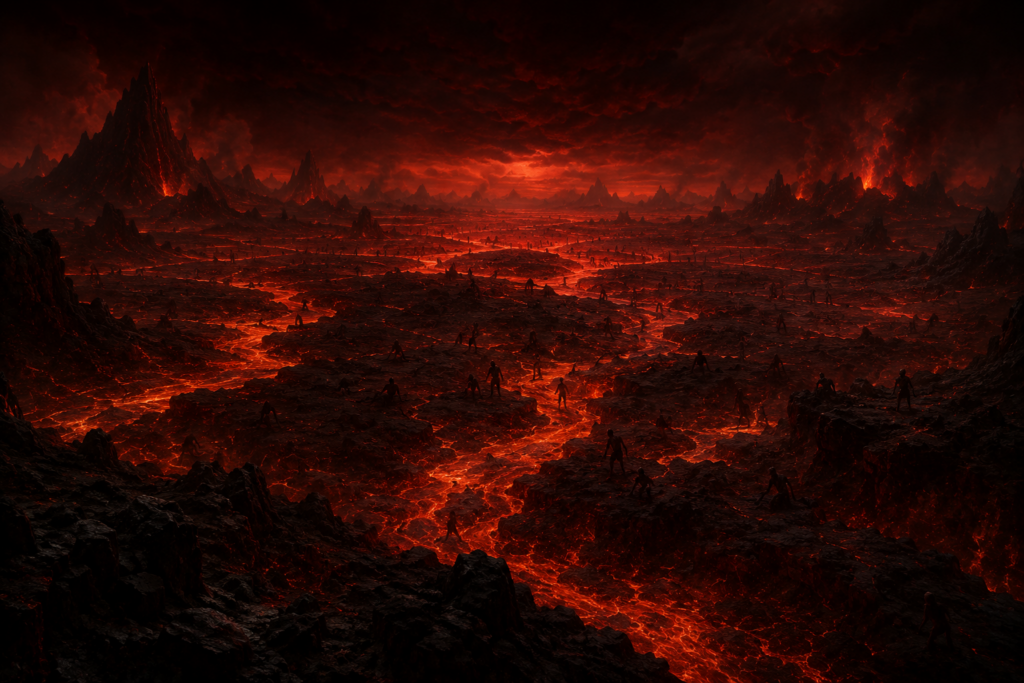
The Thirst
Of everything Sam describes, this is the detail that matters most, and it is the one that quietly proves what kind of experience he was having.
Running through the whole place was a thirst. Not an ordinary thirst, but a horrible, total, all-consuming craving that he says you wanted quenched with every fiber of your being. Everyone there felt it. And the place tormented them with it. Sam remembers walking through what looked like a small stream of water, except it was not water, and it gave no relief. It seemed to be there for no reason except to torture the thirsty with the sight of the thing they could not have. He says he cannot impress upon you the level of thirst those in that place felt.
Now remember how Sam got there. He was a diabetic who went five days intending to take in no food and no water. He did not know about the rule that a body dies after roughly three days without fluids, and that for a diabetic in ketoacidosis the danger comes faster still. By the time he reached the hospital, his body was in genuine, extreme, life-threatening dehydration. His lips had cracked. His tongue had stuck to the roof of his mouth. He was, in the most literal physical sense, dying of thirst.
And so was everyone in his hell.
This is the whole thesis of the Fear Coma Experience captured in a single image. Sam’s brain, shutting down inside a severely dehydrated body, did not invent its torment out of nowhere. It built the fear-scape directly out of the crisis the body was actually in. The defining agony of his hell, the unquenchable thirst and the mocking water that would not satisfy, is not a message about the afterlife. It is his own dying body, reporting its real emergency in the only language the coma-state had available. The brain took the single most urgent physical fact of Sam’s situation, a desperate need for water, and rendered it as a landscape of eternal thirst.
A place of punishment chosen by God would have no particular reason to center on thirst. A dehydrated brain building a nightmare has every reason in the world. Sam was not shown hell. Sam was shown his own dehydration, dramatized into a world.
No Way Out
Sam says the worst thing about that place was not the violence, or the lava, or even the thirst. It was something quieter and more total. It was that you simply accepted it as your reality.
He puts it in a way that is hard to shake. Here, he says, we do not question whether we exist or where we are. We just know that we are. In that place it was the same. He did not stand outside it wondering if it was a dream or asking when it would end. He knew, with the flat certainty we reserve for the most basic facts of waking life, that this was where he was and that this was all there would ever be. And with that knowing came the thought that he would be there for all time.
That detail, the certainty of forever, is one of the signatures of the coma-state, and it is worth understanding why. Time does not work normally in a coma. Sam was under for four days, but he describes the experience as going on and on, one long continuous nightmare with no breaks and no horizon. When there is no day and no night, no beginning that you can remember and no end that you can see coming, the mind fills that void with the only conclusion available to it: this is permanent. This is eternal. The sense of being trapped forever is not evidence that the place was eternal. It is evidence that Sam was in a state where time itself had come loose.
And then he names the cruelest part of all. Here, he says, death is an escape. There, there was no escape. In ordinary life, no matter how bad things become, there is always the knowledge that suffering ends, that the body gives out, that there is a door. In Sam’s hell that door was gone. He was already past the place where death could release him, locked inside a nightmare his own brain would not stop generating, with no exit he could find and no end he could imagine.
This is the entrapment at the center of every Fear Coma Experience. The brain, sending its signals into a body that will not respond, does not conclude that help is coming. It concludes that there is no way out, and it builds that conviction into the very architecture of the place. Sam did not visit an eternal prison. Sam was in a mind that had lost its sense of time and its certainty of rescue, and had turned that loss into a world without doors.
The Sound That Brought Him Back
Sam did not choose to leave that place. No one came to lead him out of it. There was no light at the end of a tunnel, no loving presence, no voice telling him it was not his time, none of the things that mark a genuine crossing and a genuine return. What pulled Sam back was a sound.
Beep. Beep. Beep.
It was his heart monitor. As his body climbed back up out of the coma, the steady electronic pulse of the machine at his bedside broke through into the nightmare, and Sam surfaced to it. The first thing waiting for him on the other side of that endless hell was not the memory of a divine encounter. It was a hospital room, a heart monitor, and a body so exhausted that all he wanted was to sleep.
Look closely at how he came back, because it is the mirror image of how he went under. He fell into the coma mid-sentence, while a doctor was speaking, the real world dissolving into the fear-scape. He came out of it the same way, the real world reassembling itself out of the beep of a monitor. At both ends, the boundary between the room and the nightmare is porous, the physical world bleeding in and out of the experience. That porousness is one of the surest signs of a coma-state experience rather than a journey anywhere. The machine was always there. The bed was always there. Sam never left them.
And notice what was absent. In an authentic near-death experience, the return is almost always marked: a reluctant turning-back from a place of peace, a border not crossed, a choice made, a being who sends the person home. Sam had none of that. He simply rose toward consciousness as his body stabilized, and the ordinary sound of a machine doing its job reached down and pulled him the rest of the way. That is not a soul returning from the other side. That is a brain coming back online.
There was one thing Sam brought back with him, and it was not peace. It was fear. He woke exhausted and wanted nothing more than to sleep, but he was terrified to close his eyes, afraid that if he did he would end up back in that place. That terror is the last and most telling detail of the coma itself, and it points in exactly one direction. People who return from a real near-death experience come back unafraid. People who return from a Fear Coma Experience come back frightened, sometimes for years. Sam woke from four days in hell too scared to fall asleep, and that fear is the signature of what he had actually been through.
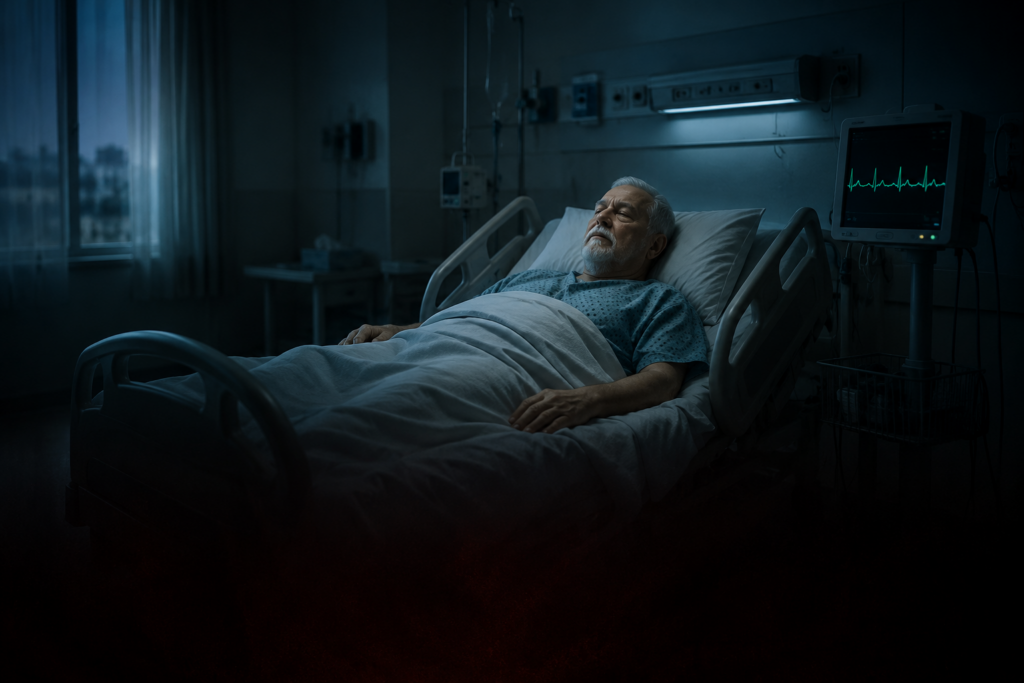
Clear Cut FCE Example
Sam DeLoach’s account was run through the same internal evaluation framework used to assess every experience examined here, and it scored a 91 out of 100, as high as any case yet reviewed. This is about as clean and clear-cut a Fear Coma Experience as exists. There is no ambiguity in it, no contamination, and nothing that pulls in a different direction.
What makes it so clean is that every element lines up and nothing works against it. The coma is real, sustained, and medically explained from the inside: a diabetic who went five days without food or water, drove his body into ketoacidosis, and slipped under mid-sentence in the emergency room while a doctor was still speaking to him, staying there for four days. The content is pure fear from beginning to end, the dark red glow and the lava, the ambient drive toward rage and violence, the refused mercy, and above all the unquenchable thirst that maps precisely onto the severe dehydration his body was actually in. The experience is vivid and durable, recounted in unflinching detail more than three decades later. And the exit is not a crossing but a return to a hospital room and the beep of a heart monitor, followed by a man too frightened to fall back asleep.
Just as important is what is absent. Nowhere in those four days is there a single marker of a genuine near-death experience. No life review, no out-of-body perception, no tunnel, no meeting with the departed, no encounter with a loving presence, no peace of any kind. There is no flatline and no clinical death, and the account was self-recorded with no interviewer feeding him a framework to fill in. It is fear, manufactured by a shutting-down brain out of the body’s own crisis, start to finish. That combination, a real and well-explained coma, wall-to-wall fear content built from the body’s actual physical emergency, complete durability across decades, and the total absence of any near-death element, earns its 91 out of 100 and makes Sam’s story one of the cleanest textbook examples of a Fear Coma Experience on record.
A Textbook Case
Sam DeLoach believes he went to hell. He says so plainly, and he leaves the judgment to you: either it was the longest and most horrible dream anyone could imagine, or it was real, and he was really there. He has carried it for more than thirty years, and he is certain of what it was.
But look at everything his own account gives us, and a different and far more consistent explanation comes into focus. Sam did not die. His heart never stopped. There was no flatline, no resuscitation, no crossing to any other side. What happened to him has a clear and documented cause: a diabetic who went five days without food or water, drove his own body into ketoacidosis, and collapsed into a four-day coma in a hospital bed. That is not the doorway to the afterlife. That is a specific, survivable medical event, and Sam came back from it because his body was stabilized, not because he was sent back from anywhere.
And everything he saw inside those four days is exactly what a Fear Coma Experience produces. The terror built from familiar images of hell. The rage and violence with no source outside his own skull. The refused mercy, the sense of being trapped forever with no escape, the loss of any grip on time. And at the center of it all, the thirst, the one detail that gives the whole thing away, because it is not a message about eternity. It is a dehydrated body screaming its real emergency up into a shutting-down mind, which dressed that emergency in fire and lava and called it hell. The nightmare was assembled, piece by piece, out of Sam’s own dying physiology and the picture of hell he had carried since childhood.
Just as telling is what never appears. In four days inside that place there is not one feature of a genuine near-death experience. No life review. No leaving the body and looking down on it. No tunnel, no light, no reunion with the departed, no loving presence, no peace. Nothing that the thousands of documented near-death accounts share in common shows up anywhere in Sam’s. What he experienced was fear, and only fear, from the moment he dropped in to the moment the heart monitor called him back. And he woke from it not transformed and unafraid, the way people return from a true crossing, but terrified to close his eyes.
This is why Sam’s story matters, and why it belongs on the record. It is one of the cleanest examples there is of what a Fear Coma Experience actually is. A real coma, with a real and understood cause. A hellscape built entirely from the body’s crisis and the mind’s inherited images. No death, no return from the beyond, and not a single near-death marker anywhere in it. Sam did not visit hell. Sam’s own brain, poisoned and dehydrated and shutting down, built one for him and made him live in it for four days. Understanding that does not make what he went through any less real or any less terrifying. It simply tells the truth about where it came from. It came from him.
Transcript:
Hello, my name is Sam DeLoach. This is my first attempt at ever making a video for YouTube, but the subject I’m going to be speaking on is a little frightening, and I think it’s one that a lot of people worry about, because it deals with people in a coma and whether or not they actually experience heaven or hell.
My experience took place in 1985. I’d been going to a revival. Not that I went to church much back then, but the preacher gave a very stirring sermon on hell, and I started praying for a greater burden for those who are going to hell. A friend of mine who went to the church regularly told me that the following week they would have a week-long revival. So this was Sunday, and I decided that I would start fasting and praying that I might have a greater burden for those that are going to hell.
Now, I’m a diabetic, and you know, I’d read in the Bible about Jesus fasting for forty days. I don’t know if he went on a complete fast or if it was just a partial fast, and what he could do none of us could do anyway. And I, like a fool, decided I would go five days without eating or drinking, without knowing that there’s a three-day rule: that if you don’t drink for three days, you die. When you’re diabetic it’s even worse, because your body builds up something called ketones and you go into ketoacidosis, which is quite deadly.
During that week I fasted, and by Wednesday my lips were cracked, my tongue stuck to the roof of my mouth and my teeth, and I couldn’t bear it. So I prayed to God and told him I had to drink. It probably saved my life. So I started drinking, but I still didn’t eat.
The following night, Thursday night, I went to bed, and later on that night I had a dream that this voice told me something. Soon something was going to happen, something that, he didn’t say it, but I felt it was going to be monumental. So the next day was Friday, and that night me and my friend went to church, and I thought something great was going to happen that night at church, without realizing that it was more me that wanted people to see it than what God really had in mind.
After I left church that night, I was disappointed, and my stomach really began to hurt. So I decided when I got home I would eat, even though it hadn’t been five days. I remember cooking something. We, down south, call them corn dodgers, or hush puppies, and they’re quite greasy because they’re fried in grease. After eating them, my stomach only hurt worse.
A little later that night I started throwing up. I threw up throughout the night, and even though I didn’t eat, my thirst was so great that I constantly drank water. After I’d thrown up the corn dodgers, there was only water and this horrible-tasting bile. This went on through Saturday. Saturday night, and by Sunday morning, I could hardly see.
At the time my vehicle was broken down, so I told my wife to go get my parents. They lived across the field. We lived on the farm. And I had them take me to a hospital. I hardly even remember going to the hospital. This one still bothers me. I’m going to try to get through it.
When I got to the hospital, I remember the doctor telling me, “I’m going to give you something for your stomach. It’ll settle it down.” As he was telling me that, I slipped into a coma.
When I slipped into a coma, it was like I dropped into a whole different realm, something I couldn’t even have imagined. As soon as I hit ground in that realm, the first thing I saw was one person hit another person so hard I could see the imprint of his fists come out of the guy’s back, and I remember blood coming out.
While this was going on, there was this sound, and it would go up in volume and down in volume, up and down, much like a sine wave. Whenever it would be going up, the anger inside of you would build like a crescendo, and it just went on and on, driving you to feel hatred and to have a desire to visit as much violence on whomever you could find. Although I didn’t do it, I watched other people do it.
This place was dark, with a red glow. There was lava, and thank God I didn’t feel the pain from the lava. I don’t think I could have stood it. Only once was I touched, and that was when I begged for mercy and it wasn’t shown. I think it was to give me an idea of how vulnerable you felt, and at the same time you felt so angry that you wanted to fight.
One thing I remember was a thirst. A horrible thirst, a thirst that you just wanted quenched with every fiber of your being. I actually remember walking in what appeared to be water, in a small stream, only it wasn’t water. It seemed like it was just there to torment those who were there, for everyone was thirsty. And I can’t impress on you the level of thirst those there felt.
Perhaps the worst thing about being in this place was that you just accepted that it was your reality. Just as we here accept this: we don’t question “am I here,” we just know we are. And I knew I was there, with the thought that I would be there for all time. This went on for days. It was like one long, horrible, continuous nightmare. You know, here death is an escape, but there, there was no escape. It was unbelievably horrible.
After three days of being here, it’s like it shifted, and I saw two things that at the time I didn’t understand. One was this beautiful woman standing before me. We were on a road. There was a little small house with a pond behind it, off to our left. As she approached me, this beautiful place suddenly changed. It was like filth was everywhere, and she changed, and suddenly I knew she was a witch. I tried to impress on her how dangerous what she was doing was. She didn’t change into an ugly woman, a hideous-looking woman, until after I mentioned that she was a witch. Her hair went from being raven black to black with streaks of grey all in it.
And then suddenly I saw something else that I couldn’t understand at the time. It was this woman, young, draped across this man, with a look in her eyes that at the time I couldn’t understand, but I do now. The look in her eyes was what you see when someone looks into the camera. It was like the camera was able to seduce her, and today, as you know, porn is all over the internet, and I think that’s what I was getting a foretelling of. And this was back in 1985. I saw where the world would eventually be.
The next thing I heard was this beep, beep, beep. It was my heart monitor, as I was waking up. When I woke up I was as tired as I could possibly be. Although I’d been in a coma for four days, I wanted to go back to sleep, but I was so scared that I’d end up back where I was.
So I called a preacher. I told him what happened, and he said, “Son, you were in hell.” And I begged him to pray for me, and he did. And that comforted me, and I fell back asleep, and I slept all night.
During that night, I don’t know if it was a dream or if I was really there, but I was in the most beautiful place you could possibly imagine. Unlike the other place, water was everywhere, real water, instead of it being where you could only see feet with this dull red glow everywhere. Everything was vibrant and green, and I remember thinking, “This is the place I always wanted to be.” And as I thought that, I heard a voice. It seemed to come from the sky, and it said, “Whenever you have a need, whatever you need, I’ll give it to you as you need it.” “Now, as you need it” was emphasized.
Soon after that I woke up. A nurse came in and told me I’d be able to be unplugged from the heart monitor in a little while, and that made me very, very happy. Shortly after that, though, I got a phone call. I answered it, and the voice on the other end said, “Mr. DeLoach, this is the billing department of the hospital you’re in. Do you have a job?” First it was insurance, and I said, “No, I don’t have insurance.” “Do you have a job?” Again I said no, because not too long before that I’d lost my job. Then she said, “Well, your bill was almost five thousand dollars. How are you going to pay for it?”
I had no idea. At the time, five thousand dollars seemed like an insurmountable sum. I slammed the phone down, wondering why, after I came right out of a coma, they would bother me with something which at the time seemed so trivial. And then I remembered the dream from the night before, and it was like God had told me. So I got angry and I said, “Well, I guess the dream meant nothing.” I was kind of aiming it at God.
Just a short while later the phone rang again. I picked it up, and it was the same voice. “Mr. DeLoach?” “Yes,” I said curtly. The voice on the other end then said, “You don’t have to worry about your bill. It’s been paid in full.” I couldn’t believe it.
Since that day, any time I’ve ever had a need, that need’s been met, far and above what I dreamed possible. Now, you might think, “Well, that seems too good to be true,” but if you read scripture, over and over and over this promise is made by Jesus to those who love him and who accept him as their Savior, because he died on that cross so that me and you would never have to go to that place. He gave us so many promises. “Seek ye first the kingdom of God, and all these things shall be added to you.” All these things were all the things we worry about in life, like food, clothing. The promises, if we believe them and act on them, are there for all of us.
I’ve had ministers tell me that it’s not possible for us to go to hell or to heaven. Well, then I was in the longest, most horrible, continuous dream than anyone could ever imagine, or else I was really in hell. You be the judge.
I don’t care how this experience came about, but I know that I prayed for a burden, a greater burden for those going to hell. But I never knew, when I began fasting and praying in earnest for this, that I would learn it in such a manner.
So for all of you listening, take heed, and know that when it’s over here, it’s only just beginning there. Here, if we’re lucky, we may live a hundred, or maybe a little over a hundred years, but eternity has no end. Here we have a choice. There we don’t.
Thank you.
Want to go deeper? Don Winner brings decades of intelligence and investigative experience to the biggest question there is: what happens when we die.
In You’re Going to Die Someday, Right? Near-Death Experiences Reveal What Happens Next, he examines the evidence from thousands of near-death experiences to find out what they actually tell us about consciousness, the soul, God, and the afterlife.
In Hell Exists, But Only for the Living, he investigates where our idea of hell came from and who built it, tracing the doctrine back to its human sources.
Get your copy of You’re Going to Die Someday, Right? or Hell Exists, But Only for the Living.