
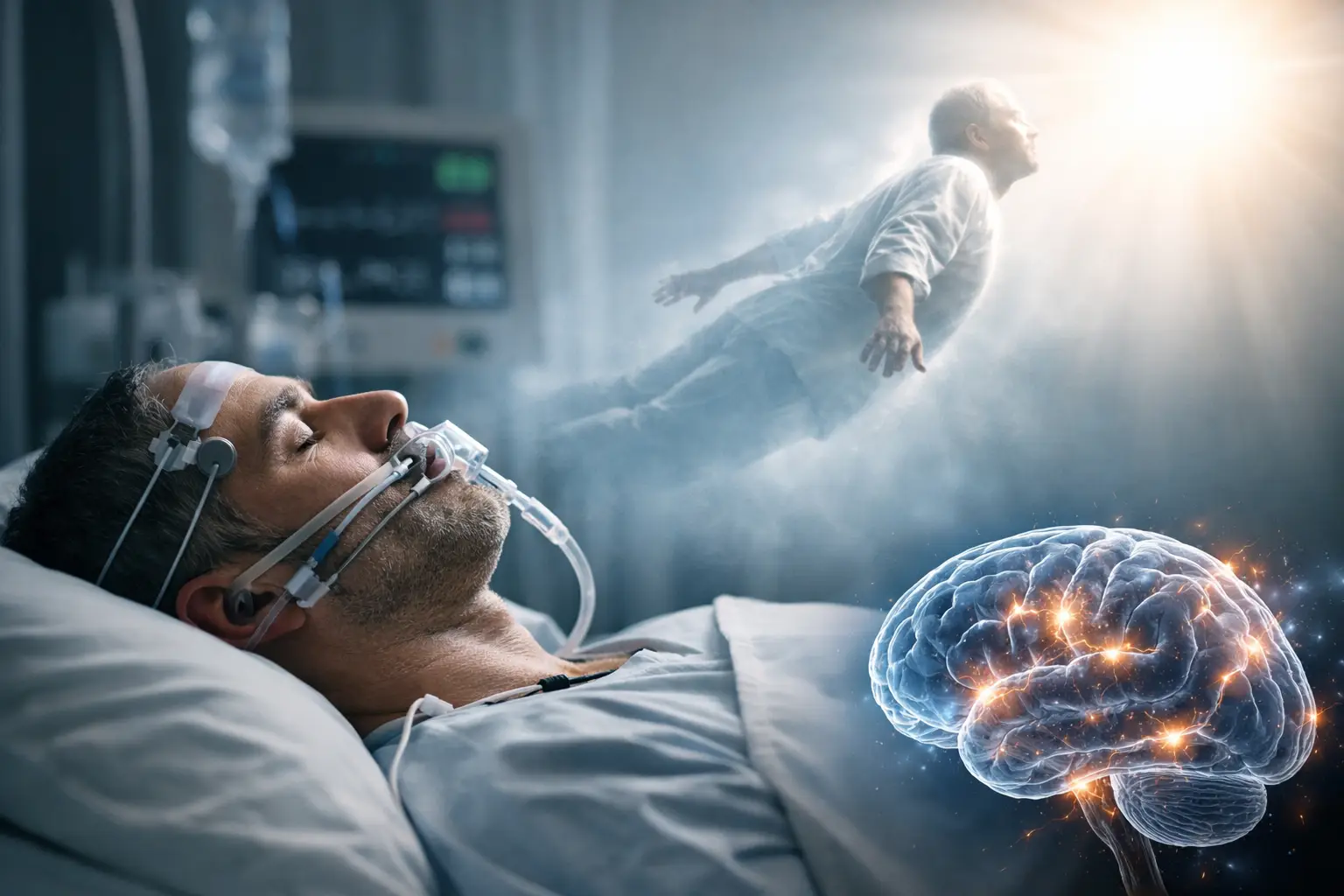
A patient reports a conversation from a hospital corridor, identifies equipment used during a resuscitation, or describes a scene above the operating room that no functioning set of eyes could have seen. Later, parts of the account are checked against the record and against witnesses. Those are not comforting stories. They are NDE medical anomalies, and they create a direct evidentiary problem for the claim that consciousness is merely what a living brain does.
The problem is not that medicine has failed to name every chemical involved in crisis. Medicine should study chemistry. The problem is far more basic: when perception is reported during genuine clinical death, and the reported perception is later verified, the materialist explanation has no adequate place to put the witness.
That is why the strongest NDE evidence is not a tunnel, a light, or a feeling of peace, however common and meaningful those features may be. The load-bearing evidence is veridical perception: accurate information obtained when ordinary sensory access was unavailable.
Why NDE Medical Anomalies Matter
Skeptics often respond to near-death experience reports with a bag of familiar explanations: oxygen deprivation, medication, anesthesia awareness, confabulation, expectation, and memory distortion. Each can describe something that happens to a living, impaired brain. None explains a verified observation made from a perspective the patient could not physically occupy during documented clinical death.
This distinction is not academic. It separates an event that challenges the survival question from one that does not. An authentic NDE occurs during genuine clinical death. It is often peaceful, coherent, and marked by a sense of separation from the body. Most importantly, it can contain information that can be checked.
A vague report is not proof. A report recorded long after the event, with no opportunity to compare it to independent facts, has limited investigative value. But when the timeline is medically documented, when the patient had no normal access to the information, and when independent witnesses confirm specific details, the case moves out of the realm of personal interpretation. It becomes an anomaly.
An anomaly does not mean every detail is beyond dispute. Investigators should test the timing, ask what the patient knew beforehand, distinguish broad statements from specific observations, and examine whether later conversation could have supplied the information. That is not hostile skepticism. That is how serious evidence is protected from wishful thinking.
The Anomalies Are About Timing and Access
The central question is brutally simple: when did the person know what they knew, and how could they have known it?
During cardiac arrest and aggressive resuscitation, the body is not participating in an ordinary conscious moment. The patient may be unconscious, intubated, sedated, immobilized, or under conditions where ordinary hearing and sight are severely limited or unavailable. Yet some accounts include accurate details about actions, remarks, objects, or events outside the patient’s physical line of access.
The timing matters because a skeptic can always relocate an experience to an earlier or later period if the medical record is ignored. Perhaps the patient heard something before losing consciousness. Perhaps they reconstructed a scene after waking. Perhaps a staff member casually revealed a detail. Those possibilities must be considered, not waved away.
But they are not universal escape hatches. A well-investigated report can rule out ordinary access with a level of specificity that forces the real question back onto the table. If the account contains independently confirmed details from the resuscitation period or from a remote location, saying “the brain made it up” is not an explanation. It is a refusal to explain the data.
There is a difference between a theory and a label. Calling a verified observation a hallucination does not show how a hallucination acquired correct, inaccessible information.
Clinical records are not decoration
Medical documentation provides the backbone for this inquiry. A credible investigation compares the account with timestamps, procedure notes, staff recollections, monitoring data, and the physical layout of the setting. It asks whether a claimed observation matches what actually occurred, not what usually occurs during a code.
That standard cuts both ways. It can weaken a dramatic story when the details do not hold up. It can also strengthen a report when the facts line up in ways the witness should not have been able to manufacture. Winner NDE favors that second kind of discipline over the lazy habit of treating every moving story as equally evidential.
The point is not to demand impossible perfection from people emerging from catastrophe. Human memory is imperfect. The point is to identify the accurate elements that survive verification. A witness can misremember a color, sequence, or phrase while still correctly reporting a highly specific event beyond ordinary access. Investigators should separate those issues rather than use a minor discrepancy as permission to discard the entire case.
The recovery anomaly
Some NDE reports also involve abrupt changes that are difficult to reduce to expectation alone: a powerful loss of death fear, durable shifts in priorities, unexpected emotional healing, or a settled conviction that life continues. These changes are meaningful, but they are not the primary proof.
People can be transformed by dreams, illness, grief, religious conversion, and trauma. A changed life tells us an experience mattered deeply. It does not by itself establish where the experience occurred or what it revealed.
Veridical perception is different. It offers an external point of contact. The account reaches into the observable world and gets something right that should have been unavailable. That is where NDE research stops being merely therapeutic or spiritual and becomes a challenge to the reigning model of mind.
The Error Behind “Distressing NDEs”
The field has created needless fear by throwing two radically different events into one bucket. The old phrase “distressing NDE” is an error of classification. Hellish imagery, terror, pursuit, punishment, grotesque scenes, and unbearable dread can be real experiences. The witnesses are not lying. But such accounts are not authentic NDEs when no clinical death occurred.
They are Fear Coma Experiences, or FCEs: terror experiences generated in a living brain under catastrophe. Coma, delirium, severe illness, injury, and extreme physiological stress can produce vivid nightmare worlds with no clock, no stable logic, and no reliable boundary between internal terror and external reality. Hell is real in that sense. It belongs to the suffering living brain, not the afterlife.
This correction matters enormously for readers frightened by hell accounts. A peaceful NDE and an FCE are not rival versions of the same destination. They are separate events with separate evidentiary profiles. An NDE follows genuine clinical death and may include verifiable perception. An FCE occurs while the person remains alive and can generate terror on a scale that feels eternal.
There is also a rare third category: the Welded NDE. In a prolonged medical catastrophe, a person may experience both an FCE and a genuine NDE, then remember them as one fused sequence because there was no clock to divide them. The answer is not to call the whole account hellish or heavenly. It is to separate the components carefully and ask what happened during each phase.
A life review belongs only to an authentic NDE during clinical death. It is not an ICU delirium feature, an FCE feature, or a generic crisis-memory effect. Precision here is not wordplay. It prevents fear-based interpretations from contaminating the evidence.
What Honest Investigation Requires
The strongest position is neither blind belief nor reflexive dismissal. It is a clear hierarchy of evidence. Reports with medical timing, independent corroboration, specific inaccessible details, and prompt documentation deserve the greatest weight. Reports with unclear timing or broad symbolism may still matter personally, but they cannot carry the same evidentiary burden.
This is where reductionist criticism often fails. It treats every NDE report as though it were a private vision and then offers a brain-based explanation for private visions. But verified perception is not private in the relevant sense. Once a detail is checked and confirmed, the claim becomes public: this person knew something they should not have known.
That does not require us to pretend every unanswered question has been solved. We do not know every condition under which veridical perception occurs. We do know the anomaly is real enough to reject the easy claim that consciousness ends where measurable brain function ends.
For readers carrying fear, that is not a minor philosophical adjustment. It changes the emotional landscape of mortality. The evidence does not ask you to accept a doctrine under threat. It asks you to look carefully at what people report, what records establish, and what the conventional explanation cannot account for.
NDE medical anomalies are not proof because they are dramatic. They matter because, when properly verified, they place consciousness where the materialist story says it cannot be. That is a fact worth examining slowly, honestly, and without surrendering to fear.
Want to go deeper? Don Winner brings decades of intelligence and investigative experience to the biggest question there is: what happens when we die.
In You’re Going to Die Someday, Right? Near-Death Experiences Reveal What Happens Next, he examines the evidence from thousands of near-death experiences to find out what they actually tell us about consciousness, the soul, God, and the afterlife.
In Hell Exists, But Only for the Living, he investigates where our idea of hell came from and who built it, tracing the doctrine back to its human sources.
Get your copy of You’re Going to Die Someday, Right? or Hell Exists, But Only for the Living.