An ongoing investigation — Part One. Work in progress.
By Don Winner
I did not go looking for Michelle Ledbetter. What I found may be something far rarer — what I’ve started calling a Welded NDE (WNDE).
Yesterday morning I sat down to do something routine. I was searching for an experiencer account identified as a “distressing near-death experience.” It’s common for someone to describe a traumatic event in which they recount terrifying hellscape scenarios, have it labeled as an NDE, and move on. My plan was to hold it up against a framework I’ve been building and use it as a working example of what I call a Fear Coma Experience, or FCE — a fear-driven episode generated by a living, injured brain that gets mislabeled as a near-death experience because “NDE” is the only vocabulary most people have for it. I run these accounts through the framework to test it — to find out where it holds and where it breaks. Not to score points, and not to confirm what I already think. That morning I was expecting a routine case.
It was not a routine case. By the end of the day I had set everything else aside, pulled eight separate podcast interviews, parsed every one of them, sorted the whole thing out, and spent nearly an hour on the phone with Michelle herself.
This is my first report on what I found. It is not finished. It is not going to be finished for a while. I’m publishing it as a live investigation — the real thing, in motion, with the pieces still moving — because I think the process is worth showing, and because I want it on the record now, while there are still questions I can’t yet answer.
What a Welded NDE Actually Is
Here is my working conclusion, and I’ll spend the rest of this series testing it: I believe Michelle Ledbetter’s experience is not a simple NDE, and not a simple FCE. I believe it is both, fused together into a single unbroken memory. I’ve started calling this a Welded Near-Death Experience — a WNDE.
The equation I’m using is deliberately simple:
FCE + NDE = WNDE.
An FCE is what a terrified, living brain produces when the body has gone offline. Fear is the most primitive lever the brain has to force the body into motion — danger, terror, run. When the body can’t respond, because it’s in a coma or badly injured, the brain doesn’t give up. It ramps the fear higher. That’s where the “hell” comes from. It is not a place. It is a living brain screaming at a body that won’t answer.
An NDE is different, and it happens on the other side of an actual clinical death — the real markers that a damaged brain cannot manufacture.
A WNDE is what you get when one person experiences both, back to back, in a single event: hell first, then death, then the crossing into the NDE, and then — this is the part that makes it so rare and so disorienting — straight back into the body, and straight back into hell. Two opposite states, welded at the seam of the death itself. And for the person living it, the two halves are impossible to pull apart, because they are stored as one continuous experience.
That, I believe, is Michelle’s case.
Why her, and why this is rare
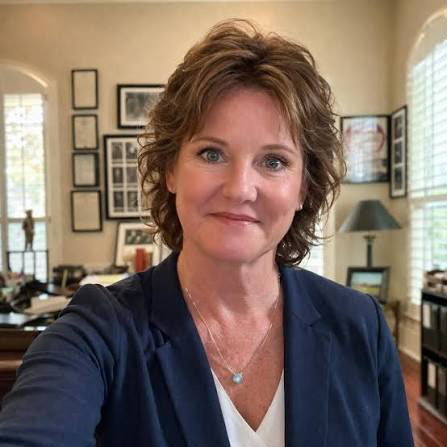
In February of 2019 Michelle Ledbetter — a traveling hospice nurse with decades of experience — was driving alone through a blizzard at night in the mountains, in an unfamiliar area, following a truck’s taillights over a pass. She went off the road. She suffered a burst fracture of her spine and a significant traumatic brain injury. She was taken to one hospital, then transferred to a trauma center for emergency surgery.
What she has described, across eight separate interviews over roughly a year and a half, is remarkably stable: a dark, cold place; overwhelming fear; a life review unlike ordinary memory; and colors she says do not exist in this world. She has told this story to eight different hosts, in eight different settings, including once from a prepared written statement — and the load-bearing pieces don’t drift. That consistency is one of the reasons I take her seriously. Consistency is the signature of someone recounting something real, not building something up.
The question nobody ever asked her
Michelle has been interviewed at least eight times by people whose entire platforms are built around near-death experiences. One host titled her episode with the word “DIES.” Another organization — the field’s own institutional body — presented her as a hellish near-death experience. And in eight interviews, not one person ever asked her the most basic question in the entire genre: did you actually, clinically die?
Not one.
So I asked her. On the phone, directly. And her answer is the reason I’m writing this series.
She said — and I’m quoting her — “It’s possible that they might have told me and I just forgot. Remember, I had a significant TBI at the time.”
She had never been asked. She had never thought about it that way. And she recognized, in that moment, that she genuinely does not know whether she died on that table, because she was unconscious and brain-injured through the exact window when it would have happened. If it occurred, the only people who witnessed it were the surgical and ICU staff — and a person with a serious head injury, in and out of a post-injury fog, is precisely the person who would not retain being told.
That is the heart of my working theory: I believe Michelle may have clinically died and been revived during her treatment, and simply was never told — or was told, and couldn’t hold onto it. The one document that would settle it is her medical record. She has agreed to obtain her complete records from both hospitals. That’s now in motion.
Who I am, and why I have no dog in this fight
When Michelle and I talked, she asked me a fair question — whether I come at this from a religious or spiritual angle. I told her the truth, in detail, and I’ll tell you the same.
My background is intelligence. United States Air Force intelligence and the National Security Agency. I was a Korean linguist and a Spanish linguist. I worked signals intelligence and I worked in Special Operations. I hold a master’s degree in Strategic Intelligence from the Defense Intelligence Agency’s college, where I graduated second in my class. After that I spent years as an investigative journalist, with work that ran on CBS 48 Hours, Dateline, NBC, the BBC, and Discovery ID.
I am not a believer building a case for heaven. I am not a skeptic building a case against it. What I am is a professional analyst who spent a career learning how to take a pile of messy, human, partial accounts and figure out what actually happened underneath them. I have no agenda here except the truth, and the method doesn’t care which way the answer comes out.
In fact, this entire framework grew out of me being told I was wrong.
In my first book I argued that hell, as a literal place, does not exist. That claim got pushback — real pushback, the kind that makes you go back and look again. So I did. I went back through the distressing accounts, the “I went to hell” testimonies, and I started asking what was actually generating them. That’s where the Fear Coma Experience (FCE) concept came from: the recognition that a living, injured brain can manufacture a convincing hell without anyone ever having died at all. The pushback didn’t soften my position. It sharpened it into a tool. And that same tool — built to take apart mislabeled accounts — is what flagged Michelle’s as something genuinely rare and genuinely real.
There is a real irony in that. I built a framework to take apart false claims of hell. It is the same framework now telling me Michelle’s case may be one of the most authentic welded experiences I have come across.
Where this stands
This is Part One. Here is what’s true as of today:
- I’ve collected and analyzed eight of Michelle’s interviews. The core account is stable across all of them.
- I’ve spoken with her directly. She’s a willing, thoughtful participant, and she grasped the framework immediately — it even explained things she’s witnessed for decades at the bedside, watching patients pass from agitation into peace.
- She is obtaining her complete medical records from both treating hospitals.
- I’ll be meeting her in person, soon. Specifically at the upcoming 2026 Annual Conference of the International Association of Near Death Studies (IANDS) in Bellevue, Washington.
And here is what I don’t yet know — the honest open question at the center of all this: did Michelle Ledbetter die on that table?
If the records say yes, then what she has is not a distressing NDE, and not an FCE mistaken for one, either. It’s a Welded Near Death Experience (WNDE) – a genuine crossing bracketed on both sides by a living brain’s terror – and it may be one of the cleanest examples of the phenomenon I’ve come across.
I don’t know the answer yet. That’s the point. Follow along.
More coming.
This is an ongoing investigation. Part Two will follow as new material comes in.
Want to go deeper? Don Winner brings decades of intelligence and investigative experience to the biggest question there is: what happens when we die.
In You’re Going to Die Someday, Right? Near-Death Experiences Reveal What Happens Next, he examines the evidence from thousands of near-death experiences to find out what they actually tell us about consciousness, the soul, God, and the afterlife.
In Hell Exists, But Only for the Living, he investigates where our idea of hell came from and who built it, tracing the doctrine back to its human sources.
Get your copy of You’re Going to Die Someday, Right? or Hell Exists, But Only for the Living.