
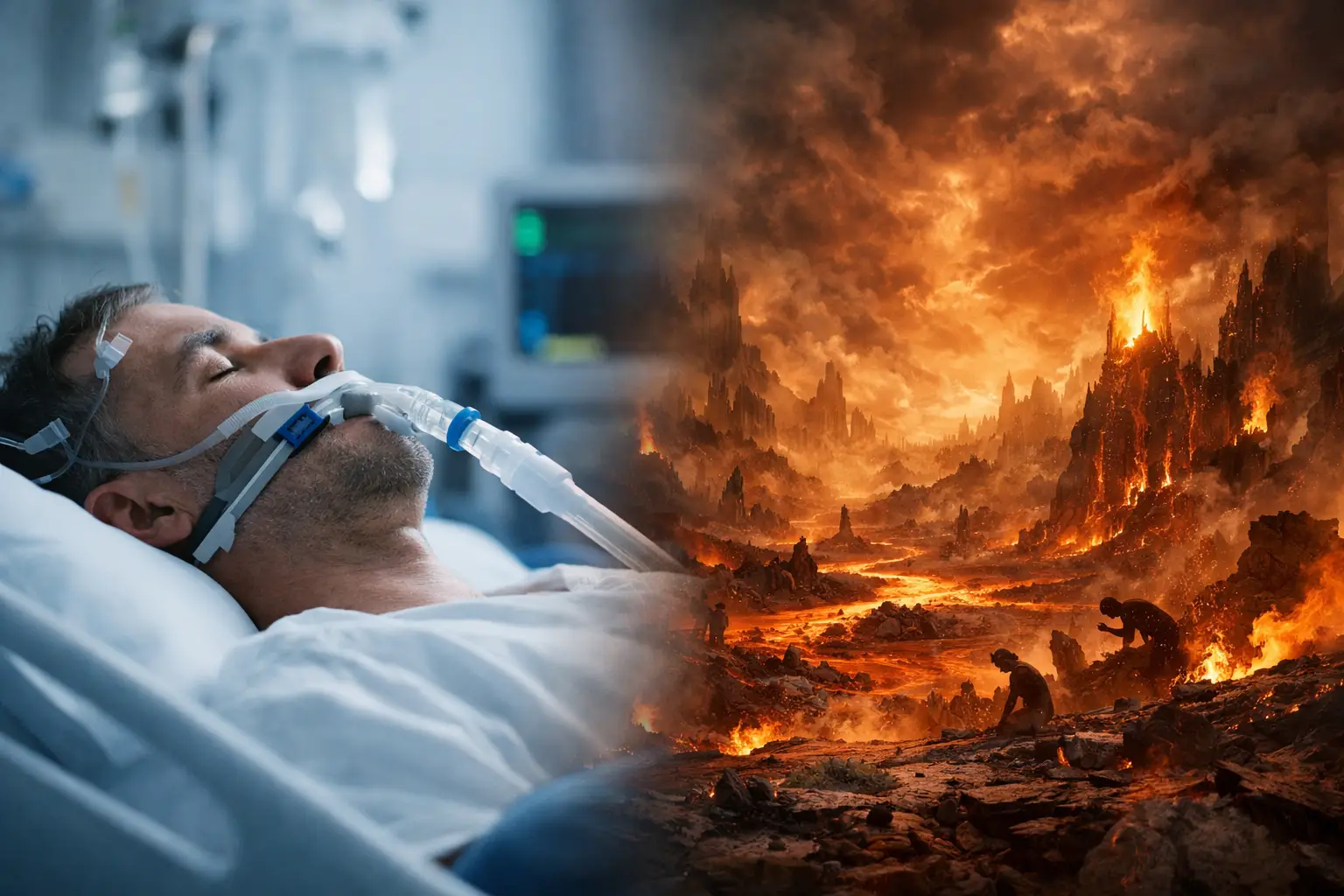
A person wakes from catastrophe convinced they have been tortured, judged, buried alive, or trapped in a place with no exit. The terror is not theatrical. It can remain more vivid than ordinary memory for decades. That is why coma creates hellscapes is not a casual question. It is a question with consequences for anyone afraid that death may contain punishment.
The answer is direct: a hellscape can be real as an experience without being a destination after death. When a living brain is under extreme physiological threat, disorientation, pain, isolation, medication effects, and fear can combine into a Fear Coma Experience, or FCE. The old label, “distressing NDE,” makes a serious analytical error. It calls a living-brain terror event an NDE, then treats the terror as evidence about the afterlife.
Those are not the same event. An authentic NDE occurs during genuine clinical death and can include verified veridical perception – accurate observations later confirmed despite the body being incapable of ordinary perception. An FCE is a catastrophe experienced by someone who has not died. Its imagery may be hellish. Its emotional force may be overwhelming. But its origin and evidential meaning are entirely different.
Why coma creates hellscapes in a living brain
Coma is not one uniform condition. It is a broad medical term covering profoundly reduced consciousness caused by injury, illness, oxygen deprivation, infection, organ failure, poisoning, or other crises. Some people remember nothing. Some emerge with fragments. Others report elaborate worlds of threat, captivity, infestation, attack, pursuit, or condemnation.
That variation matters. If coma automatically opened a window onto one external realm, we would expect a much tighter pattern. Instead, fear imagery shifts with the person’s surroundings, cultural material, bodily sensations, medical circumstances, and the specific chaos of their illness. A ventilator may become an instrument of assault. Staff conversations may enter a dream as hostile interrogators. A restrained arm may become imprisonment. Fever, darkness, interrupted sleep, and the loss of all control give fear an enormous canvas.
The brain in catastrophe does not calmly narrate events. It struggles to impose meaning on broken signals. It can convert pain into persecution, alarms into screams, and helplessness into a cosmic trial. That does not mean the witness is dishonest or weak. Quite the opposite. The witness is reporting what was experienced. The investigative task is to identify what kind of experience it was.
Fear is not merely an emotion added to a neutral scene. Under severe stress, it organizes the scene. It searches for agency, danger, and intent. A shadow becomes a captor. A procedure becomes punishment. A confused interval becomes eternity because the normal markers of time have collapsed. This is how a hospital room can become an underworld without the person ever leaving life.
The critical error behind “distressing NDEs”
The phrase “distressing NDE” has spread because it appears charitable. It says, in effect, that every intense experience near death belongs in the same basket. But charity is not analysis. Putting peaceful, evidential NDEs and terror-filled coma episodes under one label destroys the very distinctions the evidence requires.
An authentic NDE has a recognizable evidential profile: genuine clinical death, separation from the body, a coherent experience not driven by the body’s distress, and in the strongest cases, details that can be independently verified. The person may report peace, clarity, encounter, a life review, or a boundary. A life review belongs only to an authentic NDE during clinical death. It is not a feature of coma, ICU delirium, or an FCE.
An FCE has a different profile. The person remains alive while the brain and body are in a severe medical emergency. The account is dominated by terror, confusion, bodily threat, distorted time, unstable scenes, and nightmare logic. That does not make it trivial. Anyone who has endured one deserves compassion, not a skeptical shrug. Yet compassion does not require us to call the event proof of an eternal hell.
This is where a great deal of public fear begins. A reader hears a frightening story described as an NDE, assumes it reveals what happened after death, and then imagines that death itself may lead to torment. The premise was flawed before the fear even began. The account may describe a genuine FCE, not an NDE at all.
Hell is real, but it belongs to the living
That sentence can sound provocative until we define the terms. Hell is real in the sense that human beings can experience states of absolute terror, isolation, pain, guilt, and apparent hopelessness. War, torture, delirium, severe illness, and coma have produced them throughout history. Ancient accounts of descent into dreadful realms did not require a literal tour of the afterlife to arise. Human beings have always known catastrophe, fever, grief, injury, and the mind’s capacity to give fear a landscape.
The word “coma” itself carries a deep historical association with sleep-like unconsciousness. But coma is not peaceful sleep. It can be a medical battlefield. Modern clinical reports of delirium and post-coma memories make this plain: some survivors return with narratives that feel more concrete than waking life, even when those narratives are wildly at odds with the room, the staff, and the actual timeline.
The trade-off is that no single feature settles every case. A frightening memory after a medical crisis is not automatically an FCE simply because it is frightening. The timeline must be examined. Was there genuine clinical death? Was there evidence of perception beyond the body that could later be checked? Was the terror part of a longer living-brain episode before or after the death event? Serious investigation does not wave away anomalies, and it does not force every anomaly into a comforting category.
When one memory contains two events
A rare but crucial category is the Welded NDE. This is when a person experiences both a Fear Coma Experience and a genuine NDE in the course of one medical crisis, then recalls them as one continuous story because there was no clock available to separate them.
This possibility explains why some accounts seem internally divided: nightmare material marked by panic and bodily menace may sit beside a lucid, peaceful episode with characteristics of a genuine NDE. The correct response is not to declare the whole account false or to call the whole account a trip through hell. It is to separate the components with discipline.
Memory is especially vulnerable to welding during trauma. A person may move from an ICU terror episode into clinical death and an authentic NDE, then later remember a single sequence. The witness remains honest. The event remains extraordinary. But the interpretation must be precise. Fear belongs to the FCE portion. Evidential features belong to the NDE portion. Confusing them is how fear coma imagery gets smuggled into claims about the afterlife.
What this changes for people afraid of death
The reassuring point is not that terror experiences are imaginary. They are painfully real to the people who endure them. The reassurance is that they do not demonstrate a punitive universe waiting beyond death.
A living brain under catastrophe can manufacture an experience so convincing that it feels eternal. That fact should make us more careful with labels, not more afraid of dying. The strongest NDE evidence does not come from nightmare imagery. It comes from cases where consciousness reports accurate, verifiable information during genuine clinical death – evidence that cannot be reduced to an FCE because an FCE is, by definition, an experience of the living.
For readers carrying a frightening memory of their own, or the memory of someone they love, the first humane step is to stop calling it a sentence from beyond the grave. It may have been hellish. It may deserve years of patient processing. But it was not necessarily a glimpse of what comes next. Don Winner’s Hell Exists, But Only for the Living examines this distinction because getting it right replaces inherited terror with a testable, evidence-centered conclusion.
If fear has turned one terrible medical episode into a prophecy, do not let the label do more damage than the event itself. Ask what happened, when it happened, and what evidence separates catastrophe from death. That is where fear begins to lose its authority.
Want to go deeper? Don Winner brings decades of intelligence and investigative experience to the biggest question there is: what happens when we die.
In You’re Going to Die Someday, Right? Near-Death Experiences Reveal What Happens Next, he examines the evidence from thousands of near-death experiences to find out what they actually tell us about consciousness, the soul, God, and the afterlife.
In Hell Exists, But Only for the Living, he investigates where our idea of hell came from and who built it, tracing the doctrine back to its human sources.
Get your copy of You’re Going to Die Someday, Right? or Hell Exists, But Only for the Living.