For fifty years, near-death experience researchers have been staring at a category of data they call distressing NDEs — the frightening ones, the dark ones, the ones with terrifying landscapes and hostile entities — and they’ve been getting it wrong the entire time. Not a little wrong. Fundamentally wrong, at the level of basic classification. Today I’m going to show you the error, show you the case that exposes it, and tell you what’s actually happening.
I spent my career in military intelligence, and here’s the first thing you learn as an analyst: before you analyze the reporting, you validate the reporting stream. If two different phenomena are flowing into your collection under one label, every conclusion you draw downstream is contaminated. That’s not a small problem. That’s the whole problem. And it’s exactly what has happened with distressing NDEs.
Table of Contents
What the Researchers Say About Distressing NDEs
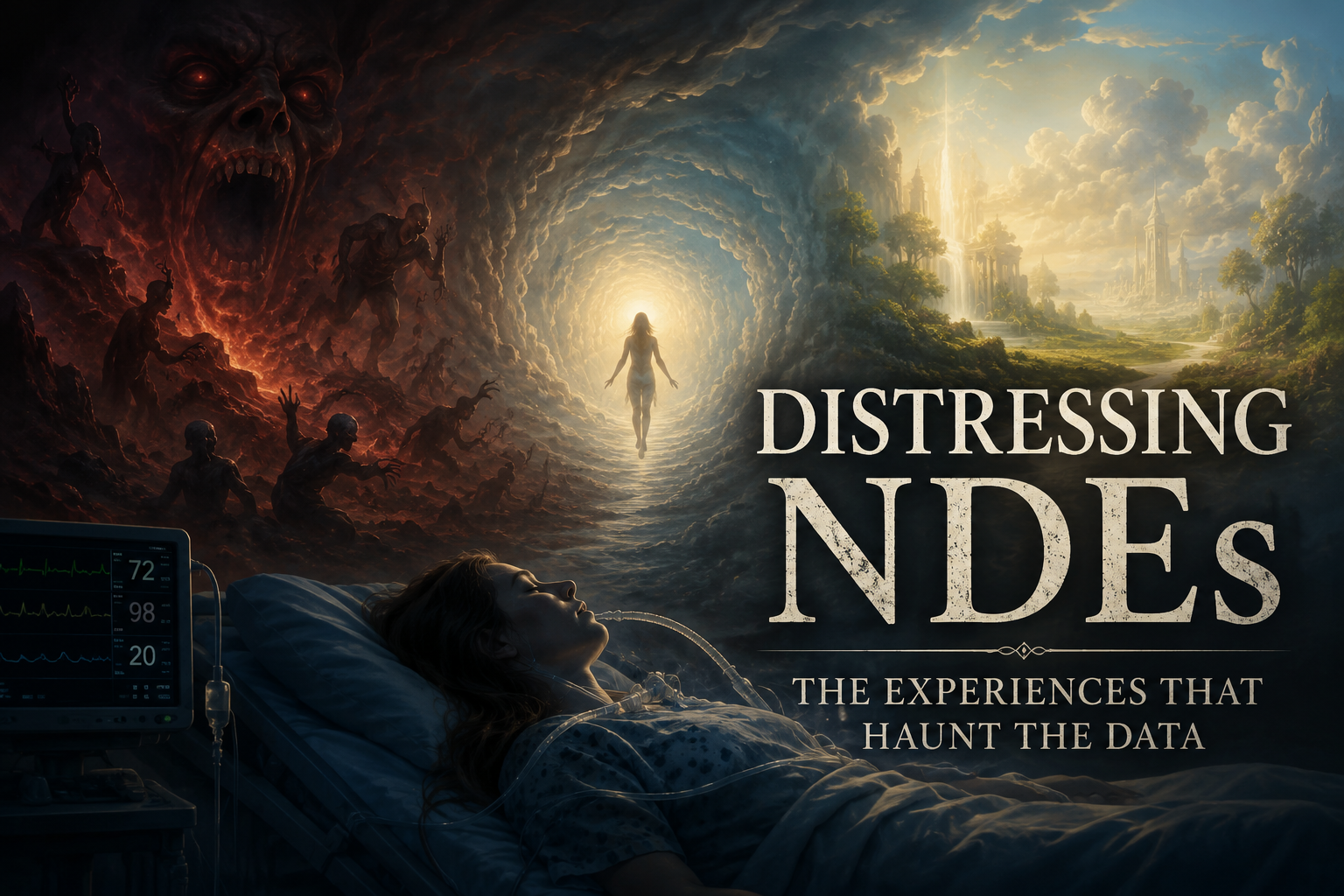
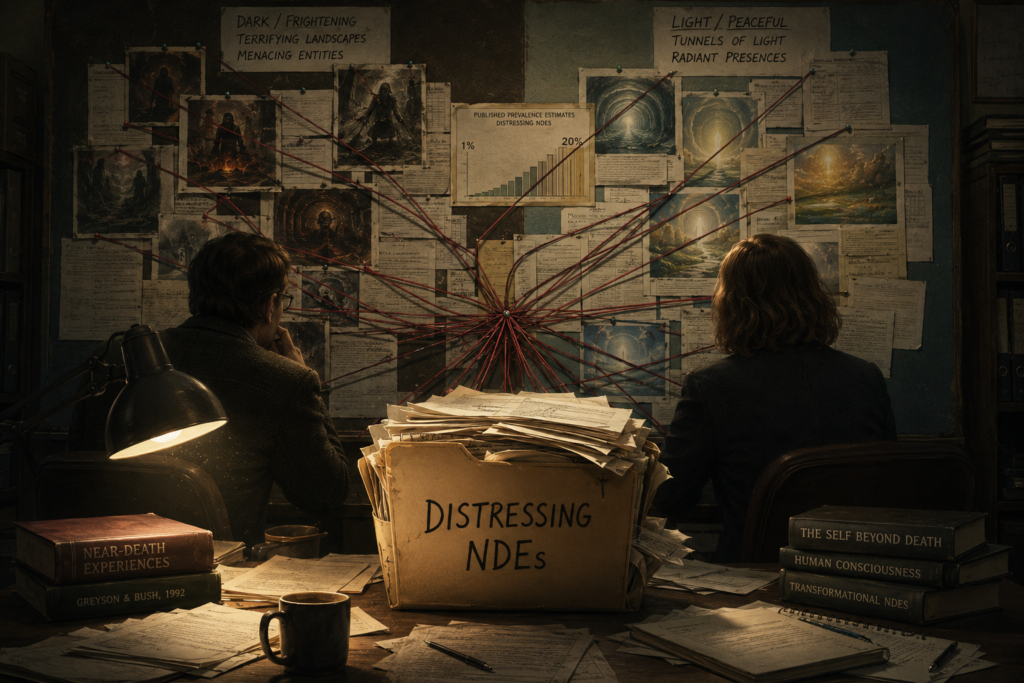
The foundational study was published in 1992 by Dr. Bruce Greyson and Nancy Evans Bush in the journal Psychiatry. They analyzed fifty accounts and sorted distressing NDEs into three types: ordinary NDE features experienced as frightening, an empty eternal void, and graphic hellish landscapes with menacing entities.
Solid descriptive work. But here’s the tell that something is broken, and any analyst would spot it immediately: the published prevalence estimates for distressing NDEs range from 1% to 20% of all near-death experiences. That’s not a measurement problem. A spread that wide means the researchers can’t agree on what they’re counting — because they’re counting two different things and calling them one thing.
The Case That Cracks It Open
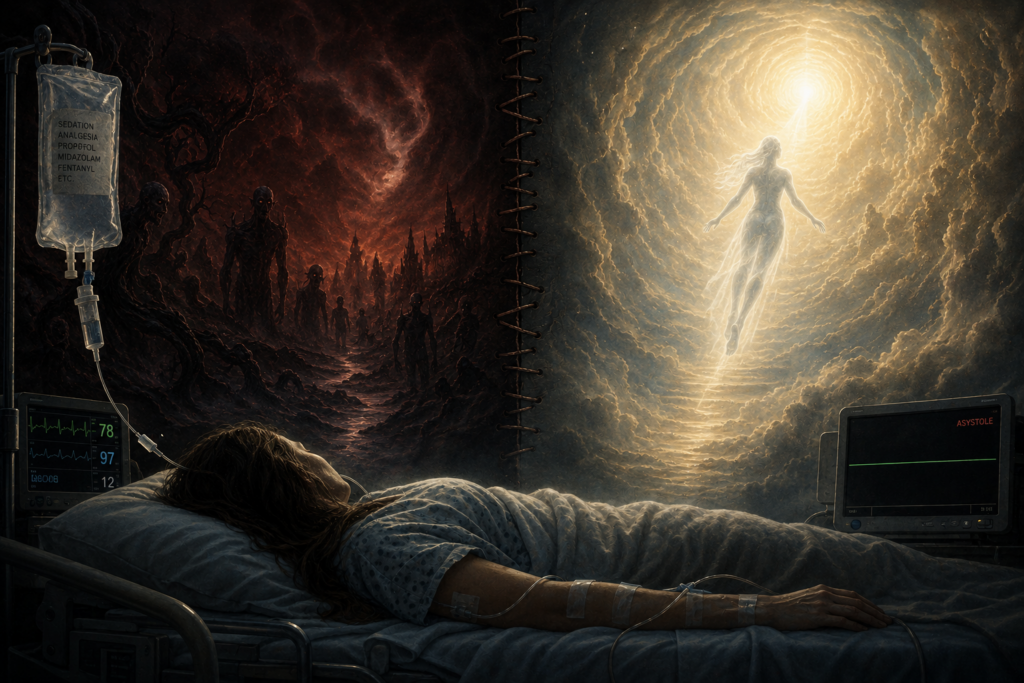
Here’s a case that shows you exactly what I mean. A woman becomes critically ill. Her doctors put her into a medically induced coma — pump her full of powerful drugs, deliberately, as part of her treatment.
Early in that coma, she has a terrifying experience. Nightmare landscapes. Strange, menacing entities. Classic “distressing NDE” material, exactly the kind of account that ends up in the research files under that label.
Then, later in the same coma, her illness actually kills her. She dies. And what happens next is a textbook near-death experience — and I mean textbook: the peace, the overwhelming love, the light, the life review, the return. Not one distressing element anywhere in it. Her soul comes back, and eventually she wakes up.
Now here’s the critical part. In her memory, it was all one experience. One continuous event. That’s how she tells it, and that’s how a researcher would file it: a “mixed” NDE, partially distressing. One data point, one label.
And that filing would be wrong. Look at the timeline. The terrifying content happened early in the coma — while she was alive, heavily drugged, and nowhere near death. The classic NDE happened at the actual death event. These were two separate and distinct experiences, produced by two separate and distinct causes, stitched into a single memory by a brain that was offline for the duration and had no timestamps to work with.
Two Phenomena, One Label
The first event was drug-induced. If the imagery sounds familiar, it should — terrifying landscapes and entity encounters are exactly what people report on DMT and Lanmaoa asiatica. I’ve written before about what I call frequency shifting: powerful psychoactive compounds temporarily altering what a living human can perceive. That’s what heavy sedation did to this woman early in her coma. It was real to her, it was terrifying, and it had absolutely nothing to do with death. She wasn’t dying yet. It was pharmacology, not mortality.
The second event was a genuine near-death experience — the thing that happens when a person actually dies. And it followed the pattern that genuine NDEs follow with monotonous consistency across every country, culture, and century in the data: peace, love, light, review, return.
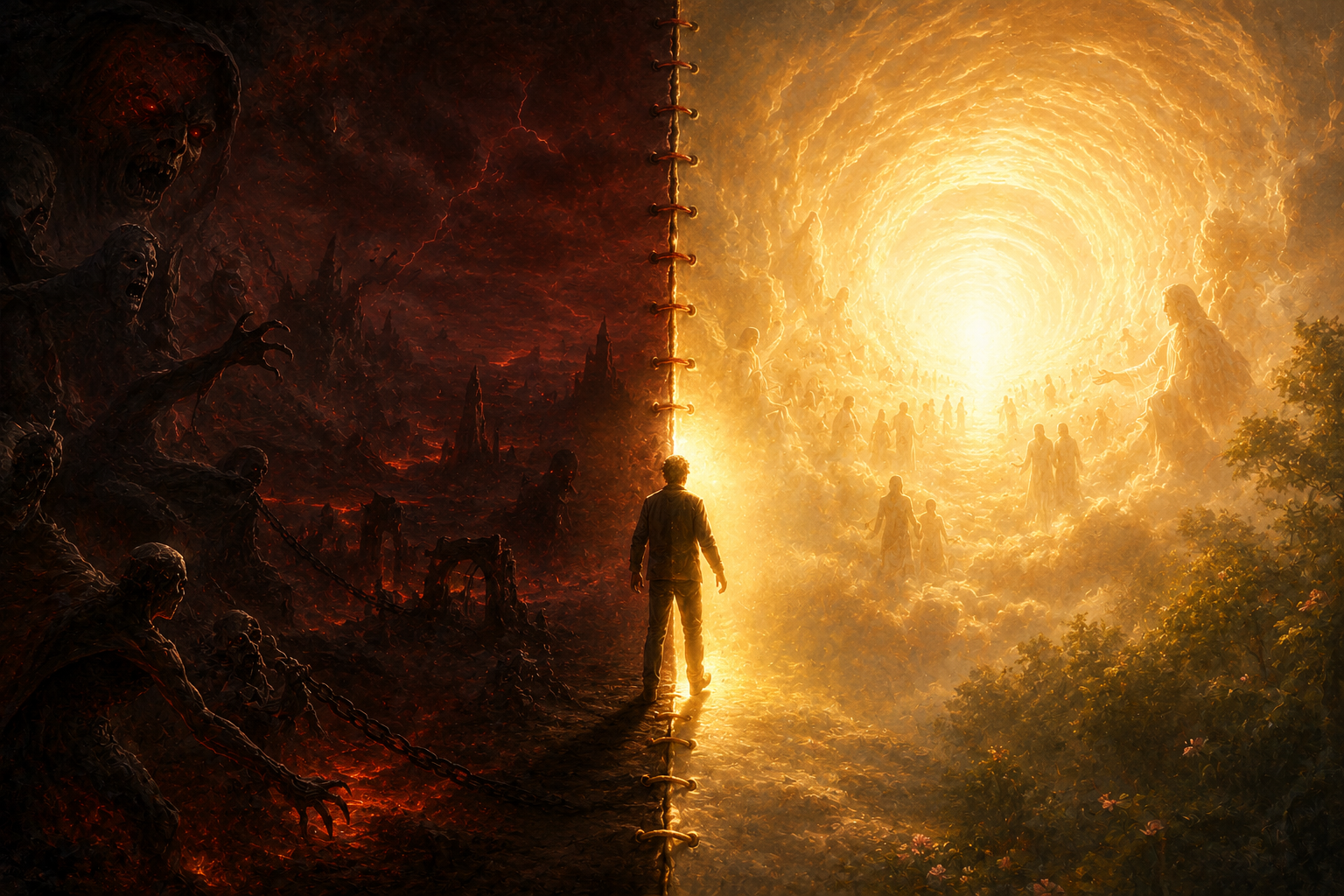
Run this template back against the distressing NDE literature and watch what happens. Those famous “conversions” — accounts where a frightening experience suddenly transforms into a peaceful, radiant one partway through? Researchers have puzzled over those for decades. There’s nothing to puzzle over. That’s not one experience changing its mood. That’s one event ending and a different event beginning — and the seam has been sitting in the published data for over thirty years, visible to anyone who thought to look for it.
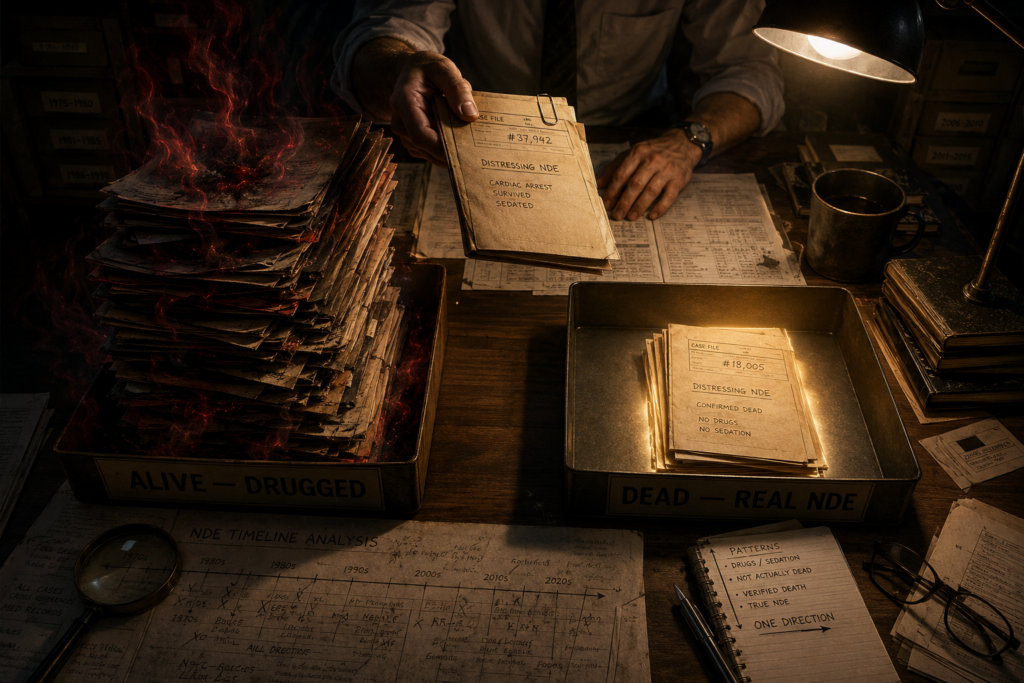
Here’s the question nobody in fifty years of distressing NDE research has systematically asked: was the person actually dead when the distressing content occurred? Not “were they in a hospital.” Not “were they critically ill.” Was the frightening material happening during the death event itself — or while they were alive, sedated, feverish, toxic, and chemically altered?
I’ve started running that sort, case by case, against the records. I’ll be publishing what I find. So far, the answer is pointing exactly one direction.
What This Means
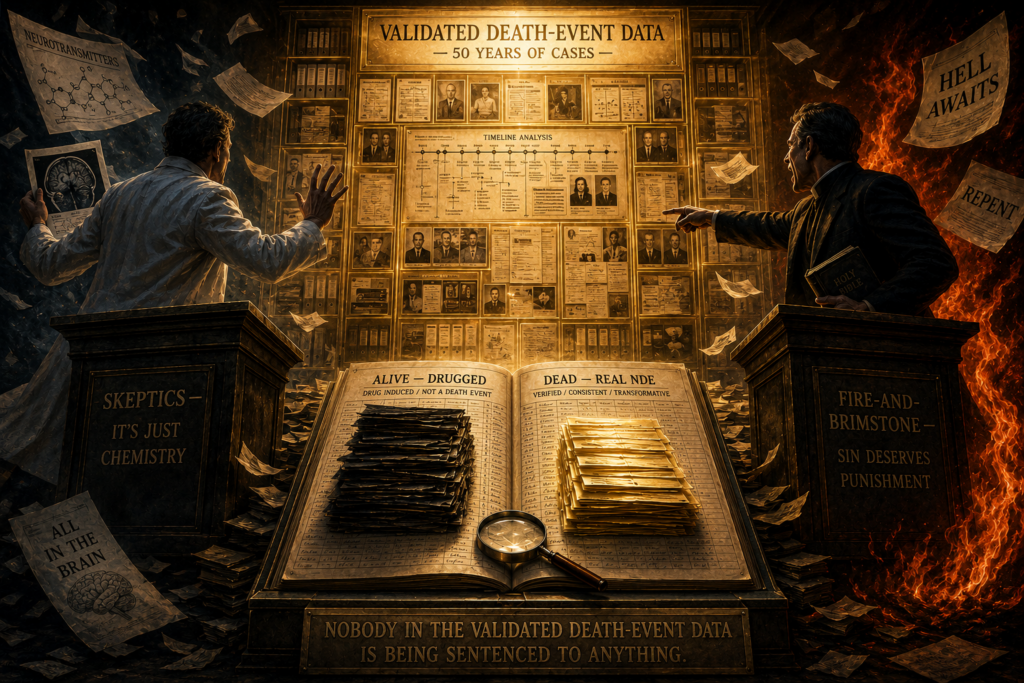
It means the skeptics and the fire-and-brimstone crowd are both wrong, and for the same reason — bad data hygiene.
The skeptics say frightening NDEs prove it’s all just brain chemistry. No. The frightening experiences are largely the chemistry cases — and when you remove them from the pile, the genuine NDE data gets cleaner, not weaker. You can drug a brain. You can’t drug a soul.
The hell-preachers say frightening NDEs prove sinners get what’s coming. Also no. The actual death events in the data keep showing the same thing they’ve always shown: love, acceptance, and a life review that operates like a schoolhouse, not a courthouse. Nobody in the validated death-event data is being sentenced to anything.
Fifty years of researchers stared at this data set. The classification error was sitting in plain sight the whole time. This article is the first in a series — I’m going to keep pulling this thread, case by case, and I’ll show you everything I find. Some of what’s coming will change how you think about a few very old ideas.
Stay tuned. You’re going to want to see where this goes.
P.S. — If you have personally experienced a frightening episode during a medical crisis, coma, anesthesia, or a near-death event — or one of each — I want to hear from you. Your account may be exactly the data this research needs. Contact me through winnernde.com or you can send an email by clicking here.
Want to go deeper? Don Winner brings decades of intelligence and investigative experience to the biggest question there is: what happens when we die.
In You’re Going to Die Someday, Right? Near-Death Experiences Reveal What Happens Next, he examines the evidence from thousands of near-death experiences to find out what they actually tell us about consciousness, the soul, God, and the afterlife.
In Hell Exists, But Only for the Living, he investigates where our idea of hell came from and who built it, tracing the doctrine back to its human sources.
Get your copy of You’re Going to Die Someday, Right? or Hell Exists, But Only for the Living.