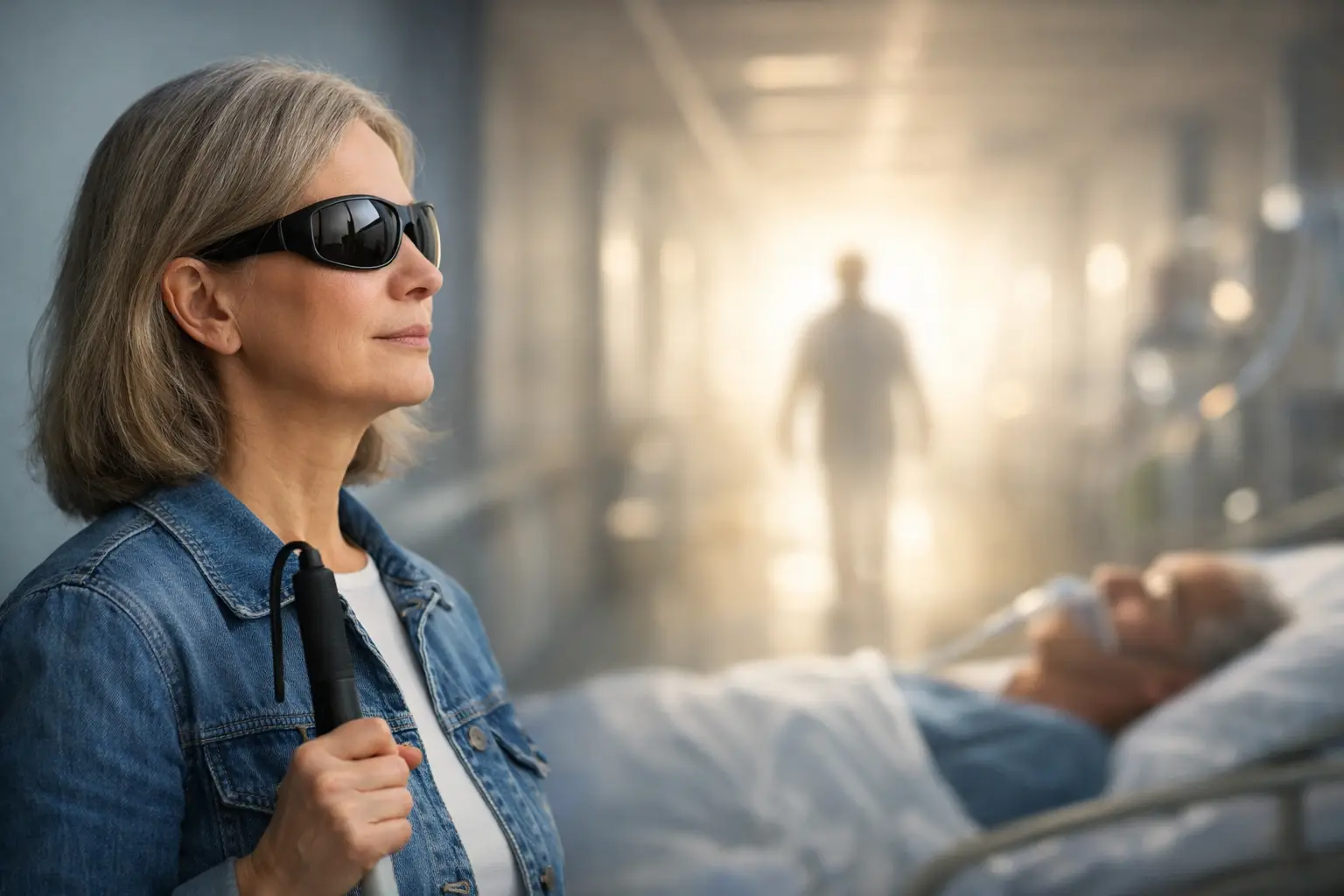
A person blind from birth describes seeing a surgical room from above: colors, instruments, clothing, the position of medical staff, and details later confirmed by others. That is why the question, can blind people see during NDEs, is not a sentimental curiosity. It is a direct challenge to the claim that consciousness is nothing more than brain-generated sensory processing.
If visual experience requires functioning eyes, optic nerves, and visual cortex, then a congenitally blind person should have no visual reference point at all. Yet some of the most striking near-death and out-of-body reports come from people who say they perceived precisely that way during a crisis. Skeptics often wave these cases aside as dreams, confabulation, or later reconstruction. But the details demand more serious investigation than a reflexive dismissal.
Can Blind People See During NDEs? Start With the Right Question
The question is often framed badly. Blindness is not one condition. Some people lose sight later in life and retain visual memories. Others have partial sight. Others are blind from birth and have never had ordinary visual experience.
The last group carries the greatest evidential weight. A person who once saw can describe visual scenes from memory or imagination. That may be psychologically interesting, but it does not settle the question. A person blind from birth who reports an organized visual perspective during an NDE presents a much harder problem.
Nor should anyone pretend every report proves the case. NDE research is built largely on testimony, medical records, witness interviews, and corroborated details, not laboratory conditions that can be repeated on command. Testimony can be mistaken. Memory can change. Investigators must ask when the account was recorded, whether the witness had access to the information by normal means, and whether independent confirmation exists.
That is not a weakness unique to NDE research. It is how serious investigation works. You separate strong cases from weak ones, identify what is verified, and refuse to let an easy explanation stand merely because it is familiar.
The Cases Are More Than Vague Claims
Researcher Kenneth Ring and social worker Sharon Cooper examined reports from blind people who had NDEs or out-of-body experiences. Their work gathered accounts from individuals with varying degrees of blindness, including people blind from birth. A recurring feature was the language of sight: people described becoming aware of surroundings in a spatial, immediate, and often visually organized way.
One of the best-known cases is that of Vicki Umipeg, blind from birth. During a severe accident, she reported an out-of-body experience in which she perceived the emergency setting, observed her own body, and later described details associated with her treatment. She also described a subsequent NDE in which sight was not merely restored but overwhelmed ordinary perception. Colors, faces, movement, and a vast environment were reported as direct experience.
Her account is not valuable because it flatters anyone’s religious preferences. It is valuable because it contains the very feature materialism says should be impossible: apparent visual awareness in someone who lacked the normal biological machinery and life history for visual imagery.
Other blind experiencers have used language that complicates the issue further. Some say they did not “see” exactly as sighted people see. They speak of knowing, perceiving, or taking in the whole scene at once. Yet when asked to describe that awareness, they offer spatial arrangements, people, objects, colors, and movement. The experience may exceed ordinary vision rather than duplicate it.
That distinction matters. Critics sometimes argue that blind people use visual words metaphorically. Of course they do, as all human beings use imperfect language for extraordinary states. But metaphor does not explain independently accurate observations. If a person identifies who was present, where they stood, what actions occurred, or an unusual object later verified by witnesses, the question becomes evidential, not semantic.
The Skeptical Explanations Break Down Under Pressure
The standard skeptical response is that the brain invents a comforting hallucination under stress. This sounds plausible until one asks what, exactly, the hallucination is built from.
For someone who lost vision later in life, stored visual memories may be available. For someone blind from birth, that explanation has a serious gap. A brain under extreme physiological distress is supposedly producing a coherent mode of visual awareness without prior visual input, while sometimes incorporating accurate information unavailable to the person at the time. Calling that a hallucination does not solve the problem. It simply gives the problem a label.
Another explanation is unconscious inference. Perhaps the person heard voices, felt movement, and assembled a scene afterward. This can account for broad guesses in some cases. It does not account for the strongest reports, particularly when the reported perception involves details outside normal hearing range or outside the physical location of the body.
Then there is the memory argument: perhaps accounts become more elaborate over time. This is a legitimate concern and a reason to privilege early documentation. But it cuts both ways. A distorted memory should become less reliable, not repeatedly produce the same core pattern found across cultures, ages, medical circumstances, and degrees of prior belief.
The pattern is stubborn. During NDEs, people report separation from the body, heightened awareness, encounters with deceased persons or presences, life review, boundaries, and a return. Blind experiencers do not merely report comfort or emotion. Some report perception that appears expanded beyond bodily limits. Their accounts fit the larger NDE record rather than standing apart from it.
What the Evidence Can and Cannot Establish
A disciplined conclusion is stronger than either blind faith or casual debunking. These cases do not mean every NDE report is visually accurate in every respect. They do not give researchers a convenient way to measure an afterlife with a ruler. And they do not permit outsiders to dictate exactly what another person experienced.
But the evidence does establish an anomaly. The materialist model predicts that a person without visual capacity, especially one blind from birth, cannot have meaningful visual perception. Yet credible reports repeatedly challenge that prediction. When some descriptions include independently supported details, the anomaly becomes sharper.
Science advances when anomalies are investigated rather than buried. For decades, the reflex has been to treat consciousness as an output of the brain and therefore extinguished when the brain is severely compromised. NDE cases involving the blind strike at that assumption from a particularly uncomfortable angle. They suggest consciousness can operate with capacities that are not reducible to damaged or absent bodily senses.
That does not require a retreat into vague mysticism. It requires intellectual honesty. If the evidence contradicts a theory, the theory must be revised. Declaring the evidence impossible because the theory says it is impossible is not science. It is ideology wearing a lab coat.
Why This Question Matters to Anyone Afraid of Death
The force of these accounts is personal. Blindness places obvious limits on embodied life, yet experiencers often describe freedom, recognition, beauty, and an awareness more complete than anything available through physical senses. The recurring message is not that disability is trivial or that suffering should be romanticized. Physical limitation is real, and it can be brutal.
The message is narrower and more hopeful: the person is not identical to the condition of the body. If consciousness can perceive when ordinary sensory pathways are absent or compromised, then the fear that death means instant blankness loses much of its claimed certainty.
For someone grieving, facing illness, or waking at 3 a.m. afraid that a loved one vanished into nothing, that is not a small point. It is a reason to look at the evidence with open eyes, even when the witness could not use eyes at all.
The next time someone insists that NDEs are only a brain’s final fantasy, ask the question they would rather avoid: how does a person blind from birth report seeing what the body could never see? The honest answer is not that we have explained it away. The honest answer is that consciousness is larger, stranger, and more durable than the materialist story allows.
Want to go deeper? Don Winner brings decades of intelligence and investigative experience to the biggest question there is: what happens when we die.
In You’re Going to Die Someday, Right? Near-Death Experiences Reveal What Happens Next, he examines the evidence from thousands of near-death experiences to find out what they actually tell us about consciousness, the soul, God, and the afterlife.
In Hell Exists, But Only for the Living, he investigates where our idea of hell came from and who built it, tracing the doctrine back to its human sources.
Get your copy of You’re Going to Die Someday, Right? or Hell Exists, But Only for the Living.