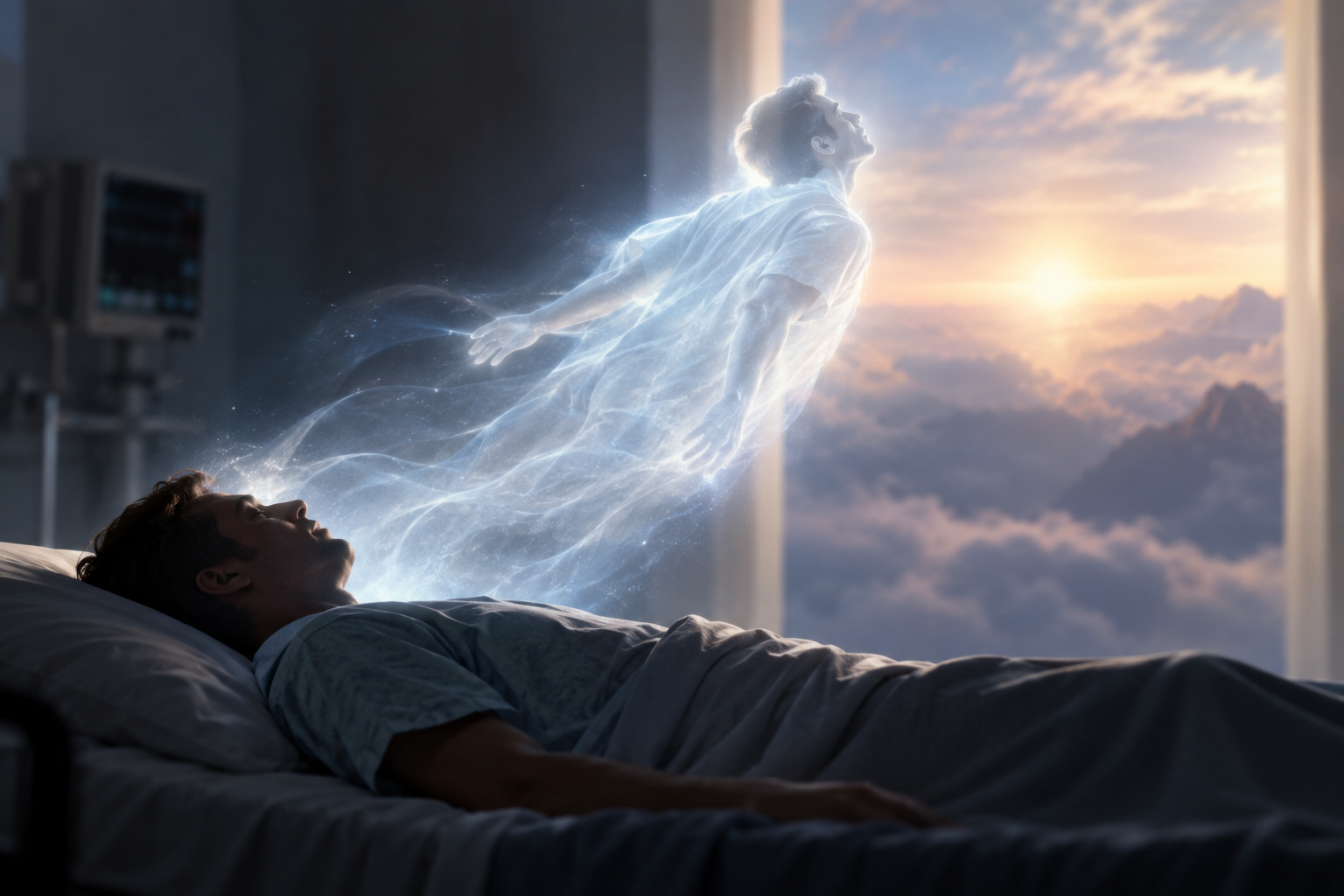
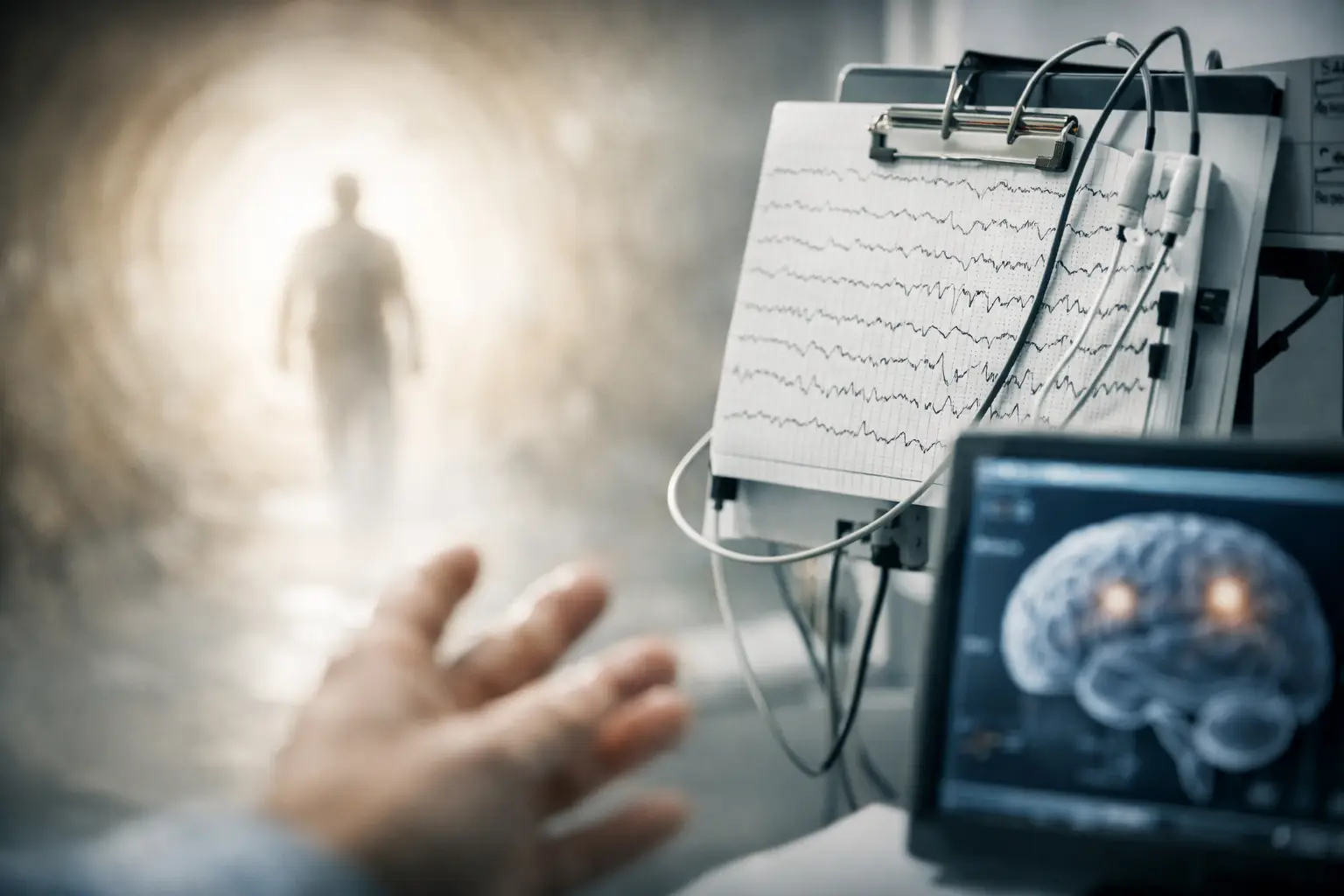
A dying patient reports leaving the body, watching a resuscitation from above, and later describing an event or object that should have been outside normal perception. The reflexive reply is usually one word: hallucination. It sounds scientific because it is familiar. But are NDEs caused by hallucinations? That question cannot be answered by attaching a label to an extraordinary report and moving on.
A hallucination is an internally generated perception — an image the brain builds from nothing external. Near-death experiences are a different animal: a recurring class of reports with a recognizable structure, often occurring during grave medical crisis, and sometimes containing details that can be checked against the record. Those distinctions matter. If an explanation cannot account for the timing, content, consistency, and verified perceptions in the data, it is not an explanation. It is an exit ramp from investigation.
Start With the Evidence
The hallucination theory begins with a reasonable premise: brains under stress can produce strange experiences. Trauma, medication, fever, sleep deprivation, seizures, delirium, and low oxygen can all alter perception. No serious investigator needs to deny that. Human beings can be confused, frightened, suggestible, and wrong.
But a reasonable premise is not a conclusion. The relevant question is whether ordinary brain-generated hallucinations match the full NDE record.
They do not match it well. Typical delirium is fragmented, unstable, and deeply tied to the patient’s immediate fears or surroundings. It often produces confusion rather than the reported clarity that many experiencers emphasize. A patient may be unable to remember the date, recognize family, or follow a conversation, yet later describe an experience as more lucid, organized, and emotionally coherent than ordinary waking life. That is not proof by itself. It is a major mismatch with the casual claim that an NDE is merely delirium with better publicity.
NDE reports also recur across decades, countries, religious backgrounds, and age groups. People describe separation from the body, heightened awareness, encounters with deceased people, a life review, an overwhelming sense of love, and an encounter with a boundary beyond which return is impossible. No two accounts are identical, nor should they be. But the pattern is far more stable than we would expect from random neurological noise.
The skeptic may answer, “People have heard the stories before.” Sometimes they have. Yet reports from children, isolated patients, and people whose expectations do not fit the experience complicate that response. Cultural background can shape imagery and language. It does not explain the underlying sequence, or the force with which experiencers say the event overturned their prior beliefs.
The Problem of Timing
The strongest version of the hallucination claim is not that patients are lying. Most are plainly sincere. The claim is that the brain creates a vivid experience as it fails, and the person later mistakes it for a journey beyond the body.
That theory must confront timing. Many of the most compelling reports are associated with cardiac arrest, profound unconsciousness, or emergency intervention. These are not normal conditions for sustained, organized experience. A cardiac arrest is not automatically a declaration that every brain cell has stopped all activity — that overstatement helps nobody. Residual or returning activity may exist, and the exact moment an experience occurs can be difficult to establish.
But the difficulty runs against the materialist, not for him. If a person reports a long, structured sequence during a period in which normal conscious function should be severely compromised, the brain-generated explanation is already under pressure. It cannot simply announce, without evidence, that the experience occurred in a convenient sliver before collapse or during recovery. That is possible in some cases. It is not a universal solvent.
And there is a harder problem waiting behind it. Some experiencers report perceptions corresponding to events in the operating room or hospital area that were not available to their physical senses. These cases demand disciplined handling. Memory can be reconstructed. Witnesses can unintentionally influence one another. Details should be recorded early, checked against records, and separated from later embellishment.
But careful screening does not make the best cases disappear. It makes them decisive. When a patient accurately reports an unusual procedure, a conversation, or a detail outside the line of sight, “hallucination” ceases to be an answer. A hallucination can explain an invented image. It cannot explain accurate information the patient had no physical route to obtain.
Brain Chemistry Is Not a Kill Shot
Skeptics frequently point to oxygen deprivation, carbon dioxide changes, endorphins, ketamine-like states, temporal-lobe activity, and DMT. These are mechanisms worth studying. They may affect the body during crisis. They may shape portions of an experience. None of that establishes that the brain manufactured the experience from nothing.
Consider what these proposals actually need to show. They must explain why an impaired brain produces not merely vivid imagery but coherent narratives; why the same features appear in widely separated populations; why so many experiencers call the event more real than ordinary life; why durable personality changes follow; and why some cases include accurate perceptions beyond any ordinary sensory route.
Saying “the brain was involved” is not the same as saying “the brain caused the content.” Every human report is later remembered, narrated, and processed through a living brain. That obvious fact does not settle what happened when consciousness appeared to continue under conditions hostile to normal consciousness.
The DMT argument is especially revealing. Even if a dying brain releases unusual chemicals, that would demonstrate a correlation, not a cause. Researchers would still have to show that the chemistry reliably produces the specific architecture of an NDE — including accurate perception of real events. At present that leap is asserted far more often than it is demonstrated.
Hallucinations Usually Leave Confusion. NDEs Often Leave Order.
The aftermath deserves more attention than it gets. People who survive frightening delirium or psychosis can be shaken, confused, and uncertain about what was real. Experiencers can struggle too — returning to ordinary life after an experience of overwhelming love or expanded awareness can be painful. Yet the long-term pattern is striking: reduced fear of death, increased compassion, less materialism, changed priorities, and a settled conviction that consciousness is more than the body.
A personal transformation does not verify an event. False beliefs can change lives. But when the transformation appears alongside recurring content, unusual timing, and perceptions that check out, it becomes part of the evidential picture. Investigations do not rest on one clue. They assess whether multiple independent clues point in the same direction.
This is also where distressing experiences must be handled without cruelty, and without confusion about what they are. A terrifying experience during coma, delirium, trauma, or medication can be completely real to the person who endured it. The witness should never be mocked or dismissed. But terror, confusion, threatening imagery, and disorientation are exactly the features a brain in catastrophe produces. Those are the signature of a living, distressed brain — not evidence of an eternal realm.
That distinction protects people from needless fear. A coherent NDE marked by clarity, lucidity, and sustained awareness beyond bodily limits is not interchangeable with a catastrophic brain state full of panic and fragmentation. Both deserve compassion. They are not the same event simply because both occur near death.
The Hallucination Label Explains Too Little
The materialist case is often presented as though the debate is over: the brain is distressed, therefore the NDE is a hallucination. That is not science. It is a conclusion smuggled into a premise.
A serious explanation must fit the difficult evidence, not only the easy cases. It must account for why NDEs have recognizable features, why they arise in conditions of severe physiological compromise, why they can feel intensely lucid, why they so often produce lasting change — and above all, why some reports contain accurate perceptions the patient had no physical route to obtain.
That last feature is not a minor anomaly to be filed alongside the others. It is the pivot on which the whole question turns. A confused brain can manufacture vivid imagery; it cannot manufacture a correct description of an instrument, a conversation, or an event outside the line of sight and beyond the reach of the senses. When a report carries verified perception like that, the timing question answers itself: the content records something real that occurred when normal perception was not available. Hallucination does not survive that fact. It is not one clue among many — it is the clue that fixes what the others only suggest.
Could individual accounts include dreamlike material, faulty memory, or cultural interpretation? Absolutely. NDE research is not strengthened by pretending every story is equally evidential. The strongest cases are built through verification, corroboration, medical timing, and perceptions that hold up when checked against the record.
The evidence does not justify the lazy claim that every NDE is a hallucination. The best-documented cases point somewhere the easy explanations cannot follow: to accurate perception occurring under conditions in which the brain should have been incapable of producing it.
For anyone afraid that death means blank extinction, the honest answer is not a promise built on wishful thinking. It is an invitation to look at the cases the easy explanations leave behind — the ones where a person knew something they could not have known. Those cases do not remove every question. They give a serious, evidence-based reason to doubt that the end of bodily life is the end of the person.
Want to go deeper? Don Winner brings decades of intelligence and investigative experience to the biggest question there is: what happens when we die.
In You’re Going to Die Someday, Right? Near-Death Experiences Reveal What Happens Next, he examines the evidence from thousands of near-death experiences to find out what they actually tell us about consciousness, the soul, God, and the afterlife.
In Hell Exists, But Only for the Living, he investigates where our idea of hell came from and who built it, tracing the doctrine back to its human sources.
Get your copy of You’re Going to Die Someday, Right? or Hell Exists, But Only for the Living.