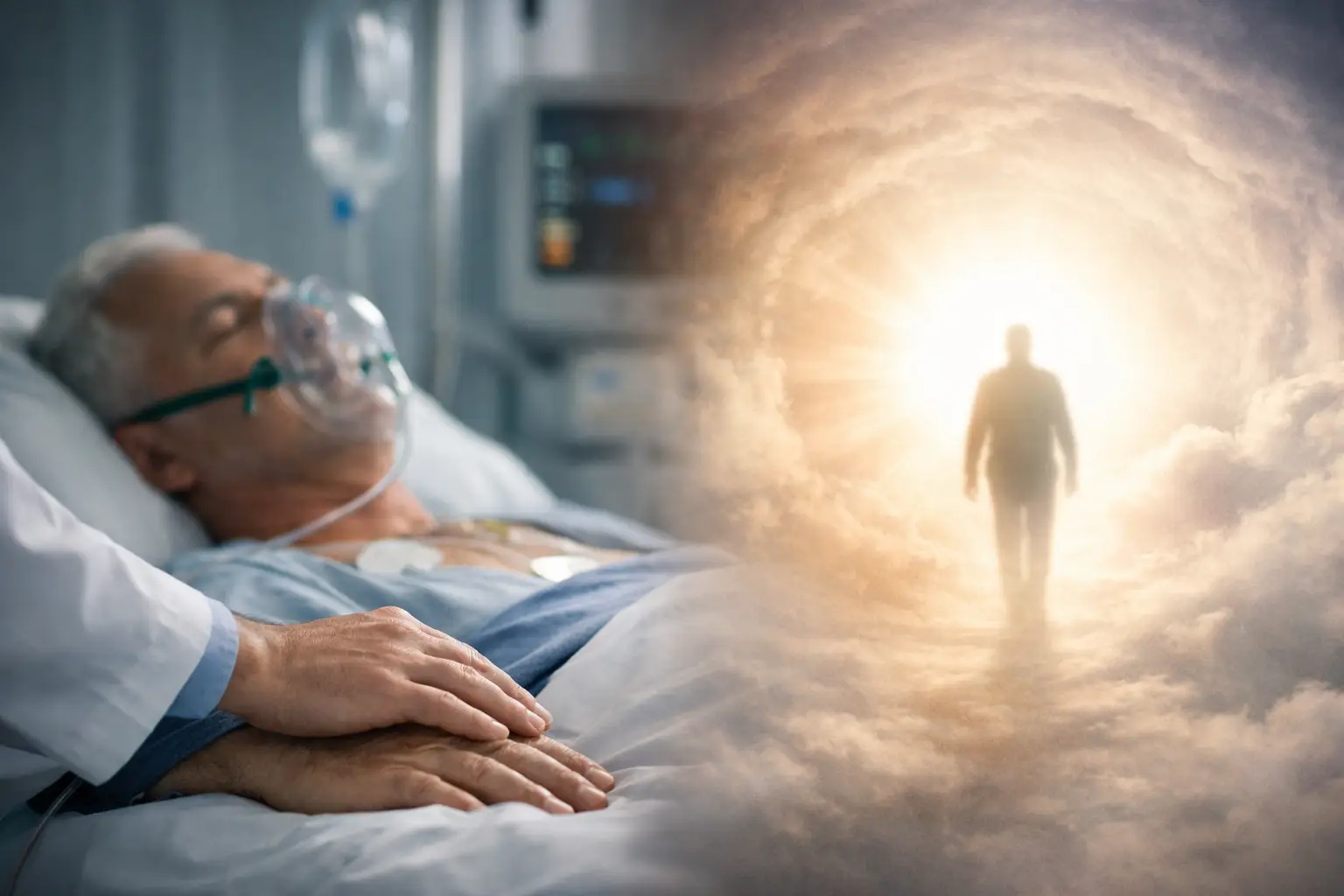
A cardiac arrest patient describes an object positioned where no bed-bound patient could see it. Another reports a conversation that occurred outside the treatment room while the medical team believed the patient was unconscious. These are not comforting metaphors or private dreams. They are the reason near death experience evidence cannot be waved away with a hand gesture toward oxygen deprivation, medication, or a dying brain.
The central question is not whether people have unusual experiences around medical crises. Of course they do. The question is whether a person can acquire accurate information while clinically dead and physically incapable of seeing, hearing, or thinking in the ordinary sense. When the information is later confirmed, the materialist explanation has a serious problem.
An authentic near-death experience, or NDE, occurs during genuine clinical death. It is frequently peaceful, coherent, and marked by a separation from the body, expanded awareness, encounters, and sometimes a life review. Most important for an investigation, some NDEs contain veridical perception: details that can be checked against the external world and found correct.
That is the load-bearing evidence. Everything else matters, but verification changes the case.
What Counts as Near Death Experience Evidence?
A serious inquiry does not treat every dramatic hospital memory as equal. It asks the questions an investigator would ask after any extraordinary report: What was the person’s medical condition? When did the reported perception occur? What details were stated? Who could confirm them? Were the details ordinary, inferred, or inaccessible by normal means?
The strongest evidence comes from cases with a documented period of clinical death, followed by specific observations the experiencer had no normal route to obtain. A vague statement that a doctor was worried proves little. A precise description of an unusual action, a hidden object, a conversation in another location, or an unexpected event later independently confirmed is different. Specificity is the enemy of dismissal.
Skeptics often respond that memories can be reconstructed after resuscitation. They can. Human memory is imperfect, and not every report survives scrutiny. That is exactly why standards matter. The existence of weak cases does not erase strong ones. Investigators reject noise so that the signal can be seen.
The decisive cases do not ask us to accept a feeling as proof. They present information that was unavailable to the body at the time it was reported to be nonfunctional. If awareness can accurately observe events under those conditions, then consciousness is not ending when the body reaches clinical death.
Verification Is More Than a Strange Story
A remarkable story may move a reader. Verified detail can move an argument.
Consider the difference between these two claims: “I floated above my body and felt peaceful,” and “I observed a distinctive event during resuscitation that was later confirmed by the people involved.” The first is meaningful personal testimony. The second is evidence with an external point of contact. It gives an investigator something to test.
This does not mean every authentic NDE must include a verifiable observation. Many do not. A person may encounter a realm beyond ordinary physical measurement, then return with no hospital-room detail for anyone to confirm. But where veridical perception appears, it establishes that the experience was not merely an internal fantasy generated after the fact.
The skeptical fallback is usually timing. Perhaps, they argue, the perception occurred just before the crisis or during recovery. That possibility must be examined, not assumed. Yet it fails when the reported details are tied to a documented period in which the person was clinically dead, and when those details involve events beyond sensory reach. Repeating “maybe it happened later” is not an explanation. It is an attempt to relocate the evidence without evidence.
The Pattern Matters, Not Just the Outlier
One verified account deserves investigation. Thousands of reports with recurring structure demand it.
Across cultures, ages, beliefs, and decades, authentic NDEs repeatedly include separation from the body, clarity rather than confusion, profound peace, an encounter with a loving reality, and a return that often changes the experiencer permanently. People who feared death commonly lose that fear. They do not return speaking like people who had a colorful hallucination. They return convinced that life has moral weight and that love is not sentimental decoration but fundamental reality.
A life review belongs in this category. It occurs only in an authentic NDE, during clinical death. It is not a chaotic replay of trauma. It is often described as an exact moral encounter with one’s life, including the effects of one’s actions on others. That recurring feature has consequences. It suggests that awareness after death is not blank, trivial, or detached from how we treated people while alive.
Consistency does not prove every interpretation by itself. It does, however, demolish the claim that NDEs are random mental debris. Random debris does not reliably organize itself into coherent reports across radically different lives. Nor does it repeatedly produce durable transformations toward compassion, reduced fear of death, and a changed sense of purpose.
The pattern is especially revealing because experiencers do not all bring the same religious expectations into the event. The details vary. Human language varies. But the core architecture remains strikingly stable.
Stop Calling Fear Coma Experiences NDEs
Confusion enters the field when every frightening experience near a hospital bed is tossed into the NDE category. The old label “distressing NDE” is wrong because it merges two different events and then pretends their conflict is a mystery.
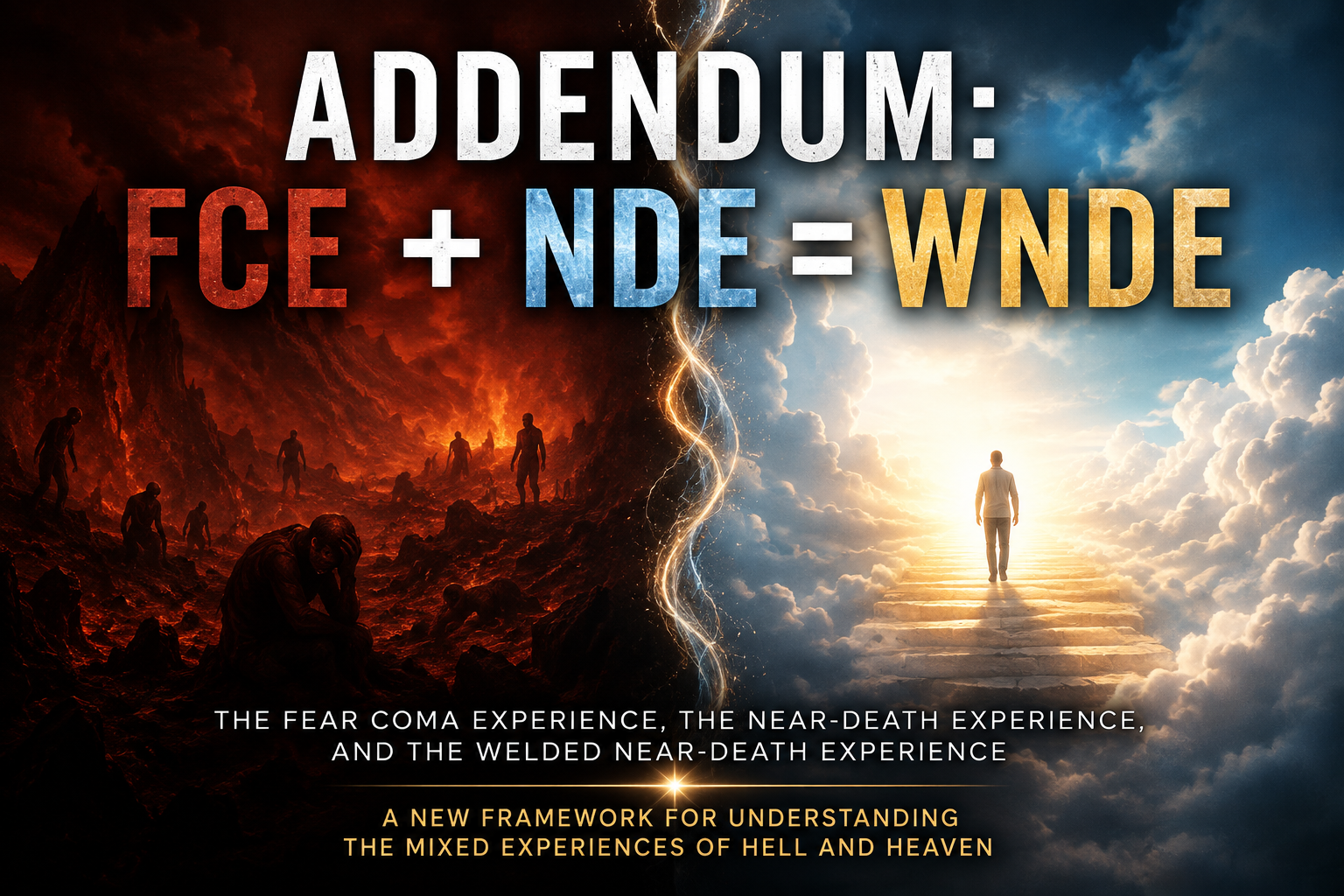
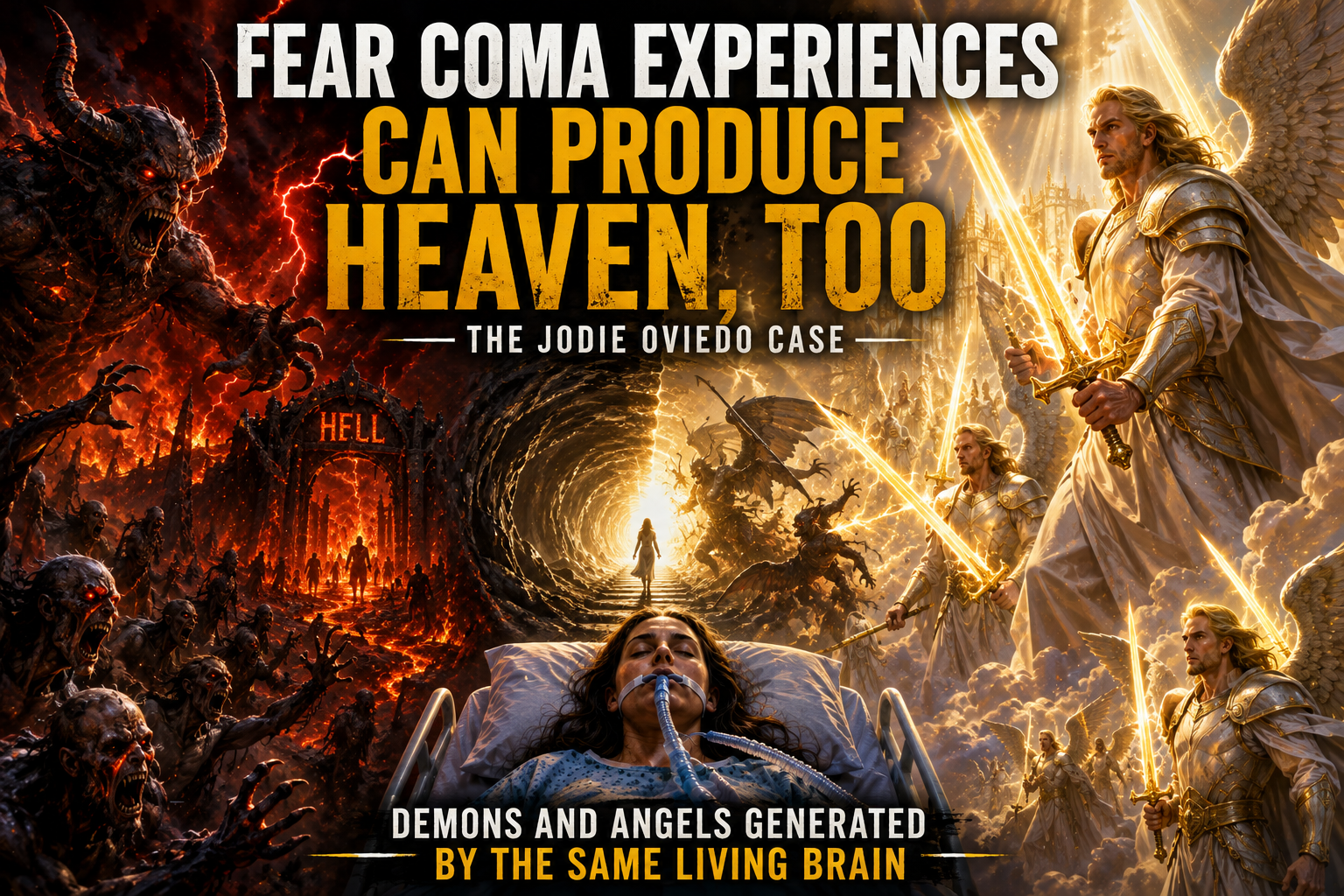
A Fear Coma Experience, or FCE, is terrifying imagery produced by a living brain in catastrophe. It can include torment, pursuit, monsters, guilt, darkness, confinement, and scenes people understandably call hellish. The witness is not dishonest. The terror is real. But no clinical death occurred, and the event is not an NDE.
This distinction is not semantic housekeeping. It protects people from a cruel and unnecessary conclusion: that horrifying coma imagery reveals their eternal destination. It does not. Hell is real as an experience of the living brain under extreme catastrophe. It is not evidence that the dead are being tortured.
There is also the rare Welded NDE, in which a person experiences both an FCE and a genuine NDE in one medical event. With no internal clock separating the episodes, the memories can fuse together. The proper response is not to flatten the account into a supposed “distressing NDE.” It is to separate the components carefully: the fear coma imagery belongs to the living brain; the authentic NDE belongs to clinical death.
This correction strengthens the evidence for NDEs. It removes a category error that skeptics exploit and that frightened readers suffer under. Peaceful, verifiable NDEs and terrifying FCEs are not rival versions of the same phenomenon. They are different phenomena with different conditions and different meanings.
Why Chemical Explanations Miss the Target
A chemical explanation can describe conditions surrounding a medical emergency. It cannot explain verified perception during clinical death.
Medication can alter experience. Fever can cause delirium. Trauma can create terror. Those facts are not controversial, and they help explain Fear Coma Experiences. But an explanation must fit the evidence in front of it. A theory of confusion does not explain clarity. A theory of hallucination does not explain confirmed observations. A theory of a failing brain does not explain accurate information acquired when ordinary brain-based perception is unavailable.
The materialist argument often survives by changing the subject. It points to an experiment involving altered perception in healthy subjects, then treats that as though it answers a verified NDE during cardiac arrest. It does not. Similar sensations do not establish the same cause. A dream of flying does not explain a documented flight.
The fair standard is demanding in both directions. NDE researchers should reject claims that cannot be checked, avoid exaggerating weak reports, distinguish FCEs from NDEs, and say exactly what a case establishes. Skeptics should meet the same standard. They do not get to call a verified anomaly “hallucination” and walk away without showing how the hallucination obtained correct, inaccessible facts.
The Evidence Has Personal Consequences
For someone grieving a parent, facing surgery, or lying awake afraid of oblivion, this is not an academic dispute. The evidence points toward a reality far more hopeful than extinction and far more humane than a theology of eternal torture.
That hope should not require intellectual surrender. It should rest on disciplined attention to the best data: clinical conditions, independent corroboration, recurring structure, and the sharp separation between NDEs and Fear Coma Experiences. My most recent book Hell Exists, But Only for the Living examines that separation directly, including why terror in a living brain must never be mistaken for an afterlife verdict.
Death remains serious. Love, choices, and the harm we cause others remain serious too. But the strongest near-death experience evidence offers a steadier message than fear: clinical death is not the end of the person, and no frightened survivor should mistake a living brain’s catastrophe for their eternal future.
Want to go deeper? Don Winner brings decades of intelligence and investigative experience to the biggest question there is: what happens when we die.
In You’re Going to Die Someday, Right? Near-Death Experiences Reveal What Happens Next, he examines the evidence from thousands of near-death experiences to find out what they actually tell us about consciousness, the soul, God, and the afterlife.
In Hell Exists, But Only for the Living, he investigates where our idea of hell came from and who built it, tracing the doctrine back to its human sources.
Get your copy of You’re Going to Die Someday, Right? or Hell Exists, But Only for the Living.