Yesterday I walked slowly through the account of Gerhard Schug, a man whose interview was titled and shared as a distressing NDE, a hellish near-death experience, and showed, point by point in his own words, that it was something else entirely: a fear coma. A real, searing experience of a living brain in crisis, with no genuine near-death experience anywhere in it. The label was wrong. There was no death, no crossing, no out-of-body perception of the physical world. Just terror, generated by a brain that never stopped running.
Today I want to examine a very different case, and I want to do it just as slowly, because this one is the opposite of Schug in the way that matters most. This is not a fear coma wearing the wrong label. This is the real thing, both real things, in a single event. And it comes not from a podcast, not from an author with a book to sell, not from a reporter filling space, but from a peer-reviewed psychiatry journal, written by physicians whose only agenda was to say to their colleagues, look at this, we cannot explain it.
Before I go a step further, let me name what this case is, because I am going to start using a term here and keep using it from now on.
Three Kinds of Account, and the One This Book Was Missing a Name For
Everything I examine in this series sorts into exactly three categories. There are only three, and once you have them, the whole confused field of scary near-death stories snaps into focus.
The first is an NDE, an authentic near-death experience. A person genuinely dies, the heart stops, and they experience the standard sequence: peace, the out-of-body view, the light, the encounters, the love. My first book, You’re Going To Die Someday, Right?, was built entirely on cases like these.
The second is a fear coma, a living brain in catastrophic crisis, generating hellscape imagery while the person is still very much alive. No death, no crossing. This is the entire subject of my second book Hell Exists, But Only For The Living, and Gerhard Schug is a clean example of it. Terror without an afterlife, because you do not reach it by dying. You reach it by not dying.
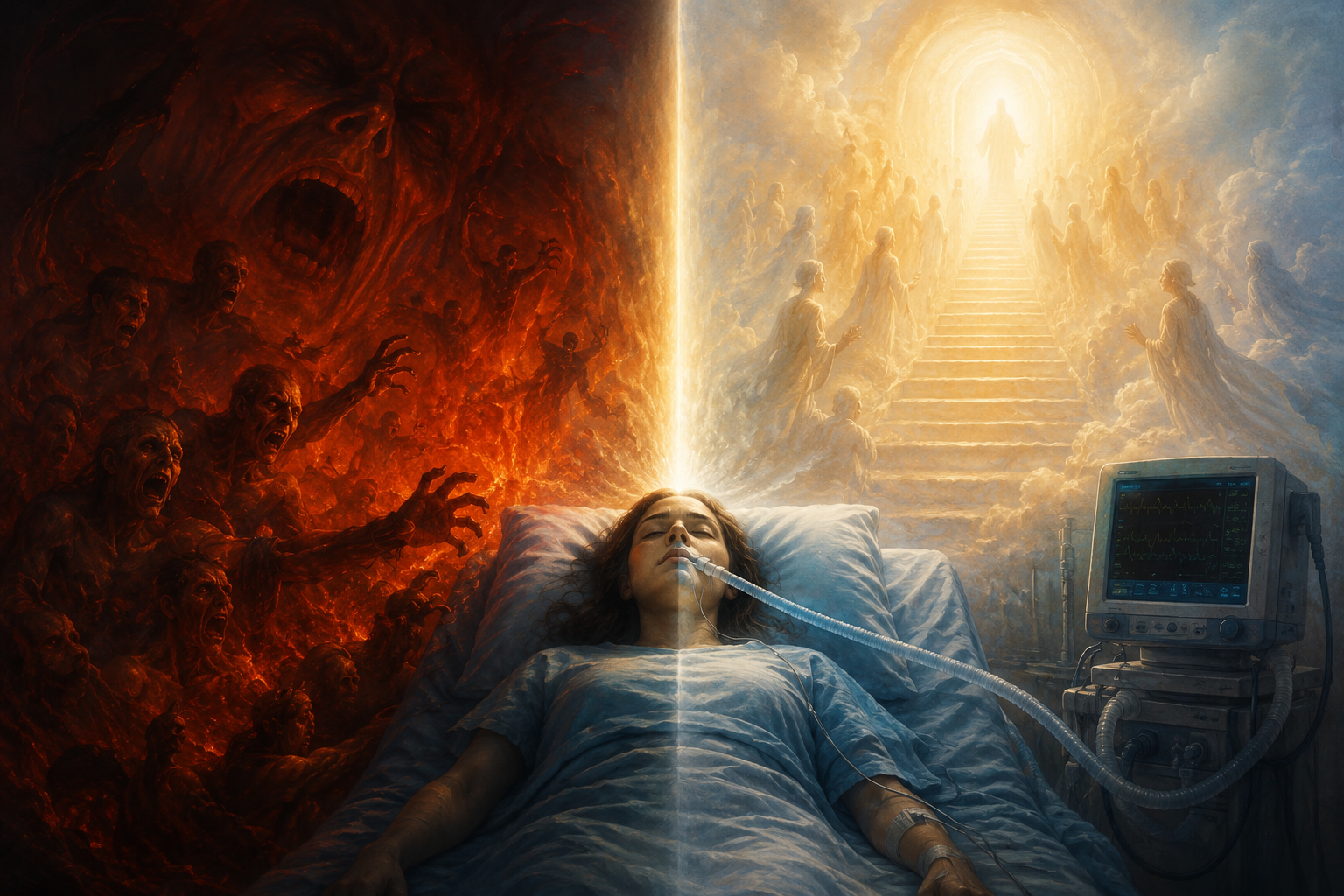
And the third is what this book always implied but what I am now going to name plainly: a Welded NDE. This is the case where a person suffers a fear coma, the hellscape, the terror, all of it, while alive, and also has a genuine, documented near-death experience during the same event. Two distinct things, happening in one medical ordeal, fused together in the person’s memory because there is no clock running inside the experience. No timestamps. When they wake and try to tell the story, the two halves have welded into what feels like a single continuous event, even though they never overlapped for a single instant.
I have written before about why these two states can never blend, why at any given moment you are purely in one or purely in the other, terror from the living brain or peace from the freed soul, never both at once. The welding happens only in the retelling, only in memory. But the term for the whole phenomenon has been sitting in quotation marks long enough. From here forward it is a Welded NDE, a real category with a real name.
Every account I examine is now one of those three: an NDE, a fear coma, or a Welded NDE. Schug was a fear coma. This case is a Welded NDE, and it may be the cleanest one ever committed to the medical literature.
The Source: A Bear-Hug, Not an Arm’s Length
The case was published as: A distressing near-death experience with veridical perceptions during coma: psychiatric and clinical reflections from a rare case, by Francesco Sepioni, Antonio Metastasio, and Manuel Monti, in the Italian peer-reviewed journal Rivista di Psichiatria.
I want you to be able to check every word of what follows against the original, so here are the links:
- The article on the journal’s site: https://www.rivistadipsichiatria.it/archivio/4641/articoli/46507/
- The full-text PDF: https://www.rivistadipsichiatria.it/r.php?v=4641&a=46507&l=362608&f=allegati%2F04641_2026_01%2Ffulltext%2F04.Sepioni+%2833-36%29.pdf
- The listing on PubMed: https://pubmed.ncbi.nlm.nih.gov/41665893/
And because the case is scored on it, here is the Greyson NDE Scale itself, the standard psychometric tool used to measure whether an experience even qualifies as a near-death experience and how complete it was: https://iands.org/nde-research/quantifying-the-phenomenon-greyson-near-death-experience-scale/
This matters. The Schug case came to us through a documentary interviewer who editorialized the label. This case comes through three clinicians in a peer-reviewed journal. There is no book being sold. There is no side being argued. There is no cool story being stretched to fill a broadcast. Two of the three authors are psychiatrists, and the entire framing of the paper is about the mind, what this case does to our models of consciousness. I could not have designed a lower-bias source if I tried. Even the title reads like it was written for this analysis: a distressing near-death experience, with veridical perceptions, during coma. That is a Welded NDE described in a single line by people who did not have the word for it.
What Happened to Her
A 25-year-old woman was brought into the emergency department after a high-speed motor vehicle collision. I will spare none of the medical reality, because the medical reality is the foundation of everything that follows.
On arrival she was in a deep coma. Her Glasgow Coma Scale score was 3. For anyone unfamiliar, the Glasgow Coma Scale runs from 3 to 15, and 3 is the floor, the lowest possible score, total unresponsiveness, the deepest measurable unconsciousness a living human can be in. She had an inoperable deep hemorrhage in the left side of her brain, multiple facial fractures with cerebral tissue exposed, and a burst fracture of the right eye socket. Her neurological exam showed abolished sensorium, decerebrate posturing, and a non-reactive right pupil. She was intubated and placed into a pharmacological coma, and she stayed in that coma for twenty days.
She had, before the accident, a documented history of depression, self-harm, and suicidal ideation. Hold onto that. It becomes one of the most important facts in the entire case.
After twenty days she began to surface. She survived with serious neurological damage, right-side weakness, a speech disorder, sensorimotor deficits, and a long road of rehabilitation ahead. And once she could speak again, she told her doctors what she had experienced while she was gone.
She scored 28 out of 32 on the Greyson NDE Scale. A score of 7 qualifies an experience as a near-death experience. She scored 28.
The Two Halves, and Why They Belong to Two Different Worlds
Now I want to separate what she reported into its two components, because the whole point of this case is that it contains both, and almost nobody in the field is trained to see them as two things instead of one.
The fear-coma half. She described the experience as frightening. Separation from her body. Distorted environments. Terrifying images. A pervasive sense of dread. This is the hellscape. This is exactly the register of the living brain in catastrophe that the entire book is about, the terror content, the wrongness, the dread. This is the hell half, and it was as real and as awful as anything in the Schug account.
The NDE half. And here is where this case leaves Schug far behind and becomes something categorically different. She reported an out-of-body experience with specific, accurate, verifiable perceptions of the physical world, perceptions that were later corroborated by the medical personnel involved.
Two of them. And they were separated by the entire distance between the crash site and the operating table.
Part One: The Ambulance
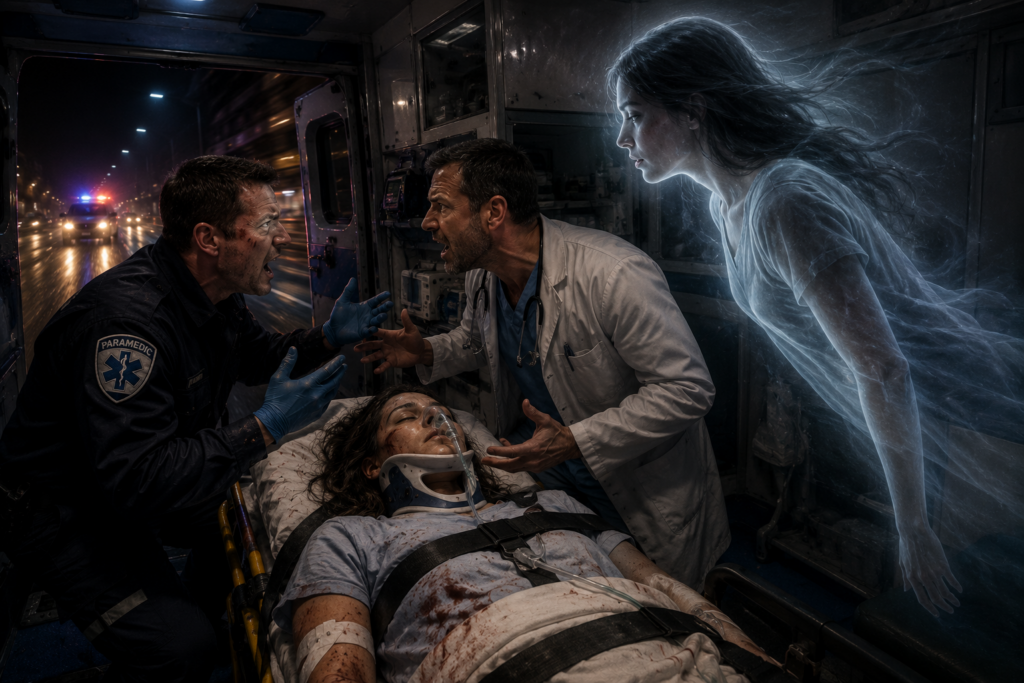
She specifically recalled witnessing a heated argument between a doctor and a paramedic during her ambulance transport, an argument she described as resulting in the paramedic sustaining a minor injury to his nose. That account was corroborated by the medical professionals who were there.
Sit with that. A woman with a Glasgow Coma Scale of 3, a brain hemorrhaging and physically exposed, accurately reported a specific, checkable, human event, an argument between two named roles, ending in a specific minor injury, that occurred around her physical body while she was in the deepest measurable coma a living person can be in. And it was confirmed.
But yet she had an Out of Body Experience (OBE) during a first Near Death Experience (NDE), and made veridical observations of things that occurred while her (now dead) body was in the ambulance.
Part Two: The Operating Theater
She also provided precise descriptions of the operating theater, the specific surgical tools used, the appearance of the medical personnel, and even snippets of their conversations. This is the second observation, and it is physically separate from the first, a different room, a different phase of her care, a different set of people, after the entire transport and admission that lay between the ambulance and the surgical suite.
Two verified observations. Two locations. One in the ambulance, one in the operating theater. Keep that geography in mind, because later it tells us something important about how this actually unfolded.

Astonishing Sensory Clarity: The Detail That Cannot Be Explained by a Body
There is one phrase inside that second observation that I refuse to let slide past, because it may be the single hardest piece of physical evidence in the entire case. She reported an astonishing sensory clarity. She said her perceptions were far more vivid than in her normal conscious state.
I want to take that apart slowly, because it does two devastating things at once.
First, consider what her body was capable of at that moment. Her right eye socket was a burst fracture. Her face was fractured with cerebral tissue exposed. She had a non-reactive pupil, a hemorrhaging brain, and a Glasgow Coma Scale of 3. It would be impossible, flatly impossible, for this woman to have had any meaningful vision at all through those eyes. You cannot see the fine detail of surgical instruments and read the faces of the staff and catch fragments of conversation through an eye socket that has been blown apart in a horrific traffic accident, attached to a brain that is offline. The visual perception she reported could not have come through her physical eyes, because her physical eyes were destroyed and the brain behind them was not functioning.
Second, and this is the part that turns an impossibility into a signature, look at the direction of what she reported. A damaged eye and a shattered brain should produce degraded perception, if any at all. Dimness. Fragments. Nothing. She reported the exact opposite. Enhanced perception. Vision and sensation more vivid than normal waking life, delivered by a body that should not have been able to perceive anything.
That inversion is one of the most specific and consistent markers of the authentic near-death experience in the entire literature. The soul does not see through eyes. It perceives with a clarity that has nothing to do with the condition of the body it left behind, and it perceives more sharply precisely because it is no longer looking through eyeballs, retinas, and optic nerves at all. This is the same phenomenon documented in the blind NDE cases, people blind from birth who accurately see during their near-death experience, some describing sight for the first time in their lives. Her case is a variant of exactly that. She was not born blind. She was functionally blinded by catastrophic injury, her seeing apparatus destroyed, and yet she perceived with astonishing clarity. Sight without a working visual system means the seeing is not being done by the body.
And notice the exact word the report uses. Not vision. Perceptions. All of it. Every sensory channel, heightened, at a moment when her entire sensory apparatus was either destroyed or shut down. Not one channel enhanced. The whole suite, sharper than waking life, coming from a body that could not deliver a single degraded scrap of it.
There is no materialist mechanism for that. There is only one explanation that fits: the thing doing the perceiving was no longer inside the ruined body. The soul had departed the body, and it was seeing the room with the perfect, unobstructed clarity that the near-death record describes again and again.
The Missing Pieces, Named Out Loud
Now I am going to do the thing that separates honest analysis from cheerleading. I am going to point directly at what this report does not contain, because the gaps are as revealing as the content, and I have no interest in hiding them.
The report contains no documentation of a clinical flatline. There is no account of cardiac arrest. There is no description of resuscitation efforts. There is no moment where the paper says, and here her heart stopped, and here it was restarted. And there is no testimony from the patient of the classic being told to go back, no spirit guide sending her home in so many words.
I want that stated as plainly as possible, on the record, in my own voice: the paper does not, anywhere I can find, document a certifiable clinical death.
And yet. Here is my prediction, and I will put a number on it. I am about 99 percent confident that if the complete clinical medical records of this case could be obtained and reviewed, the full emergency, ambulance, and operating-theater records, not the psychiatric summary, they would show a documented clinical death with resuscitation at some point during this event. Most likely at precisely the moments she was reporting her verified out-of-body observations.
Why am I that confident, when the paper does not say it? Two reasons.
First, because of the veridical perceptions themselves. She accurately saw the physical world from outside her body, with enhanced clarity, through a destroyed visual system. By everything I understand about this phenomenon, that requires genuine death. You do not leave your body and accurately observe an argument in the ambulance, or read the surgical suite with vision sharper than waking life, while the body is merely sleeping. You leave when the body dies. The evidence for the flatline is inside her verified observations. The observations are the flatline’s fingerprint, even though the paper never names the flatline directly.
Second, because of who wrote the paper. This is a psychiatric analysis. Two of the three authors are psychiatrists, and the entire framing is about the mind, consciousness, psychological transformation, and the implications for psychiatric practice. That is their department. The cardiac timeline, the exact minute the heart stopped and the exact intervention that restarted it, is not their department. It lives in the emergency and surgical records, and a paper about the nature of consciousness would have no particular reason to foreground it. The omission is not evidence there was no death. It is evidence that the people who wrote this were not looking at the part of the chart where the death would be recorded.
So I am not hiding the gap. I am highlighting it, explaining it, and telling you exactly where I believe the missing piece is sitting.
An Open Invitation to the People Who Were in the Room
Which brings me to a direct request, and I mean it as sincerely as I have ever meant anything.
To the physicians, paramedics, and surgical staff who treated this patient, and most especially to the doctor who was in the operating theater during the events she accurately described, I invite you to go back to the complete clinical record and check. Not the psychiatric summary. The full medical chart. Look for a documented cardiac arrest and resuscitation, and look at when it occurred relative to the perceptions she later reported. I am predicting you will find it, and I am predicting it will line up with her out-of-body observations.
I did the same thing yesterday with the Schug case, and I will do it with every case I examine. I am not asking anyone to take my word. I am asking the people who hold the records to look, because the missing detail is checkable, and checking it either strengthens this case enormously or moves me off my position. Either outcome is fine with me. That is how this is supposed to work.
Follow the data.
The Turnstile at Disney: What the Narrative Appears to Show
Here is a section about what she did not report, at least not in the paper’s written narrative, because at first read the absences look like they tell one story. In a moment I am going to show you why the Greyson score tells a very different one. But let me walk the first reading honestly, because it matters.
When you lay out everything a full, extended near-death experience contains, it is a long sequence. The out-of-body experience is only the very first stage, the front door. After it, in the deeper accounts, comes a spirit guide or presence, then movement into a void, then the formation of a tunnel, then a light at the far end, then movement through that tunnel, then a telepathic encounter with the source, the being of light. Then, often, a life review. Then a garden. Then encounters with deceased loved ones. Then, in the deepest accounts, a review of the current life’s purpose with guides, and even a review of past incarnations.
Now look at what the paper’s narrative actually describes. It describes the out-of-body experience, vividly, verifiably, in two locations. And in its written account, that is essentially where it stops. No spirit guide narrated. No void. No tunnel. No light at the end of a tunnel. No telepathic meeting with the source. No life review. No garden. No deceased loved ones. On the face of the prose, she got through the front gate and the story ends.
Think of it like arriving at Disney. On the strength of the narrative alone, it looks like she made it through the turnstile at the front, the out-of-body experience, the very first thing that happens when the soul leaves the body, and never got past the front gate to the rest of the park.
There is a clean explanation for a case that really does stop at the turnstile, and it comes down to time. Or rather, to how little time a person spends dead.
The deep NDE sequence unfolds for people who are dead for longer stretches. Someone who is clinically dead for several minutes tends to have the full journey, the whole itinerary from the tunnel onward. But someone who is dead only very briefly gets nothing but the opening, the out-of-body experience, the first thing that happens when the soul separates, and then resuscitation yanks them back before the tunnel ever has a chance to form.
I have studied thousands of near-death experiences, and cases like this, the ultra-brief ones, appear again and again in the data. One in particular has always stayed with me, and it came straight to mind reading this woman’s account. A man died on an operating table. He flatlined, left his body, and found himself outside of it with a spirit guide already there waiting for him. He barely had time to look around and get his bearings, to register what was even happening, before the surgical team brought him back. In the sliver of time he had, he managed a single telepathic exchange with the guide, who told him, right at the instant the doctors were reviving him, whoops, looks like you gotta go, and just like that he was slammed back into his body. The whole out-of-body experience may have lasted ten seconds. Ten seconds of death. Just long enough to leave, meet the presence, and be sent right back. No tunnel. No light. No life review. The resuscitation was too fast for any of it.
And here is the part that matters for understanding why these ultra-brief cases are showing up more and more. They are, in a very real sense, a product of modern medicine. Think about it. If you are going to die, the single best place on earth to do it is in an operating room, fully staffed, surrounded by trained professionals and every piece of equipment ever designed to keep you from staying dead. A person who flatlines on the table in a modern surgical suite is often brought back in seconds, faster than at any other time or place in human history. Modern medicine has quietly created a whole category of experience our ancestors almost never had: the flash death, the ten-second departure, the trip that ends at the front gate because the crash cart was already in the room.
Hold that reading in one hand. It is the story the paper’s narrative appears to tell, and it fits the two places she died, the ambulance and the operating theater, the two environments on earth most engineered to make death brief. Now let me put something in your other hand that complicates it, and I think corrects it.
The Buried Headline: What a Score of 28 Actually Proves
The paper tells us she scored 28 out of 32 on the Greyson NDE Scale, and then it moves on. It does not walk us through the phenomenology behind that number. And that number is the most important single fact in the entire case, so I am going to unbury it.
Here is how the Greyson scale works. It is 16 questions. Each question is scored 0, 1, or 2. Sixteen questions times a maximum of 2 points each equals 32 points total. She scored 28.
Do the arithmetic on what that requires. To reach 28 out of 32, she gave up only 4 points across all 16 questions. That means at most a handful of items scored a 1 instead of a 2, and the overwhelming majority of the 16 questions were answered at the full value of 2. You cannot arrive at 28 any other way. She had to have positively and strongly endorsed nearly the entire scale.
And now look at what the 16 questions actually ask about, because this is where the front-gate reading falls apart. The Greyson items span four domains. The cognitive items ask about altered sense of time, accelerated thoughts, a life review, and a sudden sense of understanding everything. The affective items ask about a feeling of peace, a feeling of joy, a sense of cosmic oneness, and an encounter with a brilliant light. The paranormal items ask about vivid or heightened senses, extrasensory perception, precognitive vision, and the out-of-body experience. The transcendental items ask about entering an unearthly realm, encountering a mystical being or presence, seeing deceased or religious spirits, and reaching a border or a point of no return.
The out-of-body experience is one item. Heightened senses is one item. Those two, the entire content the paper narrated, account for at most 4 points. She scored 28. Which means roughly 24 more points came from the other 14 questions, the light, the peace, the joy, the cosmic oneness, the mystical presence, the unearthly realm, the border, the altered time, and, very likely, a life review.
There is the buried headline, in plain sight. A score of 28 is mathematically incompatible with a front-gate-only experience. It is impossible to score 28 on the Greyson scale from an out-of-body experience and heightened senses alone. The number itself, recorded by the psychiatrists in their own paper, proves she experienced a large, rich, multi-domain authentic near-death experience, the tunnel, the light, the presence, the border, in all likelihood the life review, the whole deep journey. She went far, far past the turnstile. She got well into the park.
So the two readings resolve, and they resolve in one direction. The paper’s written narrative described only the out-of-body observations, which made the case look like a brief front-gate trip. But the Greyson score the same paper recorded proves that narrative is radically incomplete. The psychiatrists scored the full journey and then wrote up only the part that happened to intersect the physical room. Everything that generated that 28, the light and the presence and the border and the review, they left on the cutting-room floor.
Which forces a revision of the timing, and I will make it honestly. If she scored 28, then she was not dead for only ten seconds. At least one of those deaths lasted long enough for the full itinerary. The turnstile image is still exactly right for what the paper’s prose shows you. It is just that the prose was not the whole experience, and the score is the proof.
So here is my second 99 percent prediction of this analysis. Get me that completed Greyson questionnaire, item by item, the actual interview behind the number, and I will show you one hell of an authentic near-death experience. A full one. The score is a promissory note, and the journey it promises is enormous.
Two Events, Not One: The Geography Still Matters
Even with the deep journey restored, the geography of her two verified observations still tells us something specific about the shape of this event.
One accurate observation happened in the ambulance, the argument and the injured nose. The other happened in the operating theater, the tools and the staff and the conversations. Two different physical locations, separated by the entire transport to the hospital and the move into surgery.
My inference, and I will flag it clearly as my inference, not as something the paper states, is that this was very likely two separate clinical deaths, not one continuous departure. She died in the ambulance, left her body, observed the argument, and was brought back. Then, later, in the operating theater, she died again, left her body again, observed the surgical staff, and was again brought back. The two accurate observations in two separate rooms are the fingerprints of two separate exits.
How the deep journey and the two brief observations fit together, whether the full itinerary happened during the longer of the two deaths and the ambulance exit was the brief one, I cannot say from a four-page summary, and I am not going to pretend to. I do not have a moment-by-moment interview with this woman. I do not have a leisurely recorded conversation where she narrates every detail as she remembers it. I have a psychiatric case report, three doctors saying, in effect, this one is remarkable, look at it. So I am reasoning from a summary, and I am telling you that is what I am doing. But two verified observations in two locations point clearly to two separate departures, and a score of 28 points clearly to at least one of them being long and deep. Both things are in the evidence. The full interview would tell us how they line up.
The Aftermath: The Tell That Breaks the Skeptics’ Favorite Argument
And now the piece that, for me, closes the case.
Before the accident, this woman had documented suicidal ideation. After her experience, that ideation was completely resolved. The paper reports she emerged with a renewed and profound appreciation for life, improved emotional regulation, and a genuine spiritual curiosity that she expressed by talking with the staff, again and again, about what she had experienced and about the nature of consciousness itself.
The clinicians are careful, and I will be careful with them. They note that no formal psychometric testing was administered to quantify this change. It was observed clinically, over a long rehabilitation, by the medical team. So I am not going to call it a measured result. I will call it exactly what it was: a profound, clinically observed transformation, from a suicidal person to a person in love with being alive.
Here is why that matters more than any single other piece of the case.
That transformation is one of the most consistent, well-documented signatures of an authentic near-death experience. People who genuinely die and come back are changed, deeply, durably, for the better. Reduced fear of death, increased compassion, a reordering of what matters, a new appreciation for life. It is arguably the most reliable aftereffect in the entire NDE literature. So the fact that this woman shows it is not a footnote. It is additional corroboration that a real near-death experience occurred. The transformation is a fingerprint, and it matches.
But now look at what it does to the skeptic’s standard move. The reductionist explanation for any distressing near-death account is trauma. It was just a frightening brain event, ICU delirium, a hallucination under stress. Fine. But here is the problem that explanation cannot survive. Trauma leaves trauma.
And this is not a small point, so I want to be exact about it. The medical literature on fear-coma and catastrophic-coma survivors is thick with post-traumatic stress. Nightmares. Hypervigilance. Worsened depression. Flashbacks. More suicidal ideation, not less. PTSD shows up all over that literature, because a person who lived through what she lived through on the fear-coma side is exactly the kind of person who should come out scarred. That is the expected outcome. That is the base rate.
Note the complete and total absence of any of it in her case. No reported PTSD. None. The opposite happened. She went through the full hellscape, the dread, the distorted environments, the terrifying images, everything the fear coma had to throw at her, and she came out the other side with her suicidal ideation gone and a renewed love of life.
Something overwrote the damage. And I think the mechanism is the most remarkable thing about this entire case. The positive aftereffects of her authentic near-death experience did not merely sit beside the wreckage the fear coma should have left. They erased it. The healing half of her Welded NDE was powerful enough to wipe out the negative aftereffects the terror half should have carved into her for life. The fear coma should have scarred her. The NDE cancelled the scar before it could form. Good for her. She got lucky, genuinely lucky, because the two halves of a Welded NDE do not always net out that way, and in her case the good half won, decisively and completely.
That is an unusually beautiful outcome for a Welded NDE, and it is also the final nail in the trauma coffin. Her aftereffects behaved exactly like authentic-NDE aftereffects, transformative and healing, and nothing at all like trauma aftereffects, which scar. Trauma does not cure people. Something cured this woman, right on top of an experience that, by the trauma theory, should have devastated her. The only thing that reconciles a hellscape with a healing is that the hellscape was the fear coma, and welded to it was a genuine near-death experience, and it is the NDE half that does the healing, every single time.
She Is Telling the Truth
Before I summarize, I want to set the analysis down for a moment and say something plainly, as a human being talking about another human being.
This woman is telling the truth. She is not making any of it up. She is not exaggerating, not performing, not inventing. She experienced both things, hell and heaven, as a result of one accident and one trip to the hospital, and she is reporting exactly what happened to her, as honestly as anyone can report anything.
This is a Welded NDE precisely because it is literally impossible for her to understand how it could have been possible to experience both. How could one accident, one ambulance, one operating room, produce both the terror and the transcendence? She has no framework that separates them, because the two halves have no timestamps and have fused in her memory into one event. If you put her on a polygraph and asked her whether she went to hell, she would pass. If you asked her whether she went to heaven, she would pass. Because both are true. She visited hell while she was still alive and suffering through a fear coma, and she visited heaven when she was, briefly, actually dead. Those are real experiences. Both of them. No one can take that away from her, and no one should ever try.
I feel for her. Everything she went through, the crash, the ruined body, the twenty days gone, the terror, the long climb back through rehabilitation, and all of it landing on a young woman who was already carrying depression and thoughts of ending her life before any of this ever happened. If I could reach across whatever distance separates us, I would give her a cosmic hug and a kiss on the forehead and tell her she is going to be all right. In a strange and roundabout way, the worst day of her life may have handed her the thing that saved it.
What This Case Proves
Set it all side by side.
A verified, corroborated out-of-body experience, twice, in two locations, which requires genuine death. Astonishing sensory clarity, perception sharper than waking life, delivered through a destroyed eye socket and an offline brain, which no body could produce and which is a hallmark signature of the authentic NDE. A score of 28 out of 32 on the Greyson scale, which by simple arithmetic proves a deep, multi-domain near-death experience the paper narrated only a sliver of. A geography of two separate observations that points to two separate deaths. A clinically documented transformation from suicidal to life-affirming that both corroborates the authentic NDE and detonates the trauma explanation. A complete absence of the PTSD the fear-coma literature would predict, because the NDE aftereffects overwrote the damage. And a set of missing clinical records that I am 99 percent confident, if checked, will show the flatlines the evidence already tells us were there.
Both halves. Hell and heaven. In one event. Welded in memory because there was no clock to keep them apart. This is not a distressing NDE in the muddled sense the field usually means. It is a Welded NDE, a fear coma and an authentic near-death experience, fused, and it is the clearest one I have found, precisely because it came from clinicians who documented both halves without realizing that the two halves were the whole story.
The ancient traditions were right that hell is real. This case shows you where it lives, in the terror of a living brain in catastrophe. And it shows you, in the same woman, in the same twenty days, that when she actually died, there was no hell waiting there at all. There was only the accurate, vivid, verifiable view from outside her body, and then, in the aftermath, the peace that gave a suicidal woman her life back.
That is a Welded NDE. And I will keep examining every one I can find, exactly this closely, for as long as they keep turning up.
If you were in that operating room, you know who you are. Go check the record. I think you will find precisely what I have described.
Want to go deeper? Don Winner brings decades of intelligence and investigative experience to the biggest question there is: what happens when we die.
In You’re Going to Die Someday, Right? Near-Death Experiences Reveal What Happens Next, he examines the evidence from thousands of near-death experiences to find out what they actually tell us about consciousness, the soul, God, and the afterlife.
In Hell Exists, But Only for the Living, he investigates where our idea of hell came from and who built it, tracing the doctrine back to its human sources.
Get your copy of You’re Going to Die Someday, Right? or Hell Exists, But Only for the Living.