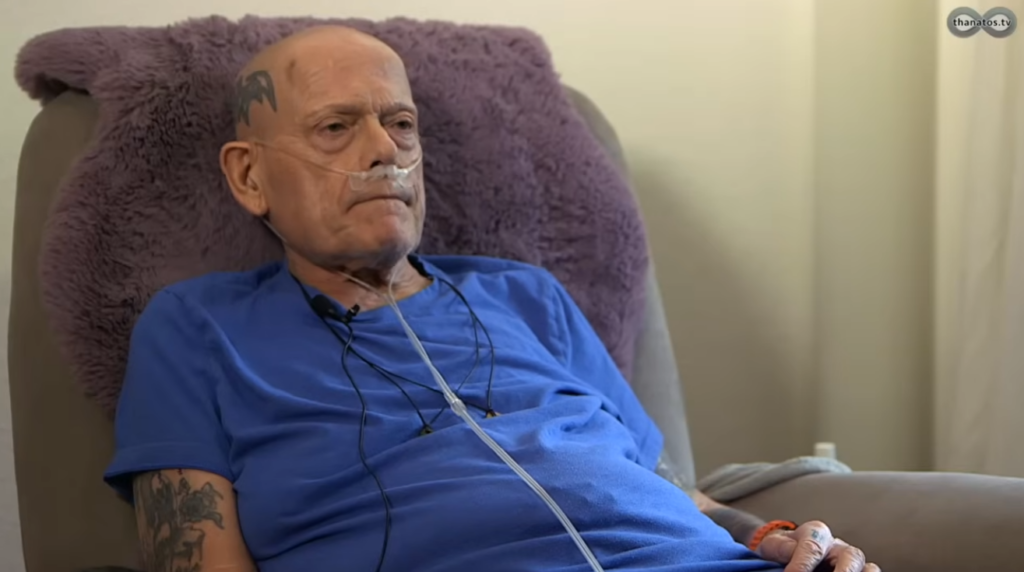
Every so often an account comes along that is worth slowing down for. Not to attack it, and not to defend it, but simply to hold it up to the light and look at it carefully, one piece at a time. Gerhard Schug’s story is one of those. It has been published and shared as a hellish near-death experience, a man who “died and went to hell” and came back to talk about it. Tens of thousands of people have watched him describe it.
I want to walk through it slowly here, because when you examine this particular account against the framework laid out in Hell Exists, But Only for the Living, something quietly remarkable happens. It fits. Not loosely, not with the edges filed off — it fits perfectly, point for point, in Schug’s own words. This is exactly the kind of case the book was written to explain. And it is exactly the kind of case that has been given the wrong name for decades. What Gerhard Schug had was not a near-death experience of any kind. It was a Fear Coma Experience, an FCE, and by the end of this article I am going to make the case that we should call it that, and stop calling it anything else.
I’d invite you to watch the source material yourself and check my work as we go. Two interviews with Gerhard Schug, both from the German outlet Thanatos TV, are the primary sources:
- “I’ve Ended Up in Hell” | Gerhard Schug’s Near-Death Experience (the original, roughly 30 minutes, published November 6, 2025, and viewed more than 54,000 times) — https://www.youtube.com/watch?v=W-y1sD7Kjt4
- After the Hellish Experience, A Miraculous Recovery | Gerhard Schug in Conversation (the follow-up, recorded about a month later) — https://www.youtube.com/watch?v=d5p_hPVypM8
Go watch them. Then come back and let’s look at what he actually said.
First, and Most Important: Gerhard Schug Is Telling the Truth
Let me be completely clear before going a single step further. Nothing in this examination is aimed at Gerhard Schug. He is a sick, elderly man who has lived through more suffering than most people could carry — the loss of his eldest daughter, years of severe illness, a suicide attempt born of overwhelming grief and loneliness. When he describes what happened to him, he is telling the absolute truth as he experienced it. Every word he says is honest. He is not exaggerating, not performing, not inventing. That was his experience, and it was real, and it was searing enough that it burned itself into his memory for years.
I believe him entirely. That is the whole point. This examination works because he is telling the truth. If you take his account at full face value, every detail exactly as he reports it, it still turns out not to be a near-death experience at all. It turns out to be something the account itself proves, once you have the right framework to see it, and the right name to call it.
And here is my own confession, because it matters: before I wrote Hell Exists, But Only for the Living, I would not have been able to tell the difference either. I would have watched this video, heard “near-death experience,” heard “hell,” and filed it away like everyone else. It took the research behind the book to be able to look at an account like this and see what is really there. So this is not about Schug missing something. It is about finally having a lens clear enough to see it.
About That Label — “Near-Death Experience”
It’s worth pausing on how this account came to be called a near-death experience in the first place, because Schug himself didn’t arrive with that label. Watch the opening of the original interview. Before Schug has characterized anything at all, the interviewer sets the frame, saying he’d like to begin with the 2020 event “that subsequently led to a special near-death experience.” The category is handed over at the very top, prepackaged. From there Schug, understandably, carries the term the rest of the way, later echoing it back — “I became aware of my near-death experience.” By the time the video is titled and published, “Near-Death Experience” is stamped right into the headline.
None of that is a mark against Schug. He is a witness describing an experience, not a researcher classifying one, and “NDE” is simply the only phrase our culture hands people for “an intense experience around the time you die.” He reached for the word that was offered to him. That’s what anyone would do.
But the label is wrong, and the beautiful thing is that Schug’s own testimony is what proves it wrong. He doesn’t need to be corrected by me. He corrects the label himself, without realizing it, every time he opens his mouth to describe what actually happened. So let’s let him do exactly that, and then let’s give the experience the name it should have had all along.
Point One: Schug Never Died
This is the quiet hammer, and it’s the whole book in a single fact. A near-death experience — the beautiful kind, the light and the crossing over — happens to people who genuinely die. The hellish experience is different. It happens to people who do not die. It’s a phenomenon of the living brain in crisis, which means you don’t reach it by dying — you reach it by not dying, while your body fights its way through catastrophe. That isn’t a contradiction. It’s the entire argument, and it’s right there in the book’s title: hell exists, but only for the living.
Schug never died. He tells us so himself, in detail. He attempted suicide with a large quantity of medication — he was a pharmaceutical chemistry lab technician with access to it, took two months’ supply in both hands, and washed it down with beer. He was rushed to intensive care. Before he woke, the doctor told his daughter that her father would most likely not survive the overdose, and that if he did survive, he would probably suffer severe brain damage.
Read that carefully. Most likely not survive. But he did survive. He was never gone. Throughout the entire ordeal he was alive — critically, desperately, precariously alive — in an intensive care unit, his body absorbing a massive chemical assault. There was no death. There was no flatline, no crossing over, no return from the other side. There was a living man in the deepest medical crisis of his life. That is the soil a fear coma grows in, and it is the opposite of the soil a genuine near-death crossing requires.
He “died and went to hell,” the story goes. He went somewhere terrifying, yes. But he never died. And that single fact reclassifies everything.
Point Two: It Lasted for Days, Not for a Moment
An authentic near-death experience, the kind reported by people whose hearts have genuinely stopped, happens in the narrow window right when a person dies — during a clinical flatline. And when people are clinically dead, they are usually revived and returned to their physical bodies relatively quickly. What defines it is when it happened: at the moment of death, in a body that had actually stopped.
Schug’s experience was the other kind. He wasn’t in a flatline. His heart was beating and his body was alive the entire time — for five or six days that he spent unconscious in intensive care. He says the experience “obviously lasted five or six days,” a span he only learned about afterward, and that he was “there the whole time.” That’s the tell. Not a moment inside a stopped body, but an unbroken ordeal running the full length of a living-body medical crisis.
That’s the signature, and notice what it rests on: not how long the experience lasted, but what his body was doing while it happened. A near-death experience happens in a body that has stopped, and it ends when the person is revived — usually within minutes. Schug’s ran for five or six days in a body that never stopped at all. His heart was beating and his brain was fighting the whole time. The coma was the experience — his mind generating hell for as long as it took to pull him through, every hour of it on the living side of the line between alive and dead.
Point Three: The Hell He Saw Was Furnished From Inside His Own Mind
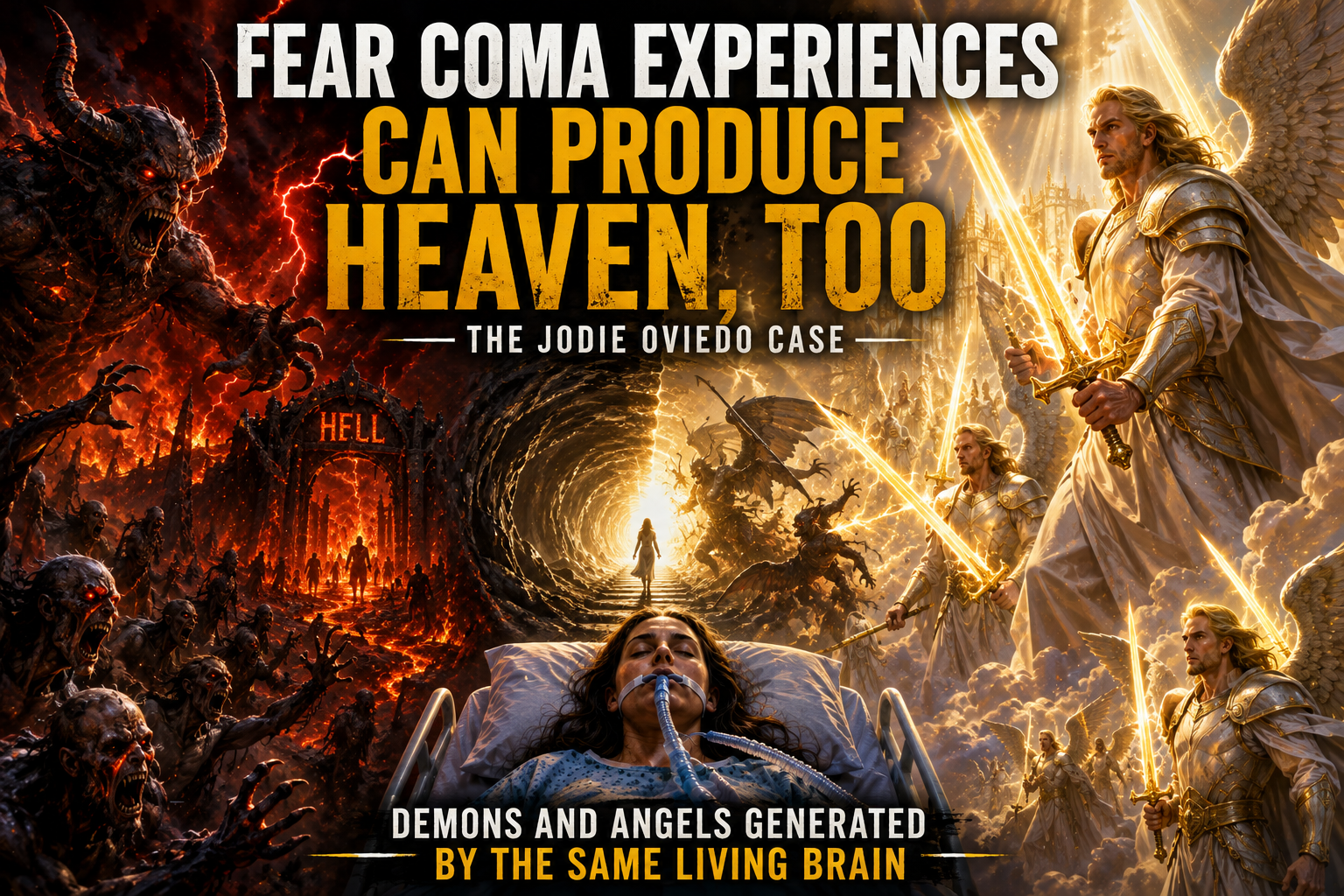
This is the part that confirms and cements everything, and it is the reason I wanted to include the links so people can hear it in his own voice. Schug describes his hell in vivid, specific detail: a vast grey stone palace with a high canopy roof “like those found in China or Japan,” a flat stone throne, and seated on it a devil — red, horned, radiating heat, “just like you might imagine your typical devil.” Souls arrived by old Japanese-looking boats moored at a jetty, were carried to the throne, and were sorted; some were dropped into a funnel and ground up by a mechanism of turning stone lion’s claws that made a terrible grinding, creaking roar.
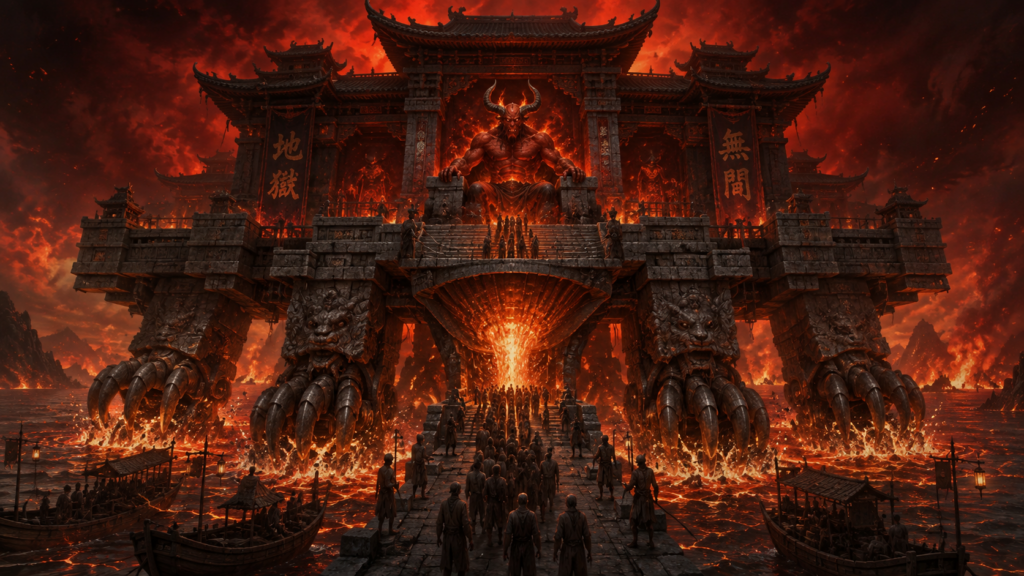
Now listen to what Schug says next, completely unprompted, right in the middle of describing it:
“I should mention that I was raised Catholic, which may have played a role in my experience.”
He hands us the key himself. He knows. Some part of him recognizes that the red horned devil, the sorting and grinding of souls, the fire and the heat, the whole architecture of judgment — that this is the hell he was raised on. A man brought up Catholic, thrown into the most extreme physiological emergency of his life, produced a Catholic hell. Not a Buddhist one, not a Norse one, not an abstract one. The specific one his own mind had been furnished with since childhood.
And notice the other furnishings, too — the Chinese-or-Japanese palace, the Japanese boats. Those aren’t from Catholic doctrine. Those are other images his particular mind happened to be carrying, stitched into the scene alongside the catechism. The whole vision is assembled, piece by piece, out of the contents of one specific human memory.
This is the entire model, demonstrated inside a single skull. The raw material of the hellish experience — the terror, the sense of judgment, the dread — is a universal product of the human brain in extreme crisis. But the costume is always local. The devil looks the way your culture drew the devil. The realm is decorated with your memories. That is exactly why hellish accounts across the world share a deep structure of torment and terror, yet each one wears the specific religious clothing of the person having it. Schug shows you both halves at once: the universal terror, and the personal, Catholic-and-otherwise imagery painted over it. It all came from inside his own still-living mind, and he all but says so.
A soul that had genuinely crossed into an objective afterlife would not need to borrow its scenery from the visionary’s childhood religion. A living brain in crisis has no other scenery to use.
Point Four: He Described the Opposite of a Near-Death Experience
For all that his interview is titled and framed as an NDE, Schug’s own description flatly rejects the classic near-death experience. In both interviews he says a version of the same thing, and it is worth quoting because he draws the distinction more sharply than I could:
“What I experienced during my near-death experience was not a bright light and then you cross over and everything is beautiful. For me, it was exactly the opposite. I ended up in hell.”
He uses the borrowed label — “my near-death experience” — and then in the very same breath describes the precise opposite of one. No light. No crossing over. No beauty. The exact inverse. He is telling you, using the only vocabulary he has, that whatever this was, it was not the thing that word is supposed to mean. The words fight the label. The label loses.
(One small note for the careful viewer: that “not a bright light… the opposite… I ended up in hell” line appears at the head of the second video as its opening hook, and it also appears in the original 30-minute interview around the ten-minute mark. It looks very much like the follow-up video reuses the original’s signature line as a cold open. Either way, the words are his.)
Point Five: It Was Real, and Permanent, and That Is Not a Problem
Schug anticipates the skeptics, and his answer deserves respect. He knows some people will wave his experience away as ICU delirium or drug withdrawal, and he pushes back: “I know I was there and that’s what matters to me.” He also contrasts it with dreaming — he says he rarely remembers dreams, that when he does they fade in seconds “like a flare,” but that this experience burned itself into his brain and is still vivid years later.
He is right on every count, and here is the crucial thing: none of that argues against the fear coma framework. It confirms it. A fear coma is not a lie and not a trivial hallucination to be dismissed. It is a genuine, overwhelming, permanently encoded experience of a real event happening in a real brain. Schug’s insistence that it was real, that he was truly there, that it marked him for life — all of that is exactly what the framework predicts. The mistake reductionists make is thinking the choice is between “real afterlife” and “meaningless brain glitch.” It is neither. It is a real experience, correctly located: in a living brain, on this side of death, not in a realm waiting beyond it.
Not real versus fake. Alive versus dead. That is the only distinction that matters, and Schug lands on the correct side of it in his own testimony.
A Better Name: The Fear Coma Experience (FCE)
We have now watched Gerhard Schug prove, in his own words, point by point, that his experience was not a near-death experience. He never died. It lasted five or six days in a living body. The imagery came from his own memory. He described the exact opposite of a real crossing. And it was a genuine, permanent experience of a real event in a real brain.
So here is the honest question. If it was not a near-death experience — and it was not — why on earth do we keep calling it one?
The current term for cases like his is “distressing NDE.” That term is not merely imprecise. It is false, and it does real harm every time it is used. It takes the words “near death,” staples them onto an experience in which nobody came anywhere near death, and then hands that false label to frightened people as if it were evidence of what waits for them after they die. A man in a five or six day overdose coma who never once flatlined was never near death in any sense the phrase is supposed to carry. He was deep in a living-brain crisis, fully alive the entire time. Calling his terror a near-death experience is a category error dressed up as a diagnosis, and that error is precisely why these accounts get weaponized as proof that hell awaits on the other side. They are not proof of anything on the other side, because the people who had them never went there.
There is a correct name for what Gerhard Schug experienced, and I am planting the flag for it here. It is a Fear Coma Experience. An FCE.
Say it plainly and the whole muddle clears. He did not die. He did not have a near-death experience. He had a fear coma, and inside that fear coma he had an experience — a vivid, terrifying, permanently encoded experience of hell, generated by a living brain in catastrophe. That is a Fear Coma Experience. Not an NDE. Not a “distressing NDE.” An FCE.
The name does everything the old label failed to do. It locates the event in the right place, the living brain. It identifies the right mechanism, the fear coma. And it makes no false promise about death, because no death occurred. A Fear Coma Experience is not a near-death experience, for the simplest possible reason: the person was never near death. They were, the entire time, near life, fighting their way back to it.
Right now, almost no one is using this term. That is exactly why it matters that someone start. The field has spent decades calling these events by a name that gets them precisely backwards, and frightened people have paid the price for the confusion. It is time to name them correctly. So from this article forward, on this website and everywhere I have any say in the matter, the experiences currently mislabeled “distressing NDEs” will be called what they actually are: Fear Coma Experiences. FCEs.
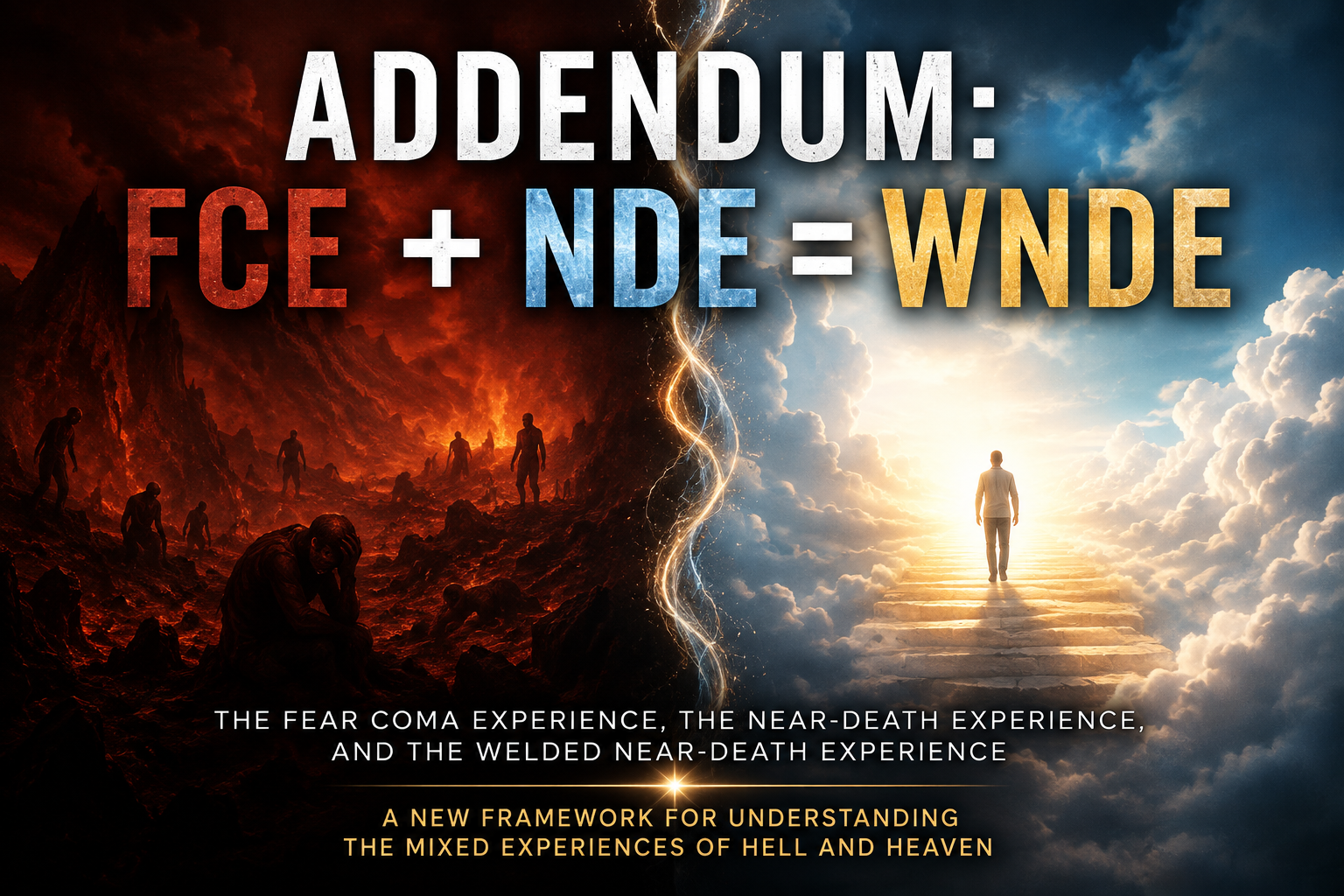
That gives us three honest names for three genuinely different things. If a person truly died and had the peaceful, verifiable, out-of-body sequence, that is a near-death experience, a real one. If a person did not die and suffered hellscape imagery in a living brain, that is a Fear Coma Experience. And in the rare cases where a person had both, a fear coma and a genuine documented death in the same event, fused in memory because there was no clock to keep them apart, that is a Welded NDE. Three things. Three names. No more stapling “near death” onto experiences where nobody came near death at all.
Gerhard Schug’s case is a Fear Coma Experience, cleanly and completely. It is as good a place as any to drive the first stake into the ground.
What the Account, Taken Whole, Actually Proves
Set the pieces side by side, all of them in Schug’s own words, and the picture is seamless. He never died — the doctors expected him not to survive, but he did, and he was alive in intensive care the entire time. His experience ran for five or six days, the full length of his coma, not the brief window of a genuine flatline death. He described the exact opposite of the classic bright-light crossing, and said so plainly. And the hell he saw was built from his own Catholic upbringing and his own stock of images — a detail he volunteered without being asked.
Every single element points the same direction. This is not a near-death experience in any sense the title claims. It is a Fear Coma Experience — a hellish experience of a living man — and it is one of the cleanest examples I have come across, precisely because Schug is so honest and so detailed that he leaves all the evidence sitting right there on the surface for anyone to find.
The ancient traditions were right that hell is real. They were only ever wrong about where it was waiting. Gerhard Schug did not go to hell because he crossed over. He went to hell because, for five or six days, he didn’t cross over — he stayed here, alive, and his brain gave him the worst of what it had. That is not a contradiction of the idea that hell is real. It is a confirmation of where it actually is.
An Open Invitation, and an Announcement
Hell Exists, But Only for the Living was written in response to a challenge. People pushed back on the earlier work with the one category it hadn’t fully addressed: what about the people who say they died, went to hell, and came back? What about the terrifying cases, the ones that don’t fit the beautiful picture?
Here’s the thing. They were right. Hell is real. The darkness is real, the terror is real, the devils and the fire and the grinding of souls are real experiences that real people really have. The challengers had a genuine point — I just followed it somewhere they didn’t expect. Hell exists. It’s simply not where you were told it was, and here is the part that changes everything: you cannot get there if you’re dead. You have to be alive. That is the whole book in one sentence, and Gerhard Schug’s account demonstrates it as cleanly as any case I’ve seen.
So consider this an open call. I am actively hunting for more cases exactly like this one — accounts from anywhere on the planet, in any language, that have been published and labeled as a near-death experience, a hellish NDE, or a distressing NDE, a man or woman who died and went to hell and came back. Every one of them that checks out is not an NDE at all. It is a Fear Coma Experience. If you know of one, send it my way. I want to examine each of them the same way, closely and honestly, in the experiencer’s own words, held up against the framework and checked point by point.
Because so far, every time I look closely, the same thing happens. He went to hell, alright. He was never dead. Next!
Prefer to watch the video? I made this short clip for YouTube, to cover this text article;
Want to go deeper? Don Winner brings decades of intelligence and investigative experience to the biggest question there is: what happens when we die.
In You’re Going to Die Someday, Right? Near-Death Experiences Reveal What Happens Next, he examines the evidence from thousands of near-death experiences to find out what they actually tell us about consciousness, the soul, God, and the afterlife.
In Hell Exists, But Only for the Living, he investigates where our idea of hell came from and who built it, tracing the doctrine back to its human sources.
Get your copy of You’re Going to Die Someday, Right? or Hell Exists, But Only for the Living.