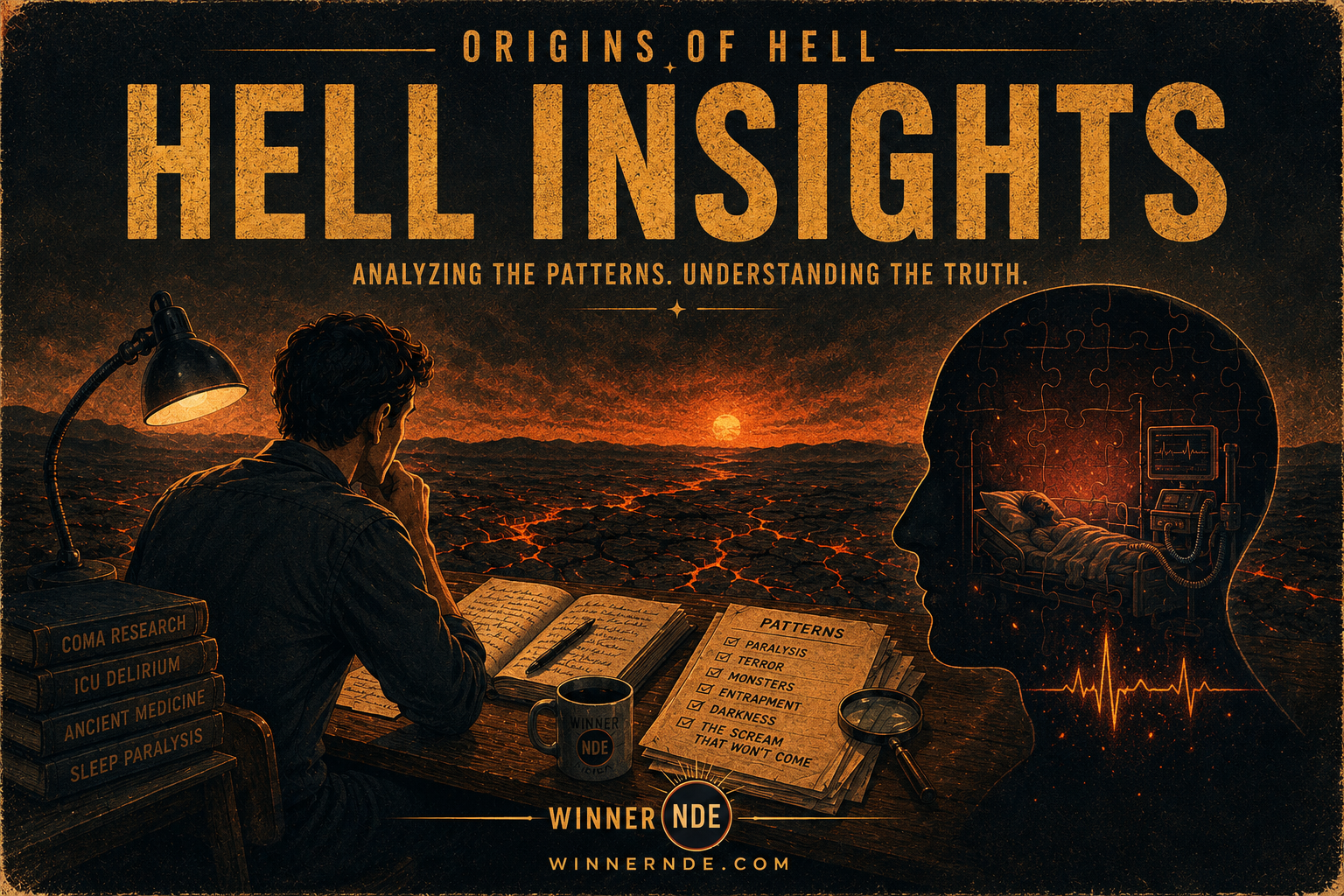
A person wakes from catastrophe convinced they have been judged, tortured, buried, burned, or trapped among the dead. The memory can be more vivid than ordinary life. That is why hell origins matter. The question is not whether the terror is real to the witness. It plainly is. The question is where it began.
For centuries, religion supplied an answer: the witness glimpsed a place of eternal punishment. Modern medicine offered a different answer: it was all random brain noise. Both explanations fail the evidence in different ways. One mistakes a living person’s terror for a report from the afterlife. The other dismisses organized, recurring human experience because it is frightening and inconvenient.
The more defensible conclusion is harder, but far more reassuring: hell is real as an experience, but it belongs to the living brain under extreme catastrophe. It is not the destination of the dead.
Hell Origins Are Older Than Religious Hell
Hell did not begin as a tidy theological doctrine with a map, a judge, and a sentence. Human beings encountered terror long before they wrote systematic religious rules. Injury, fever, drowning, suffocation, poisoning, battlefield trauma, delirium, and prolonged unconsciousness could produce states of overwhelming fear. A survivor might return carrying images that no ordinary language could contain: pits, darkness, pursuit, grotesque beings, confinement, fire, decay, and helplessness.
Those images are not trivial. They are the raw material from which cultures build stories about underworlds, demons, punishment, and the dead. Ancient literature, including the Epic of Gilgamesh, preserves a world in which death is shadowed by dust, darkness, loss, and dread. That does not prove a particular ancient writer suffered a modern clinical condition. It does show that underworld imagery has deep human roots that predate many later claims about eternal damnation.
The historical sequence matters. First comes the catastrophic human experience. Then comes the interpretation. A person survives an unbearable internal ordeal and reaches for the strongest available cultural language. In one era, that language is demons. In another, it is hell. In a hospital era, it may be called a disturbing near-death experience.
That last label is the research error. A so-called “distressing NDE” is not an NDE at all. It is a Fear Coma Experience, or FCE.
The Critical Divide: FCEs Are Not NDEs
Winner NDE uses three terms because three different events must not be pushed into one vague category.
An authentic NDE occurs during genuine clinical death. It is often peaceful, lucid, and structured. Its load-bearing evidence is verified veridical perception: accurate perception of events, people, objects, or procedures that the incapacitated person could not have known through normal sensory means. This is not a poetic flourish or a comforting belief. It is the evidential feature materialist explanations cannot absorb without special pleading.
A Fear Coma Experience occurs while the person is alive. The brain is under siege from fear, injury, illness, altered oxygen, fever, medication, trauma, or delirium. The result can be a hellscape of terrifying imagery. The witness is not lying, exaggerating, morally weak, or spiritually defective. The experience is real. But its source is a living human being in catastrophe, not an afterlife punishment chamber.
A Welded NDE is rarer and more complicated. It occurs when one person endures both an FCE and a genuine NDE in the same medical crisis. With no ordinary clock available, memory can fuse the two segments together. That fusion explains why some accounts contain radically different emotional environments without requiring us to declare that heaven and hell are neighboring rooms in the afterlife.
This distinction is not wordplay. It prevents a terrible category mistake. If every intense experience near a medical emergency is labeled an NDE, then peaceful verified death experiences and fear-generated coma imagery get thrown into the same bin. The data become muddy, skeptics get an easy target, and frightened readers are told that a nightmare may be waiting for them after death.
It is not.
Why the Living Brain Builds Hellscapes
Fear is not merely an emotion. In extreme states, it is an organizing force. The brain’s threat systems search for danger, assign agency to ambiguity, and create narratives that explain pain and helplessness. When normal orientation collapses, terror does not politely remain abstract. It takes form.
That form is remarkably consistent across time. Captivity. Pursuit. Falling. Fire. Rot. Insects. Monstrous figures. Endless corridors. Being judged. Being unable to escape. These are not necessarily reports of an external geography. They are the mind’s oldest alarm signals intensified beyond normal limits.
Coma and delirium research matters here because these conditions can generate elaborate, emotionally absolute worlds. The word coma itself comes from an ancient Greek term associated with deep sleep or stupor, a reminder that human beings have long recognized states in which ordinary awareness is profoundly disrupted. Modern clinical language is more precise, but the underlying fact is ancient: a person can appear absent from the world while enduring a private reality of astonishing force.
That does not mean the brain explains an authentic NDE. It does not. A living-brain explanation belongs to FCEs, where the person has not died. It cannot account for verified perception during clinical death. The two claims are compatible only when the categories remain clean.
Religion Mistook Terror for a Destination
Religious traditions did not invent every image of torment from nothing. They organized inherited human fears into moral systems. Fire became punishment. Darkness became separation. Monsters became enforcers. The terror of catastrophe gained a cosmic explanation.
That interpretation carried social power. A doctrine of eternal torment can frighten people into obedience, intensify guilt, and give clergy or institutions authority over the terrified. But fear is not evidence. The intensity of a witness’s conviction is not a map of the next world.
This is where compassion and rigor must stay together. A survivor who says, “I was in hell,” deserves to be heard without ridicule. But an investigator must ask the next question: Was there clinical death? Was there a documented period in which ordinary brain-based perception was impossible? Is there veridical information that can be independently checked? Or does the account show the fingerprints of a fear coma: terror, confusion, shifting imagery, medical crisis, and a living brain?
The answer may be emotionally unwelcome to someone committed to a doctrine of damnation. It is still the answer the evidence demands.
The Reassurance Is Not Cheap
Some readers will object that this framework simply replaces religious certainty with a preferred modern story. That objection would carry weight if the argument depended on wishing hell away. It does not.
FCEs are horrifying. They can leave people shaken for years. A person may need trauma-informed medical care, emotional support, and space to tell the story without being told it was meaningless. Calling an FCE a living-brain terror event does not minimize it. It removes an unnecessary second wound: the belief that the experience was an eternal verdict.
The evidence also requires intellectual discipline from NDE researchers. We should not claim every bedside vision proves survival after death. We should not flatten all accounts into a single pattern. And we should not surrender the strongest evidence by allowing terror experiences without clinical death to redefine what an NDE is.
Don Winner’s book, Hell Exists, But Only for the Living, follows this evidence trail through clinical literature, ancient sources, fear neuroscience, and the recurring mistakes made when FCEs are misclassified. Its central claim is direct because the stakes are direct: hell is not where you go when you die.
If a hellish memory has haunted you or someone you love, begin with the gentlest accurate question: what happened to the living person during the crisis? That question does not erase the terror. It puts the terror back where it belongs – in a survivable human event, not in eternity.
Want to go deeper? Don Winner brings decades of intelligence and investigative experience to the biggest question there is: what happens when we die.
In You’re Going to Die Someday, Right? Near-Death Experiences Reveal What Happens Next, he examines the evidence from thousands of near-death experiences to find out what they actually tell us about consciousness, the soul, God, and the afterlife.
In Hell Exists, But Only for the Living, he investigates where our idea of hell came from and who built it, tracing the doctrine back to its human sources.
Get your copy of You’re Going to Die Someday, Right? or Hell Exists, But Only for the Living.