Introduction
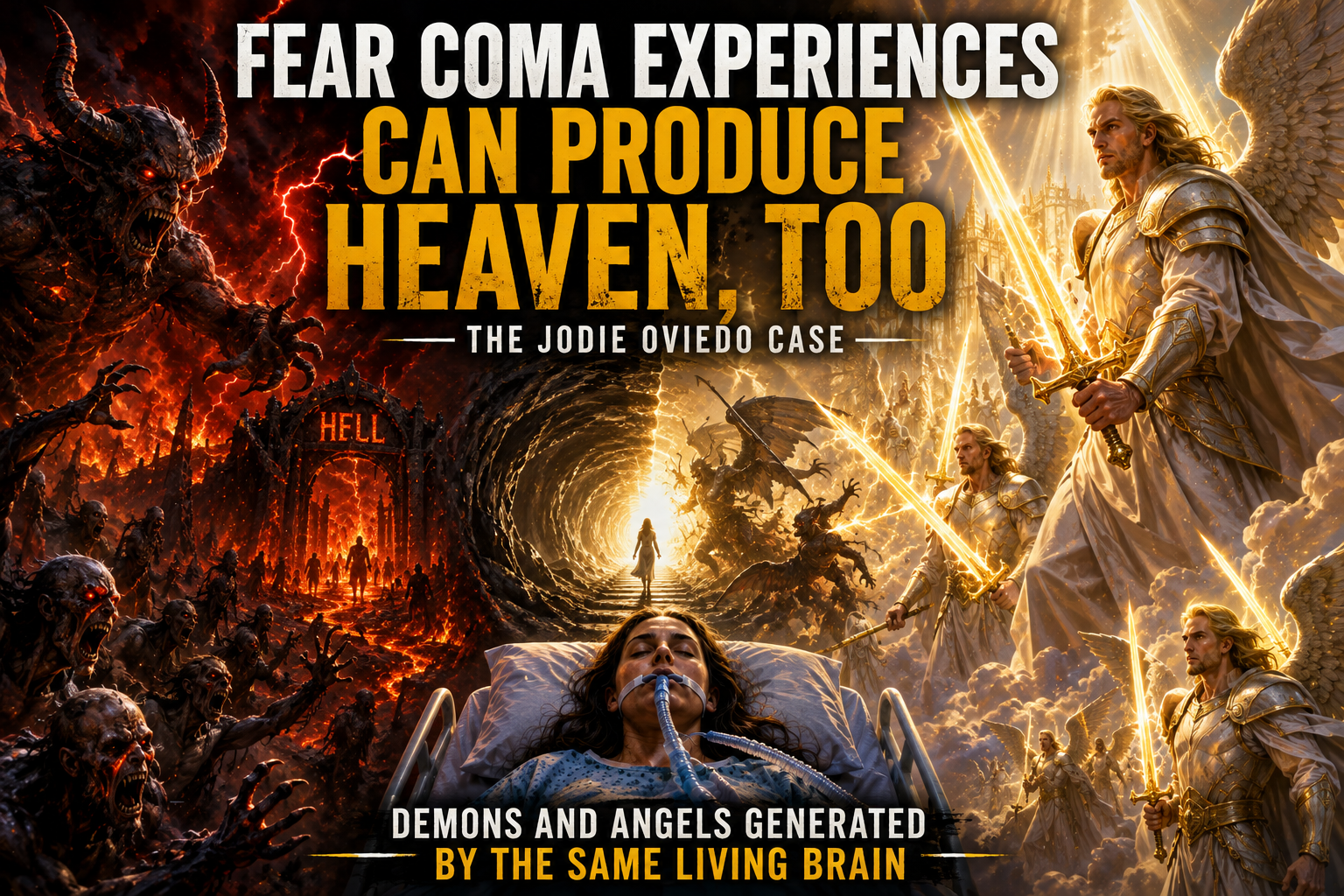
I have a very interesting case for you today, involving a woman named Jodie Oviedo and an extraordinary series of experiences she remembers from a prolonged medical crisis and medically induced coma. Her account contains demons, the Angel of Death, enormous angels armed with golden swords, the Archangel Gabriel, a tunnel leading to hell, screaming souls, pits of fire, Jesus, the voice of God and an extraordinary sensation she describes as “liquid love.” Taken at face value, it contains imagery from virtually every corner of the traditional Christian supernatural landscape.
And that is precisely what makes this case so interesting.
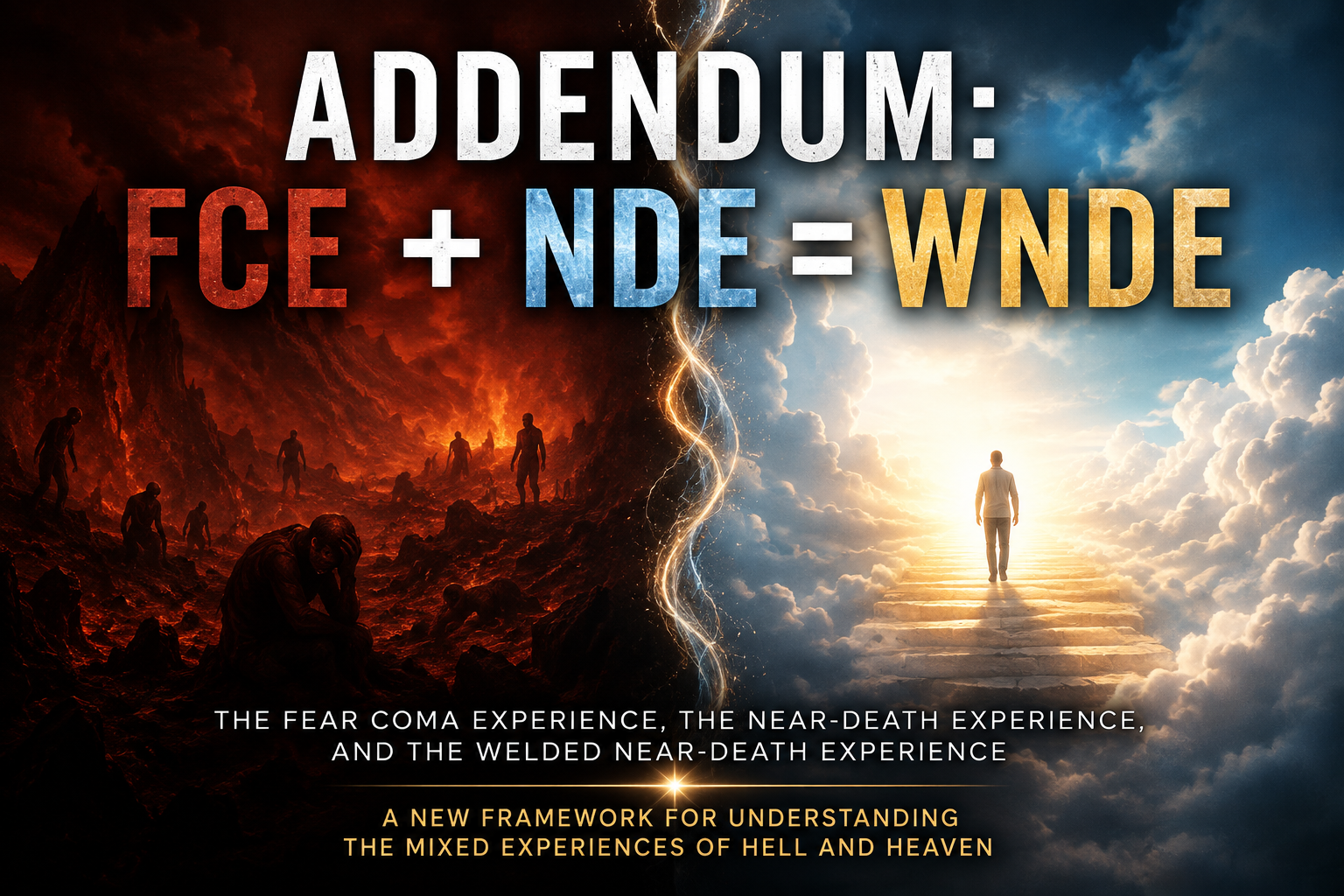
If you have followed my previous work on Fear Coma Experiences, or FCEs, you already know that I have been examining frightening experiences occurring while people remain alive and comatose. These experiences can be extraordinarily vivid and elaborate. They can contain demons, monsters, torture, imprisonment, fire, pursuit and entire constructed environments that experiencers may subsequently interpret as hell. Until now, however, the cases I have examined have primarily allowed us to study the frightening side of this phenomenon.
Jodie’s case changes that.
For the first time in my research, I have encountered a case in which the same coma experience appears to contain not only the frightening imagery we have come to associate with FCEs, but an equally elaborate collection of positive religious imagery. The demons are confronted by angels. The threat is countered by Gabriel. Hell is accompanied by salvation. Jesus appears. God speaks. Fear gives way at times to safety, peace, joy and overwhelming love.
That immediately raises an important question. Are we looking at two different phenomena? Did Jodie experience an FCE and then transition into an authentic Near Death Experience? Is this another Welded NDE, in which an FCE and NDE occurred during the same medical crisis and were subsequently remembered as one continuous experience? Or is something else happening here?
To answer those questions, I located and examined all five podcast interviews with Jodie that I was able to find. Rather than relying on a single retelling, I compared the available accounts, reconstructed the experience from her own descriptions and looked closely at her medical circumstances, religious upbringing, previous supernatural experiences, fears and the imagery appearing throughout the coma. I then evaluated the resulting account using both the Winner FCE Scale and the Greyson Near-Death Experience Scale.
What emerged was something I had not expected when I began examining this case. The evidence does not require an NDE to explain the positive religious material at all. Instead, Jodie’s experience suggests an important expansion of the FCE framework: the same living brain capable of generating the frightening side of an elaborate coma experience may also be capable of generating the rescue.
And in Jodie’s case, her brain had an extraordinary amount of material to work with.
To understand why that matters, we need to begin before the coma—with what Jodie brought into it.
What Jodie Brought Into The Coma
Long before Jodie entered the hospital, Christianity was deeply embedded in her life. She says she began attending church between the ages of five and seven. By about ten, she was helping teachers in the children’s ministry, and as a teenager she regularly attended youth group. At eighteen, she was even asked to become a youth minister, although she describes subsequently going through a period in which she “backslid” and moved away from the church. By the time she was attending nursing school at twenty-nine, she says she had returned to her faith, prayed every day and trusted in God as she worked her way through the demanding nursing program.
Her religious experiences were not limited to attending church or believing in God. Jodie says that at fourteen she had already experienced what she considered a supernatural vision. During a church service, after being called forward and prayed over, she says she saw the throne of God, a golden pathway, crystal-clear water, pillars, the twenty-four elders and an intense golden light surrounding God’s throne. She remembers wondering whether it was her “judgment day” and says the experience instilled in her what she calls “the fear of the Lord.” Later, during the period when she had moved away from church, she says she heard the Holy Spirit speaking directly to her and telling her that she did not belong in the nightclub she was visiting. Supernatural religious experiences, divine communication and highly visual biblical imagery were therefore already part of the way Jodie understood her world years before the medical crisis.
The same was true of frightening supernatural imagery. Jodie describes several experiences from years before the coma in which she interpreted unusual or frightening perceptions through a religious and supernatural framework. At approximately sixteen, while pregnant with her first child, she says she saw an enormous creature standing on a post overlooking a field. She describes it as resembling “the Mothman” and says her boyfriend did not see it. Jodie now believes she was seeing the creature “in the spirit” and interprets it as a spiritual “principality” overlooking the territory.
She describes another incident in which she and others heard strange sounds around a house in the country. Jodie interpreted what she heard as witches flying around the house, circling it while “cackling and laughing.” She prayed for God to remove whatever was there and says the sounds stopped. On another occasion, she says she saw a strange dog run past her that “looked like a demon,” describing it as muscular, with shiny skin and lime-green eyes. These experiences are important simply as background. Long before the medical crisis, Jodie’s mental and religious world already included not only God, Jesus and angels, but demons, witches, supernatural creatures, threatening spiritual forces and the belief that frightening perceptions could represent actual manifestations of the supernatural.
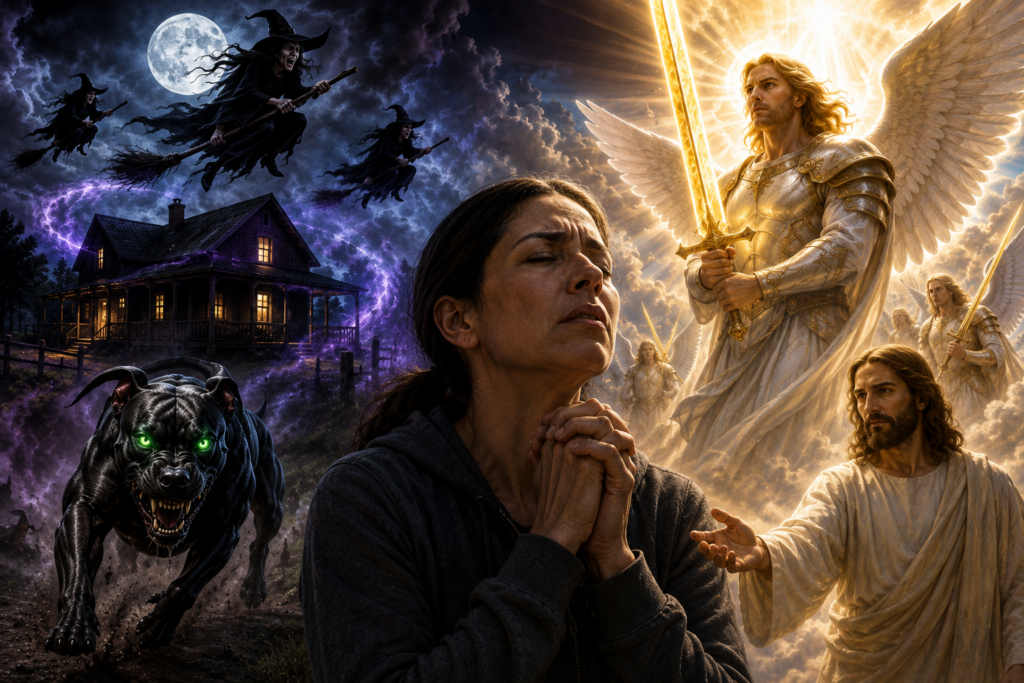
Angels were equally familiar territory. Jodie says she had watched Christian broadcaster Sid Roth since she was approximately fifteen or sixteen years old, programming that included extensive discussion of angels and supernatural experiences. Angels, demons, God, Jesus, judgment, divine communication and supernatural conflict were therefore not unfamiliar concepts being encountered for the first time during her coma. They belonged to a religious and supernatural vocabulary Jodie had been immersed in for most of her life.
Then came the medical crisis. At approximately thirty-four weeks pregnant, Jodie went into the hospital in preterm labor. Doctors initially stopped her contractions because her baby’s lungs were underdeveloped and administered steroids to help them mature. Several days later, she was told the medication could not be continued and that labor would be allowed to proceed. She called her husband and told him to come to the hospital because the baby was going to be delivered.
During labor, the situation suddenly became frightening. After her water had been broken and labor had progressed, Jodie remembers a doctor examining her and withdrawing his hands covered with blood. Her nursing education was sufficient for her to immediately understand that something was seriously wrong. “I was like in shock,” she recalls, “cuz I knew that was not normal.” At that moment, she says she heard a voice tell her, “amniotic fluid embolism.” Jodie interpreted the voice as the Holy Spirit telling her what was happening. The doctor believed she was experiencing a placental abruption instead, but there was no time for a prolonged discussion. He told them that the situation was urgent and that she needed to go immediately into the operating room, where she would be completely sedated.
Jodie survived the procedure and initially regained consciousness. Her baby had been taken to the NICU, and her husband prepared to leave the hospital to attend to their other children. Before he left, however, Jodie stopped him. Something still felt wrong. “Before you leave, pray with me,” she told him. She describes having a feeling she could not explain, a sense that something was not right. Her husband prayed with her and then left.
Approximately fifteen to thirty minutes later, three nurses were in Jodie’s room monitoring her vital signs when her condition deteriorated again. She remembers suddenly being unable to breathe. Jodie says she then suffered a cardiopulmonary collapse. Medical personnel intubated her, placed her on life support and put her into a medically induced coma. She was then transferred to the ICU. According to Jodie, her hospital record would ultimately state that she “coded times 3.”
The timing is important. Jodie had not been placed into a coma when she initially arrived at the hospital, and the emergency C-section itself did not begin the prolonged coma. She had been sedated for the procedure, regained consciousness afterward, spoke with her husband and nurses and remained aware of her surroundings. The medically induced coma came later, after her condition deteriorated and she suffered the cardiopulmonary collapse.
From that point forward, however, Jodie was intubated, on life support and in a medically induced coma. That creates an important dividing line in her account. Her memories can tell us what she remembers experiencing during that period, but they cannot independently establish when those experiences occurred in relation to the medical events happening around her. Her later attempts to determine which remembered experience corresponded with which code, transfusion or procedure were necessarily retrospective. Jodie says, for example, that she learned from her hospital record that she coded a second time during a blood transfusion and then uses that information to associate the medical event with what she identifies as her second encounter.
Jodie herself acknowledges the uncertainty. While introducing that experience, she says, “I guess I don’t know how you would call it cuz I was in a coma. So maybe it was a dream or a vision. I don’t know.” From the moment she entered the medically induced coma, Jodie was no longer consciously observing the medical chronology occurring around her. Afterward, she had her memories of what she experienced during the coma on one side and information obtained from hospital records, nurses, doctors and family members on the other. She then attempted to fit those two bodies of information together into a coherent sequence.
There is one additional piece of Jodie’s preexisting mental landscape that becomes relevant when considering what she would later describe. Jodie specifically says she is afraid of snakes, spiders and lizards. During the coma, the dark tunnel she describes is populated by precisely this kind of imagery: snakes, spiders, scorpions and other “creepy crawly things.” At this stage, that observation requires no interpretation. It simply establishes another piece of information that Jodie herself provides about what was already frightening to her before those same kinds of creatures appeared within the experience.
That is the condition in which Jodie entered what would become a prolonged medical catastrophe: a premature delivery, massive abnormal bleeding, emergency surgery, a newborn in the NICU, an unresolved sense that something was terribly wrong, the sudden loss of her ability to breathe, cardiopulmonary collapse, intubation, life support and a medically induced coma. She was also entering that coma with an unusually rich lifetime of religious and supernatural material already behind her. God, Jesus, angels, judgment, divine voices, supernatural visions, prayer and spiritual intervention were deeply familiar parts of her world. So were demons, witches, frightening supernatural creatures, spiritual warfare and the belief that threatening things she perceived could represent genuine supernatural forces. Even some of the specific creatures she would later encounter belonged to categories of animals she says she already feared.
At that point, Jodie’s extraordinary experiences begin.
The Battle Around Her Bed
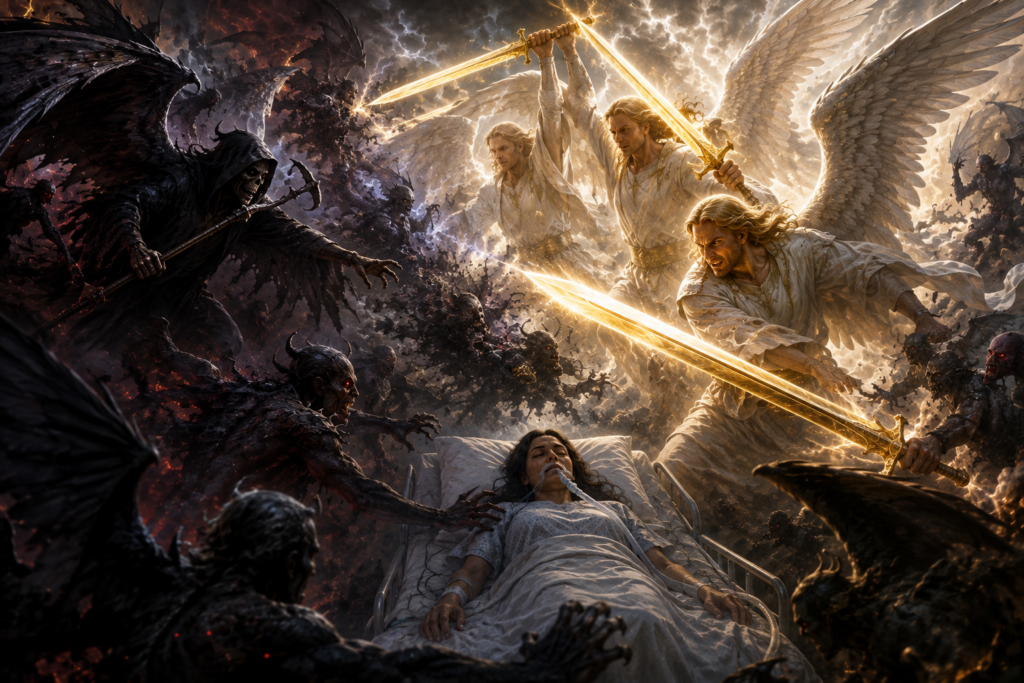
Jodie’s experience begins with fear. She is critically ill and unconscious when the experience fills with threatening figures. She describes dark angelic beings surrounding her, including one she identifies as the Angel of Death. The threatening figures are not alone, however. Three enormous angels appear to protect her. She describes them as roughly ten feet tall, dressed in white robes with golden sashes and carrying huge golden swords.
The scene develops into a supernatural battle around her. The protective angels confront the dark figures and fight them with their swords while Jodie remains at the center of the conflict. What begins as threatening and frightening imagery now contains both sides of a struggle: dark beings coming for her and powerful angelic figures defending her from them.
Then Jodie hears a powerful voice that she identifies as God. The voice declares that she belongs to Him. The threatening figures are driven away, ending the confrontation. The sequence that began with dark supernatural beings and the Angel of Death concludes with God intervening and armed angels successfully protecting her.
The Voice From The Sky
At the height of the confrontation, Jodie describes a sudden sound like thunder that shakes the entire sky. The battle stops. The angels stop moving, and for a moment everything appears to respond to the sound. The scene that had been filled with movement and conflict is interrupted by something she experiences as vastly more powerful than any of the figures fighting around her.
Then she hears a loud, authoritative voice coming from the side where the protective angels are standing. Jodie identifies the voice as God. The message is short and directed specifically at what is happening to her: “She’s my child. She always has been.”
The effect is immediate. The dark angels do not continue fighting and are not gradually defeated by the angels with swords. Jodie describes them disappearing into smoke. The supernatural threat that had surrounded her is simply gone, and the battle ends.
The Traveling Nurse
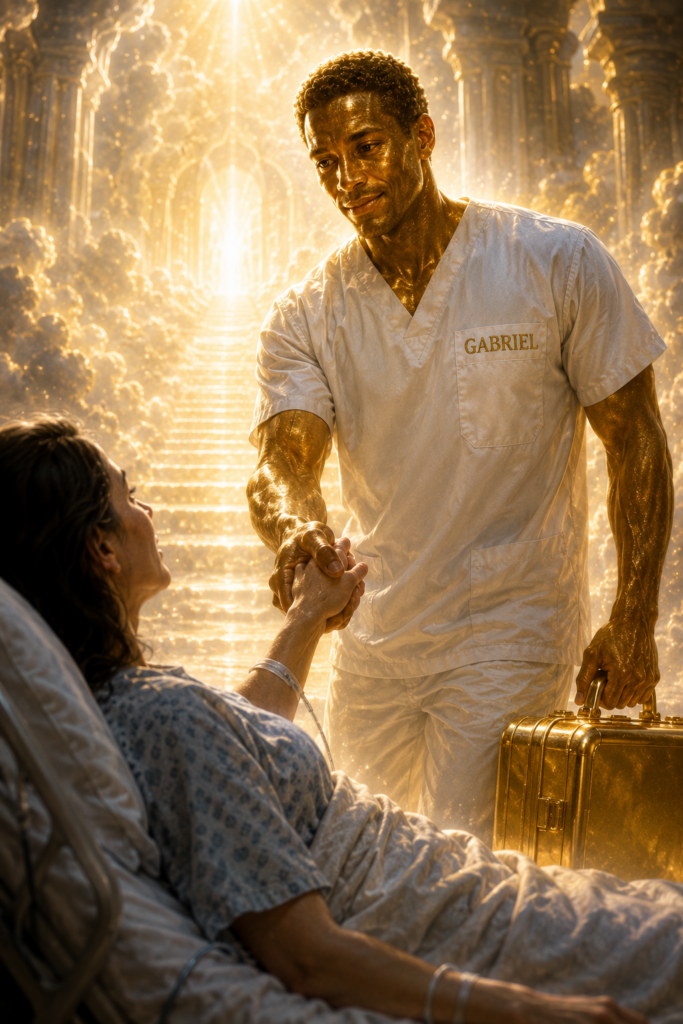
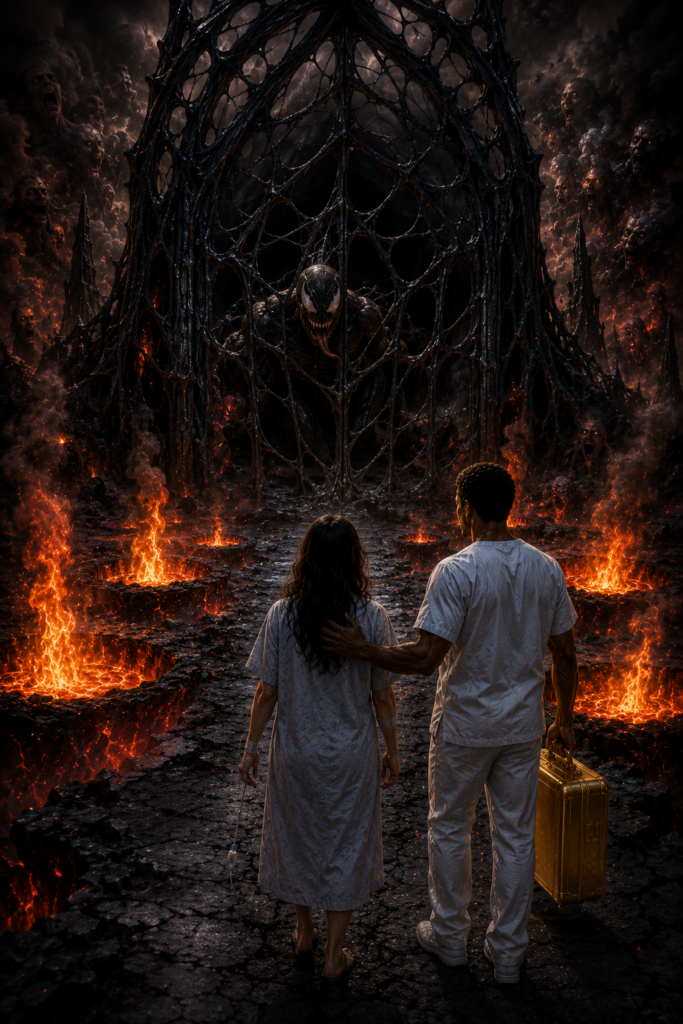
During the next part of the experience, Jodie finds herself looking at a man dressed in white medical scrubs, similar to the scrubs she had worn during nursing school. There is something unusual about his appearance. She describes him as looking Black at first, but then corrects herself. His skin is bronze and golden, almost as though highly pigmented gold dust or metallic gold makeup covers his body.
The man immediately tells Jodie not to be afraid. He identifies himself as a “traveling nurse sent from heaven” and tells her that God sends him to people who are extremely sick. Jodie tells him that she is not afraid. He assures her that she will feel no pain and explains that he has been sent both to protect her and to show her something.
He extends his hand, and Jodie takes it. She also notices that he is carrying a piece of gold luggage. When she asks what it is for, he explains that it contains tools from heaven. Jodie later describes these as tools associated with spiritual surgery.
Jodie then looks for a name tag on the man’s scrubs. As she watches, letters begin appearing one at a time, seemingly embroidering themselves onto his clothing: G-A-B-R-I-E-L. Jodie realizes his name is Gabriel and says it aloud. He confirms that she is correct. She describes their communication as occurring through the mind, something she understands as telepathy.
Gabriel then tells Jodie to follow him. He instructs her to remain in the light so that she will be protected as they continue together.
The Tunnel To Hell
Gabriel tells Jodie to stay in the light so that she will remain protected. He then opens what she describes as a portal, and the two of them enter it together. On the other side is a dark tunnel that Jodie immediately identifies as leading to hell.
The tunnel is filled with what she describes as dark, “creepy-crawly” things. Jodie says she had heard other testimonies describing demons inside similar tunnels that scratched and attacked people traveling through them. In her own experience, however, those attacks do not occur. She believes Gabriel’s presence and the protective light surrounding her prevent the creatures from reaching her.
Jodie continues through the tunnel with Gabriel until they approach its end. Ahead of them, the darkness opens into the place she understands to be hell.
The Gates Of Hell
At the end of the tunnel, Jodie describes arriving before what she understands to be the gates of hell. The entrance appears to be formed from black, cobweb-like material, and beyond it is an overwhelming darkness that she describes as “the blackest of black.” The experience becomes intensely sensory. She smells sulfur and what she describes as melting flesh, while screams come from people she believes are being tormented somewhere beyond the gates.
Standing there with Gabriel, Jodie begins to feel nervous and asks why he has brought her to this place. Gabriel identifies what she is seeing as the gates of hell, although Jodie says she already seemed to know where she was. Behind the gates she sees a demonic figure that appears to be trying to frighten her.
Jodie describes the creature as resembling Venom, the dark, monstrous comic-book character. She says she did not recognize Venom at the time of the experience and only made the connection after emerging from the coma and later seeing the character in a movie. Despite the creature’s threatening appearance, Jodie says she was not afraid of it.
Beyond the gates, she also sees six enormous pits in the ground. Fire shoots upward from them, and inside she sees something resembling molten lava. Jodie interprets what lies beneath the pits as the biblical Lake of Fire.
Gabriel Gives Her An Assignment
After witnessing the gates, the demonic figure, the fire and the people she believes are being tormented there, Jodie asks Gabriel why he brought her to this place. Gabriel tells her that God wants her to know she will be sent back and that people will recognize what happened to her as a miracle.
Gabriel tells her that people are losing faith in God, including people within the church. He tells her that they need to continue having faith, that the love of Jesus is unconditional, and that forgiveness is important.
He then gives Jodie what she understands to be an assignment from Jesus. She is going to return, and when she does, she is supposed to tell her testimony to as many people as possible.
The Liquid Love Of Jesus
Jodie’s next experience shifts dramatically away from the darkness and frightening imagery she has just described. She says that during what she associates with her third death, she encounters Jesus.
Jodie describes being overwhelmed by an extraordinary sensation of love. She calls it “liquid love,” describing it as something that seems to pour over and through her rather than simply being an emotion she feels. The sensation surrounds her and penetrates what she describes as her spiritual being, producing an intense feeling of peace, joy, comfort and unconditional love.
She identifies the source of this love as Jesus. His presence is reassuring rather than threatening, and the environment of the experience has now changed completely. The demons, darkness, fire, screams and torment of the earlier sequence are gone. In their place is a deeply familiar Christian figure associated with safety, acceptance and love.
Jodie describes Jesus wearing a white robe with a golden sash. The encounter is intensely personal, and she understands the love she experiences from him as absolute and unconditional.
Instructions From Jesus
During the encounter, Jodie says Jesus begins speaking with her as they walk together through the white environment. He tells her that she and her family will never lack what they need because of the testimony she has been given. Jodie connects that promise to her life afterward, saying that although her family has experienced highs and lows, she believes they have always been provided for.
Jesus then gives Jodie specific instructions concerning her personal life. He tells her to remarry her husband. Jodie explains that they had originally married in 2009 and divorced in 2011, although their relationship had continued after the divorce.
The instructions are directly connected to the larger purpose Jodie believes has been given to her. She is expected to return to her life, reunite with her husband, and ultimately share the testimony of what she experienced.
Waking From The Coma
Jodie does not give an exact duration for her coma. In her own words, “I woke up from the coma like about 9 to 12 days later.” By the time she regained consciousness, the extraordinary experiences she describes had ended, and she was confronted with the physical consequences of the medical crisis that had nearly killed her.
Her body was severely debilitated. Jodie describes herself as completely “dead weight” from muscle atrophy. She had a feeding tube through her nose, required a wound vacuum, and underwent dialysis four times a week for approximately a month and a half. She says she remained unable to walk for about twenty-three days and required therapy while still hospitalized.
The effects were neurological as well as physical. Jodie says she had lost so much oxygen to her brain that she could not speak properly. She describes knowing what she wanted to say but being unable to make her words align correctly with her thoughts. She had to relearn basic functions, including speech, and remembers initially being unable to say the word “yes,” using “yep” instead.
Her ability to speak began returning over the following days. Jodie remembers worship music being played during her recovery and Christian nurses bringing her faith-based pamphlets. She interpreted what was happening around her through the same religious framework that appears throughout her coma experience, saying that she knew “the presence of God was in my room.”
Coding Does Not Establish An NDE
Jodie says that she coded three times during her medical crisis because that is what she was told after she regained consciousness. She remembers asking a nurse to check her medical records, and the nurse told her, “As a matter of fact, it says you coded three times.” That is what Jodie reports, and there is no reason to dispute it.
But coding does not automatically mean that an authentic Near Death Experience (NDE) occurred. Even if we give Jodie the strongest possible interpretation of those events and assume that one or more of those codes involved an actual cardiac arrest with a period of complete circulatory arrest, that still would not establish an NDE. Prospective studies of successfully resuscitated cardiac-arrest patients generally find that only about 10 to 20 percent report an NDE. The overwhelming majority do not.
That distinction is fundamental. A person can die temporarily, be resuscitated and never have an NDE. The medical event and the experience are separate questions. Cardiac arrest establishes that a person experienced a profound medical crisis. It does not tell us what kind of conscious or remembered experience, if any, occurred during or around that crisis.
So Jodie’s three reported codes cannot be used as evidence that the extraordinary experiences she remembers from her nine-to-twelve-day coma were necessarily NDEs. Those experiences still have to stand on their own. The question is not simply whether Jodie coded. She says she did. The question is what kind of experience did she actually have?
Scoring Jodie On The Winner FCE Scale
Once Jodie’s experience is separated from the religious interpretation she later placed around it, the underlying structure can be evaluated using the Winner FCE Scale. The scale does not ask whether an experiencer saw demons, angels, Jesus or God, or whether the person subsequently interpreted those figures as spiritually real. It looks instead at the circumstances surrounding the experience and the characteristics of the experience itself. When Jodie’s account is evaluated that way, the result is striking.
The first criterion is coma or unconsciousness, and Jodie scores 2 points. The additional interviews make this considerably clearer than the original account alone. Following her cardiopulmonary collapse, Jodie says she was intubated, placed on life support and put into a medically induced coma. There is no ambiguity about whether a prolonged coma was present. For the second criterion, Glasgow Coma Scale, we have no documented GCS score. Claims made during the interviews about her neurological condition are not substitutes for an actual GCS measurement, so this criterion remains Unknown and is not counted against her.
Fear going into the experience scores another 2 points. Jodie was not peacefully drifting into unconsciousness without understanding that anything was wrong. She was a recent nursing graduate confronting an escalating medical catastrophe. She saw abnormal bleeding, immediately understood that something was seriously wrong, underwent an emergency C-section, remained convinced afterward that something was still wrong, asked her husband to pray with her before he left, and then found herself unable to breathe. By the time she lost consciousness, fear, uncertainty and perceived mortal danger were already present.
Frightening imagery scores 2 points. Jodie describes the Angel of Death, dark angels carrying black swords, supernatural combat, demons, a tunnel containing snakes, spiders, scorpions and other creatures, increasing heat, sulfur, screams, the smell of burning flesh, the gates of hell and enormous fiery pits containing what she describes as molten lava. Some of that imagery is particularly interesting because Jodie specifically says elsewhere that she is afraid of snakes, spiders and lizards. Long before the coma, she also reports interpreting unusual perceptions as demons, witches and other threatening supernatural entities. The frightening content of the coma therefore did not require the introduction of an unfamiliar conceptual vocabulary.
Entrapment or inability to escape receives a more conservative 1 point. Jodie enters threatening environments and is taken through the tunnel to hell, but she is not personally imprisoned there. Gabriel accompanies her, protects her and ultimately prevents her from crossing the gates. Other figures within the experience appear trapped, but Jodie herself retains a route out. That makes the element present, but not as strongly as in FCE accounts in which the experiencer personally reports being completely trapped and unable to escape.
Terror intensity scores 2 points. The appearance of protective figures later in the experience does not erase what preceded them. Jodie encounters threatening supernatural beings, frightening creatures and an elaborate hell environment filled with screaming, fire and apparent suffering. The important difference in this case is that terror does not remain the only emotional state. The threatening imagery is eventually countered by protective religious imagery. Gabriel, Jesus and the voice she identifies as God provide safety, comfort and protection within the same overall experience.
Acting out or witnessed struggle remains Unknown. Jodie experienced seizures and profound physiological distress while critically ill, but those events have obvious medical explanations. Without evidence that she was physically reacting to the actual content of the experience—fighting unseen attackers, attempting to escape, screaming about what she was seeing or otherwise externally acting out the internal narrative—there is no justification for awarding points simply because her body was undergoing severe medical events.
Aftermath or trauma receives 1 point. The experience clearly had an enormous effect on Jodie and became a major part of how she subsequently understood her life. However, she predominantly interprets what happened through a positive religious framework. She regards the experience as spiritually meaningful rather than describing the kind of persistent fear, nightmares, avoidance or severe psychological trauma that would justify automatically awarding the maximum score. The aftermath is substantial, but the evidence for lasting trauma specifically attributable to the frightening experience is less clear.
Lost or distorted time scores 2 points. This becomes especially apparent once all of Jodie’s interviews are considered together. She spent an extended period in a medically induced coma and afterward attempted to reconstruct the sequence by combining what she remembered experiencing with information obtained from medical records, nurses, doctors and family members. She cannot independently establish where individual experiences fit against the external medical chronology. Her statements connecting particular experiences with particular codes are retrospective attempts to assemble a timeline after she regained consciousness.
Using that conservative scoring, Jodie receives 14 points from the seven criteria that can presently be scored. Glasgow Coma Scale and acting out or witnessed struggle remain Unknown. Under the Winner FCE Scale, Unknown criteria are not treated as zeroes, because absence of evidence is not evidence that an element was absent. On the available evidence, Jodie therefore scores 14 out of 14 scorable points, placing her comfortably within the scale’s 12–18 range for a probable, almost certain FCE.
The significance of that result extends beyond the numerical score. Jodie’s account demonstrates why an FCE cannot be identified simply by looking for hell. Her experience contains hell, demons, fire, terror and threatening supernatural beings, but it also contains enormous protective angels, Gabriel, Jesus, God, safety, peace, joy and what she describes as “liquid love.” Those apparently contradictory elements can exist within the same FCE because the underlying mechanism does not require the brain to generate frightening material exclusively. It can construct the threat and the rescue, drawing both from the same preexisting store of memories, beliefs, fears, expectations, images and emotional associations.
That makes Jodie’s case particularly important. The question is no longer whether an FCE can explain hell imagery. The broader question is whether the living brain, during a coma, can construct an elaborate experiential narrative using whatever material it already has available—including both the things the person fears and the things the person believes will save them. Jodie’s account provides compelling evidence that it can.
The Greyson Scale Problem
At first glance, Jodie’s account appears capable of generating a surprisingly high score on the Greyson Near-Death Experience Scale. She reports peace, joy, extraordinary love, brilliant supernatural light, otherworldly environments, religious beings, apparent movement outside ordinary physical reality and even language that can superficially resemble separation from the body. If those elements are treated as isolated checkboxes, removed from the circumstances in which they occurred, it would be easy to classify the experience as an NDE. The problem emerges when each of those elements is placed back into the context of the medically induced coma in which Jodie experienced them.
Peace and pleasantness provide a good example. These are common features of authentic NDEs, but the way they develop in Jodie’s experience is fundamentally different. Her experience begins with threatening supernatural imagery. Dark figures appear, the Angel of Death is present and enormous angels engage them in battle. The narrative then supplies protection. Gabriel appears as a powerful guardian, accompanies Jodie and assures her that she cannot be harmed. Her fear subsides because the threatening portion of the experience has been countered by a protective one. Peace is therefore not an unexplained element requiring an NDE to account for it. It follows naturally from the evolving narrative of the FCE itself.
Joy and the extraordinary sensation Jodie calls “liquid love” work the same way. Jesus was not an unfamiliar figure suddenly encountered by someone with no previous religious framework. Jodie had loved Jesus since childhood. Christianity had shaped her understanding of the world for decades. If her living brain could generate the visual presence of Jesus during a coma, it could also generate the enormous emotional inventory already associated with him. The brain does not store Jesus merely as a picture. It stores love, salvation, safety, acceptance, protection and every other emotional association accumulated across a lifetime of belief. That is very different from the orthodox atheist who enters an authentic NDE with no belief in Jesus, God or an afterlife and nevertheless reports being overwhelmed by an inexplicable love unlike anything previously experienced.
Brilliant supernatural light initially appears to provide another Greyson marker, until Jodie’s history is considered. She had already reported extraordinary religious light imagery years before the medical crisis. At fourteen, she says she experienced a vision of the throne of God surrounded by an intense golden light. Golden pathways, crystal-clear water, divine environments and the throne of God were already part of her religious and experiential vocabulary. When brilliant religious light appears again inside an elaborate coma experience populated by God, Jesus and angels, there is no need to invoke an additional NDE mechanism to explain its presence.
The apparent out-of-body material becomes even weaker under examination. Jodie occasionally uses language such as being “sent back” or returning to her body, and in one interview briefly mentions seeing her husband and a nurse from an “aerial view.” But there is no clear sequence in which she unmistakably leaves her body, observes the physical environment from an extracorporeal position and later provides independently verifiable information she could not otherwise have known. In fact, Jodie specifically says she did not experience the kind of OBE in which people report seeing their own bodies. The isolated language may resemble a Greyson marker, but the complete phenomenology does not resemble the unmistakable OBEs repeatedly described in authentic NDE accounts.
The otherworldly environments present the same classification problem. Jodie certainly experiences environments that are not part of ordinary physical reality. She travels through a portal and a tunnel, encounters demons and supernatural beings and arrives at the gates of hell. Mechanically, those descriptions can satisfy a Greyson question concerning an unearthly realm. Contextually, however, the otherworldly environment is one of the defining components of the FCE being evaluated. Awarding NDE points merely because an elaborate coma experience contains a supernatural environment risks treating the phenomenon being investigated as evidence for an entirely different phenomenon.
The religious beings are even more revealing. Gabriel, Jesus, enormous angels and the voice Jodie identifies as God can generate multiple Greyson points if they are classified simply as mystical beings, presences or religious spirits. Yet these are precisely the characters we would expect Jodie’s existing religious framework to make available. They did not appear in isolation. They function within the narrative. Dark supernatural beings represent danger. Enormous angels armed with golden swords fight them. Gabriel becomes Jodie’s personal protector and guide. Jesus provides love and salvation. God exercises ultimate authority. The cast and their respective roles are internally coherent with the Christian worldview Jodie brought into the coma.
Even the boundary or point-of-no-return element can initially appear NDE-like. Jodie reaches the gates of hell and is told she cannot cross them. But those gates are part of the same hell narrative. Gabriel takes her there, accompanies her through the experience and establishes the limit beyond which she cannot travel. The existence of a boundary inside an elaborate coma narrative does not independently demonstrate that the boundary represents the point of no return commonly reported during an NDE.
The tunnel deserves particular attention because the same word can conceal two very different experiences. In authentic NDE accounts, the tunnel or transitional passage typically leads toward the brilliant white light associated with overwhelming love, peace and acceptance. Jodie’s tunnel does the opposite. Her tunnel leads toward hell. It becomes increasingly hot and is populated by snakes, spiders, scorpions and other frightening creatures. Jodie specifically tells us that she is afraid of snakes, spiders and lizards. Calling both experiences a “tunnel” and awarding the same phenomenological point ignores the information contained in what the tunnel actually does and where it leads.
Altered time, vivid sensory experiences and sudden knowledge also fail to provide independent evidence for an NDE in this case. Jodie was in a prolonged medically induced coma. She subsequently struggled to align remembered experiences with a medical chronology she learned from records and other people. Her experience contains vivid sights, sounds, smells, heat, creatures, supernatural figures and information she believes was communicated directly to her. But vividness, distorted time and internally experienced knowledge are all compatible with the elaborate FCE already taking place. None requires the addition of a separate NDE to explain it.
Several Greyson elements are simply absent. Jodie does not report a panoramic life review. She does not describe the characteristic experience of unity or becoming one with everything. There is no convincing extrasensory perception producing independently verifiable information, no clear preview of future earthly events and no unambiguous out-of-body observation. Most importantly, nothing in the account requires us to introduce an NDE to explain portions of an experience that is already occurring within a medically induced coma.
This exposes an important limitation in using the Greyson Near Death Experience Scale as a classification tool. If Jodie’s testimony is scored mechanically, isolated phrases and experiences can accumulate points rapidly. Peace is a point. Joy is a point. Light is a point. A supernatural environment is a point. Gabriel is a point. Jesus is a point. A boundary is a point. Something described as a tunnel looks familiar. Language about returning to the body looks familiar. Before long, an elaborate FCE can begin to resemble an NDE simply because both experiences are capable of producing extraordinary phenomenology.
Context changes the result. Once the apparent Greyson elements are examined individually, every potentially NDE-like feature in Jodie’s account is either absent, ambiguous or already accounted for by the FCE. The frightening side of the experience generates demons, hell, fire, threatening beings and creatures she already fears. The protective side generates angels, Gabriel, Jesus, God, safety, peace, joy and love. Both sides draw from the same living brain, the same memories, the same beliefs and the same lifetime of emotional associations.
That may help explain why experiences like Jodie’s have been so difficult to classify. The missing variable is not another category of NDE. It is the recognition that an FCE does not have to remain frightening from beginning to end. The same coma experience can contain both threat and rescue. Once that possibility is recognized, the apparently contradictory elements stop being contradictory. They become different parts of the same internally coherent experience.
On a purely mechanical reading of the Greyson Scale, Jodie can appear to have numerous NDE markers. After contextual analysis, however, none provides independent evidence that an NDE occurred. The apparent Greyson score collapses because the elements generating it are already explained by the FCE itself. What initially looks like evidence of two different phenomena can be explained more simply as one: an extraordinarily elaborate experience generated while Jodie was alive, critically ill and in a medically induced coma.
Summary And Conclusion
Jodie Oviedo’s case represents an important expansion of the Fear Coma Experience framework. Until now, the FCE cases I have examined have been dominated by frightening imagery: confinement, pursuit, torture, demons, fire, threatening entities, grotesque environments and other experiences built around fear. Jodie’s experience contains many of those same elements, but it also contains something that initially appears to belong on the opposite side of the equation. Angels arrive to fight the threatening entities. Gabriel becomes her protector and guide. Jesus appears and produces feelings of extraordinary love. The voice she identifies as God speaks directly to her. Hell and salvation, demons and angels, terror and protection all appear within the same extended experience.
At first glance, that combination creates a classification problem. If the frightening material is an FCE, what are we supposed to do with Gabriel, Jesus, God, peace, joy and what Jodie calls “liquid love”? One possibility would be to conclude that an FCE somehow transitioned into an authentic NDE. Another would be to treat the positive religious material as evidence that the entire experience was an NDE. Neither explanation is necessary once Jodie’s complete history and the circumstances surrounding the experience are considered.
The additional interviews make one fact particularly important: Jodie was placed into a medically induced coma. From that point forward, the extraordinary experiences she describes occurred while she remained alive and critically ill within that prolonged altered state of consciousness. Her attempts to connect particular portions of the experience with individual codes or other medical events were reconstructed later using information from medical records, hospital personnel and family members. The experiential narrative itself unfolded within the coma.
Jodie also entered that coma carrying an unusually extensive inventory of religious and supernatural material. Christianity had been part of her life since early childhood. She had already reported visions of God’s throne and brilliant supernatural light. She believed she had heard the Holy Spirit speak directly to her. She had spent years consuming Christian programming involving angels and supernatural experiences. She had previously interpreted frightening perceptions as demons, witches and other spiritual entities. She believed in spiritual warfare, divine intervention, judgment, Jesus, God, angels and hell. Even some of the creatures appearing in her frightening tunnel correspond directly with things she specifically says she fears.
Once that background is placed beside the coma experience, the apparent contradiction begins to disappear. The same living brain capable of constructing threatening imagery also possesses the material necessary to construct protection from those threats. If demons exist within Jodie’s religious framework, so do angels capable of defeating them. If hell represents ultimate danger, Jesus represents salvation. If dark supernatural forces threaten her, Gabriel can stand beside her with a golden sword. The emotional associations come with the imagery. Jesus does not merely have a recognizable appearance within Jodie’s mind; he carries decades of associations involving love, safety, salvation and acceptance.
This means an FCE does not necessarily have to be frightening from beginning to end. Fear can generate the crisis narrative without dictating every subsequent element within it. The living brain can apparently construct both sides of the conflict. It can create the monster and the hero, danger and rescue, hell and protection from hell. In someone with Jodie’s particular religious history, angels arriving to fight demons does not disrupt the FCE framework. It fits remarkably well within it.
That distinction also makes Jodie’s experience fundamentally different from the Welded NDE cases I have previously examined, including Michelle Ledbetter and Kathy McDaniel. In those accounts, the evidence indicates two different experiences joined together. The frightening coma experience has identifiable characteristics of an FCE, while another portion contains the distinctive phenomenology of an authentic NDE. Most importantly, a recognizable seam can be identified where one experience appears to end and the other begins.
There is no comparable seam in Jodie’s account. There is no point at which the FCE clearly stops and a fundamentally different experiential architecture takes over. There is no unmistakable out-of-body experience followed by the characteristic progression into an authentic NDE. There is no compelling veridical perception, no panoramic life review and no other element requiring a second phenomenon to explain what happened. Instead, the characters, environments and emotions continue to function within one extended and internally coherent coma narrative.
Even the apparently positive elements remain integrated into that narrative. The angels are summoned to fight the threatening beings. Gabriel becomes the protector who accompanies Jodie through the frightening environment. Jesus supplies love and salvation. God occupies the position of ultimate authority. The “good” imagery does not appear after a seam separating one experience from another. It interacts directly with the frightening imagery. The two sides belong to the same story.
This also helps explain why Jodie’s account can superficially resemble an NDE when evaluated using traditional tools such as the Greyson Scale. Peace, joy, love, supernatural light, religious beings, otherworldly environments and language suggestive of leaving or returning to the body can accumulate apparent NDE markers when considered individually. But contextual analysis shows that those elements do not stand independently. They can be accounted for within the same FCE mechanism generating the rest of the experience. Once their sequence, function and relationship to Jodie’s preexisting mental inventory are considered, there is practically nothing left requiring an authentic NDE to have occurred at any point.
That is the central finding of this case. Jodie Oviedo does not appear to have experienced an FCE containing fragments of an NDE. Nor does the evidence require a Welded NDE in which two fundamentally different experiences became joined together in memory. The simpler explanation is that this was an unusually elaborate FCE in which the living brain generated both the frightening problem and the religious solution. The demons arrived, and Jodie’s brain had angels available to fight them.
This case therefore marks a significant improvement in our ability to analyze some of the most challenging experiences traditionally classified as Near Death Experiences. Expanding the Fear Coma Experience framework to include protective, comforting and explicitly religious imagery resolves what otherwise appears to be a contradiction. More importantly, the expanded hypothesis survives the red-team test presented by Jodie’s account. Rather than requiring exceptions, additional mechanisms or an invisible seam, the expanded model explains more of the available data with fewer assumptions. I expect Jodie’s case will eventually prove to be the first of many accounts that can be analyzed in this way.
With that having been said, the data must continue to lead the way. Experiences involving hell, heaven, God, Jesus, angels and demons intersect directly with some of humanity’s oldest and most deeply held beliefs. Religious institutions and traditions have incorporated concepts of hell, punishment, salvation and an afterlife for thousands of years, and for many believers those concepts are foundational. Any serious examination of experiences that appear to reproduce this imagery therefore requires a thoughtful and contemplative approach. My purpose is not to threaten anyone’s belief system or dictate what anyone should believe.
The evidence nevertheless deserves to be followed wherever it leads. Fear Coma Experiences appear capable of closing a gap in human understanding that has remained open for far too long concerning the origins of some of our most persistent hell imagery. Jodie’s case now expands that possibility considerably. The same living human brain that can apparently generate extraordinarily vivid experiences of hell while under severe trauma or life-threatening duress may also be capable of generating heaven, angels, divine protectors, Jesus and God within the same experience. Hell and heaven may look like opposite destinations when the story is told afterward. Inside the living brain that produced the experience, they may sometimes be two sides of the same coin.
If you know of a particularly interesting account, testimony, or case you think I should analyze and examine against the Fear Coma Experience framework I’m actively developing, let me know via email: don@winnernde.com
Want to go deeper? Don Winner brings decades of intelligence and investigative experience to the biggest question there is: what happens when we die.
In You’re Going to Die Someday, Right? Near-Death Experiences Reveal What Happens Next, he examines the evidence from thousands of near-death experiences to find out what they actually tell us about consciousness, the soul, God, and the afterlife.
In Hell Exists, But Only for the Living, he investigates where our idea of hell came from and who built it, tracing the doctrine back to its human sources.
Get your copy of You’re Going to Die Someday, Right? or Hell Exists, But Only for the Living.