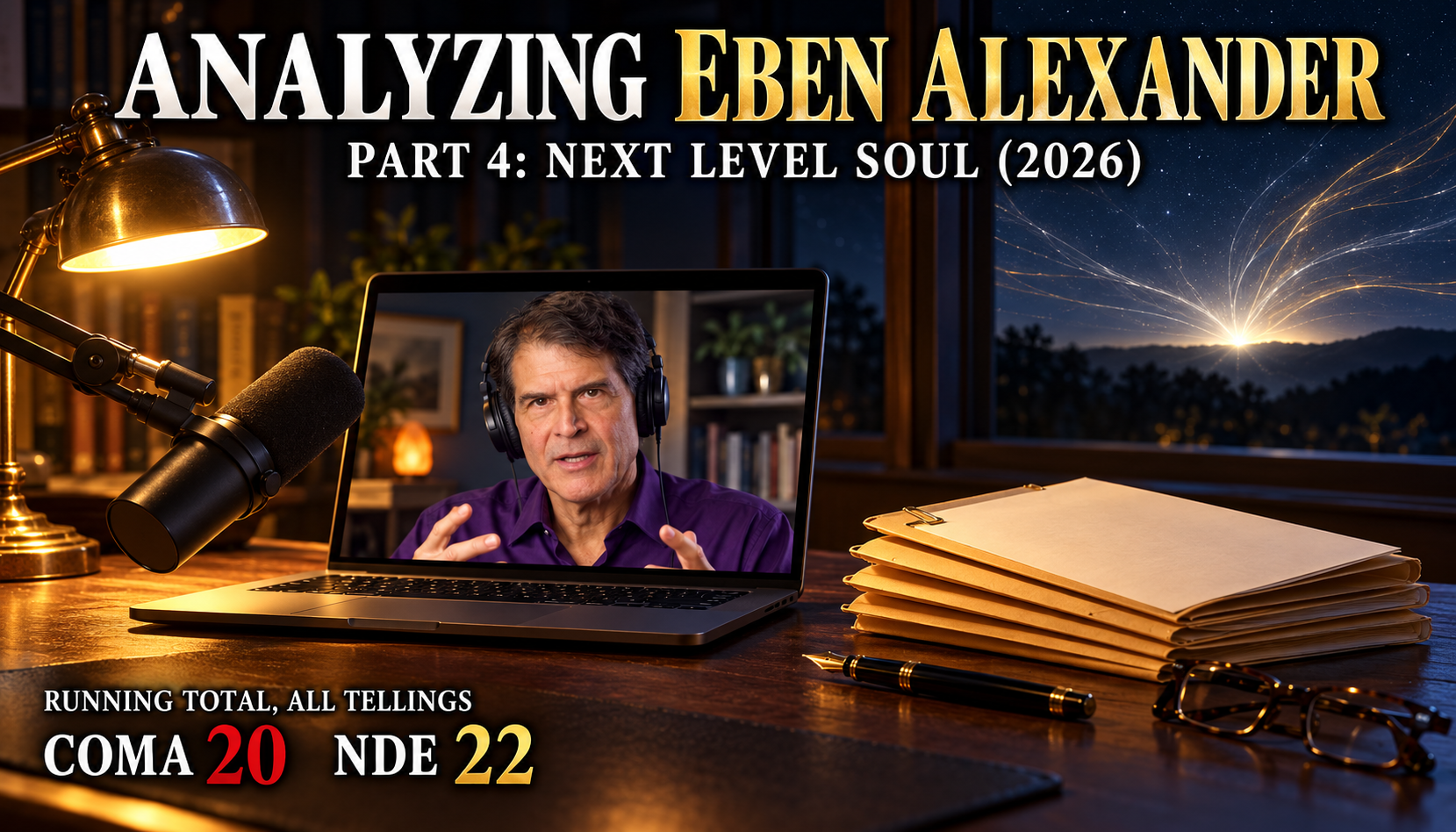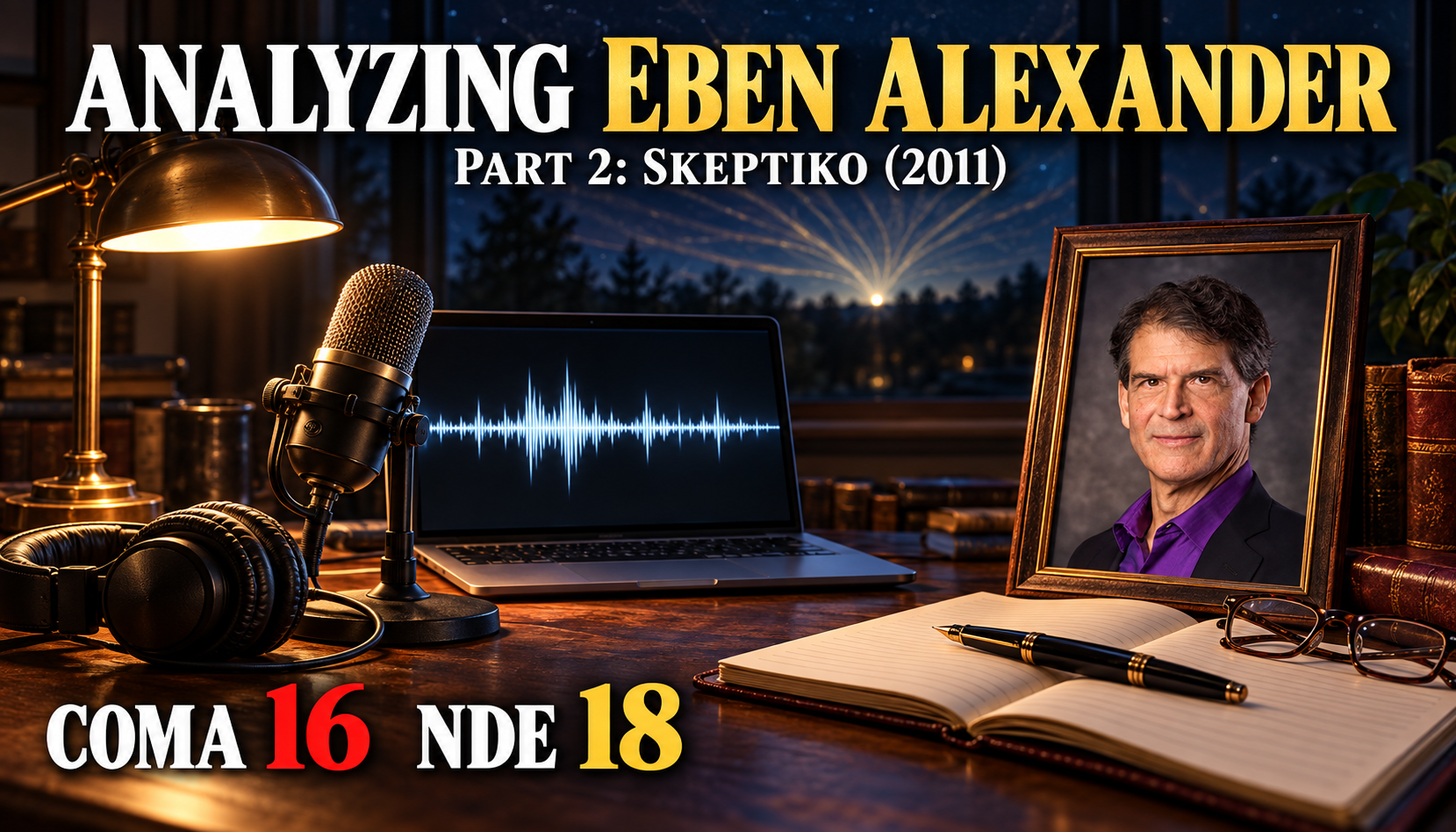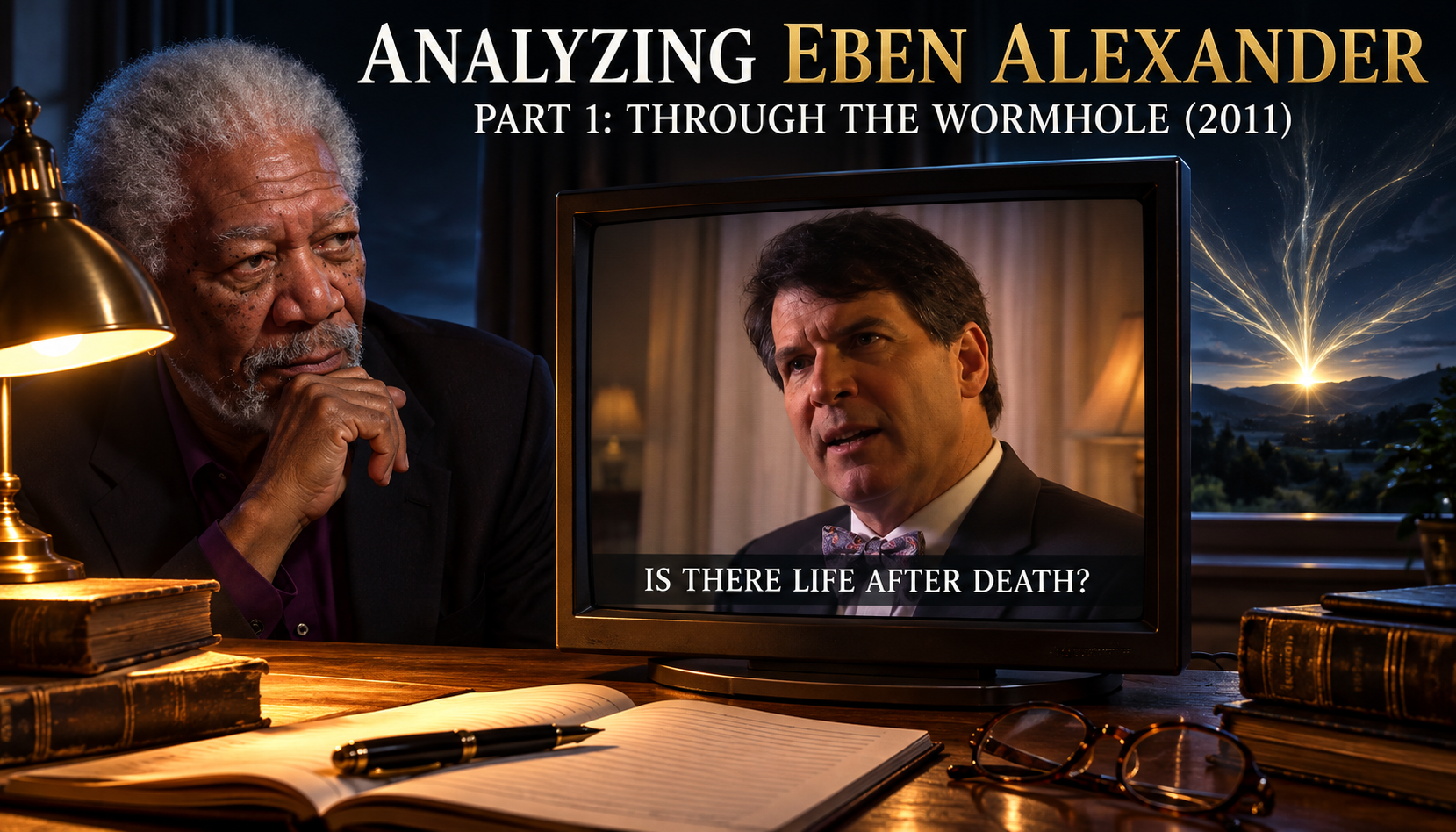
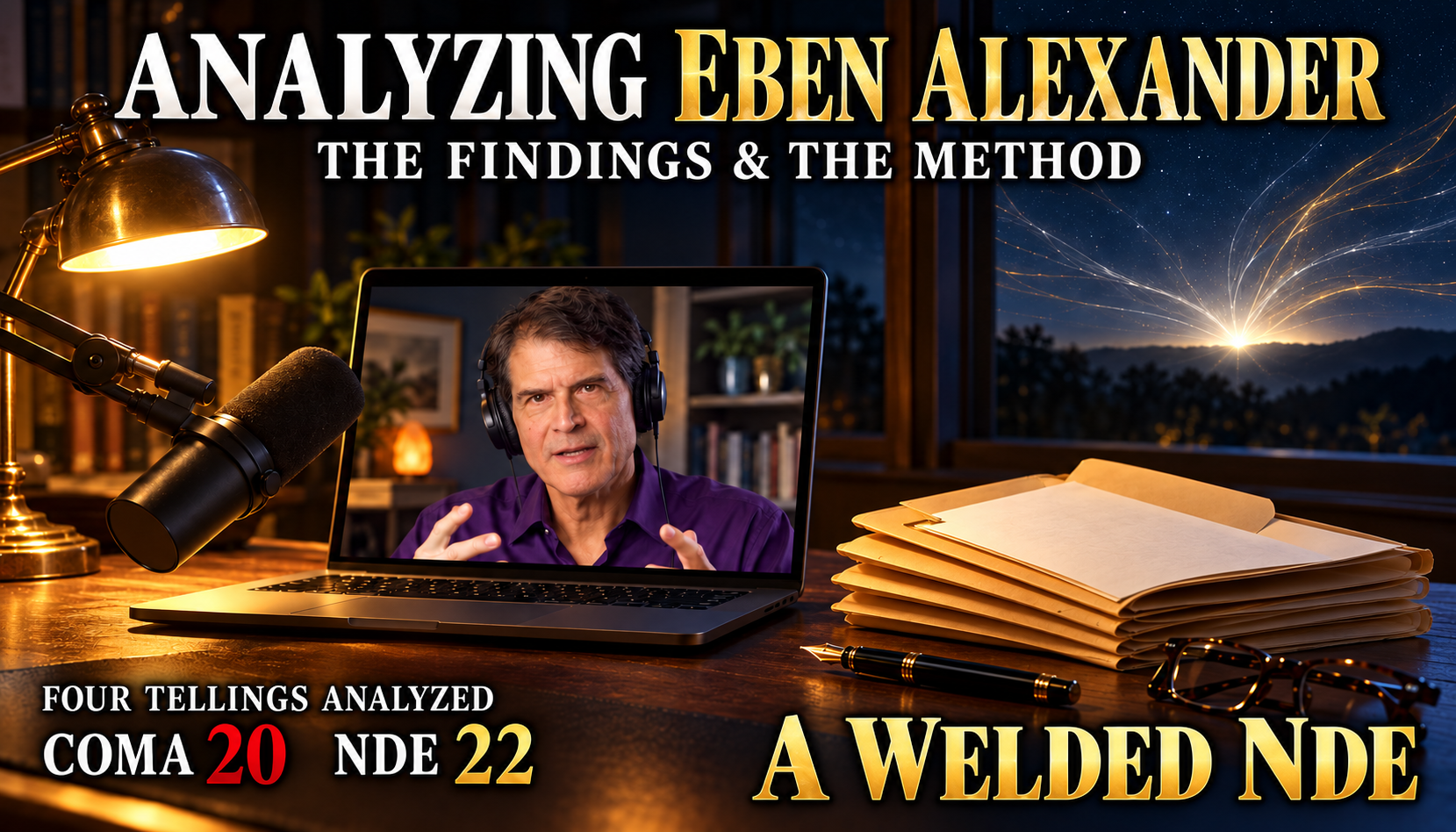
Eben Alexander had a Welded NDE.
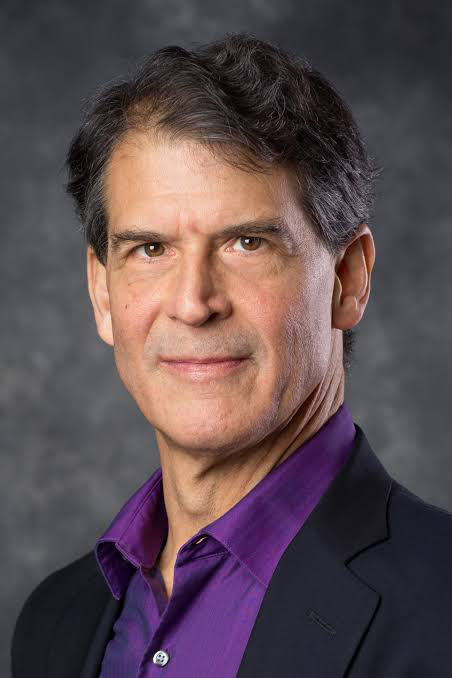
That’s the finding, after four recorded tellings spanning 15 years, from his first television appearance in 2011 to a podcast interview recorded in 2026. His account contains material from two separate sources. Part of it came from a living brain in a coma. Part of it came from an authentic near-death experience. Both sources fused into one memory, and he has been telling that one memory, honestly, ever since.
This article closes the series. It lays out the finding, the full method behind it, the evidence from his own words, and what comes next. If you’ve followed along, you’ve seen the pieces. Here they are in one place.
The Four Tellings
The series examined these tellings, line by line:
Part 1: Through the Wormhole (2011). The Science Channel, Morgan Freeman, May 28, 2011. A few minutes on camera, two and a half years after the coma.
Part 2: Skeptiko (2011). An hour-long audio interview with Alex Tsakiris, November 22, 2011, recorded while Proof of Heaven was still an unpublished draft.
Part 3: NDE Journey (2025). A polished 20-minute telling posted December 4, 2025, 17 years after the coma.
Part 4: Next Level Soul (2026). A 70-minute interview with Alex Ferrari, posted September 22, 2026.
The project began with Analyzing Eben Alexander: The Project Begins, where I stated my preliminary conclusion in public before doing the detailed work. The detailed work confirmed it.
An Honest Man, and a Terrible Witness
I’ll start with the point I most want understood, because everything else depends on it.
Eben Alexander is telling the truth. I accept every word of his testimony as an honest account of what he remembers. Nothing in this series accuses him of lying, inventing, or embellishing his experience.
That’s a deliberate part of the method. By working only from his own words, I set aside the question of truthfulness entirely. I also set aside the question of where the information came from. Every source in this series is first hand: the experiencer himself, in interviews and presentations, describing what he saw and felt. I’m not putting words in his mouth. I’m not relying on what anyone else says about him. He knows what he experienced. My job is to interpret his words by comparing them against the available data.
And yet I’ve called him a terrible witness, more than once. Here’s what I mean. Anyone who has a Welded NDE becomes a terrible witness to their own experience, through no fault of their own. The coma and the near-death experience happen during the same medical event, and the person wakes up with both fused into one continuous memory. There are no timestamps. Nothing in the memory says “this part came from your brain in the ICU” and “this part happened after you crossed over.” The person remembers one journey, so they tell one journey.
Alexander had about two and a half years to think about his experience before his first public telling, and almost 18 years since. Reflection doesn’t help. He went into that coma with no prior coma and no prior NDE to compare against. He has no point of reference. Nobody in his position would.
The Framework: FCE + NDE = WNDE
The framework is simple. A Fear Coma Experience (FCE) is the imagery a living brain generates during a coma. A near-death experience (NDE) is what a person describes after crossing over, free of the body. When both happen in the same medical event and fuse in memory, the result is a Welded Near-Death Experience (WNDE).
Every account falls into one of three categories:
Coma material only. A pure FCE.
NDE material only. A clean NDE.
Both. A Welded NDE.
The label an account arrives with doesn’t decide its category. The content does. An account presented on a podcast as a “hellish NDE” or a “distressing NDE” often contains no NDE markers at all. It’s a coma, wearing the wrong name. Other accounts, like Alexander’s, contain clear elements of both. The work is to examine what the person describes, detail by detail, and let the details sort themselves.
A Coma Doesn’t Only Produce Fear
The word “fear” in Fear Coma Experience trips people up, so this needs saying plainly. A brain in a coma produces terror, and it also produces beauty, comfort, and joy. It builds from whatever it has in storage.
Alexander’s coma material includes plenty of ugliness: the muck, the roots, the pounding, faces and animals boiling up out of the mud. It also includes millions of colorful butterflies, a festival of thousands of dancing strangers, children playing and dogs jumping, and beings with bowed heads and candles, murmuring prayers. All of it is coma material.
So beauty doesn’t establish origin. Neither does terror. A pleasant scene isn’t automatically an NDE, and a frightening one isn’t automatically a coma. The details decide.
The Soup Salad
The problem of a Welded NDE comes down to a dish I call the soup salad.
Picture someone who has never eaten soup and never eaten salad. In the kitchen, you dump a bowl of soup and a bowl of salad into the same bowl, stir it up, and serve it. The person eats it and describes it to you honestly. Having no experience of either dish, they describe it as one thing. That’s Alexander’s position.
As an analyst, I have the advantage of the kitchen. I pull a crouton out of the bowl, soaked through with soup. Then I go ask the cooks. The soup cooks say they never put croutons in soup. The salad cooks say they always put croutons in salad. Now I know where the crouton came from. Soaking in soup didn’t turn it into soup.
Some ingredients turn up in both dishes. Salt goes in soup and salad alike. For those, the ingredient alone tells you nothing, and you have to look at the context. God is an example. A person with a deep religious upbringing might see God in a coma, built from a lifetime of stored imagery. A person in an NDE encounters an all-loving source of light and communicates with it telepathically. Same word, different context, different source.
The soup is the coma. The salad is the NDE. The kitchen is the reference data.
The Kitchen: Millions of Accounts on Each Side
The comparison works because the reference data is enormous on both sides.
Millions of people have had near-death experiences, across every culture, language, and religion, and in every era. Strip out the accounts involving a coma, and what remains is remarkably consistent. Not identical, but consistent: out of the body, the void, the tunnel, the light, the life review, the garden, deceased loved ones, the lessons, and the decision to return. That’s what a clean NDE looks like and sounds like.
Millions of people have also survived comas. Most were never interviewed and never called it an NDE. Doctors know the territory as ICU delirium and ICU psychosis, and survivors often carry PTSD and nightmares for years. Their accounts show what a living brain under catastrophic stress produces: elaborate imagery, physical sensations, sounds, confusion, the hospital room bleeding into the dream.
Every element in Alexander’s account gets compared against both bodies of data. Where does it fit? What does it share with clean NDE accounts? What does it share with coma accounts? What does the surrounding testimony say? That comparison supplies the frame of reference the experiencer never had.
Taking It Apart
Analysis is a simple process at its core. You take something apart, spread the pieces out, examine each one in context, compare it against the known data, draw your conclusions, and put it back together.
You could do it with a Ford F-150. Tear the truck down to every bolt. Compare each part against every other pickup truck ever built. Then reassemble it. At the end of the day, you still have a perfectly good F-150 that runs fine. Now you understand it a whole lot better.
Alexander’s experience is still his experience. Taking it apart doesn’t damage it or take anything away from him. It explains where each piece came from and how the pieces ended up joined in a single memory.
A Scalpel, Not a Mallet
This work requires a scalpel. Alexander will say one long sentence in an interview that runs coma, NDE, coma, NDE, coma, with no pause and no grammatical break. Sort the whole sentence by its overall mood and you miss everything. Sometimes the unit of analysis is a few words.
Here’s an example from 2011, in a single breath: “There was a little melody that was spinning in front of me, and it just started spinning and expanded, and it ended up clearing away all that ugly, foreboding, gross, muddy realm, and all of a sudden I was coming up into this beautiful meadow.”
Taken apart: the melody is sound, coma. Something spinning, expanding, clearing away the darkness, and carrying him upward is the light, doing what the light does in every clean account, NDE. “Ugly, foreboding” is the dread of the coma. “Gross, muddy” is something felt on the skin, coma. “Coming up into this beautiful meadow” is the garden, NDE. Five pieces, two sources, one sentence.
Another, from Skeptiko: “It was as if there was a warm summer breeze that just blew by. Then everything changed and the scene stayed the same but I became aware… of a Divine presence.” A breeze felt on the skin is coma material. The Divine presence, in the next breath, is NDE. He moves between the two sources mid-sentence, with no awareness he’s doing it.
And this, from the same interview: “Above there were these arks of silver and gold light and beautiful hymns coming down from them.” The beings of light are NDE. The hymns are music, heard, coma. Same sentence.
Some calls are hard, and I’ve said so in the articles. The meadow is one. A meadow is an earthly landscape, and it’s also the garden reported in clean NDE accounts. I called it NDE. Other calls are clearer once you look closely. The festival of thousands of dancing strangers, random dogs, and children playing sits in that same meadow, and NDE reunions involve a few known souls and pets, not crowds. I called the crowd coma. Every call is in the record, with the words it rests on.
The Sorting Rules
The governing rule is this: if it’s something a physical body does, it comes from the coma. If it’s something only a soul free of the body does, it comes from the NDE. The soul has no nerve endings, no eardrums, no nose, no tongue. A living body in a hospital bed has all of them.
Applied sense by sense:
Touch. Physical sensation belongs to the coma: heat, pain, pressure, slime, a breeze on the skin. Emotional feeling is different. Love, reassurance, warmth in the emotional sense, remorse during a life review, all of those are NDE language. When Alexander describes a “warm awareness of the divine,” the warmth describes an awareness, and awareness has no temperature. Context decides.
Hearing. In an NDE, all communication is telepathic. Understanding arrives instantly and completely, emotion included, with no words spoken. Audible voices, music, hymns, chants, roars, and pounding are coma markers. Watch the language here, because people describe telepathic messages in conversational terms. “She told me” doesn’t establish that anyone spoke. Alexander is careful about this himself: the girl on the butterfly wing “never said a word to me… her thoughts would just come into my awareness.” That’s telepathy. The identity of the speaker doesn’t settle the question either. A religious figure speaking out loud is still speaking out loud.
Smell and taste. Smoke, sulfur, the stench of bodies, the taste of fruit, the fragrance of flowers: all coma markers, pleasant or not. Seeing fruit on a tree is visual. Biting into it is taste.
Time. Time doesn’t exist in an NDE. Experiencers say it again and again: there was no time, or time didn’t matter. Any sense of time passing, of being somewhere “a long time,” belongs to the coma. Alexander supplies both sides of this in his own words. In the muck, he heard a pounding “for eons” and stayed there “a very, very long time.” In the Core, “time out there I can say is totally different from what we call time.”
Sight. This is the hardest sense, because seeing happens on both sides. Panoramic perception, seeing everything at once, colors beyond anything on earth, and perception despite physical blindness are NDE references. Ordinary visual imagery takes a closer look at what surrounds it. A meadow, a butterfly, a face in the mud: each one gets judged on its own details.
What His Own Words Show
Some passages in Alexander’s tellings deserve special attention, because he supplies the evidence himself.
The six faces. In 2011, he described faces that would “boil up out of the muck” in the underground place, alongside animals and other grotesque shapes. Later in the same interview, he described his wife, his infectious disease doctor, and his 10-year-old son at his bedside on the seventh day of the coma, and he used the exact same words for them: they would “boil up out of the muck and then they’d go away.” In 2025, he placed them himself: “Those faces were of loved ones and friends… who were in the ICU room the last 24 to 48 hours of coma.” Real people, standing beside his living body, rising out of the same muck as the animal faces. The muck is the coma, and he locates it in the ICU in his own words.
His son’s voice. His son Bond, pleading at the bedside, “Daddy, you’re gonna be okay,” is what Alexander says drew him back. He heard the words and didn’t understand them. In 2026, he insisted he didn’t see or hear his son “with my eyes and my ears,” in the same passage where he describes Bond pulling his father’s eyelids open. A voice in the room, heard by a living brain, then a body fighting the ventilator. Coma.
The cycling. He describes going back and forth between the earthworm’s eye view and the Core “three or four times” in 2011, and “many cycles” by 2026. The earthworm’s eye view is coma. The Core is NDE. He’s describing the weld from the inside.
His own vocabulary. In 2011, he described the underground place as “one kind of soup of just mixed foam,” impossible to put in order. In 2025, he called the whole thing “a very detailed and elaborate coma journey.” His words, not mine.
The nightmare. After waking, he spent 36 hours in what he calls “a crazy paranoid delusional psychotic nightmare,” frightening enough that his family still remembers it. Doctors call that ICU delirium. The living brain, coming back online.
The Tally
Across the four tellings, I logged 20 distinct coma elements and 22 distinct NDE elements. These are counts of distinct elements in his testimony, not percentages of his experience and not measures of how long he spent in either state.
The 20 coma elements: the earthworm’s eye view, murky earth colors and roots overhead, a very long time, ugly and foreboding, gross and muddy, the melody, the butterfly wing, millions of butterflies, the pounding, faces and animals in the muck, the chant or roar, the hymns, the warm summer breeze, the soup of mixed foam, the six faces at the bedside, Susan Reintjes appearing in the muck, the nightmare of ICU psychosis, the dancing crowd, the praying beings with candles, and Bond’s plea.
The 22 NDE elements: the garden, out of the body, the void, the light, leaving this universe, the presence of God, seeing everything, oneness and love in everything, hyper-reality, indescribable colors, the girl on the butterfly wing, her telepathic message, the arcs and orbs of light, the brilliant orb, being told he wasn’t there to stay, the lessons, timelessness, deceased loved ones, the tunnel, the boundary, reincarnation, and the sense of a spiritual home.
The girl on the butterfly wing deserves a word. She’s one of the strongest NDE elements in his account. He didn’t recognize her during the experience. Four months later, a photograph from his birth family identified her as his birth sister, Betsy, who had died before he knew she existed. A deceased relative, unknown to the experiencer, identified only after the fact, delivering a single message of unconditional love telepathically. That pattern shows up in clean NDE accounts again and again.
Saturation
The fourth telling, from 2026, added zero new coma elements. All ten were repeats. On the NDE side, 16 of 17 were repeats, with one new addition, the sense of a spiritual home.
The labels shift over the years. The melody that was only music in 2011 became “this slowly spinning pure white light” by 2025, and “musical light” by 2026. “Indra’s net” became “the living tapestry vision.” The dancers became “souls between lives.” The words change. The elements underneath them stay put, and they sort into the same two piles every time.
That’s why the series stops here. I set out to examine every telling I could find, until nothing new turned up. Alexander says himself he’s given thousands of podcasts. Working through all of them to find one more element offers almost nothing when the structure has locked in place.
Two Layers Set Aside
Alexander’s tellings contain a lot of material that belongs outside the tally, and I documented it separately.
The first layer I called “The Doctor on His Own Case.” Alexander spends a large share of every interview explaining his medical condition as a neurosurgeon would: spinal fluid glucose of 1, Glasgow Coma Scale scores, the neocortex, the odds of the infection, hypotheses he considered and rejected. That’s his explanation of the experience, built afterward from his training and his records. It isn’t a remembered element of the experience. His medical training doesn’t make him a better witness to his own experience. If anything, it fills the gaps in his memory with a diagnosis.
The second layer is his general discussion of NDEs. He talks at length about life reviews, life plans, and reunions with deceased loved ones, citing Bruce Greyson’s research and other experiencers’ accounts. Discussing a feature doesn’t mean he experienced it. In four tellings, he never describes a life review of his own, and he never describes being shown his own life plan. Those stay out of the tally.
Reincarnation needs a precise distinction. He says the Indra’s net vision showed him incarnation and the time between lives, a lesson about souls in general. I counted that lesson as an NDE element. He never describes seeing a specific past life of his own, and I didn’t count one.
Keeping these layers separate keeps the analysis honest. The amount of time he spends on medicine and NDE research says nothing about how much firsthand experience he’s describing.
Move Any Element You Like
I expect debate over individual calls. Somebody will say the meadow belongs in the coma pile, or the butterflies belong in the NDE pile. Good. Make the case. Take the element, put it in context, compare it against the millions of NDE accounts and the millions of coma accounts, and show me where it lands.
Here’s what the debate won’t change. The verdict requires one element on each side. With 20 or more on each side, moving one, or five, or ten, leaves the conclusion exactly where it is. To overturn it, a critic would have to move all 20 coma elements into the NDE pile, including the muck, the pounding, the hymns, the breeze, his family rising out of the mud beside his ICU bed, his son’s voice, and 36 hours of psychosis after waking. Anyone who wants to call this a pure NDE has to explain how a soul with no body heard hymns, felt a breeze, and watched his wife and son rise out of the mud.
Why This Matters
The series does three things.
It gives the research community a worked example of the method, fully documented. Every quote, every call, and every reason sits in the record. Take the tools and apply them to other accounts. Test them. Find where they break. If you have a better framework, show it to me.
It offers a path for people with distressing accounts. Many people come out of a coma with memories of hell, sometimes mixed with light and peace, and get told they saw where they were headed. In most of those cases, the hell came from their own living brain, in a hospital bed, under catastrophic stress. Knowing that changes how a person carries the memory for the rest of their life.
And it offers Eben Alexander another way to look at his own experience. He has spent almost 18 years explaining a journey nobody could fully explain to him. The framework accounts for why the familiar NDE elements in his story sit alongside the earthworm’s eye view, the hymns, and the faces in the muck. Both halves are real. They came from two different places.
The Investigation Stays Open
This closes the series, not the question. If you have a telling I haven’t seen, a passage I misread, or an account the framework doesn’t explain, send it. Comments are open on the site. I’ll examine anything that doesn’t fit, and if the evidence moves me, I’ll say so in public.
For now, the finding stands. Eben Alexander had a Welded NDE. His testimony contains coma material and near-death experience material, joined in one honest memory.
Let the data lead the way. Bury your bias and press on.

Want to go deeper?
Don Winner brings decades of intelligence and investigative experience to the biggest question there is: what happens when we die.
In You’re Going to Die Someday, Right? Near-Death Experiences Reveal What Happens Next, he examines the evidence from thousands of near-death experiences to find out what they actually tell us about consciousness, the soul, God, and the afterlife.
In Hell Exists, But Only for the Living, he investigates where our idea of hell came from and who built it, tracing the doctrine back to its human sources.
Buy direct and support the Winner NDE Project. Signed first editions, $17.99 each, shipped by Don Winner.
Buy You’re Going to Die Someday, Right?Buy Hell Exists, But Only for the Living