
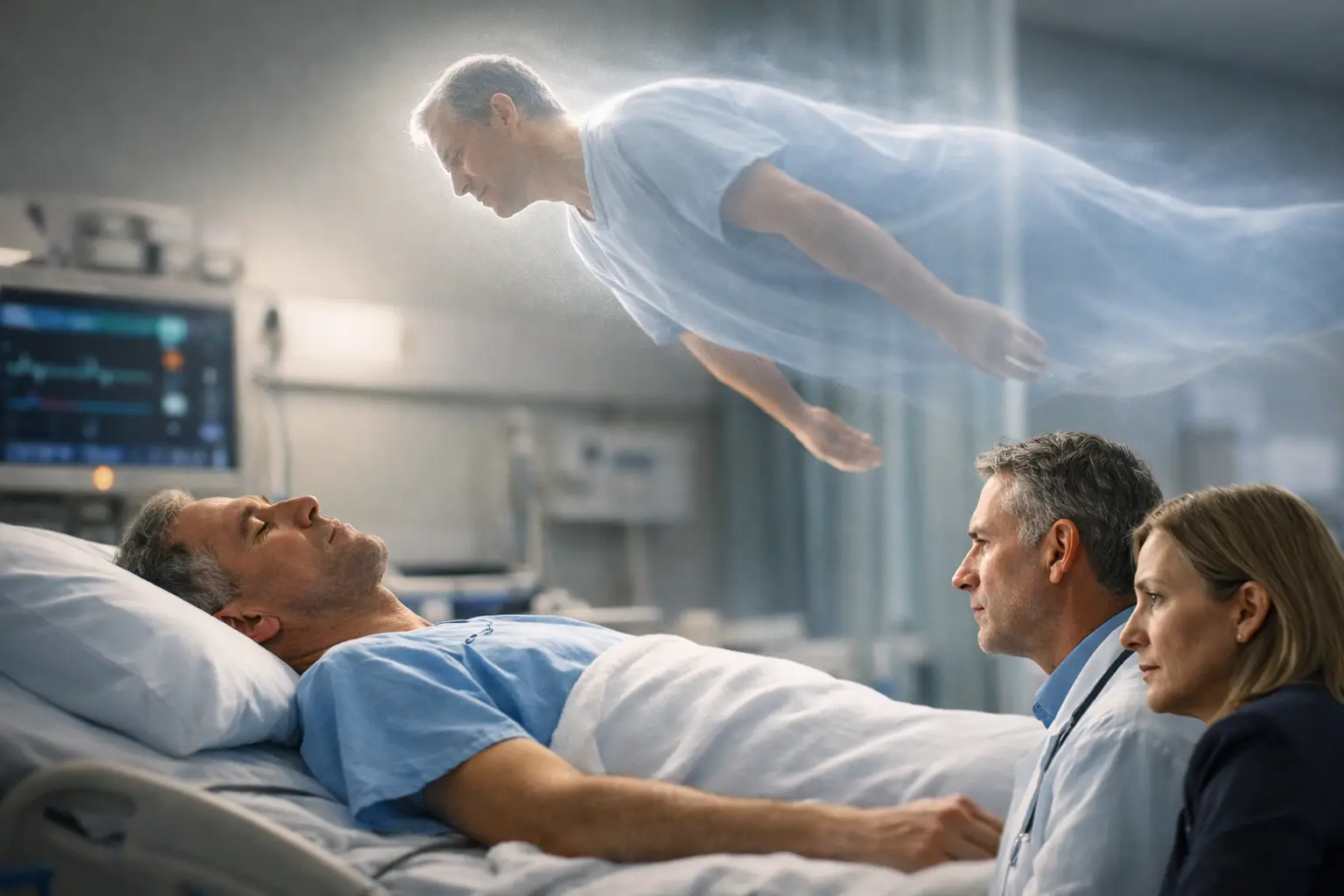
A patient lies unconscious, eyes taped shut or closed, often under emergency conditions. Later, that patient reports a conversation in a hallway, an unusual instrument, a staff member’s action, or an event that occurred away from the body. If independent witnesses confirm the detail, we are no longer dealing with a private feeling, a vivid dream, or a comforting story. We are dealing with verified out-of-body cases, and they present a problem materialism has never solved.
The issue is not whether people can have strange experiences near medical crisis. Of course they can. The real issue is far narrower and far more devastating to the conventional story: Can a person accurately perceive a real-world event while the body is clinically dead or incapable of ordinary awareness? When the answer is yes, the claim that consciousness is merely produced by a functioning brain collapses under its own weight.
What Makes an Out-of-Body Case Verified?
An out-of-body experience becomes evidentially significant when it contains information the experiencer could not reasonably have obtained through normal senses, prior knowledge, guesswork, or later reconstruction. The standard is not, “Was the account emotionally powerful?” It is, “Did the account contain specific facts, and were those facts independently confirmed?”
That distinction separates investigation from inspirational storytelling. A person saying, “I felt myself floating near the ceiling,” may be sincere and may have had an authentic NDE. But that statement alone gives an investigator little to test. A person reporting an unexpected event in another room, an exact sequence of actions during resuscitation, or a distinctive object later verified by those present gives us something different: a claim that can be checked.
Verification is strongest when several conditions converge. The account should be recorded as soon as practical, before a patient has time to absorb details from family, clinicians, or media. The reported information should be specific rather than vague. Independent people should be able to confirm it. And there should be a credible reason the patient had no normal access to the information.
None of this requires blind belief. In fact, it demands the opposite. Weak cases should be discarded. Embellished claims should be challenged. Possible information leaks should be investigated. That is how serious evidence is handled.
Why Verified Out-of-Body Cases Matter
Skeptics frequently respond to NDE reports with a familiar list: oxygen deprivation, anesthesia, medication, confabulation, expectation, temporal-lobe activity, or a brain constructing a final hallucination. These theories may sound scientific because they involve medical vocabulary. But vocabulary is not an explanation.
A theory of hallucination must explain hallucinated content. It cannot simply announce that an experience was hallucinated and call the matter settled. If a patient reports an objectively correct event that occurred beyond ordinary sensory access, then the theory must explain how a nonfunctioning or severely compromised brain acquired accurate information from that location.
This is the pressure point. A hallucination can be bizarre, symbolic, moving, or terrifying. It does not reliably provide independently accurate details about a distant physical event. A memory can be false. It does not become more likely to be false because it challenges a comfortable worldview. The question is always the same: Was the reported perception correct, specific, and unavailable through ordinary means?
If it was, then the skeptic has a problem of evidence, not a problem of vocabulary.
The strongest cases do not prove every theological doctrine ever proposed. They do something more precise. They demonstrate that conscious awareness can operate apart from the body during verified death or a period in which normal bodily perception cannot account for what was known. That is already enough to overturn the claim that death is guaranteed oblivion.
Clinical Death Is Not a Metaphor
Words matter in this field because sloppy labels create sloppy thinking. An authentic NDE occurs in genuine clinical death. The person is not merely frightened, sedated, feverish, or disoriented. The body has reached a condition in which the ordinary machinery of waking perception is unavailable.
That does not mean every report made after surgery, trauma, coma, or an ICU stay is an NDE. It clearly is not. Human beings can experience delirium, nightmares, fragmented memories, drug effects, and profound terror in catastrophic illness. Those experiences deserve compassion, but compassion does not require misclassification.
Winner NDE calls the hellish, catastrophic imagery of a living brain a Fear Coma Experience, or FCE. This is the event older literature carelessly calls a “distressing NDE.” The old label is wrong because it fuses two separate things: a terror state in a living brain and an authentic NDE during clinical death.
The distinction protects both categories from confusion. An FCE may be horrifying and psychologically consequential, but it is not evidence of postmortem punishment. An NDE may include verified perception, peace, separation from the body, and sometimes a life review. A life review belongs only to the authentic NDE, during clinical death. No clinical death, no life review.
There are also rare Welded NDEs, in which a person undergoes both an FCE and a genuine NDE during one medical crisis, with the memories later fused because there was no clock between them. This is not a license to blur the categories. It is a reason to investigate the sequence with greater care.
The Information-Leak Test
Every serious examination of a claimed verified out-of-body case should begin by trying to defeat it. Could the person have overheard staff? Could someone have mentioned the detail later? Was the feature reported common enough to be guessed? Did the memory emerge immediately, or only after years of retelling? Did witnesses independently confirm the same detail, or were they influenced by the experiencer’s account?
These are not skeptical tricks. They are basic counterintelligence questions. An analyst does not begin with a preferred conclusion and hunt for supporting fragments. The analyst identifies possible routes by which the information could have traveled and then asks whether those routes actually existed.
Sometimes they do. A patient may have heard more than relatives realize. A supposed mystery may turn out to be standard procedure. A vague recollection can become more precise through repetition. Such cases should not be used as evidence. Throwing out weak cases does not weaken the argument. It strengthens it.
But the reverse error is just as common. Critics often invent an information leak without demonstrating one. “Maybe the patient overheard it” is not a rebuttal if the patient was not present, could not hear, and the relevant event occurred elsewhere. “Maybe they guessed” is not persuasive when the reported detail was distinctive and correct. Possibility is not evidence.
A fair investigation requires the same standard on both sides. If the proponent must establish a credible route of knowledge, the skeptic must establish a credible ordinary route of knowledge. Mere speculation does not erase verified data.
Why Patterns Matter More Than Isolated Stories
No single case should carry the entire argument. Memory is imperfect, records can be incomplete, and medical crises are chaotic. Yet that is precisely why recurring patterns across independent accounts matter.
Across cultures, ages, belief systems, and medical circumstances, authentic NDE reports repeatedly include awareness apart from the body, a heightened clarity unlike dreams, encounters or environments perceived as more real than ordinary life, and lasting changes in fear of death. Within that larger pattern, veridical perception is the load-bearing evidence because it is the part that reaches beyond testimony into checkable fact.
Materialism survives by treating each anomaly as an isolated puzzle. One account is dismissed as error. Another is dismissed as coincidence. A third is dismissed as a medication effect. But a serious analyst asks whether the same dismissal explains the full data set without special pleading. It does not.
The brain-based explanation becomes especially strained when it tries to explain precise perception during a period when the body was in no position to perceive. It can describe brain activity in living patients. It cannot convert accurate information into an illusion simply by calling it one.
The Question That Remains
Verified cases do not ask us to abandon reason. They ask us to apply reason consistently, including when the conclusion is larger than our prior assumptions. The evidence does not say that every tale attached to death is true. It says something both more restrained and more revolutionary: under the right conditions, a person can know what happened while separated from the body.
For readers frightened by nonexistence, this matters personally. Death may still be serious. Grief remains real. The loss of a loved one is not solved by an argument. But verified out-of-body perception gives solid grounds to reject the bleak claim that conscious existence simply ends when the heart stops.
The honest posture is neither credulity nor denial. It is to follow the verified fact where it leads – and to recognize that a confirmed perception from outside a dying body is not a small crack in the materialist wall. It is the wall coming down.
Want to go deeper? Don Winner brings decades of intelligence and investigative experience to the biggest question there is: what happens when we die.
In You’re Going to Die Someday, Right? Near-Death Experiences Reveal What Happens Next, he examines the evidence from thousands of near-death experiences to find out what they actually tell us about consciousness, the soul, God, and the afterlife.
In Hell Exists, But Only for the Living, he investigates where our idea of hell came from and who built it, tracing the doctrine back to its human sources.
Get your copy of You’re Going to Die Someday, Right? or Hell Exists, But Only for the Living.