
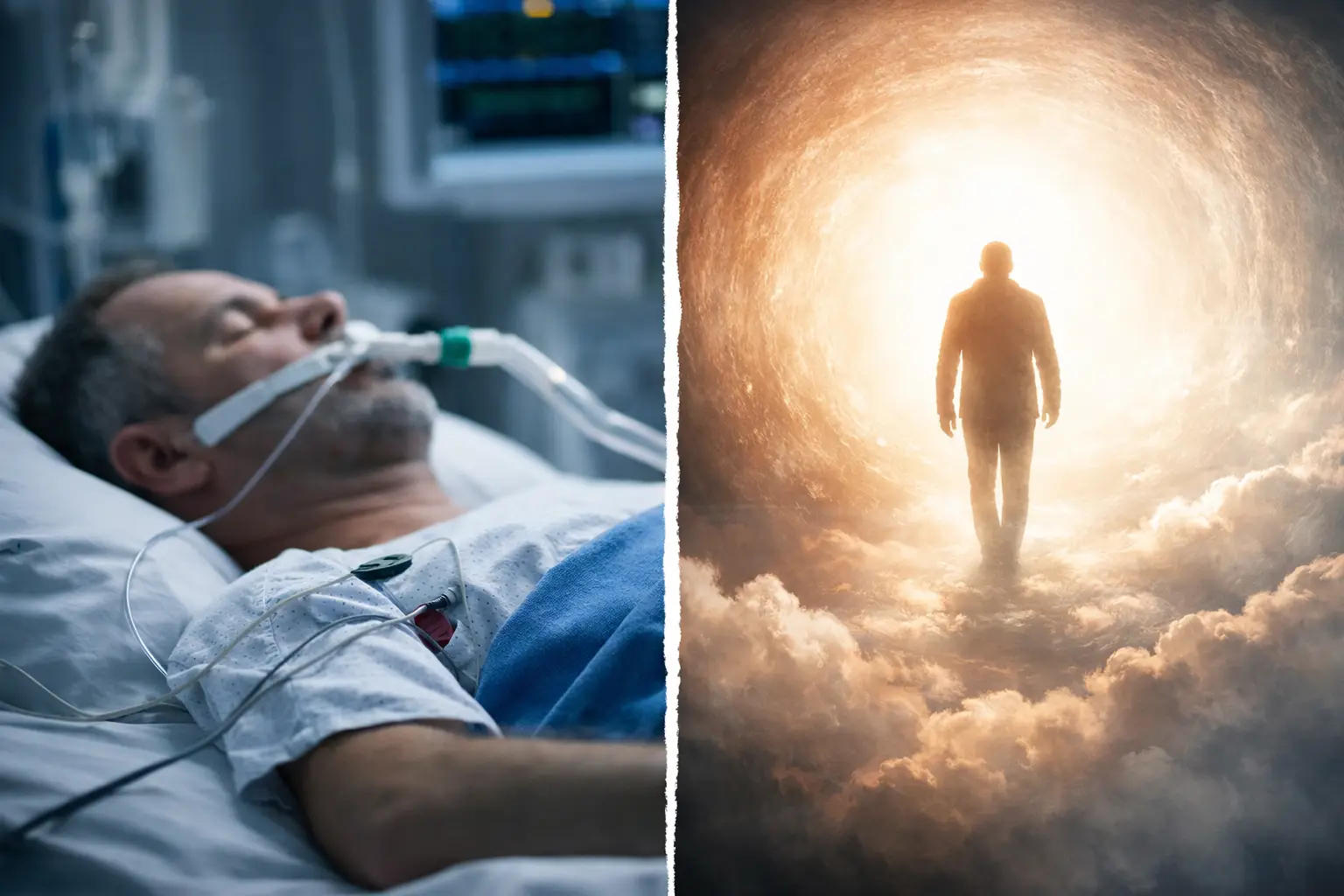
A person wakes from a catastrophic illness describing flames, torture, hostile beings, endless corridors, or a brutal sentence they cannot escape. Another person is clinically dead and later reports peace, separation from the body, and details they could not have seen from that body. Calling both accounts “near-death experiences” is not compassion. It is a category error. Coma delirium versus NDEs is the line that determines whether we are examining a terror state in a living brain or evidence from genuine clinical death.
For too long, the field has used the vague and misleading label “distressing NDE” for frightening experiences surrounding medical crises. That label creates confusion for frightened readers and hands skeptics an easy talking point: if some NDEs are chaotic, grotesque, and dependent on drugs, fever, or ICU conditions, perhaps all NDEs are. The evidence says otherwise.
There are three separate categories: the authentic NDE, the Fear Coma Experience, and the rare Welded NDE. Once those categories are kept separate, the supposed contradiction between peaceful NDEs and hellish accounts begins to disappear.
Coma Delirium Versus NDEs Is Not a Semantic Debate
Words matter because they direct the investigation. If an investigator labels every strange memory around a medical emergency as one phenomenon, the data become unusable. A nightmare during prolonged sedation, ICU delirium, severe infection, organ failure, or traumatic injury does not become an NDE merely because death was feared or because the patient later calls it one.
A Fear Coma Experience, or FCE, is a terrifying experience generated while the person is alive. The brain is under catastrophe. It may be deprived of normal sleep, flooded with fear, disoriented by medication, injured, feverish, or trapped in the confusion of critical illness. The experience can feel utterly real. Its witness can be completely honest. Its terror can remain emotionally devastating for decades.
But honesty does not settle interpretation. A person can accurately report that they endured a horrifying realm while still being mistaken about where that realm occurred. The FCE occurred in the living human brain under extreme conditions. Hell, in this sense, is real as an experience. It is not evidence that a soul traveled to a place of eternal punishment.
An authentic NDE is different at the root. It occurs during genuine clinical death, when the body has been left behind. Its strongest evidence is not pleasant imagery or spiritual language. It is verified veridical perception: accurate observations later confirmed, despite the person having no functioning sensory route to obtain them. That is the load-bearing anomaly. It is the evidence materialist explanations cannot absorb without breaking their own rules.
The Signature of a Fear Coma Experience
FCEs are not mild bad dreams. They can be more coherent, more memorable, and more emotionally violent than ordinary nightmares. That intensity is exactly why they have been misfiled as supernatural warnings.
Their recurring features are revealing. They commonly involve captivity, pursuit, punishment, contamination, bodily threat, grotesque transformation, hostile authority figures, and a crushing sense that escape is impossible. The environment often behaves like a fear machine: scenes shift without logic, threats multiply, and the person is trapped inside an emotional reality that feels larger than life.
That pattern does not resemble the evidential core of authentic NDEs. An NDE may include an out-of-body perspective, a transition beyond the body, encounters, and profound peace. Crucially, when the account includes independently verified perceptions, it presents information that cannot be reduced to an internally generated terror narrative.
FCEs, by contrast, bear the fingerprints of a brain in catastrophe. Their settings are often infused with hospital sensations, physical discomfort, restraint, alarms, authority, injury, and panic. The content may borrow from religious fears, childhood fears, films, personal trauma, or cultural ideas of damnation. The details vary, but the fear architecture repeats.
This does not make FCE survivors weak, gullible, or dishonest. It makes them human beings who survived an ordeal severe enough to produce a living hell. The correction is not an attack on the witness. It is an attack on a bad label.
Why “distressing NDE” is the wrong label
The old phrase implies that the NDE itself can turn into a horror show. That conclusion does not follow from the data. It merely reflects a failure to distinguish clinical death from catastrophic consciousness disturbance before death.
No clinical death, no authentic NDE. No clinical death, no life review. A life review belongs only to an authentic NDE, not to ICU delirium, coma terror, or any other fear state. This boundary is not arbitrary. It protects the evidence from being muddled with every frightening mental event that can occur around illness.
The distinction also answers a question many readers carry quietly: “What if I die and wake up in hell?” The evidence does not support that fear. What has been called a hellish NDE is usually an FCE – a terror experience of the living, not a destination encountered after death.
What Makes an Authentic NDE Different
A genuine NDE is not proven simply because it is beautiful, life-changing, or spiritually persuasive. People can be transformed by dreams, grief, meditation, trauma, and illness. The evidential standard must be harder than that.
The decisive cases contain veridical perception. The experiencer reports a conversation, event, object, action, or scene that was inaccessible from the physical body and is later verified. These reports matter because they are testable. They move the discussion beyond private conviction and into anomaly investigation.
Skeptics often try to erase the distinction by treating every report as a brain event, regardless of timing or corroboration. This is not scientific rigor. It is an assumption wearing a lab coat. If a person accurately perceives verifiable events while clinically dead, the explanation must account for the perception. Declaring it impossible because consciousness supposedly cannot persist does not explain the case.
The repeated structure of authentic NDE accounts also matters. Across different backgrounds, experiencers report an ordered departure from bodily awareness, not merely a chaotic hallucination. Their accounts may differ in language and interpretation, as human reports always do. Yet the central pattern remains recognizably distinct from the fragmentation, terror, and sensory confusion of the FCE.
Peace is not the only feature of an NDE, but it is not incidental either. It is part of a consistent body of testimony that points away from punishment mythology and toward a reality in which death is not annihilation.
The Rare Welded NDE
The hardest reports are not necessarily contradictions. Sometimes a person survives a prolonged medical emergency and carries memories from both an FCE and an authentic NDE. This is a Welded NDE.
The memories can feel fused because there was no ordinary clock marking the transition. The witness may describe terror first, peace later, or a confusing sequence in which incompatible scenes seem connected. The task is not to force the whole account into one label. It is to separate the components carefully.
The FCE portion belongs to the living crisis: the fear, delirium, nightmare logic, and hellscape imagery. The NDE portion belongs to clinical death and must be assessed by its own evidence, especially any verifiable perception. They are not one blended event in reality, even if they were welded together in memory afterward.
This is where careless analysis does the most damage. A skeptic may point to the terror and claim it proves the whole event was brain-generated. A religious hardliner may point to the terror and claim it proves eternal damnation. Both skip the investigative work. Both mistake emotional intensity for evidence.
Why This Divide Brings Relief, Not Evasion
Some people resist the FCE category because it sounds like an attempt to explain away suffering. It is the opposite. Calling an FCE what it is takes the suffering seriously enough to investigate its actual source.
A survivor of coma terror may need trauma-informed support, sleep recovery, medical follow-up, and room to tell the story without being told they were condemned by God. The experience can leave scars. It can reshape a marriage, destabilize faith, and produce years of dread. Reassurance should never be glib.
Yet the correct reassurance is powerful: terror in a dying medical crisis is not a verdict on the soul. It is not proof that a person has been judged. It is evidence that the living brain, under catastrophe, can construct unimaginable fear.
That conclusion is central to Don Winner’s investigation in Hell Exists, But Only for the Living. The book’s challenge is blunt: stop calling fear coma accounts evidence of an afterlife hell when the evidence points to a hell experienced before death.
For readers confronting mortality, the distinction offers something better than vague comfort. It offers an evidentially disciplined answer. Do not let the old, sloppy category of “distressing NDEs” turn a survivor’s fear into a doctrine of eternal terror. Ask the first question an investigator should ask: Was this a living brain in catastrophe, or was this genuine clinical death with verifiable perception? The answer changes everything.
Want to go deeper? Don Winner brings decades of intelligence and investigative experience to the biggest question there is: what happens when we die.
In You’re Going to Die Someday, Right? Near-Death Experiences Reveal What Happens Next, he examines the evidence from thousands of near-death experiences to find out what they actually tell us about consciousness, the soul, God, and the afterlife.
In Hell Exists, But Only for the Living, he investigates where our idea of hell came from and who built it, tracing the doctrine back to its human sources.
Get your copy of You’re Going to Die Someday, Right? or Hell Exists, But Only for the Living.