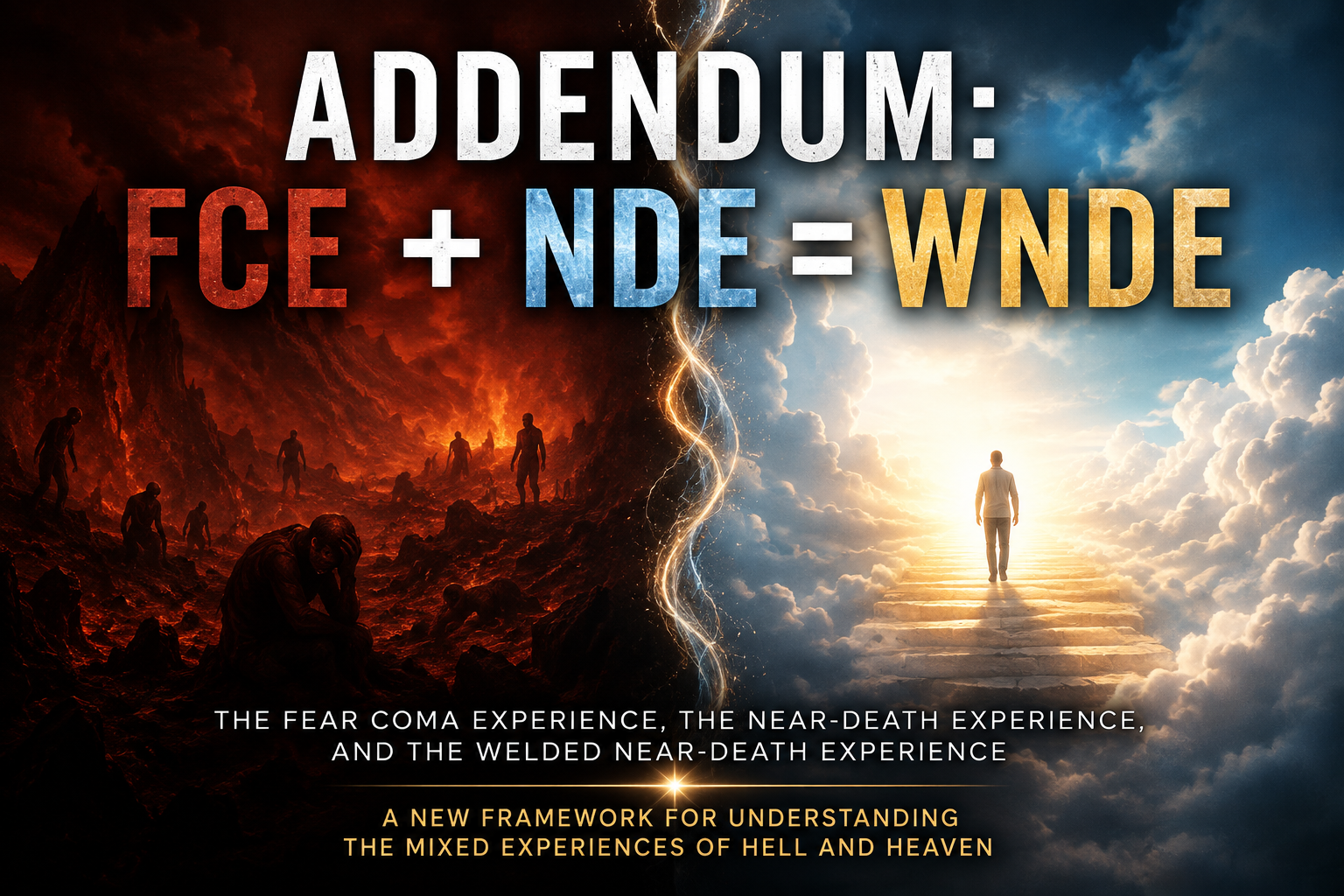
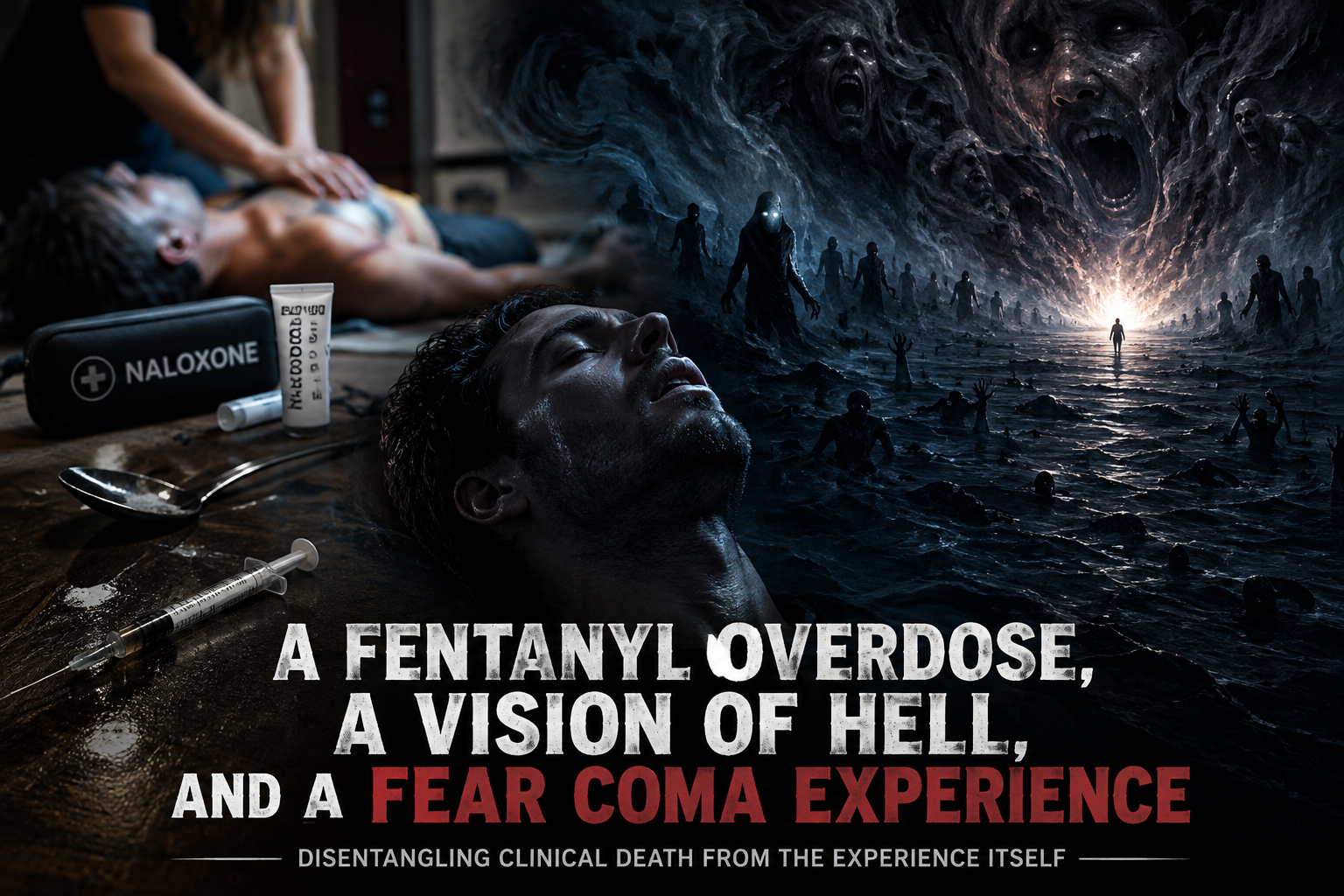
For the past several weeks, I have been looking closely at accounts commonly classified as “distressing near-death experiences” and asking a simple question: are they actually NDEs? My working theory is that many of these experiences belong to a separate category I call the Fear Coma Experience, or FCE — terrifying, highly realistic experiences produced by the living brain during periods of profound unconsciousness.
The only useful way to test that idea is one case at a time. Take the account as it was reported, separate the medical circumstances from the experience itself, identify the elements that are actually present, and see where the evidence leads. Sometimes the framework fits. Sometimes it does not. Either result is useful.
This time, the account belongs to Jason D., a longtime heroin user who suffered a catastrophic overdose and was successfully resuscitated. Unlike some of the cases I have examined, there is no large collection of interviews or other material to work with. This is a single, standalone, self-reported account. That makes it limited, but it also makes it another useful piece of data.
So that is what I am doing here: taking Jason’s account apart, running it against the Winner FCE Scale, and determining what the evidence actually supports.
A Shot at Dawn
Jason had been a heroin addict for more than twenty years. He had overdosed before, several times, and each time Narcan had pulled him back. That history matters because this was not his first encounter with a potentially fatal overdose, nor was it the first time he had lost consciousness and been revived. Yet there is no indication in his account that those earlier overdoses produced anything resembling the experience he was about to describe. He had been to the edge before and returned. This time was different.
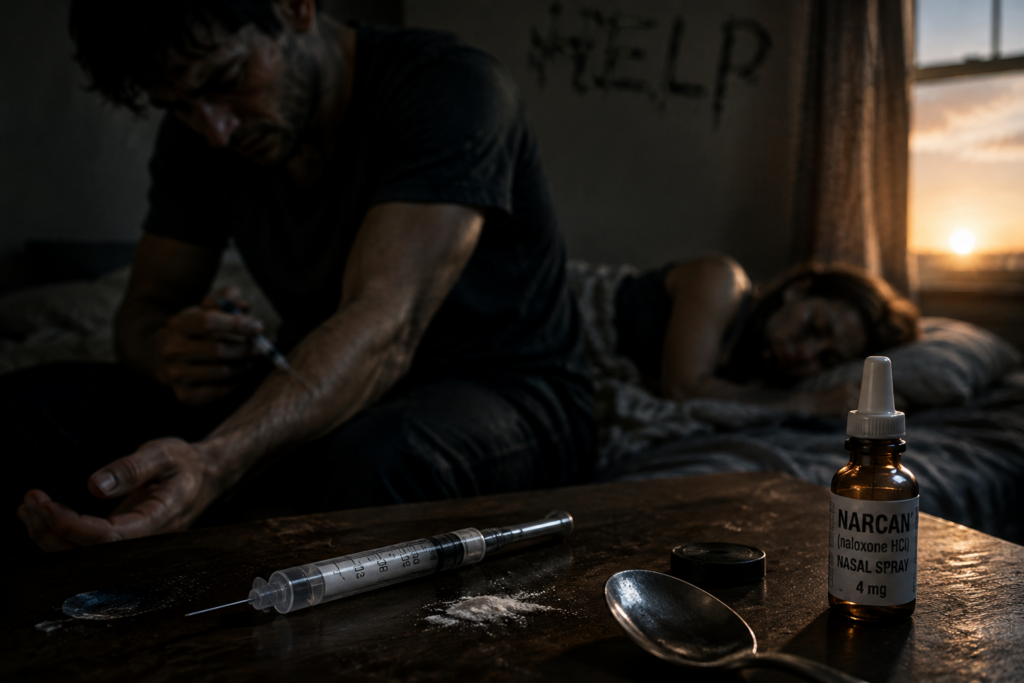
Early on the morning of November 26, 2020, Jason woke while his girlfriend was still asleep beside him. He decided to do a shot of what he believed was heroin, from, in his words, “a new batch from a dealer I didn’t really know.” Something was wrong almost immediately. “I immediately knew something was wrong when it hit me so hard.” There was no gradual slide into unconsciousness and no time to understand what was happening. His final conscious act was to smack his girlfriend on the back to wake her. He managed to get out a single word: “help.”
According to Jason’s account, what followed was a catastrophic overdose. He stopped breathing. His girlfriend could find no heartbeat. His skin turned deep blue and his lips purple. She administered Narcan and performed CPR, but four doses produced no response. She eventually found one final dose, administered it, and the fifth dose finally brought him back. By her account, Jason had been clinically dead for several minutes. Whatever else we ultimately conclude about his experience, there is no reason to minimize the severity of the physical event. This was not someone who merely became lightheaded or briefly passed out. His body was in profound, immediately life-threatening crisis.
There is, however, an important distinction that needs to be established before going any further. The fact that Jason apparently died and was successfully resuscitated does not mean that he automatically had a Near-Death Experience. People suffer cardiac arrest, stop breathing, are resuscitated, and return without reporting any NDE at all. Some remember nothing whatsoever from the period in which they were unconscious. Clinical death and Near-Death Experience are therefore not interchangeable terms. One describes a physiological condition of the body. The other describes a particular type of reported experience that sometimes occurs in association with extreme medical crisis or clinical death, but certainly does not occur every time.
That distinction is especially important here because it would be very easy to look at Jason’s circumstances and work backward: his heart stopped, he stopped breathing, he was revived, therefore whatever he experienced while he was gone must have been an NDE. That is precisely the assumption I am trying not to make. Dead does not equal NDE. The fact that Jason apparently crossed into clinical death establishes the severity of the event, but it tells us nothing by itself about how the experience he remembers should be classified. That determination has to come from the content of the experience itself.
What we can establish before examining that content is Jason’s state immediately before he lost consciousness. Whatever was in the injection hit him hard enough that he immediately understood something was seriously wrong. He was not drifting peacefully into sleep, undergoing planned anesthesia, or losing consciousness without warning. He recognized danger, physically tried to wake the person beside him, and called for help. The entire sequence unfolded in seconds. For purposes of the Fear Coma Experience framework, that detail matters: Jason went into unconsciousness with his brain already registering an immediate threat to survival.
What happened next is therefore the real subject of this investigation. Jason’s body was in catastrophic crisis and he apparently crossed into clinical death, but neither fact tells us whether the experience that accompanied those events was an NDE, an FCE, some combination of the two, or something else entirely. To answer that question, we have to temporarily set aside the fact that he died and examine the experience on its own terms. What did Jason actually see, hear, feel and remember?
That is where this case becomes interesting, because what Jason describes next bears almost no resemblance to the familiar architecture of an authentic Near-Death Experience. Instead, he describes something very different.
Catapulted Down
The overdose stopped his body. What happened next happened inside.
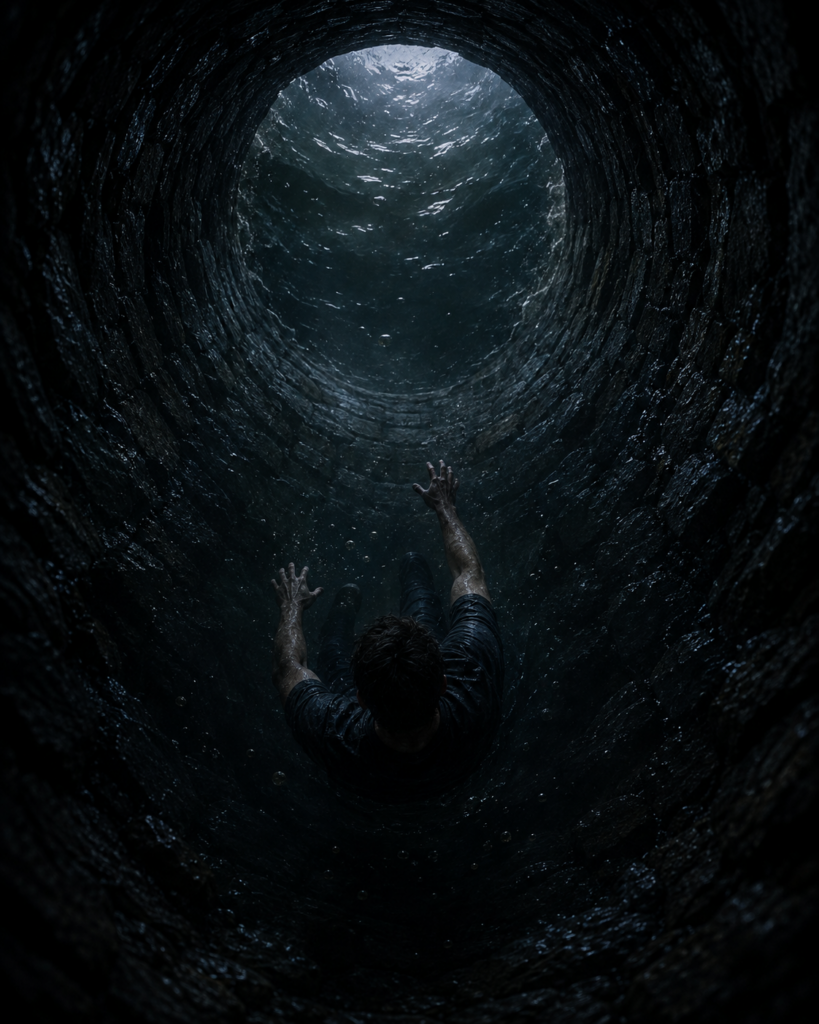
“The next thing I knew, I was catapulted down and out of my body into what seemed like a cold, dark well to land in what seemed like cold, dark water.”
This is the moment a checklist starts miscounting. He left his body — and leaving the body is one of the signature elements researchers look for in a near-death experience. On the NDERF form he affirms it plainly: he did not merely feel separated from his body, he “clearly left” it and existed outside it. Point logged in the NDE column.
But look at the motion, because the motion is everything. The classic near-death out-of-body experience is a gentle rising — the person floats up, weightless, and looks down calmly on the room, the doctors, their own body on the table. It is serene. It is elevated, in both senses of the word.
Jason’s is the opposite on every axis. He is not lifted; he is catapulted — launched by force. He does not rise; he goes down. He does not hover above a room observing in peace; he is thrown into a cold, dark well to land in cold, dark water. The direction is downward, the temperature is cold, the destination is a flooded shaft, and the force is violent.
Same label — “out of body” — opposite experience. The peaceful float and the terrified plunge get filed under the same word only because the scale that measures these things was built to catch the peaceful version and has no name for this one. What Jason describes is not transcendence lifting him free of his body. It is fear hurling him down into something worse.
The Well That Wasn’t a Tunnel
Ask anyone what a near-death experience looks like and they’ll tell you: a tunnel, and a light at the end of it. It’s the single most famous image in the entire field. So when the NDERF questionnaire asked Jason whether he passed through a tunnel during his experience, he answered yes — and on a checklist, that yes drops a point squarely in the near-death-experience column.
But watch what he does next. He can’t leave the answer alone. He immediately corrects it in his own words: “not so much a tunnel but more like a well. It was a deep well that was enclosed all around me; more like a vertical tunnel that was full of cold, black liquid.”
Read that again, because the entire distinction between a near-death experience and a Fear Coma Experience is sitting inside it.
The classic NDE tunnel goes toward something. It moves you forward and outward — toward a light, toward warmth, toward an opening, toward release. It is a passage. You travel through it and you arrive somewhere better.
Jason’s “tunnel” does the opposite in every dimension. It goes down, not forward. It is flooded — full of cold, black liquid. It is enclosed all around him — not an opening but a sealing-in. It is a well, and a well is not something you pass through. It’s something you sink into and drown in. There is no light at the end of it because it has no end; it has a bottom.
This is what makes Jason’s account so valuable. He felt the difference so clearly that he refused the word “tunnel” even as he was checking the box marked yes. He knew what he’d been handed didn’t match the story everyone told him a near-death experience was supposed to be. What he didn’t have — what nobody offered him — was the correct word for what he actually experienced.
That word is Fear Coma Experience. The descent, the cold, the black water, the enclosure: these are not the geometry of transcendence. They are the geometry of terror. And the account corrects itself, right there on the page, if you know what you’re reading.
The Sound of It
Down in the cold water, before he can make out what surrounds him, the place tells him what it is through sound. “I heard terrible screams, along with horrible, hellish sounds.”
Asked later to describe his hearing during the experience, he doesn’t reach for vague words. His hearing, he says, was heightened — sharper and more detailed than normal — and he itemizes exactly what filled it: “pain, anger, anguish, despair, and taunting.”
Sit with that list, because it is not the list of a peaceful place. Every register in it is a register of suffering. Pain. Anger. Anguish. Despair. These are the acoustics of torment — the sound a hell makes.
And then the last word on his list: taunting. That one is different in kind from the others, and it matters. Pain and anguish and despair are suffering. Taunting is suffering aimed at someone. It means something in that darkness was aware of him — aware enough to mock. The screams weren’t just ambient horror he happened to overhear. Some of it was pointed at him.
There is no near-death marker anywhere in this beat. No music, no comforting voice, no chorus of welcome. Nothing on any NDE scale corresponds to “screams of pain, anger, anguish, despair, and taunting.” This is fear-imagery, undiluted — and the taunting is the thread that pulls us to what comes next, because something that mocks you is something that knows you’re there.
Faceless in the Water
The taunting meant something was aware of him. Now he sees it.
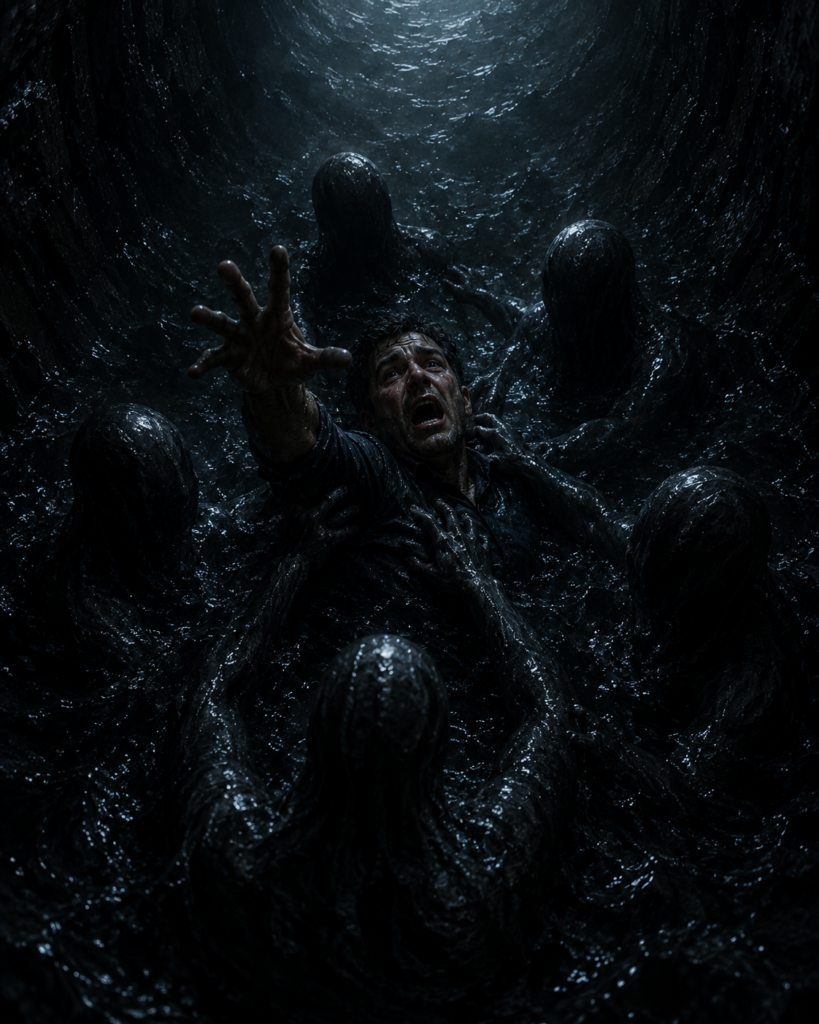
“I saw entities coming out of the water and they were trying to pull me under water with them.”
Ask most people what beings show up in a near-death experience and they’ll describe the opposite of this: figures of light, deceased loved ones, a warm presence that has come to welcome you home. That is the near-death template — and it is worth noting that Jason, on the NDERF form, answers no when asked whether he saw any beings, and no again when asked about deceased spirits. Whatever these were, he does not file them alongside the luminous welcomers of the classic account. He knew they weren’t that.
What they were is far stranger and far worse. They had no faces — formless, featureless. And they were not distinct from the place he was drowning in. In his words: “It’s like they and the liquid were one and the same.” They rose out of the cold black water, but they were the cold black water. The environment and the threat were a single thing. The hell and its inhabitants were not separable — the water that surrounded him was also what reached for him.
And what they did was pull. Not welcome, not guide, not embrace — drag. They came up out of the liquid to pull him down into it, to make him one of them, one with them, one with the water. Everything the near-death welcomers are said to do — reassure, love, receive — these did the exact inverse. They wanted him under.
You Belong Here
The entities didn’t just reach for him. They spoke.
“I distinctly remember when they telepathically communicated to me that I belonged with them there.”
This is the center of the whole experience. In the near-death accounts people know best, the message that comes at this moment is one of reassurance — you are safe, you are loved, it is not yet your time, go back. The presence that speaks is there to comfort and to return you to life.
Jason received the inverse of that message. Not “go back.” Not “it’s not your time.” The words that came up out of the black water were: you belong with us, here. No reprieve. No hand reaching down. No mistake to be corrected. A sentence, handed down — you’re one of us, stay.
And here is where we have to be careful, because Jason believed it. Reflecting on the experience afterward, he reasoned his way to a conclusion that has haunted him: “if in death these entities/beings who could only be described as evil or negative wanted me with them, that I too was evil and bad.” He heard “you belong here” and read it as a verdict on his soul — evidence that he was, at bottom, evil.
Hold that thought, because everything in this analysis is building toward taking it apart. For now, mark only what the message was: not a welcome, not love, not peace — a claim of ownership, delivered by the dark, telling a dying man he was theirs. Whether that claim was true is the question this whole case exists to answer. It was not.
The Voice in Your Head Is Not a Passport
Notice how the message reached him. Not through his ears — there was no one there to speak. It arrived directly, mind to mind: “they telepathically communicated to me that I belonged with them there.”
Telepathic communication has long been treated, by a lot of people in this field, as a kind of credential — a mark that stamps an experience as a genuine near-death experience. The reasoning goes: ordinary life doesn’t work this way, so if information arrived without words, without sound, without a mouth to speak it, then the experiencer must have crossed into some elevated state where souls communicate soul to soul. Telepathy, on this view, is a passport. Present it, and the experience is waved through into the NDE category.
That reasoning is wrong, and this account is part of why.
Telepathic communication is not exclusive to near-death experiences. It is reported constantly by people in terrifying, fear-based dying states — coma survivors, ICU patients who come back traumatized, overdose victims like Jason. In the darkest, most hellish accounts on record, the entities mind-talk. Voices arrive without sound. Messages land directly in awareness — you belong here, you are ours, stay — with no one present to speak them. The wordless channel runs straight through the fear experiences just as thoroughly as it runs through the radiant ones.
So let us plant this stake firmly and be done with it: telepathic communication is not a marker of a near-death experience. It does not certify anything. It is not a passport. It is simply a channel — a way information moves in these altered states — and that channel carries terror as readily as it carries peace. Jason’s own experience proves the point in a single line: a purely distressing, hellish account, and the defining message inside it arrived telepathically. If telepathy were an NDE credential, this drowning man surrounded by faceless entities would have to be counted as having a near-death experience. He plainly did not.
The channel tells you how the message came. It tells you nothing about what kind of place it came from. To know that, you have to stop looking at the delivery and start listening to the words. And Jason’s words — you belong with us, here — did not come from anywhere good.
Here’s the section.
A Clear-Headed Witness to a Chemical Catastrophe
There’s an obvious objection to raise about an experience that happened during a drug overdose: how much can it be worth, when the man’s brain was full of narcotics? Wasn’t he simply too high to know what was happening?
For most people, that objection would land. But Jason was not most people, and the pharmacology matters here.
A person using heroin for more than twenty years does not experience drugs the way a first-timer does. Heavy, habitual users develop enormous tolerance. The euphoria is long gone; what’s left is maintenance — using not to get high but to keep the crushing symptoms of withdrawal at bay. At his normal operating level, a user like Jason is carrying a quantity of opioid that would incapacitate an ordinary person, and yet he is functional: thinking, remembering, working, moving through his day with a relatively clear head. His tolerance is the whole reason he can function at all.
This is why his account is worth taking seriously as testimony. He is not a naive user reeling through a chemical fog. He is a long-term tolerant user whose baseline cognition is intact — which makes him a credible witness to his own experience. And indeed, his recollection is unusually sharp: he reports remembering this event in more precise detail than the ordinary events around it, in a period of his life he otherwise describes as a years-long blur.
But here is the crucial distinction. The experience did not happen at his lucid maintenance level. It happened in the catastrophic window where a fentanyl-laced batch — from a dealer he didn’t know, cut with something his tolerance was never built for — blew straight past his defenses. His own words mark the moment precisely: “I immediately knew something was wrong when it hit me so hard.” A man with his tolerance saying a dose “hit me so hard” is a man reporting a dose that overwhelmed him. What followed was clinical death: no heartbeat, no breathing, blue skin, five doses of Narcan to reverse.
So we can hold two things at once, and they don’t conflict — they interlock. The recovered, clear-headed Jason is a reliable reporter: his tolerance and his sharp memory make his account trustworthy as a record of what he went through. But the experience he is reporting on was generated in the crisis window — by a brain that had been overwhelmed, oxygen-starved, and shut down by an overdose. That dying, chemically-flooded brain is precisely the state the Fear Coma Experience arises from.
This is not the clean perception of a soul that departed the body and saw something true. It is a lucid man’s accurate report of what his overdosed, dying brain manufactured in the minutes it was collapsing. The clarity of the witness and the fear-state origin of the vision are not in tension. One tells us we can trust the telling. The other tells us where the telling comes from.
Clawing Back Up
Every element so far has pulled in one direction — down, cold, under. The end of the experience is Jason reversing that pull by force.
“I was struggling and fighting to breathe. With one last strong attempt to break free, I was able to take a deep breath. I was rocketed back into my body.”
On the questionnaire, this moment gets counted as a “border or point of no return” — one of the recognized elements researchers look for, and part of why this experience registered on the near-death scale at all. Asked about it directly, Jason describes “a definite conscious decision to return to life. I remember not wanting to be pulled under with these beings. I fought to free myself.”
But look closely at what kind of border this is, because it is the opposite of the near-death version. In the classic account, the border is a serene threshold — a stream, a fence, a line drawn across a peaceful landscape, where a calm presence tells the experiencer it is not their time and they turn back gently, often reluctant to leave the beauty behind. It is a boundary one chooses, in peace, not to cross.
Jason’s border is a man drowning. There is no serene threshold, no reluctance to leave, no calm voice granting permission to return. There is cold black water, entities dragging him down, and a desperate fight to break the surface and breathe. His “decision to return” is not a peaceful choice made at a beautiful boundary — it is the frantic will to not be pulled under and die. He didn’t turn back from paradise. He clawed his way out of a grave.
Same label on the form. Opposite reality underneath it. The peaceful threshold and the fight for survival are counted as the same element only because the instrument measuring them was built to recognize the serene version and has no name for a man escaping a hell that was trying to keep him.
The Winner FCE Scale: 9 Points, With Two Questions Still Open
Run Jason’s account through the Winner FCE Scale and the result is 9 points, with two questions still unknown. That places him, on the evidence currently available, in the Possible FCE range. The number is lower than the experience itself might lead you to expect, and the reason matters. The scale is not measuring only how terrifying the experience was. It also measures the medical and behavioral structure surrounding it — how long the person was unconscious, the documented depth of coma, whether the body was physically fighting or thrashing, what happened afterward, and how much time was lost. Jason’s event was catastrophic, but it was also relatively brief.
On the fear side of the scale, the signal is unmistakable. He knew immediately that something was badly wrong and managed only to wake his girlfriend and say “help” before losing consciousness. What followed was overwhelmingly distressing: a violent downward plunge, a cold black well, dark water, screams of pain and anguish, faceless entities trying to drag him beneath the surface, the message that he belonged there, and a desperate struggle to escape and breathe. Jason himself classified the experience as “entirely distressing.” Those elements score strongly for frightening imagery and entrapment, and they leave very little ambiguity about the dominant emotional character of the event.
Where the score loses points is mostly around the structure of the medical event. Jason was unconscious and unresponsive, but the available account describes minutes rather than hours or days, so the coma question scores only one point. We do not have his Glasgow Coma Scale score. We also do not know whether his girlfriend saw him thrashing, fighting, or physically acting out the experience while she was performing CPR and administering Narcan. Those last two questions remain Unknown, exactly as the scale allows when medical records or witness testimony have not yet been obtained.
The aftermath is equally important. Jason remembers the experience with extraordinary clarity more than four years later and says it remains more vivid than the ordinary events surrounding that period of his life. It shook him deeply enough to change the direction of his life and became a major force in his recovery from addiction. But the available testimony does not document the prolonged nightmares, flashbacks, avoidance, anxiety, or PTSD required for the maximum aftermath score. The experience remained vivid and consequential; the evidence for lasting psychological injury is simply not there.
So the correct result, for now, is 9 points with two Unknowns — Possible Fear Coma Experience. But that number needs to be read in context. Jason scores strongly on the actual phenomenology of the FCE: fear at the threshold, hellish imagery, entrapment, severe terror, and an experience that remained strikingly real afterward. The unanswered questions are largely clinical and observational. If his records document a Glasgow Coma Scale of 8 or below, and if his girlfriend reports that his body was physically fighting or agitated during the event, those two answers alone could move the score into the 12–13 range — Probable, almost certain FCE.
That makes Jason’s case useful for another reason. It exposes an edge case in the scale itself. The Winner FCE Scale was built largely around prolonged coma experiences, where medical depth, physical agitation, lost time, and extended psychological aftermath are often available to measure. Jason’s fentanyl overdose was different: catastrophic, profound, and apparently brief. His heart stopped, he stopped breathing, his body turned blue, CPR was underway, and five doses of Narcan were required before he returned. Yet the event may have been too short to accumulate some of the structural markers that drive the score higher.
The score therefore does not tell us that Jason’s fear experience was weak. It tells us that, using the scale exactly as written and refusing to award points the evidence does not support, the case currently lands at nine. The fear signature itself is much stronger than that number might first suggest. And that is precisely why the scale is useful: it forces the analysis to separate what the account clearly establishes from what we merely suspect.
Summary: What This Case Actually Shows
Jason D.’s account is valuable precisely because it is so limited. Unlike the Michelle Ledbetter investigation, there are no dozens of interviews spread across years, no podcast appearances to compare against one another, no medical records in hand, and no witnesses whose accounts have been independently collected. There is one source: Jason’s own detailed, self-reported account submitted to NDERF in 2018, describing a single event that occurred in 2014. That gives us a remarkably detailed first-person narrative, but it also places a hard boundary around what can responsibly be concluded from it. There is nothing else to triangulate against.
The event itself was also different from the cases for which the Winner FCE Scale was primarily designed. Jason did not spend days or weeks in a medically documented coma. He suffered an acute fentanyl overdose, became unconscious and unresponsive, stopped breathing, reportedly had no detectable heartbeat, turned blue, received CPR, and was revived after five doses of Narcan. It was a sudden overdose-and-reversal event, apparently measured in minutes. There is therefore nothing particularly surprising about a relatively modest score on an instrument designed to capture the broader signature commonly found in prolonged coma experiences—including documented coma depth, extended lost time, witnessed physical agitation, and lasting psychological aftermath.
What is striking is how strongly Jason’s experience matches the phenomenological core of a Fear Coma Experience despite those structural differences. He entered unconsciousness knowing something was terribly wrong. He immediately descended into an overwhelmingly dark and frightening environment. He experienced cold, darkness, screams, suffering entities, entrapment, suffocation, pursuit, and a desperate inability to escape. He fought against beings attempting to pull him beneath black water and ultimately escaped only through a final desperate struggle toward the surface. Jason himself left no ambiguity about how he classified what happened: the experience was “entirely distressing.”
Just as importantly, there is little in the account resembling the conventional architecture of a peaceful Near-Death Experience. Jason reported no out-of-body observation, no deceased relatives, no life review, no overwhelming love, no beautiful landscape, no communication with a being of light, and no boundary or decision about whether to return. Instead, the account is dominated by fear and escape. His eventual return is described almost physically: he fights upward, breaks through the surface, and suddenly awakens with his girlfriend above him trying to save his life. That distinction is central to why this case belongs in the FCE discussion even though the scale cannot classify it as strongly as a prolonged coma case.
The result, then, is more informative than the number alone. Jason currently scores 9 points with two Unknowns, placing him in the Possible FCE range. That score should not be inflated simply because the narrative fits the hypothesis well. The entire purpose of using a scale is to prevent exactly that kind of reasoning. Evidence that is missing remains missing. We do not know his Glasgow Coma Scale score. We do not know whether his body was physically fighting or agitated while his girlfriend attempted to revive him. We cannot award those points because the answers would be convenient.
At the same time, Jason’s case may expose an important boundary condition in the Winner FCE Scale itself. A scale developed primarily from prolonged coma experiences may naturally under-score a brief overdose event even when the subjective fear signature is exceptionally strong. That does not necessarily mean the scale is wrong or that Jason’s experience should be forced into a higher category. It means the instrument is doing something useful: showing us exactly where this case fits cleanly, where it does not, and where the available evidence simply runs out.
That leaves the larger question. We have a man whose body was reportedly in catastrophic physiological crisis, whose conscious experience during that period consisted almost entirely of terror, entrapment and escape, and whose account contains very little of what normally identifies an NDE. We also have only one self-reported source and no independent material with which to strengthen or challenge it. Those limitations have to remain part of the analysis.
With the evidence separated from the assumptions and the FCE score established, we can now ask the question that matters most: What, if anything, can Jason D.’s experience actually allow us to conclude?
Conclusion: This Was Not A Near Death Experience
Whatever happened to Jason D. during those minutes of unconsciousness, I do not believe it should be classified as a Near-Death Experience in any meaningful sense of the term. His body was unquestionably in catastrophic trouble. According to his account, he stopped breathing, had no detectable heartbeat, turned blue, required CPR, and needed five doses of Narcan before he returned. He was certainly near death. But being near death does not automatically make everything experienced during that period a Near-Death Experience.
The distinction matters. Jason’s account contains essentially none of the characteristics I would expect to find in an authentic NDE. There is no out-of-body observation. No perception of events occurring around his physical body. No encounter with deceased relatives. No life review. No overwhelming love or peace. No extraordinary light. No communication with a source or being of light. No boundary. No choice or instruction to return. Instead, the experience is dominated from beginning to end by fear: darkness, cold, screams, black water, threatening entities, suffocation, entrapment, pursuit, and a desperate struggle to escape. Jason himself classified the experience as “entirely distressing.”
That is precisely why this case is important. Jason came close to dying, but the experience he remembers appears to have been generated while his brain was still alive and under extraordinary physiological stress. In my framework, that makes it a Fear Coma Experience—or, given the unusual overdose circumstances and the limitations exposed by the scale, something very closely belonging to that same family of experiences. His living brain was facing an existential threat, and what emerged was not peace, transcendence or separation from the body. It was terror.
And that is the larger point. The living brain can generate hell. It can apparently construct elaborate, immersive, emotionally overwhelming environments filled with danger, suffering, hostile beings, entrapment and the certainty that something terrible is happening. Those experiences can feel completely real. They can remain extraordinarily vivid years later. And because they occur while a person is critically ill, injured, unconscious or close to death, they can subsequently be labeled a “distressing NDE” simply because nobody has given them another category.
Jason’s account gives us no reason to do that. Calling it a Near-Death Experience because he nearly died confuses the medical circumstances surrounding the experience with the nature of the experience itself. Those are two different questions. A person can be near death without having an NDE, just as a person can be unconscious without experiencing an FCE. Classification has to come from the evidence contained in the experience, not merely from what was happening to the body at the time.
This is also only one case. One man, one overdose, one experience, one self-reported account. It cannot establish how common these experiences are, prove their neurological mechanism, or tell us how many accounts currently classified as distressing NDEs actually belong somewhere else. But if this basic phenomenon occurs across the enormous number of human beings who have suffered overdoses, traumatic injuries, critical illnesses, prolonged comas, anesthesia complications and other episodes of profound unconsciousness, then Jason’s account may represent one example among potentially millions.
That is the trail I’m following.
I started by asking a relatively narrow question: if hell does not appear to be part of the authentic Near-Death Experience, where are all of these reports of hell coming from? The evidence keeps pointing me toward the living brain—to fear, catastrophic physiological stress, coma and unconsciousness, and a survival system capable of constructing extraordinarily convincing worlds of terror when the body can no longer respond.
Jason D. is another breadcrumb.
There is considerably more data out there. There are more accounts to find, more cases to score, more apparent “distressing NDEs” to pull apart, and almost certainly more exceptions that will force me to modify the framework as I go.
The work continues. I’m still following the breadcrumbs.
Want to go deeper? Don Winner brings decades of intelligence and investigative experience to the biggest question there is: what happens when we die.
In You’re Going to Die Someday, Right? Near-Death Experiences Reveal What Happens Next, he examines the evidence from thousands of near-death experiences to find out what they actually tell us about consciousness, the soul, God, and the afterlife.
In Hell Exists, But Only for the Living, he investigates where our idea of hell came from and who built it, tracing the doctrine back to its human sources.
Get your copy of You’re Going to Die Someday, Right? or Hell Exists, But Only for the Living.