
From August 26 through August 30, 2026, I will be attending the annual conference of the International Association for Near-Death Studies (IANDS) in Bellevue, Washington. This will be my first opportunity to attend an IANDS conference, meet many of the researchers whose work I have studied over the past several years, and introduce myself to a community that, until now, has had little reason to know who I am. At the time of last year’s conference, neither of my books had been published. Today the situation is very different. Two books are now available, the Winner NDE website has grown into a substantial research resource, articles are being published regularly, podcast interviews are underway, and social media channels have been established across multiple platforms. More importantly, the work itself has produced several new analytical frameworks that I believe deserve careful examination by anyone seriously interested in understanding near-death experiences.
Unlike many researchers who entered this field through medicine, psychology, or theology, my background is in strategic intelligence analysis and investigative journalism. Those disciplines teach a simple but demanding lesson: follow the evidence wherever it leads, regardless of whether the destination is comfortable or expected. Intelligence analysts are trained to recognize patterns across seemingly unrelated bodies of information, identify hidden relationships, separate correlation from causation, and constantly test competing hypotheses against available evidence. That methodology has shaped every aspect of my work on near-death experiences, and it has repeatedly led me toward conclusions that differ substantially from the conventional wisdom surrounding the field.
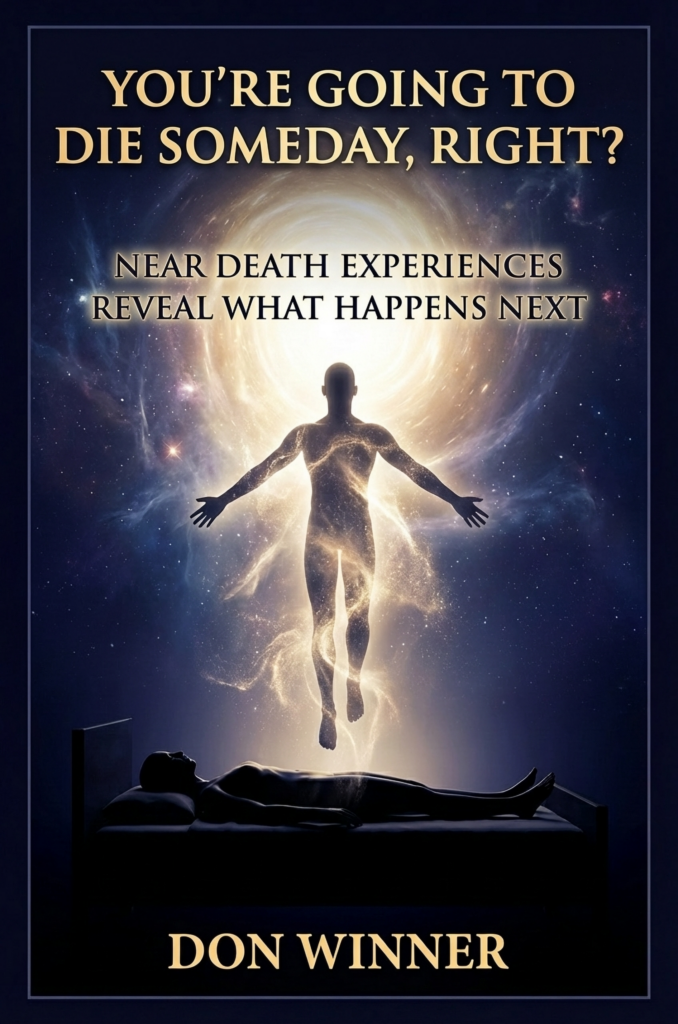
My first book, You’re Going To Die Someday, Right? Near-Death Experiences Reveal What Happens Next, began with a question that is surprisingly absent from most discussions of religion: where did humanity’s earliest concepts of God, the soul, heaven, and an afterlife actually originate? Nearly every civilization on Earth eventually developed remarkably similar beliefs concerning a continuing existence after death, despite having little or no contact with one another. Rather than beginning with religious texts written thousands of years after those ideas first appeared, I approached the question from a different direction. Long before organized religions existed, people were already surviving brushes with death and returning with extraordinary accounts of overwhelming love, brilliant light, encounters with deceased relatives, panoramic life reviews, and a continued existence beyond the physical body. Those experiences would naturally have been retold within families and tribes, gradually becoming part of humanity’s shared understanding of reality. Over countless generations, those accounts evolved into traditions, traditions evolved into belief systems, and belief systems eventually became organized religions. Within this framework, religion did not invent the concepts of God, heaven, or the soul. Rather, organized religion inherited ideas that first entered human culture through authentic near-death experiences.
While researching the origins of heaven, however, an equally obvious question emerged. If authentic near-death experiences explain humanity’s ancient ideas concerning God and the afterlife, what explains the equally widespread appearance of hell? Nearly every civilization also developed stories involving terrifying underworlds, demonic beings, punishment, darkness, imprisonment, and overwhelming fear. These concepts appeared independently across the globe just as consistently as ideas about heaven. The prevailing explanations never fully satisfied me because they addressed the religious traditions themselves rather than asking where those traditions originated. That question ultimately became the foundation of my second book, Hell Exists, But Only for the Living.

The answer, I believe, comes not from theology but from medicine. Critical care physicians have spent decades documenting patients who emerge from prolonged comas and intensive care with vivid memories of terrifying experiences involving monsters, demons, imprisonment, torture, pursuit, fire, hopelessness, and overwhelming fear. Many of these patients later develop significant psychological trauma because the experiences were completely real from their own perspective. Interestingly, this body of medical literature has developed almost entirely independently from the field of near-death studies. Physicians have been carefully documenting these frightening coma experiences for years without attempting to interpret them as near-death experiences, while near-death researchers have often encountered similar reports under the label “distressing near-death experiences.” Bringing these two bodies of evidence together revealed what I believe is an important classification problem.
That realization led me to propose a new category that I call the Fear Coma Experience, or FCE. The distinction is straightforward but important. If a patient remains alive throughout a prolonged coma and there is no documented clinical death, then the resulting experience should not be classified as any form of near-death experience. The individual is not mistaken, dishonest, or exaggerating. They are accurately reporting a terrifying experience that genuinely occurred. The question is not whether the experience happened, but rather what kind of experience it was. By recognizing Fear Coma Experiences as their own category, we can separate two fundamentally different phenomena instead of continuing to force them together under the misleading label of “distressing NDE.”
This distinction also resolves another long-standing puzzle within the literature. On rare occasions, patients report experiences that contain both terrifying hellish imagery and the classic features of an authentic near-death experience. Medical records often reveal that these individuals first entered a prolonged coma, later suffered documented clinical death during that same hospitalization, experienced a genuine near-death experience, returned to their bodies, and then continued through the original coma before finally awakening. From the patient’s perspective, however, these events occur as one continuous memory with no internal timestamps separating them. I refer to these combined events as Welded Near-Death Experiences (WNDEs) because two distinct phenomena have effectively been welded together into a single remembered experience. Once separated according to the medical chronology, the apparent contradiction largely disappears.
One point deserves particular emphasis because it lies at the heart of my investigative approach. I do not begin by questioning the honesty of the person describing the experience. On the contrary, I assume they are faithfully reporting exactly what they remember. The witness is not the problem. The classification may be. A person who experienced a terrifying Fear Coma Experience genuinely experienced that terror. Someone who experienced an authentic near-death experience genuinely encountered what they describe. A person who underwent a Welded Near-Death Experience truthfully remembers both. The responsibility of the investigator is not to decide whether the witness is sincere, but to determine, as accurately as possible, what actually occurred medically and neurologically during the event.
Because these ideas represent new analytical frameworks rather than established doctrine, I am not asking anyone to accept them simply because I proposed them. In fact, I encourage exactly the opposite approach. Apply these frameworks to existing cases. Examine the medical records whenever they are available. Ask whether documented clinical death actually occurred. Determine whether the patient was in a prolonged coma. Compare the reported imagery with what modern critical care medicine has documented for decades. Search for exceptions. Identify weaknesses. Improve the framework where necessary. The proper response to any new hypothesis is rigorous testing rather than immediate acceptance or immediate rejection.
I fully expect these ideas to generate discussion and, in some cases, significant disagreement. Many respected researchers have spent decades working within the existing terminology, and changing long-established classifications is never comfortable. Others approach these questions from deeply held religious perspectives that naturally influence how frightening experiences are interpreted. None of that concerns me. Every important idea was once a new idea, and every useful framework had to survive careful scrutiny before earning broader acceptance. If these concepts accurately describe the evidence, they will withstand that scrutiny. If they do not, they should be revised accordingly.
As I prepare to attend my first IANDS conference, my goal is not to persuade everyone that my conclusions are correct. My goal is to introduce a set of investigative tools that I believe can help move the conversation forward. Strategic intelligence analysis has taught me that progress rarely comes from defending existing assumptions. It comes from asking better questions, recognizing overlooked patterns, and following the evidence wherever it leads. That is the invitation I hope to extend in Bellevue, and it is the same invitation I extend to anyone interested in the serious study of near-death experiences, Fear Coma Experiences, and Welded Near-Death Experiences. The evidence deserves our best analysis, and the truth has nothing to fear from careful investigation.
I genuinely look forward to seeing you there.
Want to go deeper? Don Winner brings decades of intelligence and investigative experience to the biggest question there is: what happens when we die.
In You’re Going to Die Someday, Right? Near-Death Experiences Reveal What Happens Next, he examines the evidence from thousands of near-death experiences to find out what they actually tell us about consciousness, the soul, God, and the afterlife.
In Hell Exists, But Only for the Living, he investigates where our idea of hell came from and who built it, tracing the doctrine back to its human sources.
Get your copy of You’re Going to Die Someday, Right? or Hell Exists, But Only for the Living.