
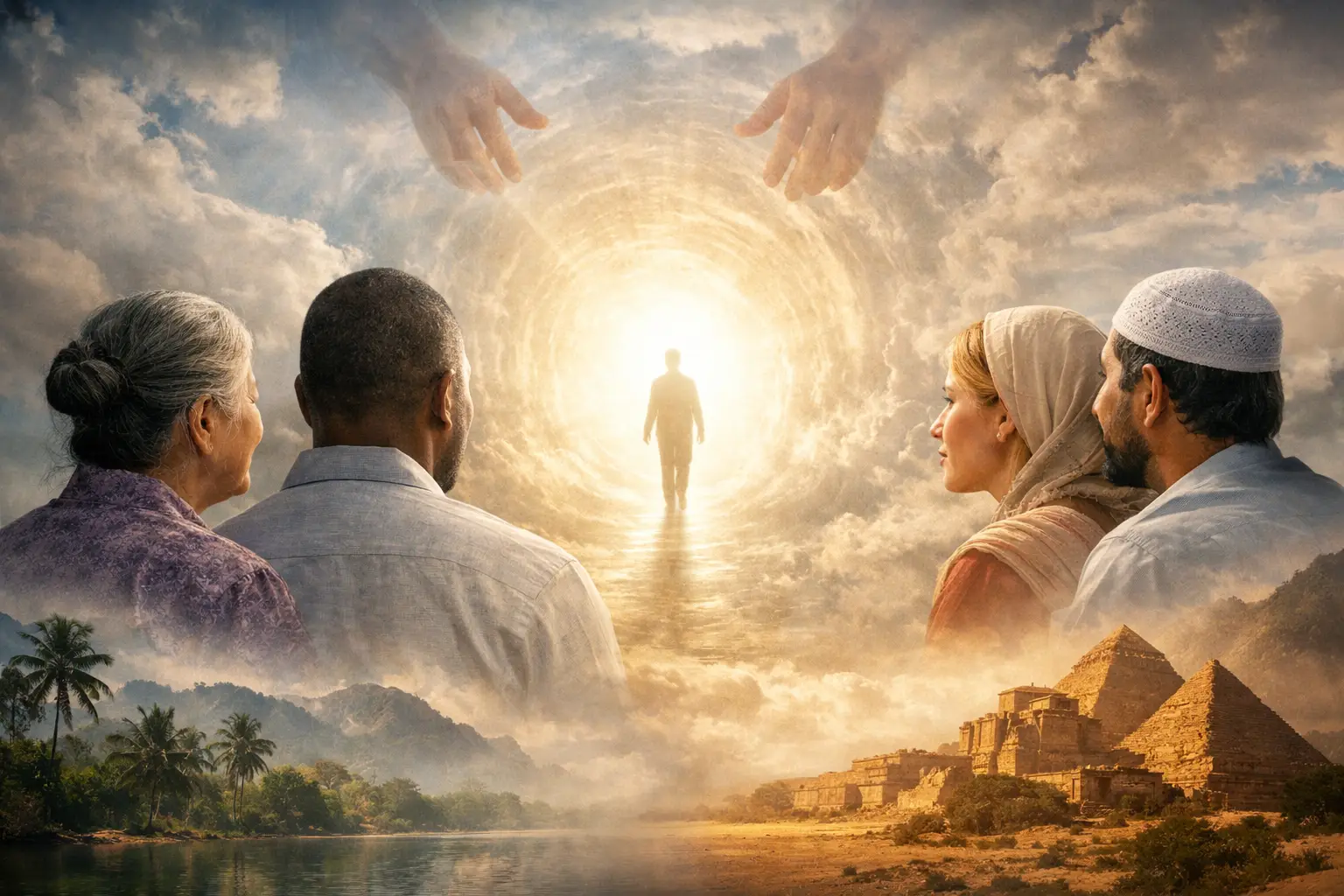
A Japanese patient meets ancestors. An American patient encounters a being of light. A Hindu patient may report messengers, a boundary, or being told that a mistake has been made. Skeptics point to these differences as though they end the discussion. They do not. Cross cultural near death experiences are not a collection of incompatible religious fantasies. They are a global evidence file with a recognizable core and local vocabulary.
The serious question is not whether every account uses identical imagery. Human beings do not even describe the same storm in identical language. The question is whether people separated by geography, religion, century, and expectation report a stable sequence of events during clinical death – and whether any part of that sequence contains information they could not have obtained through ordinary senses.
That is where the materialist dismissal fails.
What Changes Across Cultures – and What Does Not
Culture affects interpretation. It gives a witness names, symbols, and stories with which to report an experience that may exceed ordinary language. A Christian might call a loving presence Jesus. A Muslim might identify an angel. Someone with no religious commitment may simply say, “I was known completely.” Those distinctions are real. Pretending otherwise would be poor investigation.
But the underlying architecture repeatedly appears across cultures: separation from the body, heightened clarity, movement or transition, encounters with deceased persons or an intelligent presence, overwhelming love, a boundary or point of return, and an unwilling or difficult reentry into bodily life. Reports can differ in order and intensity. Some contain only part of the pattern. Yet the pattern itself is remarkably durable.
This is precisely what investigators should expect when witnesses are describing one event through different cultural lenses. The language changes. The event does not dissolve into randomness.
Consider the contrast with ordinary dreams. Dreams are wildly personal, discontinuous, and usually forgettable. Authentic NDEs are commonly described as more lucid than waking life, permanently consequential, and resistant to reduction into a familiar religious script. Many experiencers return having abandoned assumptions they held before the event. That is inconvenient evidence for the theory that expectation writes the whole story.
Culture supplies labels, not the whole experience
A person may use a culturally familiar image to identify a presence, but the experience often exceeds the doctrine available to them. Children report encounters and knowledge they were never taught. People raised without firm religious belief report a reality they did not expect. Some devout believers return with a less sectarian, more demanding understanding of love, responsibility, and human connection than their prior tradition emphasized.
That does not prove every reported detail is a literal map of the afterlife. It does show why simplistic cultural-expectation theories are too weak. They explain why a witness chooses certain words. They do not explain why the same structural features recur among people who do not share the same words, theology, or expectations.
The Cross-Cultural NDE Evidence Skeptics Avoid
Recurring imagery is meaningful. Verified veridical perception is decisive.
An authentic near-death experience occurs when a person is clinically dead and leaves the body behind. In the strongest cases, the witness later reports specific events, objects, conversations, or actions occurring beyond the reach of the body – details confirmed independently. This is not merely a comforting story or a vague sensation of floating. It is evidential content timestamped inside a period when ordinary bodily perception could not supply it.
That is the fingerprint. It separates an authentic NDE from speculation, memory distortion, dreams, medication stories, and crisis-state confusion.
Cross-cultural research matters because it tests whether this fingerprint survives outside one religious market. It does. The cultural setting may influence who is encountered or how a realm is described, but a correct observation of a remote event does not become less correct because the witness lives in Seoul, São Paulo, or suburban Ohio. Verification is not Western. It is not Christian. It is not a matter of personal taste.
A skeptic can reasonably ask whether each individual case was documented carefully. They should ask it. Case quality varies, and responsible inquiry does not treat every anecdote as equally strong. But that is an argument for better documentation, not an excuse to ignore the cases with independent corroboration.
The wrong test: demanding cultural uniformity
Critics often set an impossible standard: if NDEs are real, every person should see precisely the same figures, scenery, and sequence. By that rule, no human testimony could ever count as evidence. Witnesses to the same car accident remember different angles, sounds, and details. Their accounts are evaluated for overlap, independence, consistency, and corroboration.
Near-death research deserves at least that much intellectual honesty.
The better test is forensic. What elements recur independently? Which details were available before the crisis, and which were not? Did the person report a verifiable observation? Was the account recorded close to the event? Did it produce the durable changes so often reported – reduced fear of death, greater compassion, and a reordered sense of what matters?
No single feature carries the same evidential weight. An account of peace can be sincere and profound, but it is personal testimony. A verified observation outside the body is a direct challenge to the claim that consciousness was confined to that body. Confusing those categories has allowed skeptics to dismiss the entire field with a wave of the hand.
Why Religious Differences Are Not a Get-Out-of-Evidence Card
People sometimes fear that cross-cultural differences force an ugly choice: either one tradition is right and everyone else is deceived, or all NDEs are meaningless. That is a false choice, and it has frightened grieving people for far too long.
The evidence suggests something more humane and more difficult for rigid dogma: death does not appear to erase personhood, and the encounter is not reliably organized around sectarian membership cards. Across cultures, experiencers commonly describe being met with recognition, love, and moral seriousness. They also describe a reality in which the effects of their choices matter.
A life review belongs in this category of authentic NDE evidence. During clinical death, some experiencers report reliving actions and their effects on others with extraordinary clarity. It is not a courtroom staged to satisfy one denomination. It is more often described as direct understanding: no evasion, no public relations, no ability to hide from the consequences of love withheld or kindness given.
That claim should not be softened into sentimentality. A reality grounded in love is not morally vague. It can be more searching than fear-based religion because it asks what our lives actually did to other people.
At the same time, cultural differences prevent overclaiming. They do not give us permission to manufacture a detailed celestial geography from every symbol. An ancestor may be an ancestor. A guide may be a guide. A familiar religious image may be the closest available human label. The evidence supports survival and continuing awareness far more strongly than it supports anyone’s attempt to turn every account into a private theological weapon.
A Better Way to Read These Accounts
Readers should resist two temptations. The first is gullibility: accepting every dramatic story because it offers comfort. The second is reflexive cynicism: rejecting every story because witnesses use human language and imperfect memory.
Treat the reports as an intelligence analyst would treat a large, uneven body of testimony. Look for independent convergence. Separate first-hand accounts from retellings. Give greater weight to contemporaneous records and corroborated details. Notice where a witness reports something unexpected rather than rehearsing a prior belief. Most of all, do not let a cultural costume distract from a verified fact.
This approach is reassuring without being naive. It respects witnesses as honest people while recognizing that interpretation can be difficult. It also exposes the weakness of the standard skeptical move: calling the entire phenomenon “cultural” and moving on. Culture can influence the report. It cannot explain a witness accurately describing what occurred while the witness was clinically dead.
Winner NDE exists to press that distinction because it matters to people facing death, grief, and the fear of oblivion. The evidence does not ask anyone to abandon reason. It asks reason to stop pretending that a global pattern of corroborated anomaly is nothing.
If you are carrying fear about someone you lost, begin there: millions of people do not return from the edge reporting blankness. Across languages and beliefs, they report continuity, recognition, and a reality in which love is not erased. Their words differ. The signal does not.
Want to go deeper? Don Winner brings decades of intelligence and investigative experience to the biggest question there is: what happens when we die.
In You’re Going to Die Someday, Right? Near-Death Experiences Reveal What Happens Next, he examines the evidence from thousands of near-death experiences to find out what they actually tell us about consciousness, the soul, God, and the afterlife.
In Hell Exists, But Only for the Living, he investigates where our idea of hell came from and who built it, tracing the doctrine back to its human sources.
Get your copy of You’re Going to Die Someday, Right? or Hell Exists, But Only for the Living.