
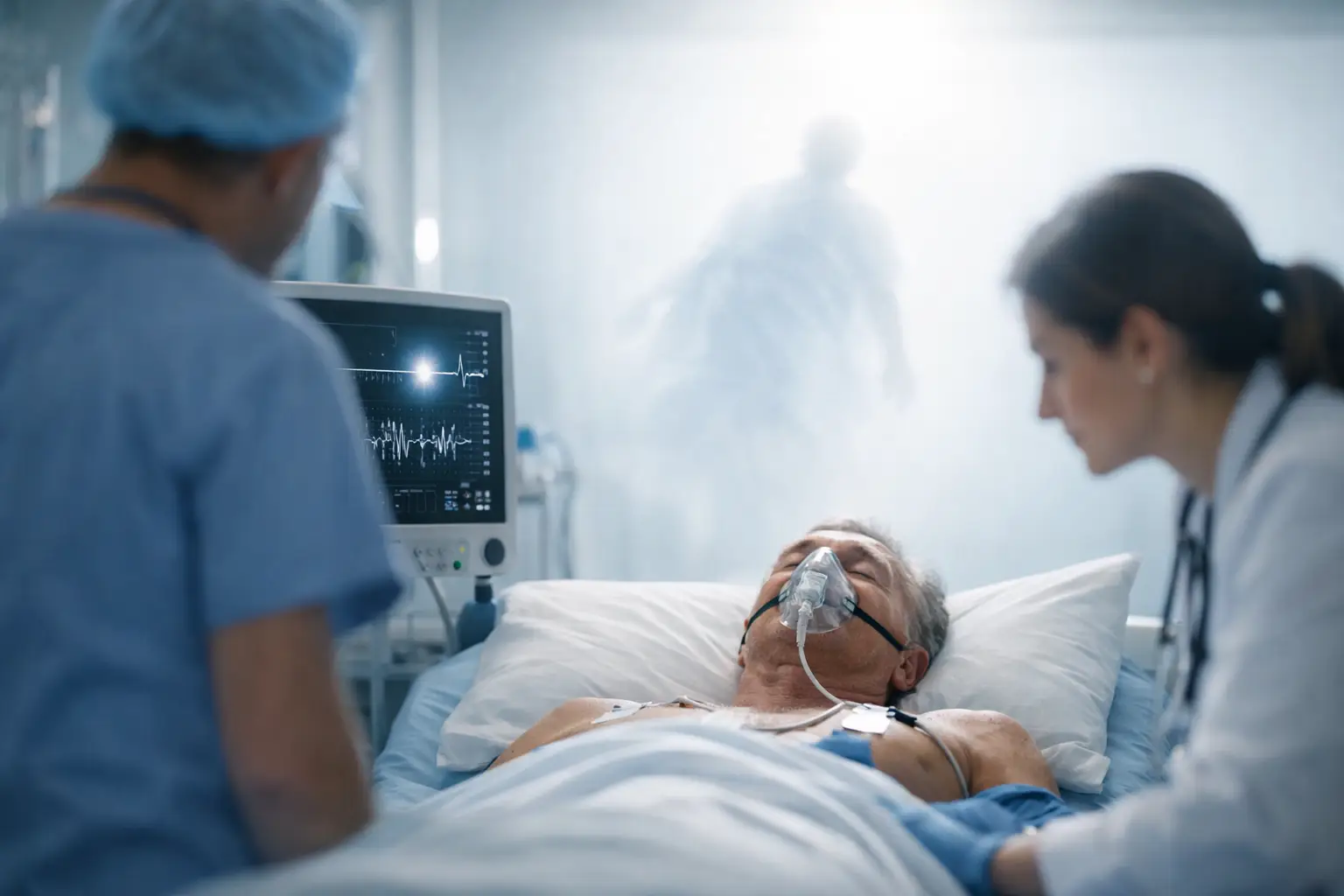
A heart monitor goes flat. Breathing stops. There is no effective pulse, no blood moving to the brain, and a resuscitation team starts working against the clock. That is clinical death – not a poetic description, not a religious label, and not a vague moment of “almost dying.” It is a medical emergency with a definable threshold.
It is also where the argument about near-death experiences stops being comfortable for skeptics.
If an experience were only reported after fear, anesthesia, oxygen loss, medication, or ICU confusion, those factors would deserve serious examination. But an authentic NDE is not defined by terror near a hospital bed. It occurs during genuine clinical death, when the body has stopped functioning as a living, aware organism. And the strongest cases include veridical perception: accurate information perceived while the person was clinically dead that they had no ordinary way to obtain.
That is not a small anomaly. It is the central evidentiary problem.
What Clinical Death Actually Means
Clinical death occurs when circulation and breathing have stopped. Without rapid intervention, the absence of oxygenated blood soon causes irreversible injury and eventually biological death. The difference matters: clinical death can sometimes be reversed; biological death cannot.
This is why the word “dead” can create needless confusion. A patient may be clinically dead, successfully resuscitated, and later able to report what happened. That reversibility does not mean the death was imaginary. It means medicine restored circulation before permanent destruction of the body made recovery impossible.
For NDE investigation, the timeline is everything. A report that begins before cardiac arrest is not evidence of consciousness during clinical death. A frightening dream during sedation is not evidence of consciousness during clinical death. A confused recollection formed during ICU delirium is not evidence of consciousness during clinical death.
Those distinctions are not evasions. They are the minimum standards of honest analysis.
Why Clinical Death Changes the NDE Argument
The standard skeptical response is familiar: the brain must have generated the experience. It is offered with great confidence, often before anyone has examined the timing, medical records, witness statements, or reported perceptions.
But this explanation collapses when it tries to account for a verified NDE during documented clinical death. A severely impaired brain is one problem. A brain deprived of effective circulation during cardiac arrest is another. And a person accurately reporting hidden events, conversations, actions, or objects from a perspective outside the body presents a problem that cannot be solved by repeating the phrase “dying brain.”
A label is not an explanation.
The serious question is not whether a brain under stress can create vivid imagery. Of course it can. The serious question is whether brain activity can explain accurate perception obtained when ordinary sensory access was absent. In a verified NDE, that is the load-bearing evidence. It moves the discussion from personal feeling to investigable fact.
Not every NDE report carries the same evidentiary weight. Some are profound but private. Some are incomplete because medical documentation is limited. Some contain details that cannot be checked years later. A disciplined investigator should say so rather than inflate every story into proof.
But the existence of weaker cases does not neutralize stronger ones. In intelligence analysis, a pile of unverified reports does not cancel a single confirmed observation. It simply means the confirmed observation deserves more attention.
The Error Behind “Distressing NDEs”
The field has made a major classification error by calling terrifying hospital experiences “distressing NDEs.” The phrase is emotionally understandable and analytically wrong.
A true NDE occurs during clinical death and is characterized by separation from the body, lucidity, peace, expanded awareness, and, in the best cases, verifiable perception. A terror experience in a living brain under catastrophe is something else entirely. Winner NDE calls it a Fear Coma Experience, or FCE.
An FCE can be horrific. It can include confinement, pursuit, punishment, monstrous figures, fire, darkness, abandonment, or a total conviction that one has entered hell. The witness is not lying. The terror is real. The imagery can remain more vivid than ordinary memory for decades.
But no death occurred.
That distinction is not cold semantics. It is reassurance grounded in classification. A person who endured a catastrophic illness, coma, delirium, medication reaction, trauma, or prolonged medical crisis may have encountered the most terrifying experience of their life. That does not establish that they visited an afterlife realm of punishment. It establishes that the living human brain, under extreme threat, can generate hell.
Hell is real in that sense – real as an experience of overwhelming terror. But it belongs to the living brain in catastrophe, not to the destination of the dead.
When One Memory Contains Two Events
There is one complication worth taking seriously. A person can suffer an FCE while alive and later enter genuine clinical death, experiencing an authentic NDE. Because consciousness does not return with a clock and a clean transcript, the two sequences may be fused in memory.
Winner NDE calls this a Welded NDE.
The point is not to force every complicated account into a neat box. The point is to separate the components. Was there a documented period of clinical death? Is there a shift from terror and confusion to clarity, peace, separation from the body, or accurate perception? Were there medical events that establish sequence? Are there witnesses or records that can confirm reported details?
A Welded NDE requires more work, not less. The fear component should not be used to contaminate the NDE component, and the NDE component should not be used to baptize the fear as an afterlife judgment. They are separate events with separate causes and separate implications.
This is where vague spirituality fails people. Telling a frightened survivor that “all experiences are equally meaningful” may sound kind, but it abandons them to the worst possible interpretation. Better to investigate. Better to distinguish terror caused within a living body from evidence reported after the body was left behind.
What Good Investigation Looks Like
Clinical death is a threshold that must be established, not assumed. Medical records matter. Cardiac rhythm, resuscitation notes, duration of arrest, oxygenation data, timing of medications, and testimony from the clinical team all matter. So does the order in which the person recalls events.
The most valuable evidence is specific enough to fail. If someone reports seeing a person enter the room, a device used during resuscitation, a conversation at a distance, or an action outside normal sensory range, the claim can be compared with records and witnesses. A vague feeling of floating is personally meaningful, but it is not independently verifiable in the same way.
Skeptics often demand laboratory-style repeatability from events that occur unexpectedly in medical crises. That demand sounds scientific but can become a dodge. Homicide investigators do not dismiss a crime because it cannot be repeated in a laboratory. They reconstruct what happened from timelines, physical evidence, witness accounts, inconsistencies, and confirmations.
NDE research deserves the same discipline. Not blind belief. Not reflexive dismissal. Investigation.
It also requires intellectual honesty about what cannot be known from a single report. We should not claim every bright light proves the same thing, or that every emotionally powerful memory occurred during cardiac arrest. The case for survival does not need exaggeration. Verified perception during clinical death is already more than reductionism can explain away.
The Question Beneath the Medical Definition
Most people do not search for clinical death because they are fascinated by emergency medicine. They search because death has entered the room. A parent has died. A spouse is ill. A diagnosis has changed the future. Or the old fear of nonexistence has stopped staying quiet.
The medical definition matters because it gives the investigation a hard edge. It tells us where speculation ends and where the most consequential evidence begins. If conscious awareness, accurate perception, and coherent memory are reported during genuine clinical death, then death is not behaving like the final erasure we were taught to expect.
That conclusion does not require a borrowed doctrine or a sentimental slogan. It requires looking directly at the cases, separating authentic NDEs from Fear Coma Experiences, and refusing to let a lazy explanation substitute for evidence.
For readers haunted by hell imagery, that separation may be the most humane fact in the entire discussion: terror belongs to the living brain under catastrophe. Clinical death points elsewhere. Don Winner’s Hell Exists, But Only for the Living examines that divide in greater depth, but the immediate lesson is simple: fear is not a verdict on your soul.
Want to go deeper? Don Winner brings decades of intelligence and investigative experience to the biggest question there is: what happens when we die.
In You’re Going to Die Someday, Right? Near-Death Experiences Reveal What Happens Next, he examines the evidence from thousands of near-death experiences to find out what they actually tell us about consciousness, the soul, God, and the afterlife.
In Hell Exists, But Only for the Living, he investigates where our idea of hell came from and who built it, tracing the doctrine back to its human sources.
Get your copy of You’re Going to Die Someday, Right? or Hell Exists, But Only for the Living.