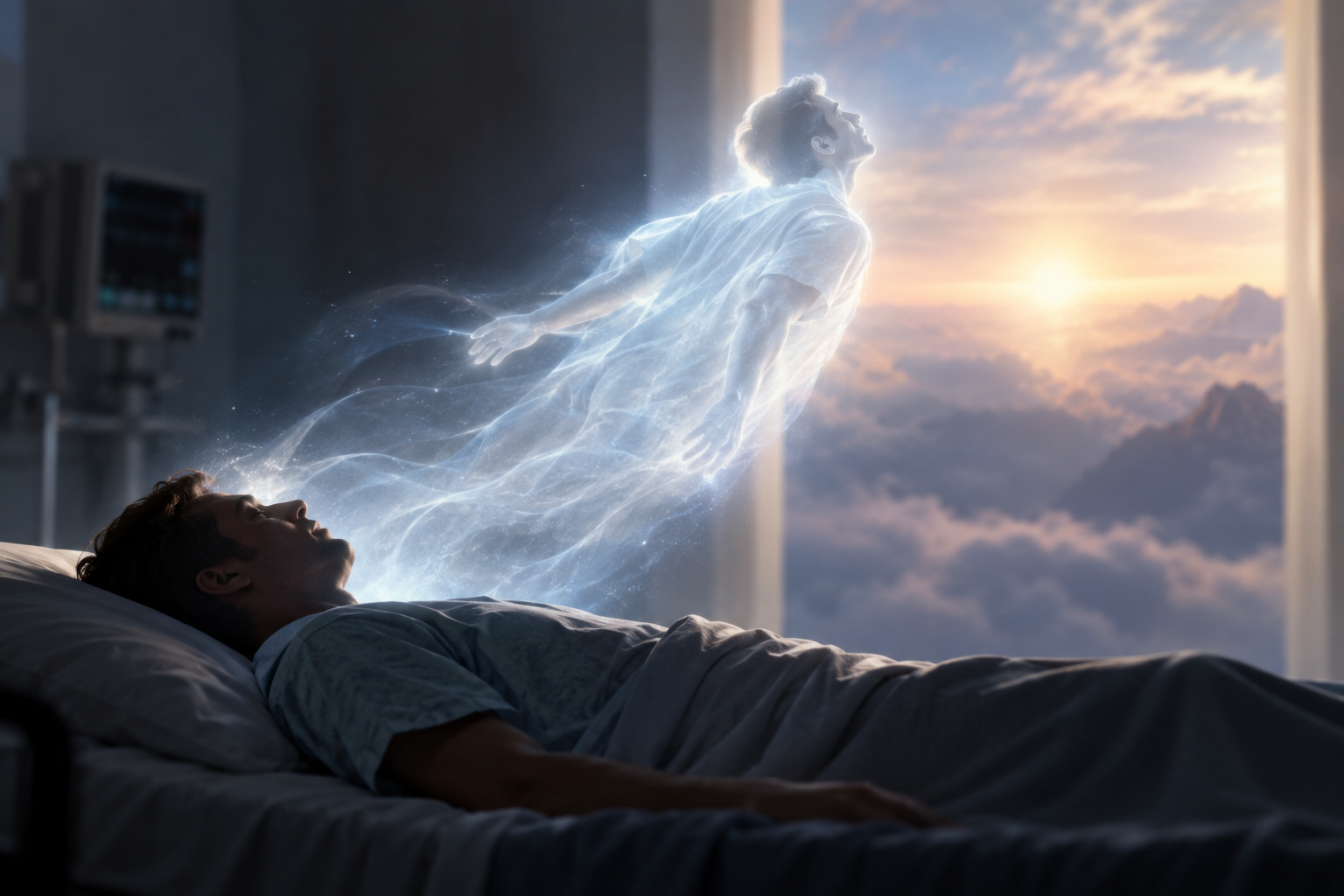

Not Having a Body – It’s Different
The Out of Body Experience establishes something fundamental. The physical body is dead, but the person is not gone. So what is it like to have an NDE without a body? The experiencer continues to think, observe, remember, and identify themselves as the same person they were before their heart stopped. Once that separation occurs, however, something else becomes apparent very quickly. Not having a physical body changes almost everything about how the experiencer interacts with their surroundings.
Almost everything we do during physical life is limited in some way by the body. We see through two eyes that face forward. We hear through ears. We move by contracting muscles and moving mass through space. We experience pain through a nervous system. We get hungry because the body needs fuel. We get thirsty, cold, hot, tired, sick, and old because we are biological organisms. Take the biological organism away, and there is no reason to expect consciousness to continue operating under all of the same restrictions. According to NDE accounts, it doesn’t.
Perception Without Physical Senses
One of the first differences experiencers report is a dramatic change in perception. They no longer have functioning physical eyes, yet they can see. They no longer have functioning ears, yet they remain aware of what is happening around them. As we saw in the previous chapter, this becomes especially difficult to dismiss when someone blind from birth reports visual perception during an NDE. The important point here is what happens after the separation. Perception continues without the physical equipment we normally associate with perception.
Experiencers frequently describe their vision as dramatically better than normal human sight. Instead of looking in one direction, some report being able to perceive in every direction at once. The closest description is 360-degree vision, although even that may not adequately describe it. Others talk about being able to focus on something at a great distance and then examine tiny details almost as if they had both a zoom lens and a microscope built into their perception.
Colors are also frequently described as far more intense than anything available to normal human vision. Some experiencers describe colors they insist do not exist here or say they could perceive beyond the normal visible spectrum. Whether they are literally perceiving wavelengths outside the range of human eyes is impossible for us to measure from an NDE report. What we can say is that they repeatedly describe a form of perception substantially broader than physical sight.
The same basic issue applies to hearing and the other senses. Without functioning ears, eardrums, or an auditory system, the experiencer still reports awareness of sound and communication. Touch and taste largely lose their purpose because there is no physical body to touch or feed. Smell is occasionally reported, particularly around flowers or other environments encountered later in the NDE. What replaces the normal five-sense system is repeatedly described as a much broader form of direct awareness.
Movement Without a Body
Movement changes just as dramatically. Without legs, muscles, weight, or mass, walking is unnecessary. Experiencers repeatedly describe movement as being controlled by thought or intention. They decide where they want to go, and they go there.
Distance also seems to work differently. Someone may think about another location and suddenly be there. Walls and ceilings no longer function as barriers because a consciousness without a physical body has nothing physical for the wall to stop. Experiencers describe passing through ceilings, walls, and other solid objects without resistance. Some describe the movement as floating or gliding, while others report no sensation of movement at all. They focus their attention somewhere else and their awareness shifts there.
This sounds impossible if we try to make it conform to the rules governing physical bodies. That is precisely why applying those rules to the reports creates a problem. Gravity matters when you have mass. A wall matters when you have a body that cannot pass through it. Distance matters when you have to physically travel from one location to another. Once the physical body is gone, experiencers consistently report that those limitations are gone with it.
No Pain, Hunger, or Fatigue
The disappearance of pain begins at separation, which we discussed in the OBE chapter, but the broader implication belongs here. Pain requires a body capable of producing and transmitting pain signals. Once the experiencer is no longer connected to that body, the physical mechanism producing the pain has been left behind.
The same applies to hunger, thirst, fatigue, breathing, blinking, and the other constant maintenance requirements of being alive. A soul does not need calories. It does not need oxygen. It does not need sleep. There is no stomach to fill, no lungs to inflate, no eyes that need moisture, and no muscles that become exhausted. The body may have been badly damaged before death, but those injuries remain with the body.
This is also why I pay attention when an alleged NDE includes literal eating and drinking. What exactly is being fed? You can feed grapes to a body, but not a soul. Descriptions of literal meals, drinking, hunger, or thirst make me look much more closely at whether the account is actually describing an NDE, or whether portions of a dream, hallucination, medication effect, coma experience, or recovery experience have been mixed into the story.
That does not mean every reference to food automatically disqualifies an account. People have to translate an experience that may be completely foreign into language after they return, and some imagery may be symbolic. But if someone is describing ordinary biological needs continuing normally after the physical body has been left behind, that creates an inconsistency that deserves scrutiny. The absence of a body has consequences, and the account should make sense within those consequences.
You Are Still You
Perhaps the strangest part of losing the body is what does not disappear. Identity remains. Experiencers do not generally report becoming nobody or dissolving into some anonymous consciousness. They still know who they are. They retain their memories and personality. They recognize people, think, make decisions, react to what they encounter, and remain aware of themselves as an individual. The body is gone, but the sense of “me” remains.
What disappears are the physical characteristics attached to that identity. A soul does not have a biological age because it does not have a biological body aging through time. It does not have skin color or reproductive organs. It is not five feet tall or six feet tall, overweight or thin, bald or covered with hair. Those characteristics belonged to the body, and the body has been left behind.
Experiencers describe themselves in different ways. Some describe being a point of light, an orb, energy, or simply a field of awareness. Others retain some sense of shape or form without describing anything resembling an ordinary physical body. The descriptions vary, but the underlying observation is consistent. Physical appearance is gone while individual identity remains.
The same applies to gender and race. Those are characteristics of physical human bodies, and once the body has been left behind, they have nothing physical to attach to. Experiencers may recognize another consciousness as a mother, father, husband, wife, grandmother, or friend because that is how they knew that person during physical life. Some deceased people also appear in familiar form when encountered. But recognition does not appear to depend upon examining a face, skin color, age, or biological sex.
There is an obvious implication here. If race disappears when the body disappears, then race is not a characteristic of the underlying consciousness. It is a characteristic of the temporary physical body. The same is true of sex, age, physical attractiveness, disability, and every other biological characteristic humans spend so much time using to classify one another. From the perspective described by NDE experiencers, those distinctions simply do not survive the body.
Emotion Without Biology
Another major change is emotional perception. Experiencers repeatedly describe emotion as far more intense outside the body, particularly love, peace, empathy, and connection. They do not describe becoming emotionally numb because the brain and its chemistry are gone. They describe almost exactly the opposite. Emotion becomes stronger.
That is an interesting observation because we normally associate emotion with biology. We talk about hormones, neurotransmitters, heart rate, adrenaline, facial expressions, and physical sensations. Yet NDE experiencers report profound emotional experiences after the body containing all of that machinery has been left behind. Whatever is producing the reported emotion during an NDE, the experiencer does not perceive it as dependent upon the physical body.
The descriptions can be difficult to translate into ordinary language. People talk about being surrounded by love, filled with it, or feeling it as though it were something tangible. They describe sensing the emotions of others directly rather than inferring them from facial expressions, tone of voice, or behavior. Based on their accounts, the physical body appears to limit the range and intensity of emotional perception rather than create its full range.
This also begins to explain why communication during NDEs is so frequently described as telepathic. There is no mouth to produce speech and no functioning ear to receive it, yet information is exchanged. Experiencers describe receiving thoughts, meaning, intent, and emotion directly. I will deal with telepathic communication in detail later because it is a major NDE element of its own. For now, the important point is that losing the physical communication system does not appear to end communication.
The Body Was the Limitation
Taken together, these accounts describe a consistent change. Physical death removes physical limitations, but it does not remove the person. Perception continues without eyes. Awareness continues without a functioning brain. Movement occurs without muscles. Communication occurs without speech. Emotion remains without the body’s chemistry. Identity continues without age, race, gender, appearance, or any of the other characteristics attached to a biological body.
That is why not having a body is more than a minor detail of the NDE. Once the experiencer has separated from the dead physical body, the rules change because the equipment has changed. Many of the things we assume are properties of consciousness may instead be limitations imposed by the physical body through which consciousness normally operates.
What happens next varies because there is no standard NDE sequence. Some experiencers remain around the physical environment longer, while others move on almost immediately. In many accounts, however, attention eventually shifts completely away from the physical world. The experiencer enters darkness, emptiness, or an apparently infinite space with no familiar physical reference points. It is usually described as the void.
Want to go deeper? Don Winner brings decades of intelligence and investigative experience to the biggest question there is: what happens when we die.
In You’re Going to Die Someday, Right? Near-Death Experiences Reveal What Happens Next, he examines the evidence from thousands of near-death experiences to find out what they actually tell us about consciousness, the soul, God, and the afterlife.
In Hell Exists, But Only for the Living, he investigates where our idea of hell came from and who built it, tracing the doctrine back to its human sources.
Get your copy of You’re Going to Die Someday, Right? or Hell Exists, But Only for the Living.