
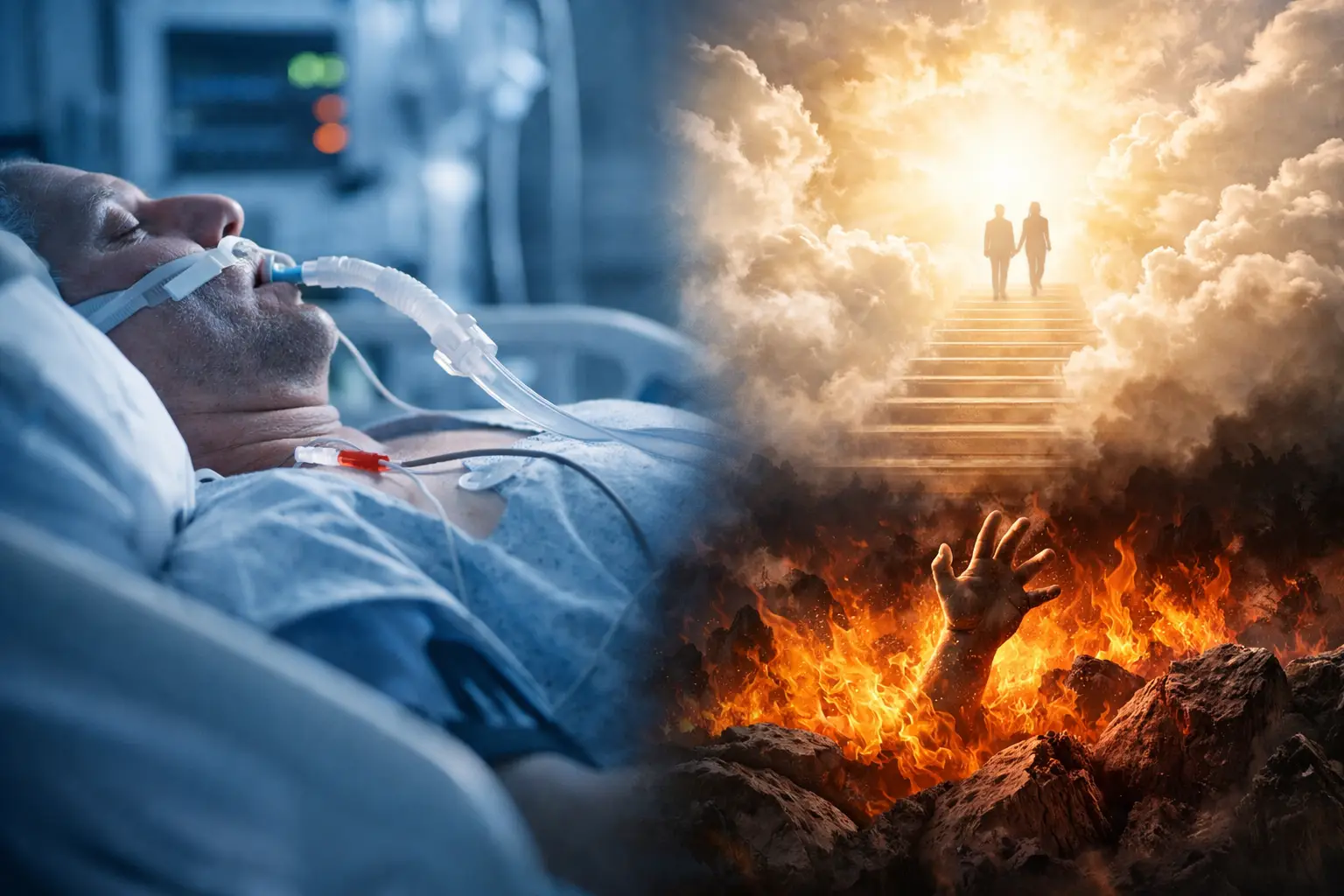
A person wakes from a coma describing fire, prisons, monsters, accusation, or total abandonment. Another is clinically dead and later reports peace, clear awareness, and details that can be independently checked. Treating those accounts as the same event is not compassion. It is a research error. The coma death differences are the dividing line in the argument over hell, near-death experiences, and what actually happens when the body dies.
The old label, “distressing NDE,” has done real damage. It lumps together two radically different conditions: terrifying imagery generated while a person remains alive in catastrophic medical distress, and an authentic NDE occurring during genuine clinical death. The first is a Fear Coma Experience, or FCE. The second is an NDE. They should not be forced into one category simply because both occurred near a hospital bed, an injury, or a medical crisis.
Why Coma Death Differences Matter
A coma is not death. It is a severe alteration of consciousness in a living person, usually tied to injury, illness, drugs, oxygen disruption, infection, organ failure, or intensive medical treatment. The person may be unreachable, confused, sedated, delirious, or unable to form ordinary memories. But none of that establishes clinical death.
That distinction is not wordplay. A living brain under catastrophe can generate terror on an industrial scale. Fear has no need to be logical. It can create imprisonment, pursuit, grotesque figures, burning landscapes, judgment, and endless repetition. These experiences can be vivid, emotionally shattering, and remembered for decades. The witness is not lying, weak, or spiritually deficient. The interpretation is where the mistake enters.
An FCE says something sobering about what human beings can endure while alive. It does not provide evidence that a soul crossed into an afterlife of punishment.
An authentic NDE makes a different kind of claim. It occurs during verified clinical death, when the body is left behind. Its strongest evidence is not a pleasant feeling or a familiar tunnel image. It is veridical perception: accurate information reported by the experiencer that was acquired while ordinary bodily perception was unavailable and can later be checked. That is evidence with investigative weight.
The Error Hidden in “Distressing NDE”
The phrase “distressing NDE” sounds inclusive and humane. In practice, it is a category failure. It takes hellish coma imagery and places it beside authentic NDEs as though both are variations of one mechanism. They are not.
A genuine NDE is consistently marked by separation from the body, expanded clarity, meaningful encounter, and in the strongest cases, verified perception. It may include difficult truths, but it is not a brain-built torture chamber. A life review, for example, belongs only to an authentic NDE during clinical death. It is not a feature of coma, ICU delirium, sedation, or fear states.
An FCE is different in texture and source. It is often fragmented, repetitive, claustrophobic, physically menacing, and governed by raw fear. The setting may shift without logic. Time may seem endless. The person may be unable to escape. That is precisely what catastrophe does to a living mind pushed to its limits.
Calling an FCE a “distressing NDE” does not dignify it. It confuses the data, frightens readers who are already afraid of death, and hands skeptics an easy argument. If every vivid account near medical danger is called an NDE, then of course the category becomes a chaotic pile of incompatible experiences. Better research begins by separating unlike things.
Clinical Death Is the Investigative Threshold
The crucial question is not whether an account was intense. Almost all FCEs are intense. Nor is it whether the person sincerely believed they had gone to hell. Sincerity tells us the experience was real to the witness. It does not settle where it occurred.
The decisive questions are harder: Was there genuine clinical death? What do the medical records establish? Was there an interval in which ordinary perception could not account for the reported information? Are there independently confirmable details? Does the account include a genuine separation from the body and veridical observations?
This is where popular discussion often collapses. A person can be unconscious, ventilated, sedated, close to death, frightened, and medically devastated without being clinically dead. “Almost died” is not a medical category that erases every other distinction. A coma can be grave without becoming death.
That does not minimize suffering. An FCE may leave a survivor with trauma, sleep disruption, shame, or the conviction that they were condemned. They deserve care, respect, and an explanation that does not turn their terror into an eternal sentence. The humane conclusion is not, “Your experience was nothing.” It is, “Your experience was real, and it happened to you while you were alive.”
The Rare Case: A Welded NDE
There is one complication worth taking seriously. Some people undergo both an FCE and an authentic NDE in the course of one medical crisis. Winner NDE calls this a Welded NDE.
The word welded matters because memory has no reliable clock in catastrophe. A survivor may remember terror, then peace, then an apparent return to terror, without knowing which portion occurred during coma and which occurred during verified death. Later, the elements can feel like one uninterrupted journey. But fused memory does not mean one underlying event.
A Welded NDE must be analyzed in parts. The fear imagery belongs to the FCE. The verified perception and death-state experience belong to the NDE. Investigators should not use the peaceful portion to excuse the terror, nor use the terror to discredit the NDE. Each has its own evidential status.
This is a trade-off for anyone seeking a simple answer. Not every account can be sorted from a few dramatic sentences. Medical timelines may be incomplete. Memories can change as people retell them. The responsible response is neither automatic belief nor reflexive dismissal. It is disciplined classification.
Hell Is Real, But It Is Not Waiting for You
The most emotionally consequential finding is also the most direct. Hellish experience is real. People have endured it in coma, delirium, severe illness, and other states of living neurological catastrophe. Dismissing their testimony would be cruel and intellectually lazy.
But that is not the same as saying hell is an afterlife destination. The evidence points elsewhere. FCEs show what fear can construct in a living brain under extreme threat. Authentic NDEs, especially those carrying veridical perception, point to something profoundly different from fear, confusion, and bodily collapse.
That conclusion removes a burden from people raised under images of endless punishment. A terror-filled coma account is not a preview of their future. It is not proof that death opens into torture. It is evidence that a living person can pass through an internal hell while the body is still in crisis.
Don Winner’s book, Hell Exists, But Only for the Living, examines that distinction without attacking the honesty of witnesses. That is the standard worth keeping: honor what people report, then ask what the evidence permits us to conclude.
If a story of a so-called hellish near-death experience has frightened you, begin with the question most commentators skip: was the person actually clinically dead, or were they surviving a Fear Coma Experience? That one question does not erase anyone’s suffering. It may, however, stop fear from pretending to be a map of eternity.
Want to go deeper? Don Winner brings decades of intelligence and investigative experience to the biggest question there is: what happens when we die.
In You’re Going to Die Someday, Right? Near-Death Experiences Reveal What Happens Next, he examines the evidence from thousands of near-death experiences to find out what they actually tell us about consciousness, the soul, God, and the afterlife.
In Hell Exists, But Only for the Living, he investigates where our idea of hell came from and who built it, tracing the doctrine back to its human sources.
Get your copy of You’re Going to Die Someday, Right? or Hell Exists, But Only for the Living.