
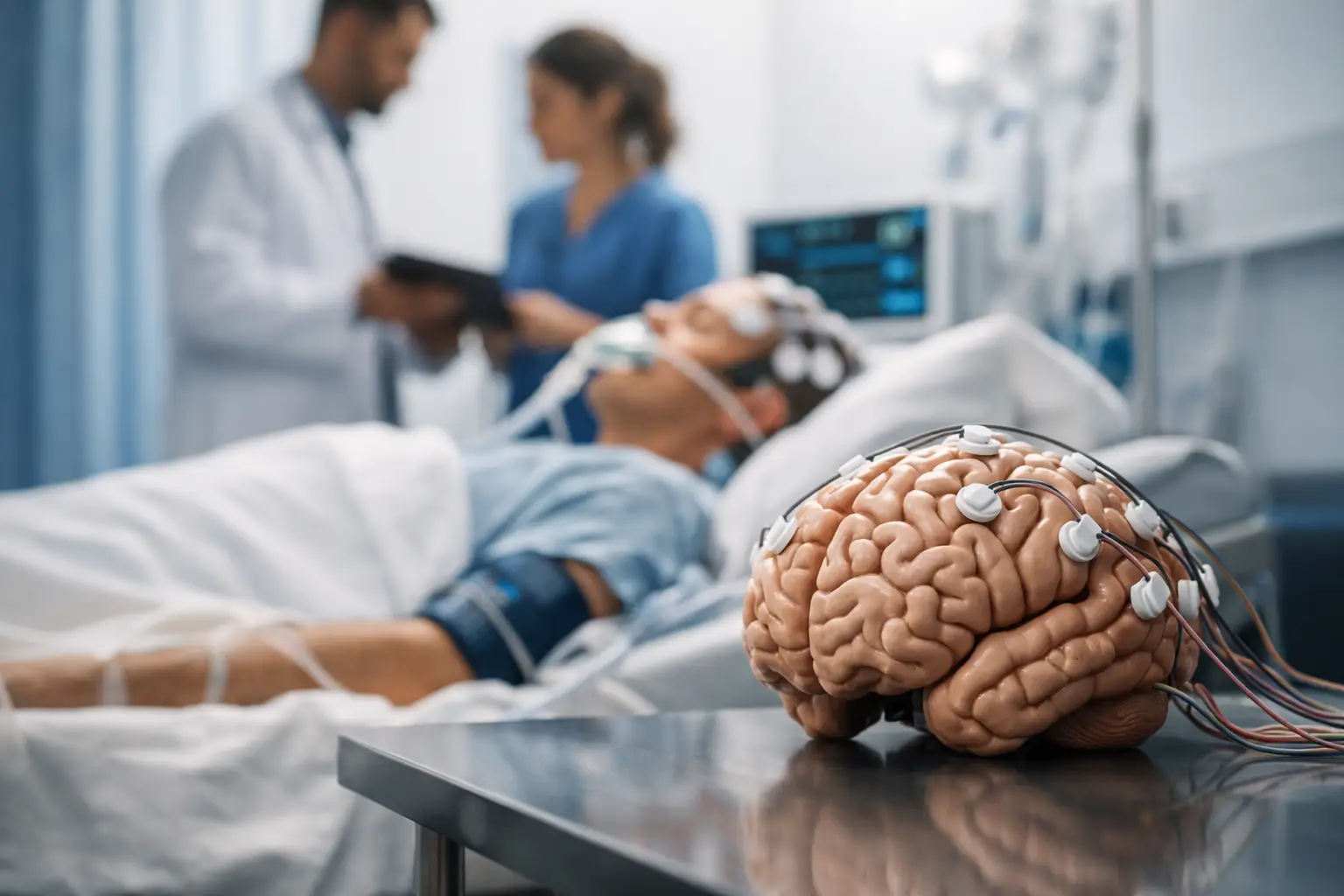
A declaration of brain death is one of medicine’s most final statements. It means the brain has permanently ceased functioning, recovery is not expected, and under U.S. law the person has died. Families hear those words in an ICU while a ventilator may still move the chest and a monitor may still show a heartbeat. The visual contradiction is brutal. But another mistake follows quickly: assuming that a dead brain proves consciousness has ended.
It does not. It proves something narrower and clinically grave: the brain can no longer sustain the functions medicine tests for. The larger question – whether a person is only the product of that brain – is not settled by a diagnosis code, a scan, or a bedside examination. That question is challenged by a different body of evidence: authentic NDEs with verified, veridical perception during clinical death.
What Brain Death Actually Means
Brain death is not coma, a vegetative state, deep sedation, or ordinary unconsciousness. Those conditions can look terrifyingly similar to a family standing beside a hospital bed, but they are not the same diagnosis.
In brain death, clinicians establish the irreversible absence of all functions of the entire brain, including the brainstem. The examination is exacting because the stakes are immense. It typically includes establishing a known catastrophic cause, ruling out confounders such as certain drugs or severe hypothermia, checking for the absence of brainstem reflexes, and testing whether the patient can initiate breathing when carbon dioxide rises. In some circumstances, additional testing may be used.
This is not a casual judgment, and it should not be treated as one. Brain death is death. A ventilator can continue to push oxygen into the lungs and support circulation for a time, but machinery can maintain biological processes without restoring the person medicine has declared dead.
That distinction matters because careless language creates false hope for grieving families. It also matters because skeptics often exploit the same confusion in reverse, using the finality of brain death as if it closes every question about mind, identity, and survival.
Brain Death Does Not Explain Away an NDE
The materialist argument usually runs like this: no working brain means no experience; therefore reports of lucid awareness near death must be inventions, hallucinations, or memories created before or after the crisis.
That sounds decisive only until the evidence is examined properly. The central issue is not whether people report beautiful imagery after medical trauma. Human beings can dream, confabulate, hallucinate, and form distorted memories. Those possibilities must be taken seriously. The load-bearing evidence is verified perception: a person reports specific events, conversations, actions, or details from a period when ordinary sensory access was unavailable, and independent witnesses confirm them.
That is a forensic problem, not a mood problem. If the information was genuinely inaccessible and accurately reported, calling the experience “a hallucination” explains nothing. It merely gives an unanswered anomaly a label.
An authentic NDE occurs during genuine clinical death. It is characteristically coherent, peaceful, and often transformative. It may involve separation from the body, an encounter with a reality not bound by ordinary physical limits, or a life review. A life review belongs here and nowhere else: it occurs in an authentic NDE during clinical death, not in ICU delirium, terror, or a damaged but living brain.
Brain death is not the same evidentiary category as cardiac arrest cases in which a patient is resuscitated and later reports an NDE. A person declared brain-dead does not recover to provide a report. That limitation should be stated plainly. But it does not rescue the skeptical claim. The skeptical claim is broad: consciousness cannot operate when brain function fails. Verified NDE perception during clinical death is direct evidence against that broad claim.
The Crucial Error: Treating Every Dark Account as an NDE
This is where the public conversation has gone badly wrong. People hear frightening accounts of fire, monsters, punishment, tunnels, imprisonment, or cosmic accusation and call them “distressing NDEs.” That old label is inaccurate. It mixes two fundamentally different events and gives fear far more authority than it deserves.
A Fear Coma Experience, or FCE, is a hellscape generated by a living brain under catastrophe. Severe illness, coma, delirium, injury, fever, terror, medication, oxygen disruption, and the neurological chaos surrounding a medical crisis can produce experiences of astonishing intensity. The witness is not lying. The terror is real. But no death occurred, and the experience is not evidence of an afterlife punishment system.
The distinction is not semantic housekeeping. It changes the emotional meaning of the evidence. If an FCE is mislabeled as an NDE, a vulnerable reader may conclude that death leads to torture, judgment, or arbitrary spiritual cruelty. That conclusion does not follow.
An FCE belongs to the living brain in catastrophe. An NDE belongs to clinical death. They are separate by definition, and their features differ in ways that matter: the FCE is usually chaotic, persecutory, fragmented, and bound to terror; the NDE is coherent and may include verifiable observations that no brain-based explanation has accounted for.
There is one rare complication: the Welded NDE. In this event, a person endures both an FCE and a genuine NDE in the same medical episode. With no ordinary clock to separate the phases, memory fuses them together. The result can sound contradictory – terror followed by peace, grotesque imagery beside lucid perception, confusion beside profound certainty. The answer is not to force it into one category. It is to separate the evidence with discipline.
Why Medical Precision and Existential Honesty Belong Together
Some readers worry that questioning materialism means minimizing medicine. It means the opposite. Bad analysis begins when someone calls a coma brain death, calls delirium an NDE, or calls a verified perception a hallucination without testing the facts. Precision protects patients, families, and the evidence.
The diagnosis of brain death carries immediate practical realities: the end of treatment aimed at recovery, agonizing family decisions, and sometimes conversations about organ donation. Nothing in NDE research changes the need for clear medical communication or qualified clinical care. A family facing this diagnosis deserves neither false promises nor cold reductionism.
They also deserve better than the claim that love, identity, awareness, and meaning have been disproven because a physician has documented irreversible neurological failure. Medicine can establish the limits of a body. It cannot simply declare the nonexistence of what its instruments are not designed to measure.
That is why the strongest NDE cases matter so much. They do not ask us to accept a comforting belief because grief is painful. They ask us to account for evidence that does not fit the claim that consciousness is confined to a functioning brain. The fact that this evidence is inconvenient to a materialist worldview is not a reason to downgrade it.
The Question Families Are Really Asking
When someone searches for brain death, the question beneath the medical term is usually personal: Is my loved one gone? Was there anything left to experience? Will I disappear too?
The medical answer is sober. Brain death is death, and families should be given that truth with compassion. The evidential answer is more hopeful. Death of the brain is not proof of the death of the person. Verified perception in authentic NDEs has created a problem that reductionist explanations have not solved, despite decades of confident dismissal.
For readers burdened by frightening stories, the corrective is equally direct: hellish accounts do not establish a hell after death. They point first to the Fear Coma Experience, a living brain’s encounter with catastrophe. Don Winner’s Hell Exists, But Only for the Living examines that distinction because fear deserves investigation, not surrender.
If brain death has entered your life through a hospital room, give yourself permission to hold two truths at once: the medical loss is real, and the evidence does not require you to believe that your loved one became nothing. Grief may remain, but the verdict of oblivion is not supported by the facts.
Want to go deeper? Don Winner brings decades of intelligence and investigative experience to the biggest question there is: what happens when we die.
In You’re Going to Die Someday, Right? Near-Death Experiences Reveal What Happens Next, he examines the evidence from thousands of near-death experiences to find out what they actually tell us about consciousness, the soul, God, and the afterlife.
In Hell Exists, But Only for the Living, he investigates where our idea of hell came from and who built it, tracing the doctrine back to its human sources.
Get your copy of You’re Going to Die Someday, Right? or Hell Exists, But Only for the Living.