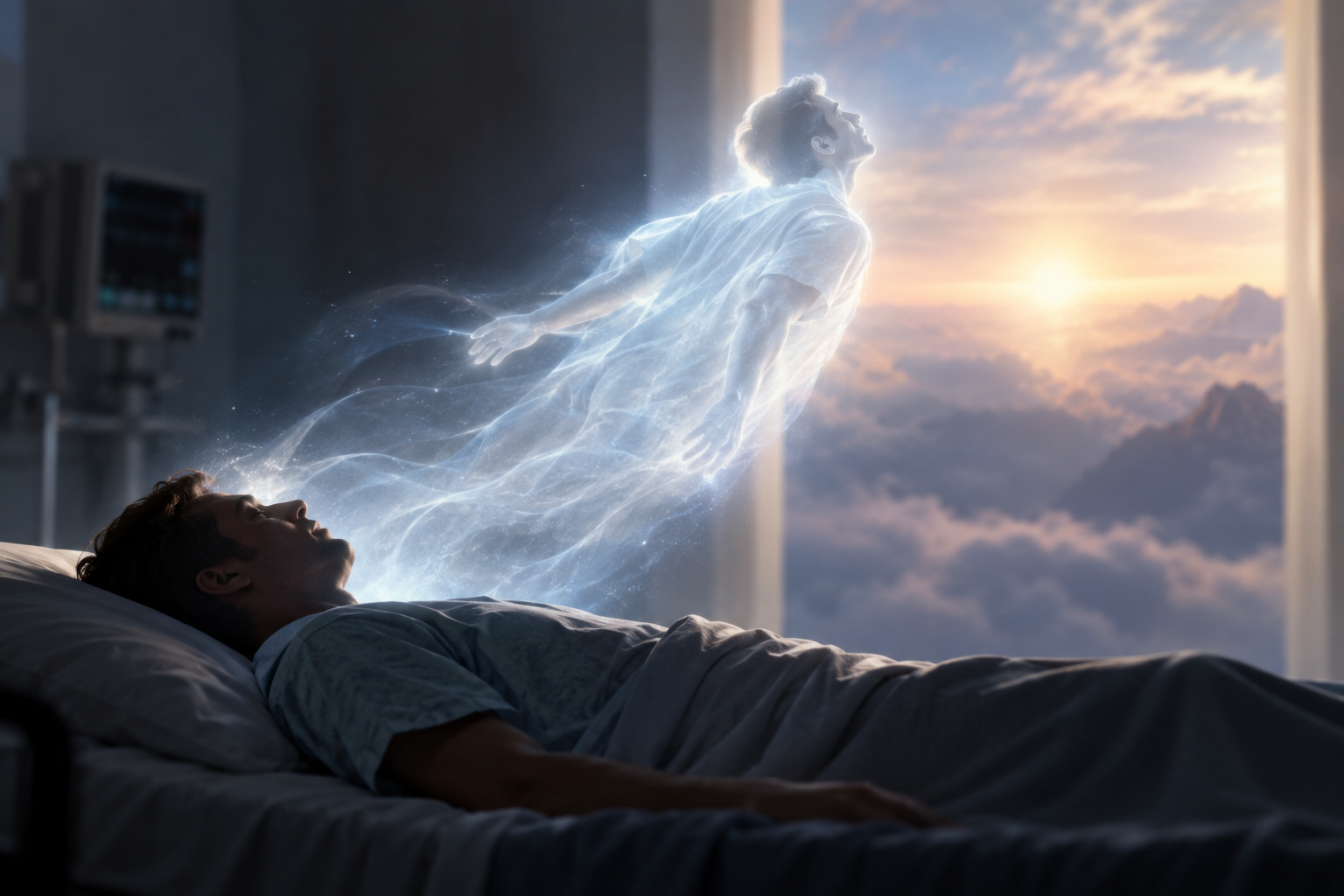

A person reports leaving the body during clinical death, then accurately describes an event, object, conversation, or medical action that should have been impossible to perceive. That is veridical NDE perception. It is not a warm feeling, a religious preference, or an argument from wishful thinking. It is an evidentiary problem for anyone claiming consciousness ends when the brain stops functioning.
The skeptical response usually arrives on schedule: perhaps the person heard something before losing consciousness; perhaps staff accidentally supplied details afterward; perhaps memory filled in the gaps. Those are reasonable possibilities to investigate. They are not automatic answers. When the reported information was inaccessible, specific, and later confirmed, the materialist explanation has a problem it cannot solve by simply repeating the word “hallucination.”
What Veridical NDE Perception Actually Means
Veridical means truthfully corresponding to facts. In NDE research, the term applies when a person who was clinically dead reports information later found to be accurate and not plausibly available through ordinary senses, prior knowledge, or post-event suggestion.
The claim is narrow, and that is its strength. Not every near-death account contains veridical perception. Not every striking detail can be independently checked. A report such as, “I saw a beautiful light,” may be meaningful to the person who experienced it, but it cannot be externally verified. A report describing a specific medical intervention, an unusual item outside the room, or a conversation occurring beyond normal sensory access can be checked against records and witnesses.
That distinction matters. A field that calls every vivid story proof becomes easy to dismiss. A field that separates emotionally powerful testimony from testable information begins to look like an investigation.
Authentic NDEs occur during genuine clinical death. The person may report peace, separation from the body, an encounter with a reality beyond physical life, or a life review. But the load-bearing evidence is not the imagery. It is the accurate perception of the physical world while ordinary perception should have been unavailable.
The Evidence Standard Is Higher Than a Good Story
A compelling account is not enough. Verification requires disciplined questions: What exactly was reported? When was it reported? Who knew the fact at the time? Could the experiencer have seen, heard, inferred, or later learned it? Is there a medical timeline? Are independent witnesses in agreement?
The strongest cases have a clean sequence. The experience occurs during a documented emergency. The experiencer reports details soon afterward, preferably before extensive conversation with family or staff. The details are unusual enough that a lucky guess is weak as an explanation. Then they are independently confirmed.
This does not mean every case has courtroom-perfect documentation. Emergency medicine is designed to save a life, not preserve an evidentiary archive for a future consciousness investigation. Timelines can be incomplete. Memories can be recorded too late. Staff members can disagree about minor details. Those limitations should be admitted plainly.
But imperfection is not refutation. The relevant question is whether the alternative explanation actually accounts for the observed facts. If a patient accurately reports information from a location or interval beyond sensory access, then vague claims about oxygen deprivation or dreamlike reconstruction do not meet the burden. They describe conditions in a body. They do not explain knowledge the person had no normal route to obtain.
Why Hallucination Fails the Test
Hallucinations can be vivid. Dreams can borrow fragments from waking life. Anesthesia awareness and ICU confusion can produce bizarre, frightening, or convincing memories. None of that is controversial. The mistake is pretending those facts explain a verified perception simply because both involve an altered state.
A hallucination can generate an image. It cannot reliably generate a correct, independently checkable fact that was unknown to the person. It cannot explain why the fact is later confirmed by people who were present. Calling an accurate observation a hallucination is not an explanation. It is a label applied after the explanatory work has been abandoned.
There is also a basic analytical failure in the usual skeptical move. It takes a broad category – unusual experiences around medical crisis – and treats it as if every event inside that category has the same cause. That is not science. It is category error.
A person can have confusion, panic, medication effects, or a Fear Coma Experience while alive in a catastrophic medical state. An FCE is the hellscape experience: terror, punishment imagery, pursuit, torment, or cosmic dread generated by a living brain under extreme fear. The old label “distressing NDE” obscures the difference and terrifies people unnecessarily. No clinical death means no NDE.
An authentic NDE is not an FCE with better scenery. They are separate events with separate evidentiary profiles. In the rare Welded NDE, an individual may remember both an FCE and a genuine NDE as one fused sequence because no clock separated them in memory. The investigator’s job is to identify the components, not flatten them into one convenient explanation.
Veridical perception belongs to the authentic NDE side of that line. It is precisely why the line matters.
The Skeptic’s Escape Routes
The most common escape route is residual hearing. Yes, patients may sometimes hear during a medical emergency. That possibility must be considered in every auditory claim. But it does not account for accurate visual details from an elevated viewpoint, events in another area, or facts occurring outside the relevant time window.
Another escape route is information leakage. Maybe someone told the patient afterward. Again, investigate it. A verified case becomes stronger when the account was documented early and when the detail was obscure enough that casual post-event conversation cannot plausibly explain it. This is why prompt reporting, contemporaneous notes, and interviews with separate witnesses matter so much.
Then comes coincidence. Coincidence is always possible in the abstract. But it becomes a refuge, not an explanation, when it is used to wave away specific correct details without calculating what was guessed, what was inferred, and what was later verified. Skepticism is not the habit of saying “maybe” forever. It is the discipline of comparing competing explanations against the evidence.
The best skeptical arguments force better case standards. That is useful. The lazy arguments merely declare the result impossible because it threatens a prior belief that consciousness cannot survive death. That is not a conclusion produced by evidence. It is a rule imposed on evidence before the investigation begins.
What This Means for People Afraid of Death
For someone grieving a spouse, facing surgery, or lying awake afraid that death means erasure, veridical perception is not an academic footnote. It addresses the central question directly: can a person know something while the body is clinically dead?
The verified cases say yes. Not sentimentally. Not because every account must be accepted without scrutiny. Because some reported perceptions contain accurate information that the ordinary senses cannot account for. The conclusion is as unsettling to materialism as it is comforting to the rest of us: the person does not vanish when the body fails.
That conclusion also removes a cruel confusion. Hellish fear imagery does not prove a person entered an eternal realm of punishment. A Fear Coma Experience belongs to the suffering living brain, not the afterlife. Don Winner’s Hell Exists, But Only for the Living examines that distinction in depth, including why honest witnesses can misidentify the source of terrifying imagery without being dishonest about what they endured.
Follow the Facts, Not the Labels
Veridical NDE perception does not ask anyone to abandon reason. It asks reason to do its job. Separate what is verified from what is assumed. Examine access to information. Identify leakage. Respect medical timelines. Refuse to treat a dismissive word as a mechanism.
The next time someone says an NDE was “just brain activity,” ask one quiet question: how did the brain obtain the verified information? If no ordinary pathway exists, the case has already crossed the line from personal testimony into evidence. And for people carrying fear about what awaits them, that line is worth looking at carefully.
Want to go deeper? Don Winner brings decades of intelligence and investigative experience to the biggest question there is: what happens when we die.
In You’re Going to Die Someday, Right? Near-Death Experiences Reveal What Happens Next, he examines the evidence from thousands of near-death experiences to find out what they actually tell us about consciousness, the soul, God, and the afterlife.
In Hell Exists, But Only for the Living, he investigates where our idea of hell came from and who built it, tracing the doctrine back to its human sources.
Get your copy of You’re Going to Die Someday, Right? or Hell Exists, But Only for the Living.