
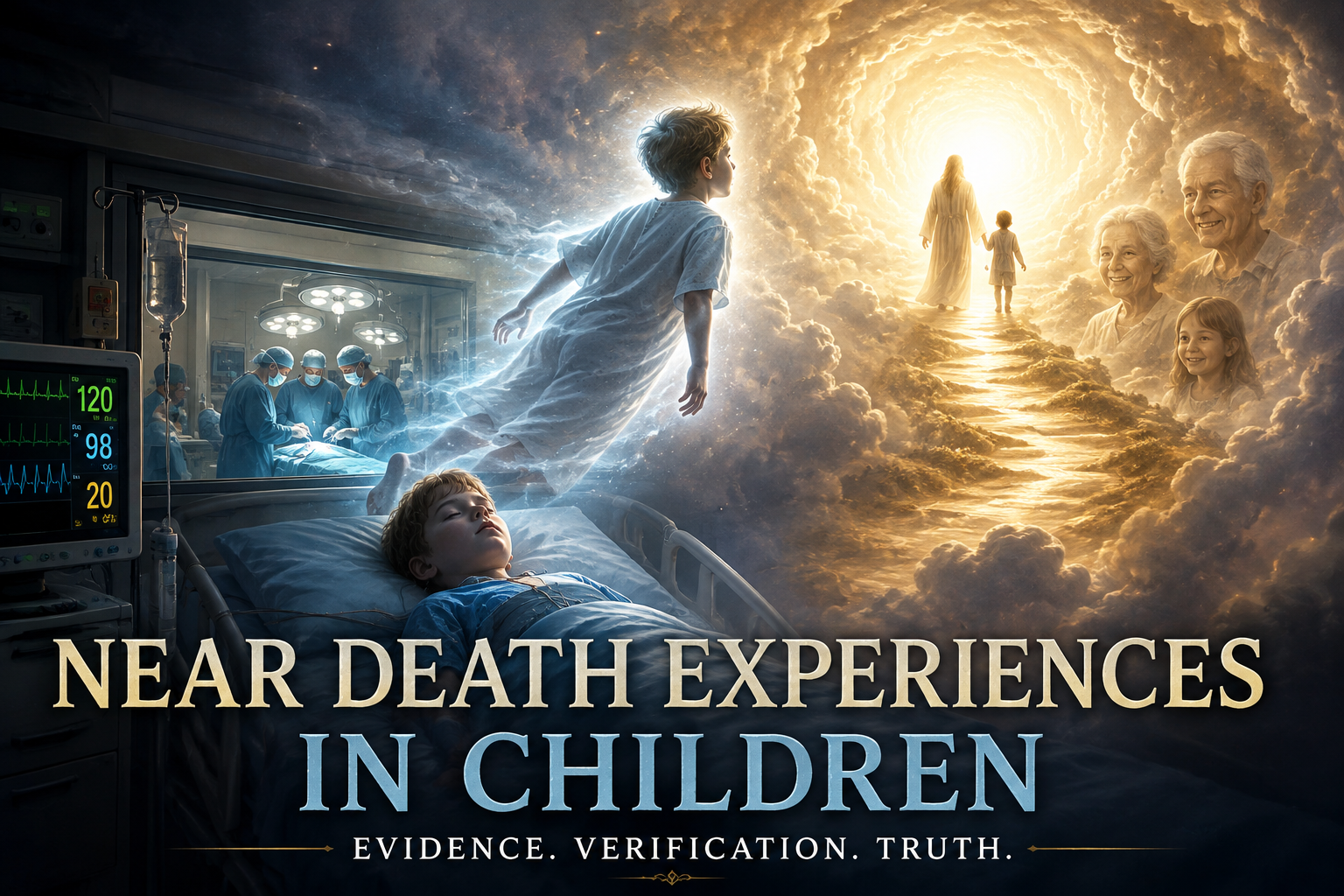
A small child is not supposed to have a sophisticated theory of death, a rehearsed spiritual vocabulary, or a polished story designed to impress adults. Yet some children who come close to death report events with a clarity that should stop any honest investigator cold. Near death experiences in children are not sentimental proof by themselves. They are evidence with unusual value because they remove several of the skeptic’s favorite escape routes.
A child may lack the cultural baggage, theological training, and decades of expectation that critics often invoke to explain adult NDEs. That does not make every childhood account automatically authentic. It does mean the strongest cases deserve serious examination rather than a reflexive wave toward imagination, medication, or parental influence.
Why Children Change the NDE Debate
The materialist explanation usually relies on a familiar script: people expect a tunnel, a light, dead relatives, judgment, or heaven because culture has supplied the imagery. Their distressed brains then assemble those expectations during a medical crisis.
That explanation weakens sharply when the witness is very young. A preschooler may not have been taught detailed ideas about an afterlife. A child raised in a nonreligious household may still describe leaving the body, encountering a loving presence, seeing deceased family members, or returning with a striking loss of fear about death. Children from different backgrounds can report the same broad sequence without being coached into a common doctrine.
The pattern matters. Across reported NDEs, children often describe separation from the body, an environment experienced as more real than ordinary life, communication that does not depend on spoken words, and a reluctant return. These are not random fragments of a nightmare. They are recurring features within a body of testimony that spans age, culture, and time.
Skeptics may respond that children are imaginative. Of course they are. Imagination is not the issue. The issue is whether imagination can supply accurate information unavailable to the child through normal senses, memory, or suggestion. It cannot.
The Evidence That Separates an NDE From a Story
Verified veridical perception is the load-bearing discriminator in any authentic NDE investigation. It is not a decorative detail or one data point among many. It is the fingerprint that timestamps real NDE content inside a period when the dying body could not have provided it.
A child who accurately reports an event occurring outside the room, identifies a person they could not have known was present, or describes a medical action later confirmed by staff has supplied something fundamentally different from a vivid internal experience. The question is no longer whether the account felt real. The question is how the information was obtained.
This standard protects the field from both gullibility and cynicism. A moving story without verification may still matter deeply to the family, but it cannot bear the same evidential weight as a case with independently confirmed details. Conversely, a verified perception cannot be dismissed by calling all children suggestible. Suggestion may shape how a child tells a story after the fact. It does not explain accurate knowledge acquired while the child was physically incapable of observing it.
The strongest investigations establish the timeline first. What was the child’s medical condition? Who was present? What information was available before the account was given? When did the child first describe the event? Were the details recorded before adults began discussing possibilities? Could the alleged observation have been learned normally?
That is not cold bureaucracy imposed on a sacred event. It is how an investigator prevents a genuine anomaly from being buried under sloppy reporting.
Children Often Speak Before Adults Teach Them What to Say
Parents are frequently the first and most important witnesses, but they are also human. They may be grieving, terrified, relieved, religious, skeptical, or all of these at once. A careful approach does not accuse parents of inventing anything. It simply recognizes that memory can be influenced by repeated conversations, especially when a family is trying to make sense of a traumatic medical emergency.
The best practice is straightforward. Preserve the child’s earliest words as closely as possible. Ask open questions instead of supplying details. “What do you remember?” is useful. “Did you see Grandma in heaven?” is not. Note the date, who heard the account, and what was said before the child heard other adults discuss it.
Children also communicate differently by age. A younger child may draw what they experienced, use improvised language, or return repeatedly to one odd detail. An older child may be more coherent but also more aware of what adults expect. Neither format is inherently superior. The investigator’s task is to separate firsthand reporting from later interpretation.
Four questions should govern every serious case review:
- Did the child suffer a clinical death, with a clear medical timeline?
- Did the child report information that could not have come through ordinary means?
- Were key details independently verified and recorded promptly?
- Is the account distinct from a dream, delirium, fear state, or later family retelling?
Those questions are not a trap designed to disqualify childhood experiences. They are a defense against the casual treatment that has damaged NDE research for decades.
Do Not Confuse Terror States With Authentic NDEs
This distinction matters especially when children report frightening experiences during illness, sedation, fever, prolonged hospitalization, or coma. A terrifying experience can be real to the child and leave lasting emotional wounds. It deserves compassion, clinical care, and respect. But fear coma, ICU delirium, nightmares, and crisis imagery are not authentic NDEs.
The difference is not whether an account is emotional, visual, or unforgettable. It is whether the person was clinically dead and whether the report carries the evidential signature of an NDE, above all verified veridical perception. Horror imagery arising in a living brain under catastrophe belongs to a separate category. Treating it as evidence about the afterlife is an investigative error that frightens families unnecessarily.
This also prevents a cruel confusion around so-called hellish experiences. A child who has endured terror in a medical crisis should never be told that they glimpsed eternal punishment. That is not evidence-based care. It is fear imposed on a vulnerable witness. The honest conclusion is more reassuring: terror experiences of the living and authentic NDEs are mutually exclusive events.
The Life Review Is Not a Child’s Moral Threat
When an authentic NDE includes a life review, the experience is not a cosmic scolding session. Witnesses commonly describe an expanded understanding of how their choices affected others, often accompanied by overwhelming love rather than humiliation. But precision is essential here. A life review belongs only to an authentic NDE during clinical death. It is not a feature of delirium, a fear state, or an ordinary childhood dream.
Children who report NDEs may not frame their experiences in adult moral language. They may speak instead about kindness, love, being told they had to return, or feeling connected to everyone. Adults should resist the temptation to turn those reports into sermons. The point is not to recruit a child into anyone’s theology. The point is to hear what was actually reported.
What the Skeptics Still Cannot Explain
A materialist can explain that children fantasize. A materialist can explain that families tell stories. A materialist can explain that a medical crisis is confusing and emotionally intense. None of that explains a properly documented case in which a child reports verified information beyond the reach of ordinary perception while clinically dead.
The usual objections are often presented as if they settle the matter: residual brain activity, hidden sensory cues, reconstruction after recovery, confabulation. But these are proposed mechanisms, not explanations of verified facts. Naming a possibility is not demonstrating that it occurred. The burden is to show how a particular child acquired a particular accurate detail at a particular time.
That is where the skeptical case repeatedly collapses. It asks the public to accept broad speculation over direct testimony corroborated by independent facts. In intelligence analysis, that would be backward. You do not discard a verified report because you can imagine several unverified alternatives. You test the alternatives against the record.
How Adults Can Respond Without Damaging the Memory
If a child shares an extraordinary experience after a medical emergency, calm attention is more useful than excitement or dismissal. Listen. Write down their words. Ask only simple, nonleading questions. Do not pressure them to repeat the story for relatives, clergy, social media, or skeptical adults eager to cross-examine them.
Some children want to talk once and move on. Others revisit the experience years later. It depends on the child, the severity of the medical event, the family’s response, and whether the experience brought comfort or confusion. If the child is distressed, withdrawn, frightened, or struggling with sleep, professional support can help without forcing a predetermined interpretation.
But adults should not erase the experience merely because it challenges their worldview. Telling a child, “You dreamed it,” may be factually wrong and emotionally dismissive. Telling them, “You went to hell,” can be far worse. A better response is simple: “I believe you had a powerful experience. I want to understand what you remember.”
Children do not settle every question about death. No single case should be asked to carry that burden. Yet their strongest accounts create a problem that materialism has not solved: consciousness can present accurate knowledge when the body has been left behind. For parents and grandparents facing mortality, that is not an abstract debate. It is a reason to meet the unknown with less fear and far more attention.
Want to go deeper? Don Winner brings decades of intelligence and investigative experience to the biggest question there is: what happens when we die.
In You’re Going to Die Someday, Right? Near-Death Experiences Reveal What Happens Next, he examines the evidence from thousands of near-death experiences to find out what they actually tell us about consciousness, the soul, God, and the afterlife.
In Hell Exists, But Only for the Living, he investigates where our idea of hell came from and who built it, tracing the doctrine back to its human sources.
Get your copy of You’re Going to Die Someday, Right? or Hell Exists, But Only for the Living.