
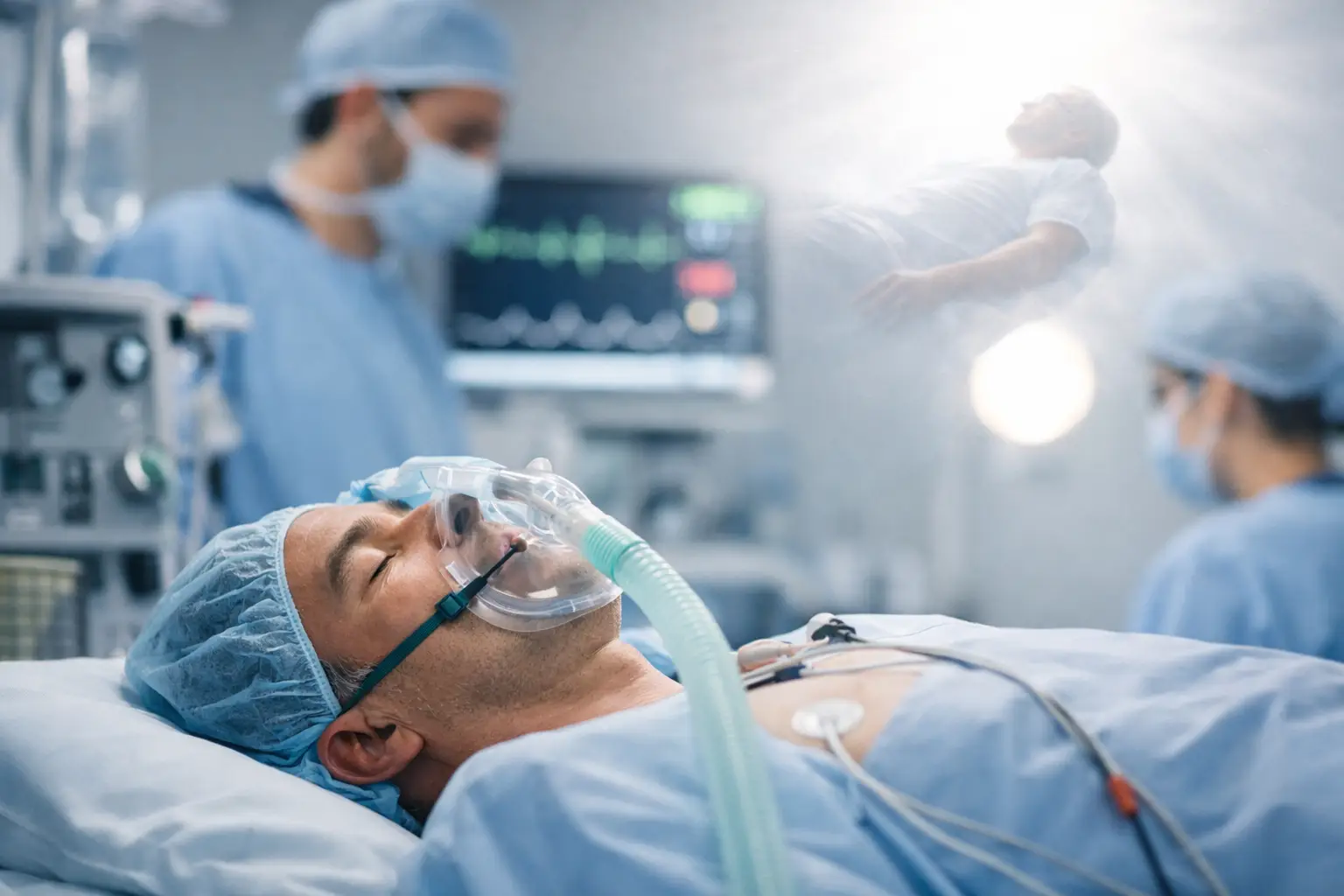
A patient is placed under general anesthesia, loses awareness, suffers an unforeseen cardiac crisis, and later reports floating above the operating table. They describe a surgical instrument, a conversation, or an event outside their normal field of view. Can NDEs occur under anesthesia? Yes – but the question is routinely mishandled because people lump together radically different experiences under one label.
Anesthesia can produce confusion, fragments of awareness, dreams, and disturbing emergence reactions. Those are medical events occurring in a living brain. An authentic near-death experience is different in kind, not merely intensity. It occurs when the person is clinically dead and has left the body behind. The decisive evidence is not that someone saw a light or felt peaceful. It is verified veridical perception: accurate information acquired during a period when the body could not have supplied it.
That distinction matters because skeptics frequently use the word “anesthesia” as though it settles the case. It does not. In some of the most consequential cases, anesthesia is simply the setting in which a genuine medical emergency occurs.
Can NDEs Occur Under Anesthesia Without Clinical Death?
No, not if we are using the term NDE with any discipline.
A person who recalls a voice during surgery may have experienced anesthesia awareness. This is real, frightening, and medically recognized. General anesthesia is not a magical off-switch that works identically in every body and every procedure. Dosage, metabolism, emergency conditions, and the need to maintain cardiovascular stability can all affect how deeply a patient is anesthetized.
But anesthesia awareness is not evidence that a person left the body. It usually involves partial perception of sound, pressure, paralysis, panic, or isolated memory fragments. A patient may hear staff speaking because their auditory system is still processing input. That is alarming enough without turning it into something it is not.
The same rule applies to dreams and disorientation during induction or recovery. The boundary between waking and anesthesia can be strange. Time may distort. Images can feel intensely real. Some patients emerge with terrifying, disconnected scenes that resemble a nightmare more than a coherent memory. None of that establishes an NDE.
The error goes in both directions. Believers can mistake every vivid surgical memory for proof of survival. Materialists can point to those ordinary altered states and declare the entire NDE record explained. Both moves are intellectually lazy. The investigation has to begin with the medical timeline and the quality of the reported information.
The Surgical Crisis Changes the Question
During an uncomplicated operation, anesthesia is the obvious explanation for a patient’s altered experience. During cardiac arrest, catastrophic blood loss, anaphylaxis, or another collapse that stops circulation, the case changes completely.
The relevant question is no longer, “What does anesthesia do?” It is, “What did this person know, and when could they have known it?”
An operating room is actually a useful environment for investigating this. It is controlled. There are multiple trained witnesses. Events are documented in anesthesia records, surgical notes, and resuscitation timelines. Staff can sometimes confirm precise details that the patient later reports. That is a better evidentiary setting than a vague recollection years after an illness with no records and no independent witnesses.
A strong case does not rest on a patient saying, “I felt as if I was above my body.” That may be sincere, but sincerity is not verification. The case becomes serious when the patient reports specific, checkable details from outside normal sensory access: an action behind a curtain, an instrument handled after loss of responsiveness, a statement made during the code, or an event elsewhere that is subsequently confirmed.
That is the fingerprint. Verified veridical perception timestamps real NDE content inside a period the dying body could not supply. It separates an authentic out-of-body observation from a memory, a guess, a dream, or an experience reconstructed after the fact.
Why “The Drugs Did It” Fails as an Explanation
The drug explanation sounds forceful because anesthetic agents unquestionably alter experience. But it answers the wrong question when a verified case is on the table.
Drugs may explain sedation, confusion, amnesia, hallucinations, and incomplete awareness. They do not explain accurate perception of events that occurred while the patient was clinically dead, especially when those events were unknown to the patient and later corroborated by the people present.
Saying “anesthesia caused it” after such a report is not a scientific explanation. It is a label placed over an anomaly. The label does no investigative work.
Imagine an intelligence analyst reviewing a report. A witness describes a broad impression – perhaps a feeling of floating or a bright space. The analyst records it but cannot independently prove it. Then the witness identifies a sequence of actions, an unusual device, or a conversation that records and witnesses confirm. Those two claims do not carry equal weight. The second demands an explanation that fits the facts.
This is where much public discussion collapses. Critics often attack the easiest elements of an NDE account: tunnels, lights, euphoria, or symbolic imagery. Fine. Those features alone do not settle the survival question. But removing the weakest evidence does not remove the strongest. Verified perception remains, and it is the evidence critics would prefer to blur into a generalized account of drug effects.
Anesthesia Awareness, Fear Coma, and NDEs Are Not One Category
There is another source of confusion, especially for readers frightened by reports of dark or hellish experiences. Not every terrifying experience around surgery, coma, or critical illness is an NDE.
A fear coma, ICU delirium, and anesthetic emergence reaction belong to the world of the living brain under extreme stress. They can be vivid, cruel, and unforgettable. They may involve persecution, confinement, monsters, punishment, or a sense of absolute dread. The witness should be treated with compassion and respect. The experience was real to them. But its interpretation must follow the evidence.
An authentic NDE is not a terror state dressed up in spiritual language. Nor should distressing clinical imagery be used to define what death itself holds. These are separate events with separate evidence bases. A catastrophic brain under fear can generate catastrophe. That does not tell us what happens when a person is clinically dead and outside the body.
This distinction is not cold academic sorting. It has direct human consequences. A person recovering from a nightmare of delirium should not be told they glimpsed eternal punishment. That is reckless. Conversely, a person whose verified observations point beyond bodily perception should not be told it was merely a bad drug reaction because an anesthetic happened to be used earlier in the operation.
What a Careful Investigation Should Ask
The phrase “under anesthesia” is only the first fact in a much longer timeline. A credible investigation asks whether there was clinical death, what the records show about circulation and resuscitation, when the reported perceptions occurred, and which details can be independently checked.
It also asks whether the account was recorded promptly, whether the patient had access to the information by ordinary means, and whether witnesses confirm the details without being led. Memory is fallible. Medical records can be incomplete. Not every dramatic surgical story will survive scrutiny. That is not a weakness in the case for NDEs. It is why standards matter.
The strongest cases do not demand blind belief. They invite examination. They contain claims that can be compared against documentation and witness testimony. If a case fails verification, say so. If it succeeds, do not evade the result by retreating into the vague word “anesthesia.”
The Direct Answer
NDEs can occur in the context of anesthesia when anesthesia is followed by a genuine death crisis. They do not occur simply because a person is sedated, dreaming, partially aware, or frightened during recovery. The dividing line is clinical death, and the load-bearing evidence is verified perception from beyond the body’s available senses.
For anyone facing surgery, this should not create a new fear. Modern anesthesia is designed to protect patients, and anesthesia awareness remains uncommon. But the deeper lesson is reassuring: a surgical emergency does not automatically reduce a profound report to chemicals and confusion. When the facts show that a patient knew what no unconscious body could know, the honest response is not dismissal. It is to follow the evidence wherever it leads.