
There’s a concept in cross-cultural NDE research that doesn’t get nearly enough attention, and it took one famous case from rural India to crystallize it for me. The idea is this: every Near Death Experience, at its core, is essentially the same experience. What changes is the cultural filter it gets poured through on the way back. Strip away the seasoning, and chicken is still chicken.
Let me show you exactly what I mean.
The Case of Srinivasa Reddy
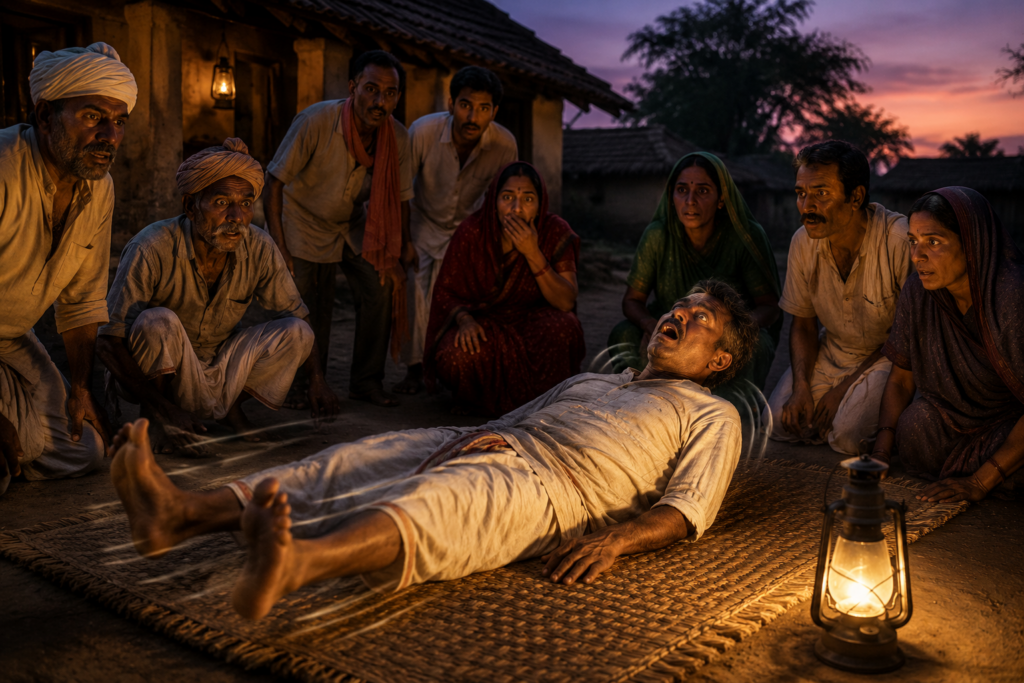
In mid-20th century India, a man named Srinivasa Reddy fell severely ill with a high fever. His condition deteriorated rapidly while his wife was away. By the time she returned, he had lost consciousness completely. Local villagers, noticing that his breathing had stopped entirely, concluded he was dead.
Following local custom, the community laid his body outside on a mat and sent word to distant relatives to come for the final funeral rites. Then, somewhere between 8:00 and 9:00 in the evening, Srinivasa Reddy shocked everyone watching by shaking his legs, moving his head, and gasping for air.
He was back.
When he revived, he described what had happened in his own words — as recorded decades later by field researchers in July 1995, when Reddy was 75 years old:
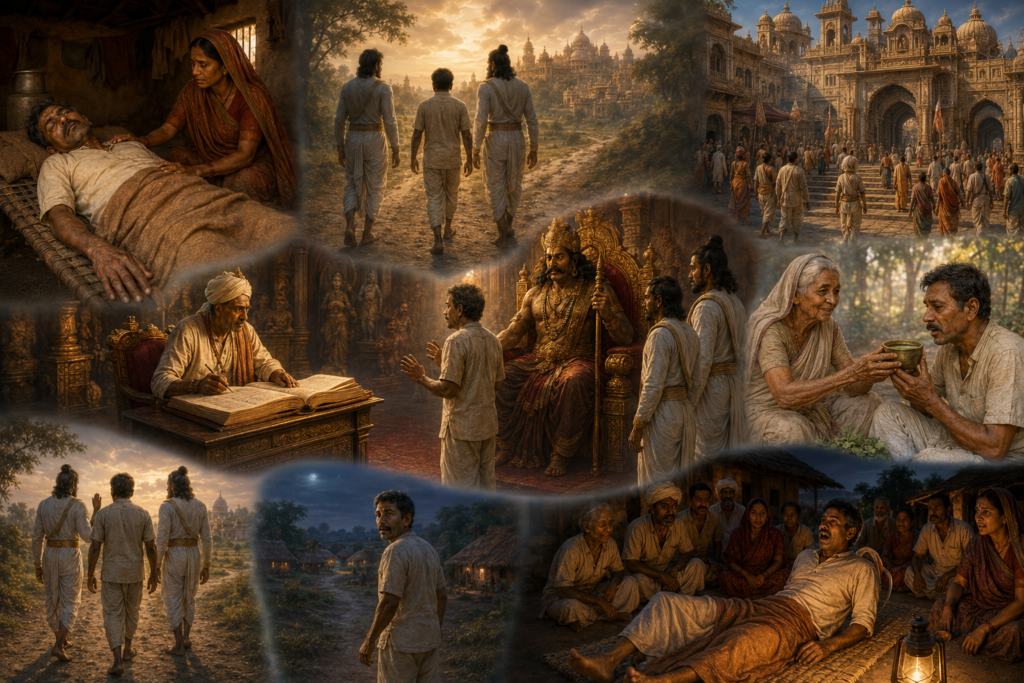
“Two people came and asked me to go with them. I went with them walking on a mud road. We walked for a long time and reached a big place, which was like a city. There were big houses and many people. We went inside a big house where I saw a man with a big book to the left of Yamraj. The man with the book said, ‘Why have you come here?’ I said, ‘These people have brought me here.’ He said, ‘You are not required here; I had asked for Ashwath Reddy. You go back,’ and asked those two persons to bring Ashwath Reddy. We came out; while coming out I told them that I was suffering from fever; could they give me some medicine to cure my illness? They took me to an old lady who gave me some herbal juice which I drank and came back with them; they left me outside my village. After I came back my fever came under control quickly and since then I have not suffered from fever even once. For this reason the memory of my experience is still fresh in my mind.”
That account has been cited in cross-cultural NDE research ever since as a textbook example of what researchers call the Indian “clerical error” motif — the idea that the returning experiencer was taken by mistake and sent back because the cosmic authorities wanted someone else. Researchers have long held it up as evidence that Indian NDEs are fundamentally different from Western ones.
I respectfully disagree. And I think the full account — particularly that last paragraph — shows exactly why.
Looks Different. Isn’t.
When Western NDE researchers first began cataloguing Indian accounts alongside their own data, the clerical error motif stood out as something exotic and distinct. In Western accounts, the experiencer is typically told “it’s not your time” or “you still have work to do” — and they make a personal choice to return. In Indian accounts like Reddy’s, the return is framed as an administrative correction. The cosmic authorities got the paperwork wrong. Wrong name, wrong address. Go back.
On the surface, that looks like a fundamentally different experience. But strip away the cultural furniture and look at the actual structure of what happened to Srinivasa Reddy:
He left his body. He was escorted by guides. He traveled to another realm. He encountered a figure of authority. He met someone connected to the cosmic record of his life. He reached a decision point. And he returned.
That is not an Indian NDE. That is just an NDE. The same pipeline that shows up in accounts from Ohio and Oslo and São Paulo and Tokyo, dressed here in the imagery of rural Telangana — mud roads, a city of big houses, Yamraj, a man with a book.
The tunnel becomes a road. The Being of Light becomes a divine administrator. The life review becomes a ledger check. The “it’s not your time” becomes a clerical error. Different words. Same sentence.

Was It an Order or a Choice?
Here’s the question that gets to the heart of it: when the man with the book told Reddy to go back, was that a mandate — or was it a choice?
My research leads me to a firm position on this. Free will is always preserved, on this side of the veil and on the other. The NDE data across thousands of accounts from every culture does not support the existence of a top-down cosmic authority that overrides a soul’s autonomy. What it does support, consistently, is the idea that consciousness at the moment of death interacts with a reality so vast and formless that the human mind immediately reaches for the nearest available symbols to make sense of it.
In the West, those symbols tend to involve light, personal mission, and individual choice — because Western culture places the individual at the center of the narrative.
In mid-20th century rural India, the nearest available symbol for unavoidable authority was a government official checking a ledger. In a deeply communal society where individual agency was often secondary to family, caste, and civic duty, the mind translated the soul’s own decision to return into the most culturally familiar form of an instruction from above.
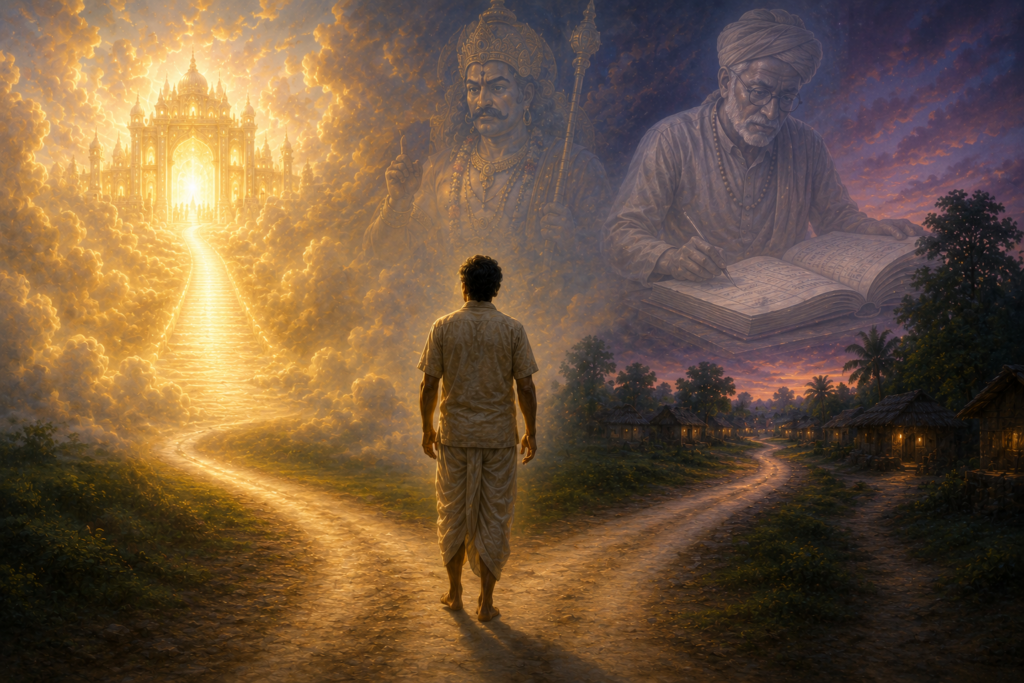
At the level of the soul, I believe Reddy’s higher self looked at the situation and made a decision: there is more to do, I am going back. But when that realization filtered down into the conscious mind of a man whose entire life had been shaped by deference to elders and community authority, it came back as: the man with the book looked at my papers and told me I had to leave.
Was it an order? Or was the soul’s own choice dressed up in the only costume that made sense to the person wearing it?
If free will is the fundamental operating law of consciousness — and the data says it is — then it was always a choice. The cosmic bureaucracy is theater. Familiar, culturally specific theater that the mind helpfully staged so the soul could understand its own decision in terms it could actually process and later communicate to the people back home.
There’s also a practical dimension worth noting. In Reddy’s community, telling people you chose to leave paradise and come back to a life of poverty and illness would have sounded irrational. Saying the cosmic authorities made a clerical error and sent you back? That’s a story a village can accept. It validates the reality and beauty of what you experienced, while neatly explaining why you returned to a difficult earthly life. The mind, consciously or not, found the most socially coherent frame available.
But Wait — There’s More
Now here is where this case goes from interesting to extraordinary — and where I think most researchers, focused on the cultural comparison angle, have failed to give Reddy’s account its full due.
Read that last paragraph of his testimony again.
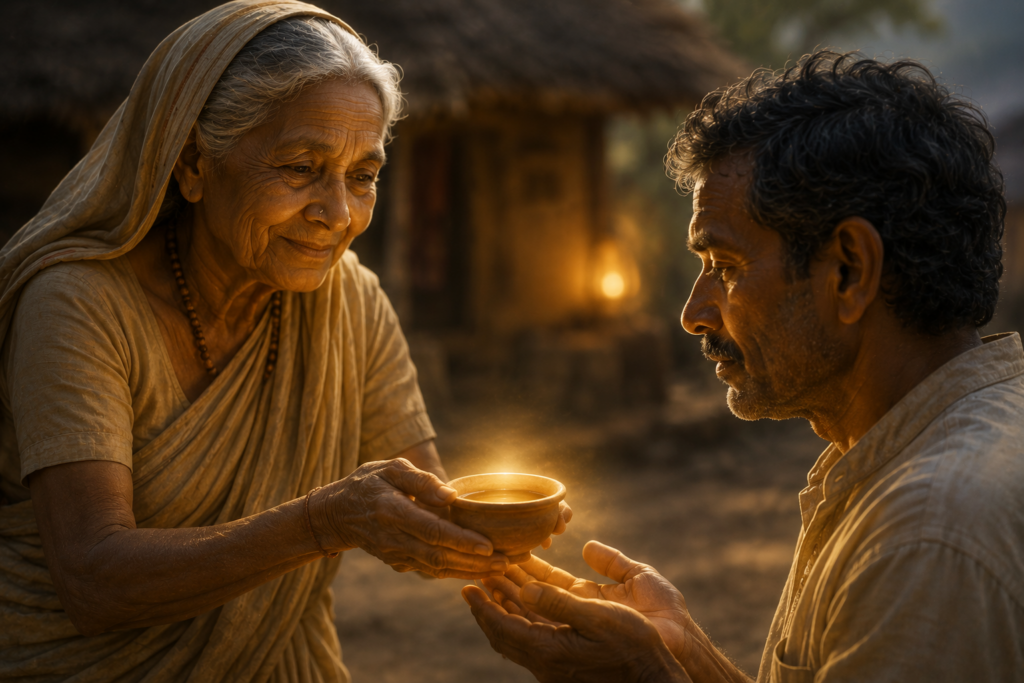
On the way out of the other realm, Reddy told his escorts that he was suffering from fever and asked if they could give him something for it. They took him to an old woman, who gave him an herbal juice to drink. He came back. And then — the fever that had killed him broke. Not gradually. Not with treatment. It broke. And in the decades that followed, Srinivasa Reddy reported that he had not been sick even once.
Not once.
This is what NDE researchers call a miraculous healing — one of the most consistently documented yet persistently under-discussed aftereffects in the entire body of NDE literature. It appears across cultures and across centuries. People return from the threshold of death not just psychologically transformed, but physically healed of conditions that were present at the moment they crossed over. The International Association for Near-Death Studies maintains an entire research category dedicated to NDE-related physical healings because there are enough verified cases to warrant it.
What makes Reddy’s healing remarkable even within that category is his level of conscious participation in it. He didn’t passively receive a cure. He was lucid enough, present enough, and composed enough during the experience to recognize that he was ill, identify the problem clearly, and ask for help. The request was granted by a figure in the other realm. He returned. The illness resolved. And that was apparently the last time his body ever failed him.
Decades later, at age 75, he credited the vividness of his memory directly to the healing: “For this reason the memory of my experience is still fresh in my mind.” The cure wasn’t a footnote. For Reddy, it was the proof. The thing that made it impossible to dismiss or forget or rationalize away over fifty years of living.
Layer that on top of everything else this case contains — the verified departure from the body, the escort, the otherworldly realm, the deceased relative, the decision point, the return — and what you have is not an exotic regional curiosity. You have one of the most complete NDE cases on record, wrapped in the cultural language of rural India, containing every major element the broader research literature has identified as characteristic of the experience.
Chicken Is Still Chicken
The Srinivasa Reddy case ultimately demonstrates something that I think is the most important single insight in all of NDE research: the experience itself appears to be universal. What varies is the vocabulary used to describe it afterward.
The tunnel of light. The celestial courthouse. The beautiful garden. The river crossing. The Being of Light. The cosmic bookkeeper with the ledger. These are regional spices. Different kitchens, different presentations on the plate, different names for the figures encountered along the way.
But strip all of that away — the cultural scaffolding, the local mythology, the familiar symbols the mind reaches for when it tries to translate the untranslatable — and what you find underneath is the same thing, every time, in every country, in every century.
Consciousness leaves the body. It enters a state of expanded awareness outside of time. It encounters some version of a boundary or decision point. It returns to the physical body, permanently changed — and in some cases, like Reddy’s, physically healed.
Chicken is still chicken.
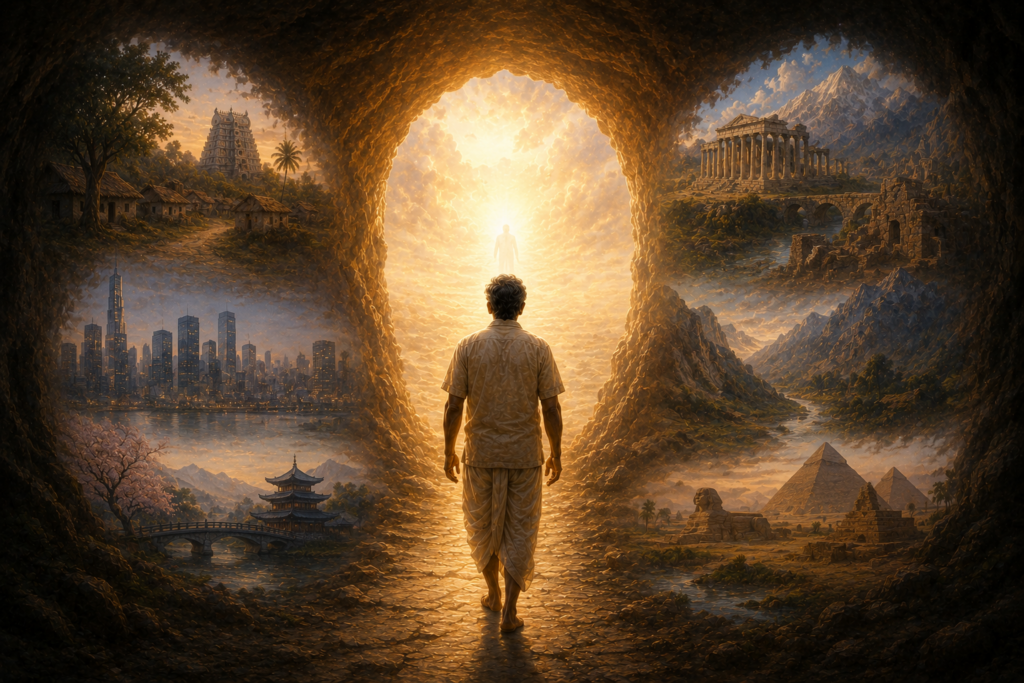
Whether the mind of the person having the experience dresses it in the imagery of rural Telangana or suburban Ohio or medieval Japan or ancient Egypt, the underlying structure of what is happening to human consciousness at the moment of death appears to be identical across the entire species. That universality, more than any single dramatic verified case, is what makes this body of data so difficult to dismiss. It’s not one person’s account. It’s millions of accounts, from every culture and every century, all pointing at the same thing.
And in Reddy’s case, one of them came back with a cure.
Srinivasa Reddy’s account is documented in peer-reviewed field research and published in the Journal of Near-Death Studies. Primary source: Pasricha, S. (2008). “Near-Death Experiences in India: Prevalence and New Features.” Journal of Near-Death Studies, 26(4): 267–282. https://digital.library.unt.edu/ark:/67531/metadc799327/m2/1/high_res_d/vol26-no4-267.pdf
For a deeper dive into how NDE data points to the universality of consciousness at the moment of death, including the prehistoric roots of the experience, get the book: You’re Going to Die Someday, Right?
Want to go deeper? Don Winner brings decades of intelligence and investigative experience to the biggest question there is: what happens when we die.
In You’re Going to Die Someday, Right? Near-Death Experiences Reveal What Happens Next, he examines the evidence from thousands of near-death experiences to find out what they actually tell us about consciousness, the soul, God, and the afterlife.
In Hell Exists, But Only for the Living, he investigates where our idea of hell came from and who built it, tracing the doctrine back to its human sources.
Get your copy of You’re Going to Die Someday, Right? or Hell Exists, But Only for the Living.