-
- Shin Suzuki
- Role,From BBC News Brazil in São Paulo
- PublishedDecember 2, 2024
- Reading time: 8 min
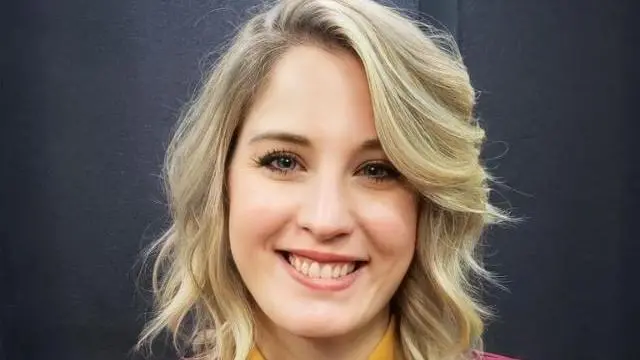
For two years, Fernanda Schreiber Ramos Pereira, from Rio Grande do Sul, underwent fertility treatment that was unsuccessful. Shortly after, to her surprise, she became pregnant naturally.
“It was a miracle,” he says. “But I had no idea what was coming next.”
At 30 weeks pregnant, Fernanda underwent an emergency delivery in January 2021, during the Covid pandemic .
The surgery was a traumatic turning point in her life.
A hemorrhagic shock during the procedure caused her to lose 3.8 liters of blood out of her body’s 4.2 liters.
“I could hear all the doctors screaming as they tried to save me, asking for blood transfusions, saying ‘I can’t find the [location of the] uterine rupture.’ I saw all that desperation and I wasn’t afraid. I didn’t get caught up in that atmosphere. Because I wasn’t there.”
The hemorrhagic shock was contained, and she and the baby were moved to an ICU.
Fernanda, now 39 years old, survived. Her daughter did not.
“I sincerely asked to join [my daughter] because I had nothing else to do here. But life isn’t what we want. It’s what we have.”
After being discharged from the hospital, Fernanda had to relearn how to walk. And while grieving for her daughter, she began to process what had happened during the surgery.
On that border between life and death, she recounts remembering seeing herself outside her body on the operating table. And experiencing an altered state of consciousness in the form of two “visions.”
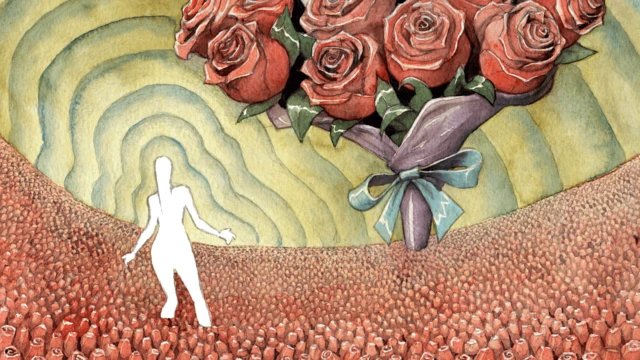
“The first time was that I was in a field of flowers. I couldn’t see the sky, but I could see that it was an endless field. There were many flowers, and from that field came a gigantic bouquet of red roses. And it was a feeling I had never felt in my life. Like a feeling of fullness,” says Fernanda.
“I was in that place, but I didn’t want to go back because I felt like I belonged to that whole place, to everything. I didn’t know who was giving me that flower, I didn’t know if it was nature, God… I don’t know, the universe. I didn’t know who was giving me that flower, but it was wonderful.”
The second one was less consistent.
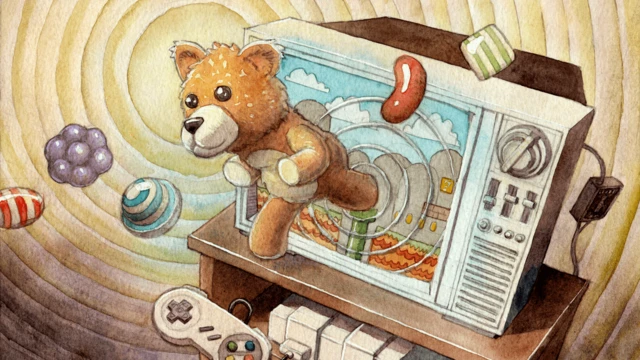
“It was like a video game. I was watching TV or playing a game, something like that. Then I clearly saw teddy bears jumping, and candy was coming towards them. They were talking and playing. At the time I didn’t understand and didn’t want to know the meaning of that image. I just recorded it. Later I thought it could be the idea of overcoming a difficult phase, like in a video game.”
Altered states of consciousness (the “visions,” the sensation of seeing oneself outside the body) are scenarios frequently described by people who have undergone near-death experiences (NDEs), a relatively new field of study that has been attracting more attention in recent years, including in Brazil.
Fernanda is often asked if this was a hallucination resulting from the effects of surgical anesthesia.
“I keep hearing people say, ‘Could you have been delirious?’ But I’ve had numerous anesthetic treatments and never experienced anything like that.”
‘Near death’
Before addressing the issue, it’s necessary to understand the circumstances that give rise to these states. After all, what is a “near-death experience” in the context of science and medicine?
Generally speaking, it is a stage in which the heart has already stopped beating, but there is still a window of time for resuscitation. According to the traditional consensus in medicine, soon after cardiac arrest, oxygen and blood cease to be pumped and the brain stops functioning.
The question is: if it’s switched off, what explains the ability to produce visions during an NDE? And how are they then stored in memory? After all, even for a “hallucination,” an active brain is necessary.
Researcher Jimo Borjigin, from the University of Michigan (USA), monitored the level of brain activity during this near-collapse stage of life, first in rats and later in four human patients.
And he encountered a scenario that contradicts classical medicine: the brain is not paralyzed. On the contrary, there is a “storm” of activity.
“It’s as if a 1G connection cell phone suddenly became 5G,” she tells BBC News Brazil. “This way, the brain can process more information much faster.”
Borjigin points out that there is a surge of gamma activity, of super-fast waves, in the so-called “hot zone of the brain”—an area activated in visual and auditory experiences, as well as being related to dreams, visual hallucinations of epilepsy, and precisely altered states of consciousness.
This hyperactivity seems consistent with the intensity of NDE reports: they are “life movies” that unfold in microseconds, scenes with explosions of colors and tones, a feeling of inner peace, in addition to the ineffable—which is difficult to translate into words.
And, according to the researcher, what is called a “hallucination” (a term more appropriate for psychiatric disorders and not for a near-death experience, she emphasizes) does not invalidate the fact that all of that was experienced internally.
“Just because we have difficulty understanding what patients are feeling, doesn’t mean it didn’t happen to them inside the brain, right?”
For Borjigin, the most important question revolves around the reason why the body triggers this hyperactivity in the head.
“I think this brain activation might indicate a built-in survival mechanism. It’s as if the brain is making a quick calculation through this gamma activity,” he says.
There is a vast array of mysteries to be understood, including episodes that occur after the actual NDE (Near-Death Experience).
Fernanda, for example, recounts some intriguing effects that she relates to her experience.
“I was never much of a writer or reader. After that episode, sometimes I would wake up in the middle of the night with a complete text in my head. I would watch a series during the day or read something and wake up with a complete ‘message’ about the content. It was like an open channel.”
She is participating in a research study conducted by Ana Cláudia Mesquita Garcia , a professor at the School of Nursing at the Federal University of Alfenas (MG) and a palliative care nurse.
The researcher is interested in investigating altered states of consciousness for their potential benefits to overall health. She has already studied how psychedelic substances can help people with serious illnesses , including end-of-life patients, in alleviating distressing symptoms.
He also coordinates Death Cafe Alfenas, an outreach project based on an idea that originated in Switzerland in 2004. It’s a more informal and relaxed space to discuss the finiteness of life, a topic often seen as taboo.
“In most of these [NDE] accounts, the person said it was a transformative experience for them in a positive way, with an impact on the rest of their life. They begin to rethink their choices, so, according to these people’s accounts, it really does have a positive impact on their lives,” she states.
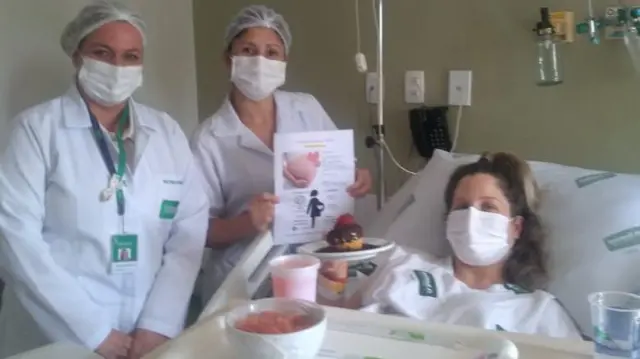
Ana Garcia’s proposal is to analyze interviews with people who have experienced a near-death experience (NDE). From this collection, she aims to identify the patterns that characterize these episodes, using a scientific scale developed by the American psychiatrist Bruce Greyson and adapted for Brazil.
She wants to understand what the positive (and also negative) impacts are on life that result from a near-death experience.
“Healthcare professionals need to know that these experiences exist and know how to approach them with the patient, because often the person avoids talking because they think they won’t be believed. The healthcare professional can prepare themselves to listen without judgment and understand, in the best way possible, what the patient has experienced.”
Fernanda experienced post-traumatic stress and a kind of loneliness resulting from the experience. There was the shock experienced during the surgery. There was the loss of her daughter.
“Having courage isn’t easy. It’s very painful. I’ll be very honest: because of the grief over my daughter’s death, I feel very lonely. For people, it’s difficult to understand what happened.”
“The doctors say that my husband, my mother, and I are experiencing post-traumatic stress. It’s like we went to war and came back with several triggers for the rest of our lives. Because what we experienced in the hospital was very intense.”

Researcher Ana Garcia also investigates the theme of spirituality in health, with the aim of better understanding the “spiritual dimension” of the human being — an expression that may sound esoteric, but which denotes a valuable element in an individual’s life.
“Spirituality is something that is part of us as human beings; we are born with this search for meaning, for purpose and transcendence—that is, a search for something that is beyond us, that is greater than us. Obviously, what is transcendent for one person may not be for another.”
Fernanda says that today she values what she went through: “Today I feel very honored to have gone through this experience, very honored indeed.”
“A question they always ask is: if I saw anyone, if anyone spoke to me, what was it like? And I say that I didn’t see anyone, only nature. Then they ask: ‘Did you feel there was a hierarchy, like someone above you?’ Yes. I felt it. As I said: I was part of a whole. It wasn’t about a human Fernanda, but part of a whole. But I felt it was something bigger than me.”
Today she is developing a project with two psychologists in which she works with women to empower them through books, writing, and the exchange of experiences. “I have a greater thirst for life. I have much more love, more determination to live.”
Editor’s Comments: (Note – I do this to make a clear separation or boundary between the original article as published, and my comments. I wish to remove my personal bias from the material, and I want the reader to know – “now I’m listening to Don’s voice.” I find this to be a very effective way of removing or eliminating editorial bias. You’re smart, and you can think for yourself. This is what I think. Take it or leave it. Comments follow…)
This account is particularly interesting because it appears to describe two distinct phases of the same Near-Death Experience (NDE), both occurring during a catastrophic medical emergency.
One of the things that immediately caught my attention is the severity of the crisis. Fernanda lost 3.8 liters of blood out of a total blood volume of approximately 4.2 liters. That’s not a minor complication. That’s a life-threatening hemorrhage. According to her account, she could hear the doctors frantically trying to save her life while simultaneously experiencing herself as separate from the operating room environment. She describes watching the medical team work desperately to save her, but emotionally she was detached from the entire scene. She wasn’t caught up in their panic because, as she explained, she “wasn’t there.”
This is a classic Out-of-Body Experience (OBE), one of the most common features reported in NDE accounts worldwide. From there, the experience transitions into another familiar pattern. Fernanda describes finding herself in an endless field of flowers and being presented with a gigantic bouquet of red roses. She speaks of overwhelming peace, belonging, completeness, and not wanting to return. Those themes appear repeatedly in thousands of NDE reports collected from different cultures, religions, and countries around the world. The scenery varies. The emotional experience is remarkably consistent.
Then the experience changes.
In what appears to be a second phase, Fernanda describes imagery involving teddy bears, candy, and something resembling a video game. Unlike the flower field, she admits she did not understand the meaning of these images and simply stored them away in memory for later reflection.
Here’s my take on what may have happened.
I believe Fernanda died, at least in the sense that her soul separated from her physical body during the first phase of the event. She was bleeding out, her consciousness detached from the operating room, and she began experiencing a reality that closely resembles countless other NDE accounts involving gardens, fields, beauty, peace, and a profound sense of belonging. Meanwhile, back in the operating room, the doctors were fighting to keep her alive. Faced with that degree of blood loss, they would have been focused on two simultaneous objectives: replacing lost fluids to restore blood pressure and locating the source of the bleeding in order to stop it.
My suspicion is that the second, more dreamlike sequence occurred after the medical team began making progress. As fluids were replaced and the hemorrhage was brought under control, Fernanda’s body once again became mechanically viable. In my opinion, her soul recognized that the body could continue functioning and returned. The teddy bears and candy strike me as more dreamlike and less representative of the broader NDE data than the flower-field experience that preceded them.
The article then shifts into a lengthy discussion of possible neurological explanations. This is where I part company with much of the medical community.
In fact, I dedicated an entire chapter of my book to this exact issue. Chapter 19 is titled The Science of Denial because I believe that much of the scientific establishment approaches NDEs with a predetermined conclusion already in hand. The assumption is that consciousness is produced by the brain. Therefore, if an NDE occurs, the explanation must ultimately be found inside the brain.
Notice what happens. An experiencer reports leaving their body, observing events from outside themselves, entering another reality, and returning profoundly transformed. Researchers immediately begin measuring electrical activity, oxygen levels, neurotransmitters, blood flow, and gamma waves. All of that may be scientifically interesting, but in my opinion it completely misses the point.
The experiencer is describing what happened to their consciousness.
The researchers are studying the body that consciousness temporarily left behind.
Imagine a television displaying a football game. You can take the television apart, measure voltages, inspect circuits, and analyze every component inside the set. What you cannot conclude is that the football game originated inside the television. You are studying the receiver, not the source of the signal.
I believe the same mistake is being made here.
The article cites research suggesting that the dying brain experiences a surge of activity rather than simply shutting down. Fine. Let’s assume that observation is completely accurate. What exactly does it prove? Does it prove that consciousness is being generated by the brain? Or does it merely prove that something is happening inside the brain while consciousness is separating from the body?
Those are two very different questions.
To me, much of modern NDE research resembles an effort to explain away the experiencer rather than investigate what the experiencer is reporting. The person who actually lived through the event says, “I left my body.” The response is often, “Let’s find a way to prove you didn’t.”
That’s not following the evidence wherever it leads. That’s defending a preexisting belief system.
What I find most remarkable is that experiencers consistently describe these events as being more real than ordinary waking life. Not dreamlike. Not confused. Not fragmented. More real. More vivid. More meaningful. More coherent. Yet many researchers dismiss the testimony of the experiencer while simultaneously accepting machine readings as unquestionable truth.
To me, that’s backwards.
Another noteworthy detail is what Fernanda did not encounter. She didn’t report seeing deceased relatives, religious figures, angels, or beings of light. Critics often assume that all NDEs follow a single script. The actual data is far more diverse. Some people encounter relatives. Some encounter landscapes. Some encounter a void. Some encounter a life review. Some simply experience overwhelming peace, love, or unity. What remains surprisingly consistent is not the scenery, but the emotional and psychological impact.
The aftereffects described by Fernanda are equally familiar. She reports a greater thirst for life, increased determination, deeper appreciation for relationships, and a desire to help others. These are among the most common long-term changes reported by near-death experiencers. Whether one interprets the experience as spiritual, neurological, or something not yet fully understood, people often return with dramatically altered priorities. Material concerns become less important. Relationships become more important. Service to others becomes more important.
I was particularly interested in her statement that she felt herself to be “part of a whole.” Similar descriptions appear throughout the NDE literature. Experiencers frequently struggle to find adequate language for what they encountered, but many eventually settle on phrases such as unity, interconnectedness, oneness, universal consciousness, Source, God, or simply being connected to everything. The words vary. The underlying concept is often remarkably similar.
Finally, I think this article unintentionally demonstrates why near-death experiences continue to attract serious attention from researchers. If these experiences were merely random hallucinations produced by a dying brain, we might expect them to be chaotic, fragmented, and quickly forgotten. Instead, many experiencers describe them as highly structured, emotionally profound, unforgettable, and life-changing. Fernanda’s account fits that pattern almost perfectly.
After reviewing thousands of NDE accounts from around the world, I no longer find the experiences themselves to be the mystery. The real mystery is why so many people continue trying so hard to explain them away.
Link To Original Article: https://www.bbc.com/portuguese/articles/clyjrmlmgm4o
Want to go deeper? Don Winner brings decades of intelligence and investigative experience to the biggest question there is: what happens when we die.
In You’re Going to Die Someday, Right? Near-Death Experiences Reveal What Happens Next, he examines the evidence from thousands of near-death experiences to find out what they actually tell us about consciousness, the soul, God, and the afterlife.
In Hell Exists, But Only for the Living, he investigates where our idea of hell came from and who built it, tracing the doctrine back to its human sources.
Get your copy of You’re Going to Die Someday, Right? or Hell Exists, But Only for the Living.