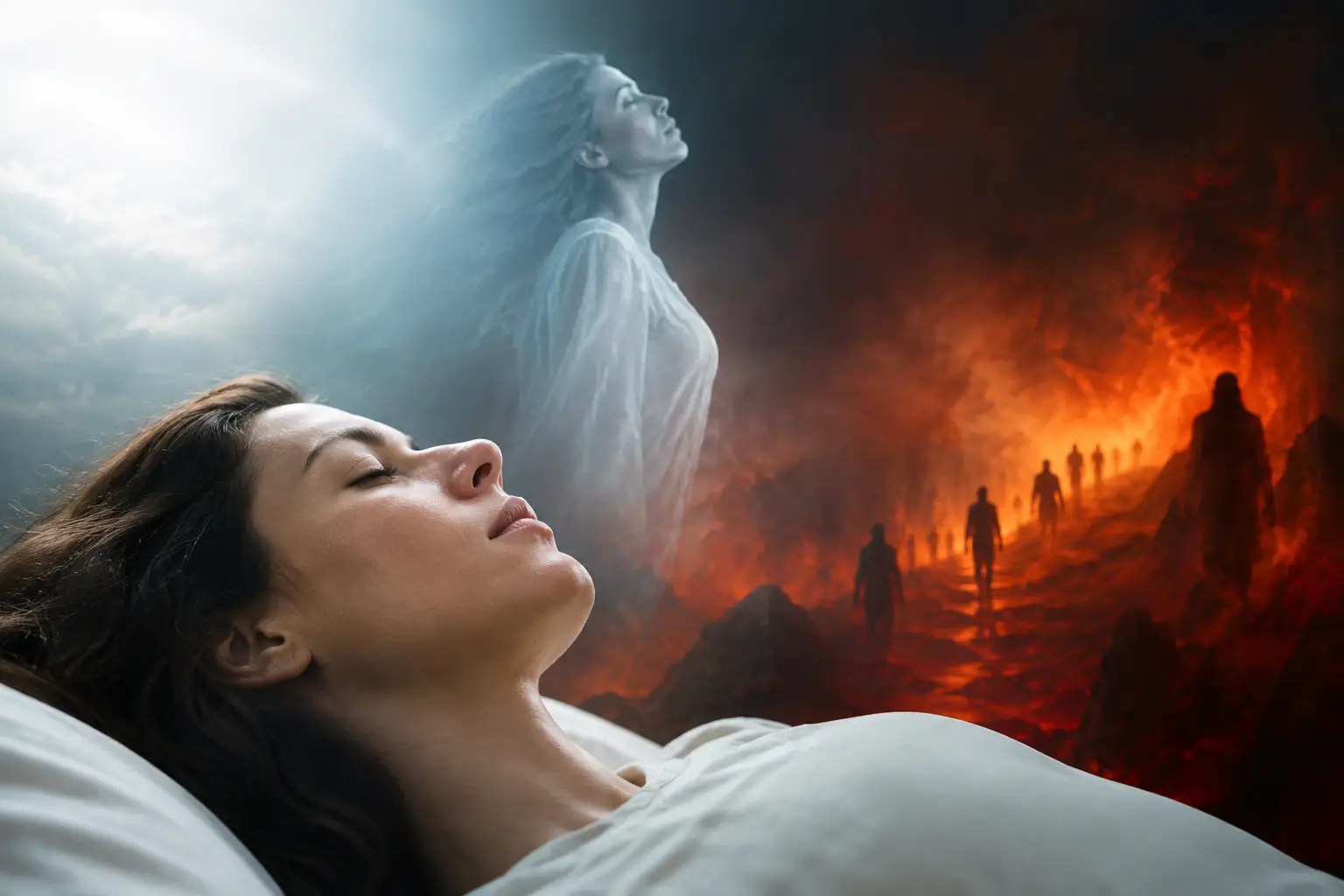

A monitor can go flat. Breathing can stop. The pulse can disappear. Yet the clinical dying process is not one clean, cinematic moment. It is a sequence of bodily changes, medical judgments, and, in some cases, reports that should not be possible if conscious awareness ends when the body fails.
That last point is where public discussion usually breaks down. People mix together dying, coma, ICU delirium, terror, medication effects, and authentic near-death experiences as if they were one category. They are not. The distinction is not semantic housekeeping. It changes what the evidence means, and it can spare frightened people from a devastating mistake: treating a terrifying experience in a living brain as a preview of the afterlife.
The Clinical Dying Process Is Physical and Observable
In medicine, the active dying phase often refers to the period when the body is shutting down, commonly over hours or days. A person may sleep more, become less responsive, eat and drink less, develop cool or mottled hands and feet, and breathe in an irregular pattern. Some breaths may be deep, followed by pauses. Congestion in the throat can create a loud rattling sound that alarms families, even though it does not necessarily mean the person is consciously suffering.
These signs deserve plain language, not euphemism. The body is losing the ability to regulate itself. Blood pressure falls, circulation weakens, kidney output declines, and the pattern of breathing changes as the body approaches its limit. Comfort care exists for a reason: pain, breathlessness, agitation, and family distress are real concerns and should be addressed by qualified clinicians.
But active dying is not identical to clinical death. Clinical death refers to the cessation of effective circulation and breathing. The heart is no longer delivering blood to the brain and organs. In a resuscitation setting, this may be the period after cardiac arrest before circulation is restored, if it can be restored. Medical language can vary by setting, and death determination involves formal standards beyond what a family sees at the bedside. Still, the central fact is straightforward: clinical death is a threshold event, not merely a person becoming very ill, frightened, sedated, or unconscious.
Why the Distinction Matters to NDE Evidence
An authentic NDE occurs during genuine clinical death. Its strongest evidence is not a warm feeling or a beautiful image. It is verified veridical perception: accurate observations later confirmed by people, records, or circumstances that the experiencer could not have accessed through ordinary senses.
That is the load-bearing evidence. A patient reports details from a resuscitation effort, events outside the room, or information later verified despite the absence of functioning ordinary perception. Skeptics may attempt to bury such cases under a pile of general claims about oxygen deprivation, drugs, memory construction, or hallucination. None of those explanations answers the central problem. A hallucination does not reliably deliver independently checkable information from a location the patient could not physically observe.
The clinical dying process therefore matters for more than medical education. It establishes the conditions under which the most consequential reports occur. If the body is in genuine clinical death, and the account contains verified perception, the lazy claim that this was merely a stressed brain has already failed its first evidential test.
This does not mean every unusual report near a hospital bed is an NDE. It means investigators must establish the timeline, the medical condition, the source of later verification, and whether the experience contains features consistent with authentic death-related consciousness. That is how serious inquiry works. It does not begin by calling every dramatic story proof. Nor does it end by calling every anomaly a hallucination.
The Fear Coma Experience Is Not an NDE
Here is the correction the field badly needs. What has often been called a “distressing NDE” is usually not an NDE at all. It is a Fear Coma Experience, or FCE.
An FCE is a terrifying experience generated by a living brain under catastrophe: coma, extreme illness, delirium, fever, trauma, oxygen stress, medication disruption, or overwhelming physiological fear. Its imagery may be grotesque, punitive, chaotic, or hellish. People may report darkness, attacks, imprisonment, monsters, judgment, or unbearable dread. The witness is not lying. The terror is real. But the interpretation is wrong when the event is presented as a trip to an eternal realm of punishment.
The decisive distinction is clinical death. No clinical death, no authentic NDE. And no clinical death means no evidence that a person entered an afterlife hell.
This is reassuring without being evasive. It does not mock people who have endured terrifying medical experiences. It takes their suffering seriously enough to identify it correctly. A brain under catastrophe can produce a fearscape of extraordinary force. That is not a character verdict. It is not divine punishment. It is not a cosmic sentence handed down against a frightened human being on an ICU bed.
The old label “distressing NDE” did real damage because it fused two unlike events. It placed peaceful, verifiable experiences during clinical death in the same bucket as terror imagery arising while the person remained alive. Once those categories are welded together by careless language, skeptics get an easy talking point: all reports must be brain-generated because some reports plainly have brain-generated qualities. That argument succeeds only by mislabeling the evidence.
The Rare Exception: A Welded NDE
There is one complication, and it must be handled precisely. A Welded NDE occurs when someone experiences both a Fear Coma Experience and a genuine NDE during one medical crisis, with no ordinary clock inside the experience to separate them afterward.
Memory can fuse the episodes. A person may recall terror, confusion, or hellscape imagery, and also recall a peaceful separation from the body or verifiable perception during clinical death. The fact that the memories are reported together does not make them the same event. It means two events were welded in recall.
This is where a disciplined investigation becomes essential. Ask what happened before clinical death, what happened during it, and what details can be independently verified. Separate fear imagery from the evidential core. Do not force every memory into a single simplistic narrative just because that is easier for a skeptical commentator or a sensational headline.
A life review belongs only to an authentic NDE during clinical death. It is not an ICU delirium feature, not an FCE feature, and not an effect of terror in a living brain. This boundary matters because the life review is often described as morally profound, lucid, and coherent – the opposite of the fragmented, fear-driven chaos characteristic of an FCE.
What Families Can Take From This
If you are watching someone die, the visible signs can be frightening. Changes in breathing, responsiveness, skin color, and restlessness can make a family feel helpless. The practical first step is to ask the care team what they are seeing and what comfort measures are available. Do not assume a sound or movement means the person is consciously experiencing pain. Ask.
If you are afraid because you heard a hellish account, ask a different set of questions. Was there confirmed clinical death? Was there verified perception? Was the experience a terror-filled episode during coma, illness, delirium, or medical crisis? Those questions do not trivialize the account. They prevent fear from outrunning the evidence.
Don Winner’s Hell Exists, But Only for the Living follows this divide where it leads: hellish terror is real, but it belongs to the living human brain under catastrophe, not to the afterlife. That conclusion is not soft comfort. It is a hard-won correction based on separating events that should never have been treated as identical.
The clinical dying process asks families to face the body’s final limits honestly. The evidence from authentic NDEs asks us to face another possibility honestly as well: death may not be the end of the person we love. Fear has its own biology. But verified perception during clinical death points beyond it.
Want to go deeper?
Don Winner brings decades of intelligence and investigative experience to the biggest question there is: what happens when we die.
In You’re Going to Die Someday, Right? Near-Death Experiences Reveal What Happens Next, he examines the evidence from thousands of near-death experiences to find out what they actually tell us about consciousness, the soul, God, and the afterlife.
In Hell Exists, But Only for the Living, he investigates where our idea of hell came from and who built it, tracing the doctrine back to its human sources.
Buy direct and support the Winner NDE Project. Signed first editions, $17.99 each, shipped by Don Winner.
Buy You’re Going to Die Someday, Right?Buy Hell Exists, But Only for the Living