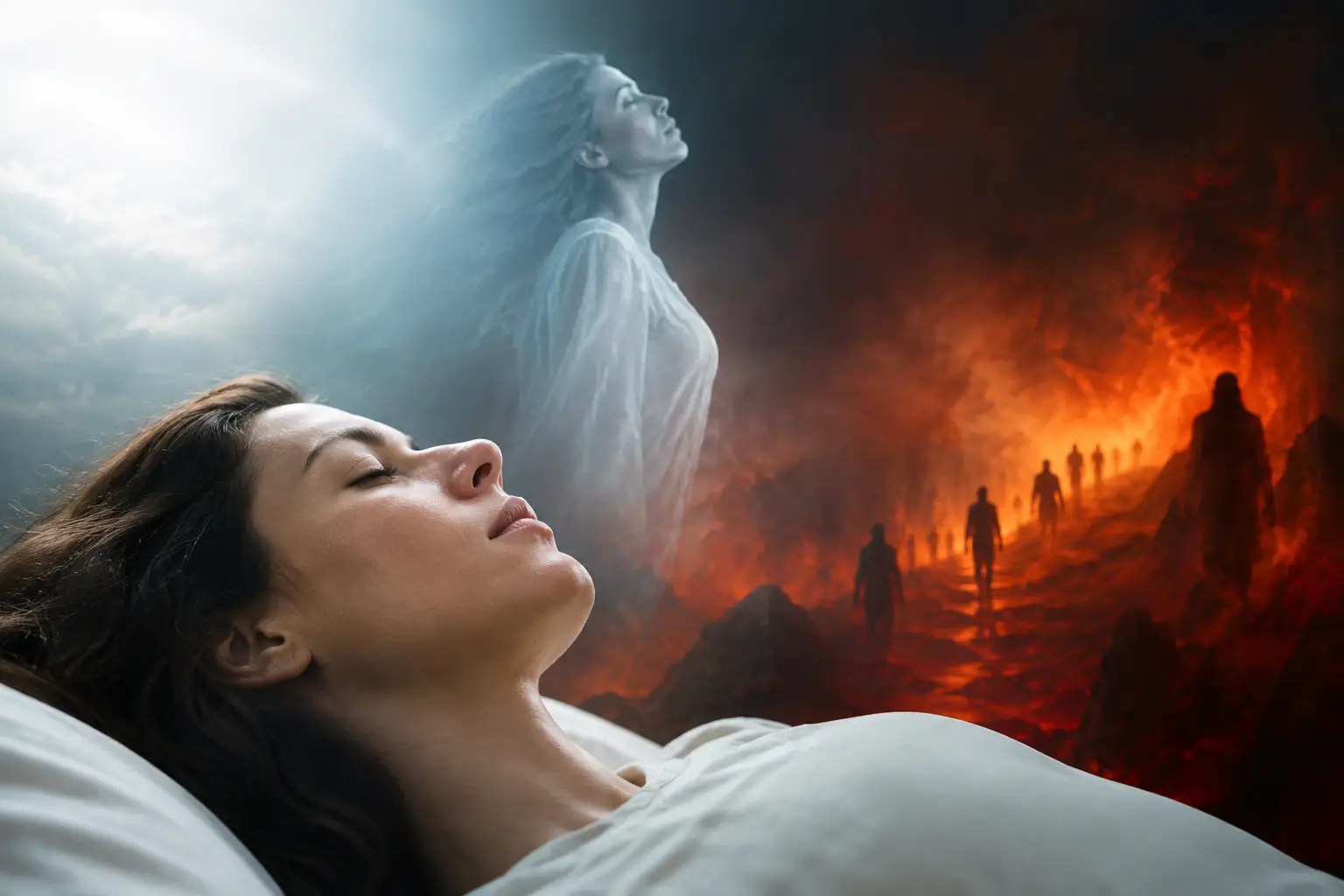

A person reports watching a medical emergency from above, then accurately describes an event, conversation, or object they could not have perceived from the hospital bed. Materialism has one job at that moment: explain how a brain-centered mind obtained the information. That is why the ways NDEs challenge materialism are not sentimental curiosities. They are an evidence problem that reductionism has never solved.
Materialism claims that consciousness is produced by the brain and ends when the brain can no longer produce it. An authentic near-death experience, or NDE, makes a far more disruptive claim through the testimony of the experiencer: the person was conscious during genuine clinical death, outside the body, and sometimes aware of facts later confirmed by others.
Not every dramatic hospital memory is an NDE. That distinction matters. Confusion, dreams, medication effects, ICU delirium, and Fear Coma Experiences have their own explanations and must not be thrown into the same evidentiary bin. The strongest NDE evidence is not a feeling. It is a report that survives investigation.
1. Veridical Perception Breaks the Brain-Only Model
The load-bearing evidence is veridical perception: accurate information perceived while ordinary sensory access was impossible. This may involve details of resuscitation, activity elsewhere in the building, or words spoken beyond the patient’s physical ability to hear. The important point is not that a person felt detached from the body. The important point is that the report can be checked.
Materialism can explain a great deal of human experience by appealing to memory errors, suggestion, partial awareness, and reconstruction after the fact. Those are reasonable hypotheses until the details are independently confirmed and cannot be traced to ordinary perception. Then the explanation becomes an excuse rather than an investigation.
A serious analysis asks hard questions. Was the timing established? Were the details recorded before the witness was coached? Could the patient have seen or heard the information normally? Did independent witnesses confirm it? The more tightly those questions are answered, the less room remains for the claim that a nonfunctioning brain somehow manufactured correct knowledge from nowhere.
This is not an argument from gaps. It is an argument from positive evidence. If consciousness can perceive accurately when the body cannot supply the perception, consciousness is not confined to the body.
2. NDEs Present Lucid Awareness at the Wrong Time
Materialism predicts that as the brain loses oxygen, blood flow, and organized function, experience should become degraded, fragmented, or extinguished. Yet authentic NDEs are commonly described as unusually lucid, coherent, and structured. People report clear thinking, heightened awareness, stable memory, and an unmistakable sense that they were more awake, not less.
A skeptic can say that this clarity was created before the crisis or during recovery. Sometimes timing will be uncertain, and honest investigators should admit it. But materialism does not get to use uncertainty as a universal solvent. Where experience contains veridical information tied to the resuscitation period, the convenient claim that it all happened later loses its force.
The issue is not whether a stressed living brain can generate vivid experiences. Of course it can. The issue is whether it can generate lucid awareness during verified death and furnish it with accurate information unavailable to the senses. Those are different questions, and blending them is how weak explanations survive.
3. Accurate Information Is Not a Hallucination Feature
Hallucinations can be vivid. Dreams can feel real. A frightened brain can produce terrifying scenes with total conviction. None of that is controversial. But hallucinations do not reliably supply externally correct, independently checkable facts that were beyond the person’s access.
That is the line materialist commentary routinely blurs. It treats all unusual inner experience as if it belonged to one category, then applies the weakest explanation to the strongest evidence. A dreamlike memory and a verified observation are not equivalent data points.
This is why case verification matters more than emotional intensity. An NDE account may be moving, but emotion does not establish its evidentiary value. Conversely, a calm, matter-of-fact report can be explosive if its information checks out. The investigator’s task is not to reward the best story. It is to identify what could not have been known through ordinary means.
Materialism has no credible mechanism for consciousness obtaining such information after sensory channels have failed. Repeating the word hallucination does not create one.
4. The Life Review Carries Moral Knowledge, Not Random Noise
An authentic NDE may include a life review, an experience in which a person encounters the consequences of choices made in life with extraordinary moral clarity. It is not merely a replay of memories. Experiencers often describe understanding how their actions affected other people, including effects they had minimized, forgotten, or never recognized.
No clinical death, no life review. That boundary is nonnegotiable. A Fear Coma Experience is generated in a living brain under catastrophe, and it can be horrifying, chaotic, and deeply memorable, but it is not an NDE and it does not contain the genuine life review of an NDE.
Materialism can label the life review a final mental montage, but labels are cheap. The harder question is why these reports so often carry a consistent moral architecture: compassion matters, cruelty is understood from the injured person’s perspective, and the person remains recognizably themselves while seeing more than their ordinary self-serving viewpoint allowed.
Consistency alone does not prove an afterlife. It does, however, create a pattern demanding explanation. Random neural collapse should not be casually presumed to yield recurring, intelligible moral disclosure across people who did not share the same expectations, religion, or language.
5. The Pattern Survives Cultural and Personal Differences
NDEs do not arrive as carbon copies. People interpret unfamiliar realities through their own vocabulary, memories, and cultural setting. That is expected. Human beings report experience in human language.
But beneath those differences, recurring elements appear with striking regularity: separation from the body, continued identity, heightened awareness, encounters, meaningful communication, a boundary, and reluctance to return. A materialist may point to the differences as proof of cultural construction. That argument ignores the more revealing question: why does the underlying structure recur at all?
In intelligence analysis, the goal is not to demand identical witness wording. It is to isolate converging details among independent reports and separate signal from interpretation. The signal in NDE evidence is not that every person draws the same theological conclusion. It is that thousands report consciousness continuing when the physical conditions should make consciousness impossible.
Fear Coma Experiences Are Not Evidence Against NDEs
The old label “distressing NDE” has caused years of needless fear and analytical confusion. It lumps two fundamentally different events together: an authentic NDE during clinical death and a Fear Coma Experience, or FCE, in a living brain under terror, injury, illness, or catastrophe.
FCEs can include hellscape imagery, persecution, darkness, monsters, punishment, and overwhelming dread. The witness is not dishonest. The experience is real to the person enduring it. But its source is the living brain in extreme fear, not the afterlife. Hell is real in this limited and terrifying sense: it is an experience the living brain can create under catastrophe.
A Welded NDE is rarer and more complicated. It occurs when a person has both an FCE and a genuine NDE in one medical event, with no clock in memory separating them. The experiences may later appear fused, which is precisely why careless classification fails. The answer is not dismissal. It is disciplined sorting.
That distinction should reassure readers frightened by hellish accounts. An FCE does not overturn the evidence for peaceful, verifiable NDEs. It reveals what happens when investigators fail to distinguish brain terror from verified death.
Materialism remains attractive because it promises a tidy universe: brain on, mind on; brain off, mind off. NDE evidence is untidy only if the theory matters more than the facts. For anyone facing illness, grief, or the terror of nonexistence, the honest response is neither blind belief nor reflexive dismissal. Demand the verified details. Follow the evidence where it leads. The question of death is too personal, and the evidence is too consequential, to let an outdated assumption make the final ruling.
Want to go deeper?
Don Winner brings decades of intelligence and investigative experience to the biggest question there is: what happens when we die.
In You’re Going to Die Someday, Right? Near-Death Experiences Reveal What Happens Next, he examines the evidence from thousands of near-death experiences to find out what they actually tell us about consciousness, the soul, God, and the afterlife.
In Hell Exists, But Only for the Living, he investigates where our idea of hell came from and who built it, tracing the doctrine back to its human sources.
Buy direct and support the Winner NDE Project. Signed first editions, $17.99 each, shipped by Don Winner.
Buy You’re Going to Die Someday, Right?Buy Hell Exists, But Only for the Living