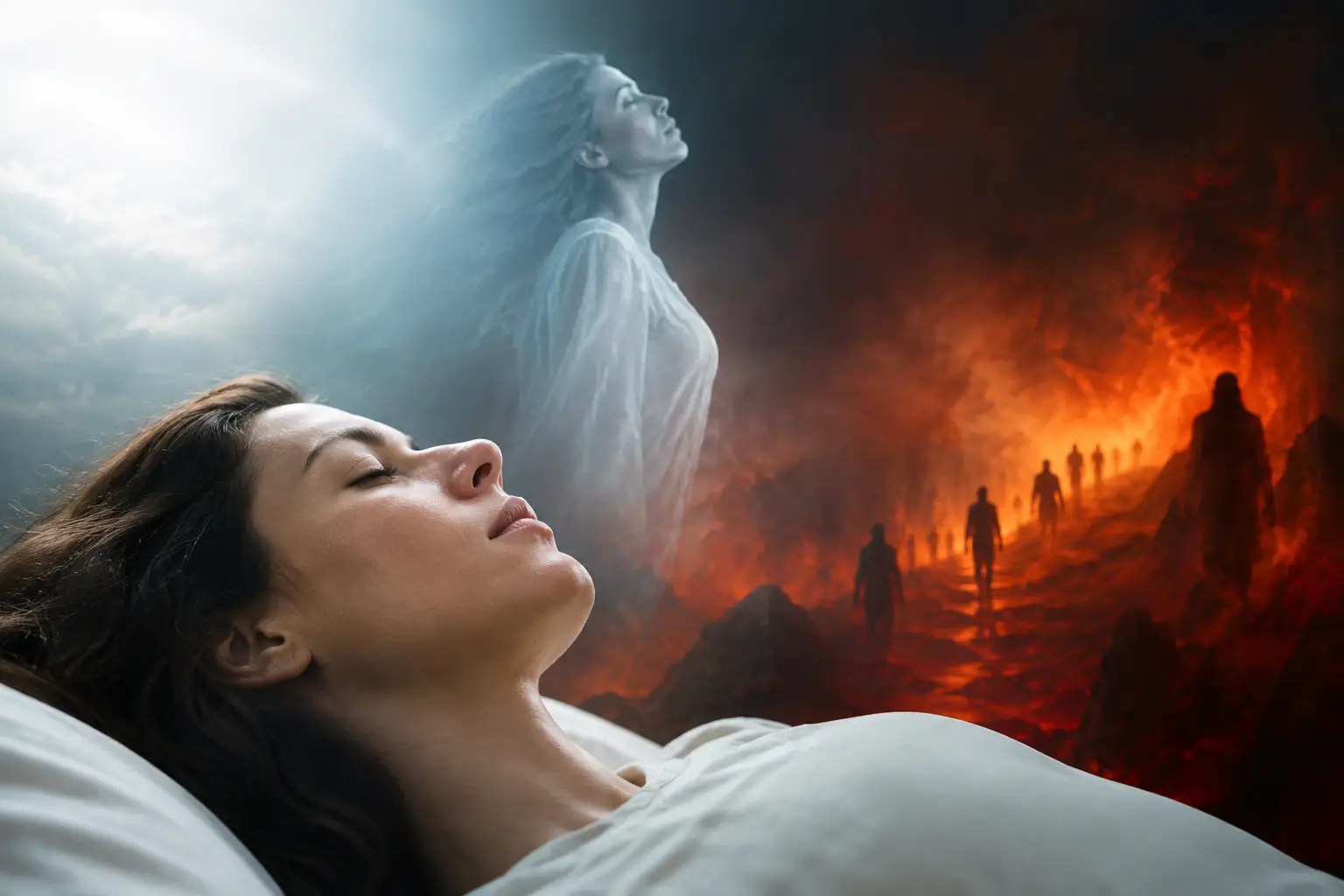

A person wakes in the dark, cannot move, feels a presence nearby, and becomes certain something evil is in the room. Another person survives a medical catastrophe and remembers an infernal prison, torture, judgment, or endless pursuit. Search for sleep paralysis versus coma terror, and the internet often throws both experiences into one frightening pile.
That is a mistake. The fear may be real in both cases. The mechanism, setting, and evidential meaning are not.
Sleep paralysis is a brief collision between waking awareness and the body’s normal sleep paralysis. What people casually call coma terror is usually closer to a Fear Coma Experience, or FCE: terrifying imagery generated by a living brain under catastrophe, severe illness, sedation, delirium, trauma, or prolonged unconsciousness. Neither is an authentic NDE. And confusing either one with an NDE has done real damage to people already frightened about death.
Sleep Paralysis Versus Coma Terror Is the Wrong Comparison
“Coma terror” is understandable language, but it is not precise enough. It makes a terrifying hospital memory sound like a single, mysterious condition. The more useful term is Fear Coma Experience. An FCE identifies what is actually at issue: fear imagery produced while the person is still alive, in a brain under extreme physiological and psychological stress.
Sleep paralysis is different again. It most often appears at the edges of sleep – while falling asleep or waking. During REM sleep, the body is normally immobilized so people do not act out their dreams. In sleep paralysis, awareness returns before that immobilization fully lifts. The person may be unable to speak or move for seconds or minutes. Hallucinations can be vivid: a shadowy intruder, crushing pressure on the chest, footsteps, voices, a sense of being watched.
An FCE does not require that sleep-wake mismatch. It can unfold amid coma, intensive care treatment, fever, infection, organ failure, traumatic injury, medication effects, withdrawal, delirium, or other states of bodily catastrophe. It can seem far longer than sleep paralysis and may form a sustained nightmare world with captors, prisons, grotesque landscapes, punishment, and panic.
These experiences should not be mocked. Nor should they be promoted as a preview of eternal punishment. The first response to a frightened witness should be respect. The second should be classification.
The Key Difference Is the Body’s Condition
A sleep paralysis episode usually occurs in an otherwise ordinary sleep setting. The person is in bed, drifting in or out of REM sleep, often under conditions that increase sleep disruption: exhaustion, irregular schedules, stress, sleeping on the back, or certain sleep disorders. The body is temporarily unresponsive, but the episode is generally brief and self-limited.
An FCE occurs in a far more dangerous medical landscape. The person may be sedated, ventilated, delirious, severely injured, fighting infection, or recovering from a prolonged period of unconsciousness. That does not mean every frightening ICU memory is an FCE, but it means the investigator must begin with the medical record rather than the story’s emotional intensity.
Fear is not evidence of death. Vividness is not evidence of death. A story containing demons, fire, judgment, or terror is not evidence of death.
This is where the old phrase “distressing NDE” fails. It lumps together two opposing categories: an authentic NDE occurring during verified clinical death, and a terror event occurring in a living, compromised brain. The witness may be completely honest in both cases. The interpretation is where the error enters.
Why Both Experiences Can Feel Supernatural
Sleep paralysis has frightened human beings for centuries because it creates a brutal combination: immobility, vulnerability, dream imagery, and partial awareness. A person does not merely dream of an intruder. They feel awake while unable to escape. The brain supplies a threat, and the body supplies the evidence of helplessness.
FCEs can be even more persuasive because medical catastrophe strips away normal orientation. Time disappears. Familiar surroundings are replaced by confusion, pain, frightening procedures, fragmented voices, and long periods without reliable memory. A terrified brain does not need religious instruction to produce hellish imagery. Catastrophe itself supplies the raw material: confinement, pursuit, mutilation, isolation, authority, and hopelessness.
That does not make the experience trivial. It makes it human. Someone who wakes from weeks of severe illness carrying a memory of terror may need serious emotional support, sleep restoration, trauma-informed care, and a chance to tell the story without being ridiculed or spiritually threatened.
But compassion does not require surrendering judgment. The claim that an FCE proves a punitive afterlife is an interpretation with no evidential foundation.
What an Authentic NDE Looks Like Instead
An authentic NDE belongs in a separate file entirely. It occurs during genuine clinical death, not ordinary sleep, not delirium, not sedation, and not a period of frightening but ongoing bodily survival. Its central evidential feature is veridical perception: accurate perception of events, details, conversations, or circumstances that the experiencer could not have obtained through normal senses.
This is the load-bearing evidence. It is why the NDE cannot be dismissed as a vivid hallucination, a fear response, or a dramatic dream. A person may report peace, separation from the body, encounters, expanded awareness, or a life review. But the investigative question is always sharper: what did they accurately perceive while clinically dead that they had no normal way to know?
A life review belongs only to an authentic NDE during clinical death. It does not occur in sleep paralysis. It does not occur in ICU delirium. It does not belong in an FCE. If there was no clinical death, there was no life review.
The contrast matters because authentic NDEs are overwhelmingly marked by coherence, peace, clarity, and meaningful perception, even when the person was not expecting such an event. Fear Coma Experiences are marked by terror, confusion, fragmentation, and imagery that tracks bodily danger and psychological threat. Those are not small stylistic differences. They point to different events.
Can One Person Have Both?
Yes, but the category must remain clean. A Welded NDE is the rare case in which a person has both an FCE and a genuine NDE during the broader arc of a medical crisis, then later remembers them as one fused sequence. With no ordinary clock and a shattered sense of time, the memories can weld together.
This is exactly why sloppy labels fail. If an investigator treats the whole account as one “hellish NDE,” the terror gets falsely assigned to death itself. If a skeptic treats the whole account as delirium, the verified perception gets falsely assigned to a malfunctioning brain. Both sides erase the evidence that does not fit their preferred conclusion.
A proper analysis separates the account into components. What happened before clinical death? What happened during verified cardiac arrest or comparable clinical death? What information was later confirmed? What occurred during sedation, coma, delirium, or recovery? The sequence may be difficult to reconstruct, but difficulty is not permission to abandon standards.
What to Do After a Terrifying Episode
If the event happened around sleep and involved temporary paralysis, recurrent episodes deserve practical attention. Improve sleep regularity, reduce severe sleep deprivation where possible, and discuss frequent or dangerous episodes with a qualified clinician, especially if they occur with overwhelming daytime sleepiness or sudden loss of muscle control.
If the experience followed critical illness, coma, surgery, major trauma, or an ICU stay, do not let anyone weaponize the memory against you. It may have been an FCE, not a sentence, not a prophecy, and not a map of your eternal future. Request the medical timeline if you can. Knowing when sedation, delirium, infection, respiratory distress, or procedures occurred can turn an apparently supernatural horror into an intelligible record of a body in crisis.
Don Winner’s book, Hell Exists, But Only for the Living, takes this question seriously because terror deserves more than a shrug and more than a sermon. The evidence points to a firm but merciful conclusion: hellish experience is real, but it belongs to the living brain under catastrophe.
If you have carried one of these memories for years, do not let its intensity decide its meaning. Fear can be unforgettable without being final.
Want to go deeper?
Don Winner brings decades of intelligence and investigative experience to the biggest question there is: what happens when we die.
In You’re Going to Die Someday, Right? Near-Death Experiences Reveal What Happens Next, he examines the evidence from thousands of near-death experiences to find out what they actually tell us about consciousness, the soul, God, and the afterlife.
In Hell Exists, But Only for the Living, he investigates where our idea of hell came from and who built it, tracing the doctrine back to its human sources.
Buy direct and support the Winner NDE Project. Signed first editions, $17.99 each, shipped by Don Winner.
Buy You’re Going to Die Someday, Right?Buy Hell Exists, But Only for the Living