Another Test of the WNDE Hypothesis
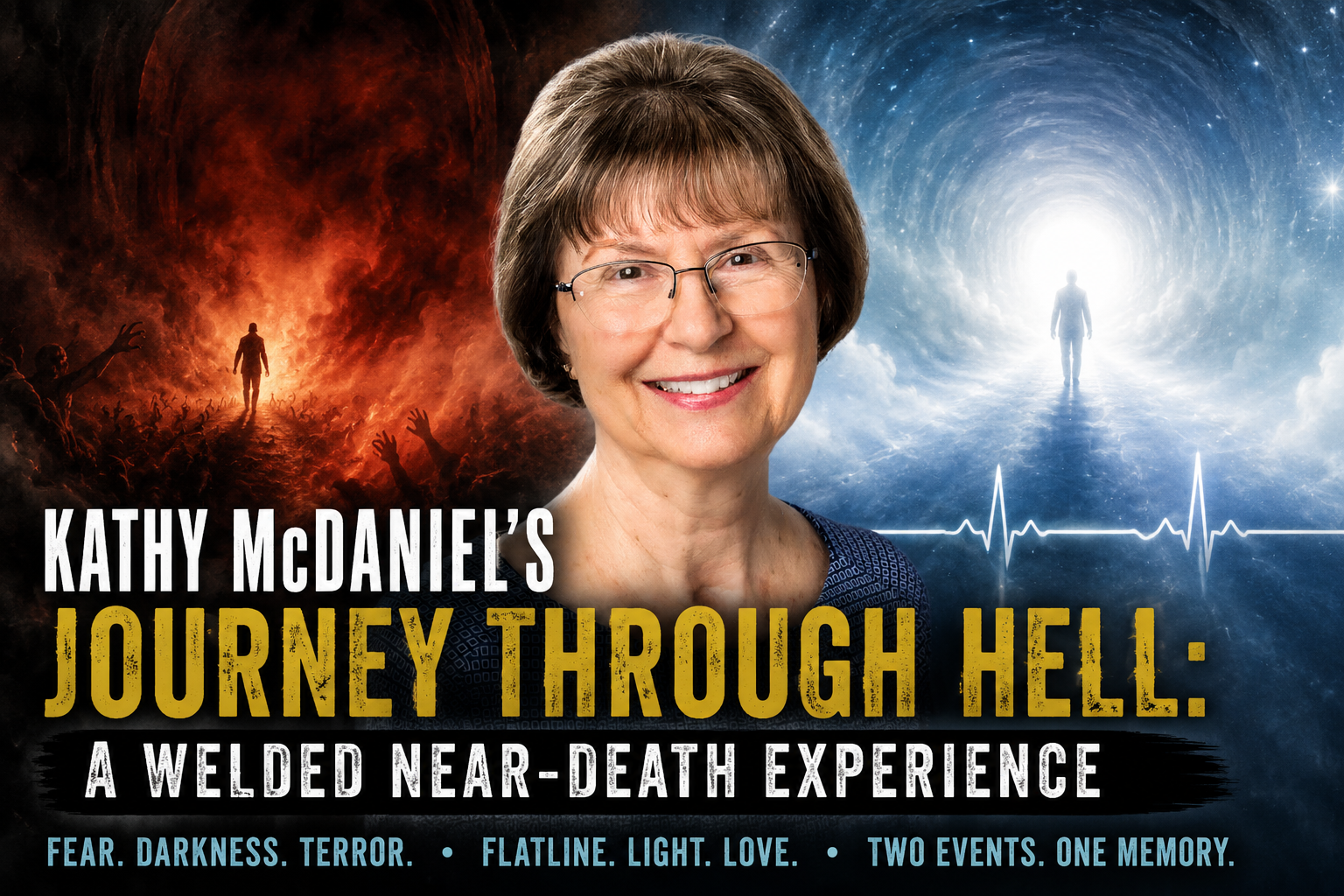
I have been investigating a very specific hypothesis: some experiences commonly described as distressing Near-Death Experiences may actually contain two separate events — a Fear Coma Experience and a Near-Death Experience — later welded together in memory as a single experience, a Welded Near Death Experience (WNDE).
The only way to find out whether that idea holds up is to test it against actual cases. In this case, I also owe a tip of the hat to Michelle Ledbetter. During several of our conversations, Michelle repeatedly asked whether I was familiar with an experiencer named Katherine whose story she thought I should examine. I didn’t make the connection at the time.
Then I came across the account of a “Kathy.” Only after I started digging into it did I realize that Kathy was actually “Katherine” and her last name was McDaniel. I was investigating the case Michelle had been telling me about all along! So Michelle gets the credit for putting this case on my radar. And she was right – it’s an amazing case.
So here’s what happened to Kathy.
The Medical Crisis
Kathy’s experience began with a severe respiratory illness. After months of physical and emotional exhaustion caring for a close friend with leukemia, she traveled to Southern California and contracted what she describes as a particularly severe flu that attacked her lungs. By the time she returned to Washington, she was seriously ill. One night the coughing became so violent that she began coughing up blood. Too weak to make it down three flights of stairs and drive herself anywhere, she called a friend for help.
Her friend came to get her and drove her to a nearby urgent care facility, rather than directly to a hospital. Kathy was deteriorating rapidly during the drive and remembers feeling as though her life were “draining down” from her head toward her feet. She tried to tell her friend that she was dying but could barely whisper the words. When they arrived, her friend opened the passenger door and Kathy lost consciousness. Staff from the urgent care facility came outside, carried her inside and, according to Kathy, could not find a pulse. An ambulance was called, and she was transported from the urgent care facility to the hospital.
Kathy eventually regained consciousness and learned that she had double pneumonia that was progressing into acute respiratory distress syndrome, or ARDS. Her lungs were failing. The doctors determined that they needed to perform a tracheostomy, place her on respiratory support and medically induce a coma while they attempted to treat the underlying illness.
She remembers the doctor explaining what they were going to do. They would give her medication that would put her into what he described as a very deep sleep. She was told that she should not remember anything that happened while she was under. The medication was about to be administered…
Going Under in Fear
Before moving into what Kathy experienced during the coma, there is an important detail about her mental state when she entered it. She already believed she was dying. During the drive to the urgent care facility, she felt her life draining out of her body and tried to tell her friend that she was dying. She then lost consciousness, was told that no pulse could be found, regained consciousness in the hospital, and learned that she was suffering from double pneumonia progressing into acute respiratory distress syndrome. Her lungs were failing.
Now the doctors were telling her that they needed to take away her consciousness deliberately. They would perform a tracheostomy, support her breathing, administer powerful drugs and place her into a deep medically induced coma while they tried to save her life. She was also told that she would remember none of it. From Kathy’s perspective, there was no guarantee that she would ever wake up again. She knew how sick she was, she knew she had already come frighteningly close to death, and she understood that the doctors were now taking extraordinary measures to keep her alive.
That gives us something unusually valuable when examining what happened next: we know something about the condition of Kathy’s mind immediately before consciousness disappeared. She wasn’t peacefully drifting off to sleep. She wasn’t undergoing a routine procedure with every expectation of waking up a short time later. She entered the coma after an escalating medical crisis in which she already believed she was dying. Whatever physiological processes followed, the last waking brain state she carried into unconsciousness was loaded with an unmistakable message: something is terribly wrong, my life is in danger, and I may not come back.
Then the drugs took effect, and everything went black. What Kathy describes after that is where the Fear Coma Experience begins.
The Hellscape
One of the clearest FCE elements in Kathy’s account is the environment itself. She describes becoming aware of a fog swirling around her. The temperature begins to rise until it becomes uncomfortably warm. Then comes a terrible smell. From somewhere inside the fog she begins hearing moaning and shrieking. Before she sees anything clearly, the environment is already communicating danger through heat, smell and sound.
Then a voice emerges from the fog. Kathy describes it specifically as a horrible, demonic voice. It asks her a simple question: “Do you know where you are?” Her mind races, but she says there is only one answer she can come up with: Hell. Whatever the voice does next frightens her so badly that she turns and runs blindly into the darkness. She says she did not care whether she fell into a hole or ran into a wall. Her only concern was getting away from whatever was behind her.
That reaction matters because Kathy is not retrospectively looking back at an unpleasant scene and deciding years later that it must have represented Hell. Within the experience itself, she perceives the environment as threatening, identifies it as Hell, becomes terrified and attempts to escape. The fear is immediate and behavioral. She is not observing suffering from a protected position. She believes she is inside the threatening environment and that she needs to get away from it.
The imagery then expands into scenes built around the same basic architecture. Kathy describes finding herself in a bombed-out city with collapsed buildings, shattered windows, fires, people running and screaming, and no understanding of where she can go to be safe. She hides among large pieces of concrete and tries to determine what is happening, only to hear a horrible metallic scraping sound and see an enormous unfamiliar object moving through the ruins. Again, her response is not curiosity or wonder. She searches for somewhere safer and eventually runs.
This is a strong FCE marker because the environment itself has become the threat. There is no destination she is moving toward and no safe place waiting for her. Heat, darkness, terrible smells, screams, destruction and threatening presences surround her, while her behavior is dominated by the same basic objective throughout: find safety, escape the danger, survive.
No Way Out
Another strong feature of Kathy’s experience is the repeated inability to find safety. The settings change, sometimes dramatically, but the underlying structure remains remarkably consistent: she is somewhere dangerous, she recognizes the danger, and she cannot find a reliable way out.
That description applies just as accurately to Kathy’s physical body as it does to the world she is experiencing. She is critically ill. Her lungs are failing. Doctors have placed her into a medically induced coma because extraordinary intervention is necessary to keep her alive. Somewhere beneath all of the imagery, her living brain is attached to a body in genuine danger, and there is no simple escape from what is happening to it. She cannot wake herself up, get out of the hospital bed or make the illness disappear. Her body is trapped in a life-threatening medical crisis that it must somehow survive.
Inside the experience, that same problem appears again in symbolic form. In the bombed-out city, Kathy suddenly finds herself surrounded by collapsed buildings, shattered windows, fires and people running and screaming. She does not know what has happened or where she is supposed to go. Her immediate response is to take cover between large pieces of concrete, catch her breath and try to determine where she might find somewhere safer. Then she hears a horrible metallic scraping sound and sees the shadow of something enormous moving nearby. The refuge she has found no longer feels safe, so she moves again.
Even changing locations does not solve the problem. Kathy describes the lights going out and then coming back up with an entirely different scene around her. This happens repeatedly. She does not choose these destinations or control the transitions. One threatening environment simply gives way to another, leaving her to confront whatever danger the next setting contains.
The parallel is difficult to miss. In the hospital, her body is in danger and cannot escape its condition. Inside the experience, Kathy is in danger and cannot escape hers. The scenery changes, but the underlying message remains the same: find safety, get away, survive. There is nowhere she can simply step outside the threat because the threat is not ultimately a place. It is the condition of the living body generating the experience.
That is exactly what the Fear Coma Experience model predicts. The brain does not need to understand pneumonia, ARDS, ventilators or medically induced coma in order to recognize the more fundamental biological fact underneath all of them: the organism is in danger. Kathy’s experience translates that threat into a world she can perceive and react to. She is somewhere dangerous. She recognizes the danger. And she cannot find a reliable way out.
Every Sense Says Danger
Kathy’s experience is not frightening because of a single disturbing image or encounter. The threat surrounds her through almost every major sensory channel. She sees darkness, fog, destruction and fire. She feels the environment becoming increasingly and uncomfortably warm. She smells something terrible. She hears moaning and shrieking coming from somewhere she cannot see. Her experience is not simply visual. Nearly everything she can perceive is telling her that she is somewhere dangerous.
The sensory assault continues as the environments change. The fog conceals something threatening and eventually produces the demonic voice that addresses her directly. Elsewhere she sees collapsed buildings, shattered windows, fires and terrified people. She hears screaming and the horrible metallic scraping of something large approaching. What she sees is threatening. What she hears is threatening. What she smells is repulsive. What she physically feels is uncomfortable. Almost every sensory pathway represented in the experience contributes to the fear.
And it keeps coming. Changing locations does not end it. Running does not end it. Hiding does not end it. One frightening environment gives way to another, and the assault simply takes another form. Kathy is not describing an isolated moment of terror embedded within a larger neutral experience. Fear saturates the experience, repeatedly reaching her through sight, sound, smell and physical sensation.
Different scenes. Different threats. Different senses. But wherever Kathy finds herself and however the experience presents itself, the message remains remarkably consistent: danger.
Something in the Darkness
The fear does not remain environmental. Darkness, heat, terrible smells, screams and ruined landscapes are already enough to establish a threatening world, but Kathy’s experience escalates beyond frightening surroundings. Her brain introduces something more frightening than a dangerous place: something inside that place that appears to know she is there.
The first unmistakable example comes from the fog. Kathy is already uncomfortable from the increasing heat, the terrible smell and the moaning and shrieking around her when a voice suddenly addresses her. She describes it as a horrible, demonic voice. It asks, “Do you know where you are?” Kathy’s mind races until she arrives at the only answer that makes sense to her: Hell. The encounter frightens her so badly that her immediate response is escape.
That is an important escalation in the structure of the fear. A fire does not know you are there. A collapsed building does not care about you. Darkness does not pursue you. But an entity that speaks directly to you appears to possess awareness and intent. The danger is no longer simply something Kathy happens to be surrounded by. Something within the environment has noticed her.
The same basic pattern appears again as Kathy moves through other frightening scenes. Threatening figures and presences emerge within environments that are already dangerous. They do not provide comfort, guidance or protection. They add another layer of uncertainty and fear. Kathy is no longer simply trying to survive the places in which she finds herself; she must also contend with what appears to inhabit them.
As a fear experience, the progression makes sense. First the environment is dangerous. Then there is nowhere reliably safe to go. Nearly every sense reinforces the threat. And now the danger acquires a face, a voice and apparent intention. The fear has been ramped up again. Kathy is not merely somewhere terrifying. Something terrifying is there with her.
It Just Keeps Going
One of the most disturbing features of Kathy’s experience is not any particular scene. It is that the experience simply keeps going. She describes being confronted with one frightening situation after another, with little opportunity to understand where she is or what is happening before something else takes its place. At one point she describes the pattern directly: the lights would go out, another scene would appear, and this happened “time and time again.”
That repetition adds an entirely different dimension to the fear. A terrifying event has an ending. You survive it, escape it, or eventually realize that the danger has passed. Kathy is repeatedly denied that relief. Getting out of one situation does not mean she is safe. It simply means she is about to encounter another one. There is no dependable refuge and no point at which she can conclude that the ordeal is finally over.
There is also no opportunity to adapt. If Kathy remained in one threatening environment, she might eventually understand its boundaries, identify where the danger was coming from, or learn how to avoid it. Instead, the rules keep changing. A new environment means new surroundings, new threats and another problem she has to solve. Just as she begins to orient herself, everything can disappear and something else can take its place.
We cannot know how long these individual experiences lasted or reconstruct their actual sequence from Kathy’s memory. Nor do we need to. What matters here is how she remembers the overall experience: prolonged, repetitive and relentless. She remembers being subjected to frightening situations again and again, without knowing what would come next or when any of it would finally stop.
That may be one of the most terrifying elements of the entire account. Fear is one thing. Fear without an apparent ending is something else entirely. There is no rest, no chance to catch her breath, no reliable escape and no assurance that the next moment will be better than the last. Whatever Kathy survives, the experience simply resets and comes at her again.
Fear Creates Motion
There is another pattern running through Kathy’s account that deserves to be pulled out on its own. Fear has a biological purpose. It is not simply there to make an organism feel bad. Fear is designed to produce a response. Something is wrong. Something is dangerous. Do something. Move.
That is exactly what Kathy does throughout the frightening portions of her experience. She does not simply stand in these environments and observe them. When something frightens her, she reacts. She runs. She hides. She searches for shelter. She tries to get away. She moves from one place to another looking for somewhere safer. Again and again, perceived danger is followed by action.
That pattern is especially striking because Kathy is physically incapable of carrying out the normal response. Her body is lying in a hospital bed in a medically induced coma. She cannot get up and run from the danger threatening her body. She cannot leave the hospital. She cannot escape her failing lungs. The ordinary physical machinery through which fear produces purposeful movement is effectively unavailable to her.
But inside the experience, she can move.
When the demonic voice frightens her, she runs into the darkness. In the bombed-out city, she takes cover among the concrete and looks for somewhere safer. When that refuge becomes threatening, she moves again. Other scenes present other dangers, and again Kathy responds by trying to do something about them. The details change, but the underlying sequence remains remarkably consistent: perceive threat, become afraid, move.
This is critically important to the Fear Coma Experience model because it provides a possible explanation for why so much FCE imagery is organized around pursuit, escape, entrapment and desperate attempts to get somewhere else. Fear is not the endpoint of the survival response. Fear is the alarm. The point of the alarm is to make the organism act.
Kathy’s body cannot run. Kathy’s body cannot hide. Kathy’s body cannot find a safer place. Yet throughout the experience she repeatedly does all three. Her physical body lies immobilized while the Kathy inside the experience is constantly trying to escape danger. The survival imperative remains the same even though the arena in which she can respond has changed.
Something is wrong. You are in danger. Move. (Survive).
Fear Is the Dominant Emotion
There is no real ambiguity about the emotional character of Kathy’s experience. She is not describing something merely strange, confusing or uncomfortable. Fear dominates the experience. The environments frighten her, the sounds frighten her, the entities frighten her, and her repeated response is to search for safety or get away from whatever is threatening her.
Her own descriptions make that clear. When the demonic voice emerges from the fog, Kathy says it was “horrible” and that it scared her badly enough to run blindly into the darkness. When she suddenly finds herself in the devastated city, she describes being shocked, disoriented and uncertain where to go or what to do. She searches for cover, hears something threatening approaching, and once again tries to get somewhere safer. The fear is not something being imposed on the account by an outside interpretation. Kathy repeatedly tells us through both her words and her actions that she is afraid.
That distinction matters because frightening imagery and experienced fear are not necessarily the same thing. A person could observe destruction, threatening figures or grotesque imagery without personally experiencing overwhelming terror. Kathy does not. She experiences the environments as immediate threats to herself. She responds to them as though the danger is real, consequential and happening to her.
The persistence of that emotional state may be even more important than any individual moment of terror. Kathy describes the threatening scenarios occurring “time and time again.” The setting changes, the nature of the danger changes, and the sensory details change, but fear keeps returning. She may escape one threat, only to find herself confronting another. There is no dependable emotional reset in which she recognizes that she is safe and the danger has passed.
Taken together, the pattern is difficult to characterize as anything other than sustained fear. Kathy is immersed in threatening environments, assaulted through multiple senses, confronted by hostile presences, repeatedly unable to secure lasting safety, and driven again and again to move in response to perceived danger. Fear is not one feature among many in this portion of her experience. It is the organizing emotion around which almost everything else is built.
The Seam
And then something changes.
Kathy describes the frightening scenes ending and everything becoming dark again. Then a light appears. This light is different from anything she has described before. It is warm and embracing, and she begins moving toward it.
The emotional change is immediate. The fear is gone. Kathy describes feeling overwhelming joy, bliss and love. She feels herself floating and says the experience is so wonderful that she does not want it to end. After everything she has described up to this point, there is no threat to escape from, nothing pursuing her and nowhere else she is trying to go.
She then becomes aware of what appears to be another place. She sees walls and a large open book that seems to contain something she is being shown. Then she looks up and sees someone she knows: her friend who had recently died of leukemia. He no longer looks sick. Kathy remembers how terrible he had looked near the end of his illness, but here he appears healthy, happy and much younger, perhaps around thirty-five years old.
The change could hardly be more complete. The terror stops. The threatening environments disappear. The hostile presences are gone. Kathy is surrounded by warmth, light, joy and love, and standing before her is a friend she knows to be dead.
This is the seam.
Two Completely Different Experiences
This is the critical dividing line in Kathy’s account. Everything we have examined before the seam is organized around fear. Kathy is threatened, trapped, assaulted through her senses, confronted by frightening entities and repeatedly driven to run, hide and escape. The experience keeps finding new ways to frighten her, and Kathy keeps responding exactly as a frightened human being would respond: get away, find safety, survive.
Then it stops.
What replaces it is not simply a nicer version of the same experience. The emotional architecture reverses. Fear becomes peace. Threat becomes welcome. Terror becomes joy. Instead of desperately trying to escape, Kathy suddenly does not want to leave. The environments that had continually placed her in danger disappear, and she finds herself surrounded by warmth, light, love and calm.
That reversal is one of the defining characteristics I have been finding in Welded Near-Death Experiences. While the living brain is producing the fear-based experience, the account contains the characteristics of an FCE. Then comes a dramatic change, and on the other side begin appearing the familiar characteristics associated with an NDE. The experiencer remembers both and reports them together as one extraordinary event. The two experiences become welded together in memory.
There may also be something important about the sheer magnitude of the contrast. Kathy has just endured what she remembers as an extended, relentless hellscape. Fear has been coming at her through nearly every sense. She has been running, hiding and searching for safety without finding lasting relief. Then suddenly it is over. Nothing is chasing her. Nothing is threatening her. She is safe.
After that much terror, relief alone must have been extraordinary. The absence of fear would have been profound. Add warmth, light, love, joy and the appearance of a beloved friend she knows has died, and Kathy does not merely find herself somewhere better. By comparison with everything she has just endured, she has arrived in heaven. Literally. She’s dead now, her fear producing terror brain is offline.
Now we can leave the fear side of Kathy’s account behind. From this point forward, the question changes. We are no longer looking for the characteristics of a Fear Coma Experience. We are looking for the markers of a Near-Death Experience.
Into the Light
On the other side of the seam, Kathy encounters one of the most familiar elements reported in Near-Death Experiences: light. But the significance of what she describes is not simply that something became brighter. The light has an entirely different character from everything she experienced before it. Kathy describes it as warm and embracing. She is not frightened by it. She is drawn toward it.
Then comes the emotional transformation. The fear that dominated the earlier experience is gone. Kathy describes overwhelming joy, bliss and love. There is no threatening voice, no screaming, no desperate search for safety and no need to run. She feels herself floating, surrounded by an experience that is peaceful rather than threatening.
The reversal is almost absolute. Earlier, Kathy’s movements were driven by fear. She moved because she wanted to get away from something. Now she is drawn toward something. Earlier, her surroundings continually gave her reasons to leave. Now she has found somewhere she does not want to leave.
That desire to remain is particularly important. Kathy does not merely report that the new environment is pleasant. She wants the experience to continue. After repeatedly trying to escape from the places she experienced before the seam, she now has exactly the opposite problem: she does not want to go back.
Light. Warmth. Love. Joy. Bliss. Peace. Floating. A desire to remain. The fear-based characteristics that dominated the FCE side are absent, and in their place is a cluster of some of the most recognizable elements associated with Near-Death Experiences.
And Kathy’s NDE has only begun.
The Friend Who Was Already Dead
Then Kathy sees someone she knows.
Standing before her is a close friend who had recently died from leukemia. This is not an unfamiliar figure whom Kathy later decides must have been some kind of spiritual being. She recognizes him immediately. She had known him in life, had helped care for him during his illness, had watched his health deteriorate, and knew that he was dead.
But he does not appear as Kathy last remembers him. Near the end of his illness, leukemia had devastated his body. He had lost his hair and looked terribly sick. The man Kathy encounters now looks healthy. She estimates that instead of appearing as the 53-year-old man who had been dying from cancer, he looks approximately 35. He is happy, looks wonderful, and is wearing a sweater Kathy had given him for Christmas.
That restored appearance is itself familiar territory in NDE accounts involving deceased people. The dead are frequently described not as they appeared during the illness, injury or old age that preceded their deaths, but as healthy, younger and free from the physical deterioration associated with their final days. Kathy’s description fits that pattern remarkably well.
More importantly, there is no ambiguity in Kathy’s mind about who she is seeing or what his status is. She knows this man. She knows he died. In fact, her recognition of him produces an immediate realization. Looking at her healthy, happy friend standing there, Kathy thinks that he apparently does not understand that he is dead.
That thought is about to produce another recognizable NDE element, because Kathy says she never actually speaks it. Her friend responds anyway.
He Heard What She Never Said
As Kathy looks at her deceased friend, she has an immediate thought: he does not seem to realize that he is dead. She knows that he died from leukemia, yet here he is standing in front of her looking healthy, happy and decades younger than he appeared near the end of his life.
Kathy does not say what she is thinking. There is no spoken question and no conventional conversation in which she explains her confusion to him. Nevertheless, her friend appears to understand the thought. Kathy says that he responds by laughing.
The exchange is brief, but Kathy remembers it clearly. She thinks something without speaking, and the person standing before her responds as though he heard her anyway. There is no need to assign more significance to it than Kathy herself gives us. It is simply another element of the experience she reports.
What happens next is more consequential. Her encounter with someone she knows is dead forces Kathy to consider the obvious implication of where she now finds herself.
Then I Must Be Dead Too
Seeing her deceased friend leads Kathy to an unavoidable conclusion. She knows that he died from leukemia. She knows that the man standing in front of her cannot still be alive. If she is standing there with him, then something must also have happened to her.
Kathy realizes that she must be dead too.
What is remarkable is what does not happen next. The realization does not frighten her. There is no sudden panic, no desperate attempt to escape, and no fear about what death means. Earlier in the experience, far smaller threats sent her running for safety. Now she reaches what should be the ultimate conclusion — I am dead — and it produces none of the terror that dominated everything before the seam.
Instead, Kathy is happy. She is surrounded by warmth, joy, love and a sense of peace. Her friend is there, healthy and restored. She has already said that she does not want to leave. The realization that she may be dead does not transform this place into something frightening. If anything, it helps her understand why she is there.
That contrast is difficult to overstate. During the FCE, Kathy behaves as though survival is everything. She runs, hides, searches for safety and repeatedly tries to escape perceived threats. Here, she concludes that the thing she had feared has actually happened: she has died.
And she is perfectly fine with it.
The Life Plan
Kathy is happy where she is. The fear is gone. The hellscape is gone. She is surrounded by warmth, love and joy, reunited with her deceased friend, and has come to a remarkably straightforward realization: her friend is dead, she is there with him, therefore she is dead too. And she is perfectly happy being dead. She does not want to leave.
Then Kathy sees a table with what she describes as a “great big book” lying open about halfway. She has the impression that she is being shown something in that book, something connected to what still lies ahead for her. She cannot remember exactly what she was shown, but she remembers her response: “No, that’s going to be too hard.”
This fits comfortably within another familiar pattern reported in NDEs: the life plan. Experiencers sometimes describe being shown something about the life they have lived, the life still ahead of them, or things they have not yet accomplished. Sometimes the information is extraordinarily detailed while they are there, only to become inaccessible after they return. They remember being shown something. They remember understanding it. They may even remember how they reacted to it. But they cannot bring all of the information back.
That is essentially what Kathy describes. Whatever she sees in that book makes sense to her while she is there. She understands enough to know that it concerns something difficult ahead of her, and she objects. What disappears afterward is the detail. What remains is the knowledge that she was shown something and her immediate reaction to it.
And “that’s going to be too hard” takes on considerably more meaning when we consider what Kathy would be returning to. She is not being asked to leave this peaceful experience and wake up healthy the next morning. Her body is still critically ill. Her lungs are failing. She is in a medically induced coma, dependent upon intensive medical intervention to keep her alive. Returning means going back to that body and everything that comes with surviving what has happened to it.
She does not want to go.
But eventually, Kathy is convinced to return. That distinction matters. She describes a decision. She has reached a place where she feels overwhelming love and joy, believes herself to be dead, is reunited with someone she loves who has already died, and would prefer to remain there. Nevertheless, she ultimately exercises her own free will and chooses to go back.
That choice becomes one of the most consequential moments in her entire account. Kathy has already crossed the seam. The fear-producing ordeal is over. She believes she is dead and has no desire to return to the critically ill body she left behind. Yet when confronted with the life that apparently still awaits her, she makes the decision to return to it.
Kathy chooses life.
When the Timeline Breaks
There is a problem with accounts like Kathy’s that has to be understood before we follow her back into the hospital room. She spent almost three weeks in a medically induced coma. Somewhere within that enormous block of lost ordinary time, she experienced everything we have been examining. What we should not expect her to provide afterward is a reliable chronological map telling us precisely when each experience occurred.
That is particularly important with a Welded Near-Death Experience. The FCE and the NDE represent two radically different experiential states, but Kathy remembers them as parts of the same extraordinary period. She can tell us what she experienced. She can describe the darkness, the heat, the screams, the entities, the running and the fear. She can also describe the warm light, overwhelming love, her deceased friend and the realization that she herself was dead. What she cannot give us are timestamps.
That is why the method I use to examine these accounts does not depend upon the experiencer getting the chronology right. First, I isolate and document the Fear Coma Experience material. I look at what happened while the experience was dominated by fear, threat, escape and survival. Then I look for a seam: a point where the character of the experience changes dramatically. On the other side of that seam, I separately identify and document the Near-Death Experience elements. Only after those two bodies of evidence have been separated do I begin asking what their relationship might have been.
And there is a critical implication here. If Kathy died during her medical crisis and subsequently chose to return, returning to life does not mean returning to consciousness. Those are two completely different events. Her body was still in a medically induced coma. The doctors had placed her there deliberately, maintained that condition as part of her treatment, and would ultimately bring her out of it according to their own medical schedule. The end of Kathy’s NDE therefore gives us no reason to assume that she suddenly opened her eyes and found her family standing around the bed.
Quite the opposite may have occurred. If Kathy returned to life while she remained in the coma, then the living brain capable of producing the Fear Coma Experience was functioning again. She may have dropped directly from the peace of the NDE back into the terror of the FCE. The process could potentially have happened more than once as her condition changed during those weeks. We cannot reconstruct that sequence from her account, and we should not pretend that we can.
That possibility also helps explain why the remembered story can sound chronologically chaotic. Hell can appear to become heaven. Heaven can disappear. Darkness can return. Another frightening scene can begin. The experiencer later stitches those memories together because that is how memory presents them after recovery. The transitions may be real while the remembered order is not.
For that reason, the seam is not a timestamp. It is a boundary between two recognizably different kinds of experience. We can identify what belongs to the FCE. We can identify what belongs to the NDE. But we cannot look at the end of the NDE and automatically declare that the coma ended at the same moment.
The end of Kathy’s coma is a separate event entirely. And unlike the internal chronology of those three weeks, Kathy remembers that moment very clearly.
Back in the Hospital
Eventually, Kathy’s coma actually ends. This time there is no ambiguity about where she is. The lights come up and she becomes aware of people moving around her. The light is painfully bright. She cannot move. She cannot speak. She does not understand what is happening. Then her daughter sees her and announces to everyone in the room, “Mom’s back.”
Kathy has returned to a body that has been through an extraordinary physical ordeal. She has a tracheostomy tube in her throat and cannot talk. She says her weight has fallen to just 86 pounds and she has lost so much muscle mass that she is essentially incapable of voluntary movement. The next day, when the doctor comes in, Kathy says she can blink and move one finger. That is about it.
Her family begins filling in the enormous blank in ordinary time. They tell her she has been in a coma and that her condition had become so grave that the doctors thought they had lost her. Family members had been called in to say goodbye. Her mother tells her about a prayer circle that had formed around the world and tells Kathy that they had brought her back. Kathy, unable to speak, has a very different reaction internally. She does not want to be back.
Surviving the medical crisis is only the beginning. Kathy remains in the ICU for about three weeks and then spends another week in the hospital. Her body has deteriorated so severely that even sitting upright has become a challenge. She describes being strapped into a chair simply so she can begin rebuilding enough strength in her back muscles to support herself.
From there, she is transferred to a physical rehabilitation hospital for another month. The work is relentless and basic. Kathy has to relearn how to crawl. She has to relearn how to button things, talk and swallow. Ordinary physical functions that had once required no thought now have to be deliberately rebuilt. She compares herself to a baby, learning everything all over again.
The experience she has just survived does not end with a miraculous moment in which she opens her eyes and everything is fine. Kathy survives, but survival comes with a long and difficult road back. After almost three weeks in a coma, severe respiratory failure and profound physical deterioration, simply returning to the ordinary world means learning how to inhabit her body again.
The Experience Followed Her Home
Kathy survived the illness. She survived the coma. She endured the rehabilitation and gradually rebuilt a body that had been reduced to 86 pounds and could barely move. But another part of the experience proved much harder to leave behind. The fear came home with her.
Kathy was deeply disturbed by what she remembered. She had experienced what she understood as Hell, and surviving it did not make that memory disappear. Instead, it created a new fear: if this had happened once, what would happen when she eventually died for good? Kathy remembers worrying that she might have to go through “that whole damn Purgatory thing again” before she could reach Heaven. She had escaped the experience physically, but she had no assurance in her own mind that she would never have to experience it again.
Making matters worse, she had almost nowhere to take those fears. When Kathy tried to talk about what had happened, people did not want to hear it. Even her mother responded by asking what Kathy had done to go to Hell. For someone already struggling to understand an experience of prolonged terror, that question carried an awful implication: perhaps what happened to her was deserved.
Kathy describes herself afterward as scared and lost. She had survived an extraordinary medical crisis and returned with memories that she could not explain, surrounded by people who could not help her make sense of them. The physical rehabilitation had professionals, exercises and a defined objective. Her psychological recovery had none of those things. She was left trying to reconcile Hell, Heaven, death and survival largely by herself.
And it did not resolve quickly. Kathy says it took roughly ten years before a series of events finally led her toward people with whom she could begin discussing and understanding what she had experienced. That is an extraordinary length of time to carry fear generated during a few weeks of catastrophic illness.
This is one of the most important consequences of misclassifying Fear Coma Experiences. The experience ends, but the interpretation can remain for decades. If someone believes the terror they experienced was a glimpse of what awaits them after death, then recovery from the medical crisis does not necessarily remove the threat. Death itself can become the trigger. Every thought of eventually dying carries with it the possibility of having to go back.
Kathy survived the coma and eventually rebuilt her body. But the fear lasted much longer. Whatever label we ultimately place on her experience, the psychological injury it left behind was real.
Scoring Kathy’s Fear Coma Experience
With the FCE portion of Kathy’s experience isolated from the NDE material, we can now score it against the nine questions of the Winner FCE Scale. The maximum possible score is 18. A score between 12 and 18 falls into the scale’s highest category: probable, almost certain FCE.
Question One asks whether the experiencer was unconscious, in a coma or in a comatose state during the experience. Kathy receives 2 points. There is no ambiguity here. Her doctors deliberately placed her into a medically induced coma as part of the effort to keep her alive while treating her severe respiratory illness. She remained in that state for almost three weeks.
Question Two asks about the depth of the coma, using the Glasgow Coma Scale as the objective measure. Kathy receives 2 points. We do not have a numerical GCS score, but this is not a case in which we are trying to determine whether an unexplained period of unconsciousness constituted a coma. Kathy’s coma was deliberately medically induced and maintained by physicians. The fact that she was in a coma is established; the missing GCS number does not create meaningful uncertainty about that fact.
Question Three asks whether fear was already present as the person entered the coma. Kathy receives 2 points. She knew she was desperately sick. During the trip to the emergency clinic, she felt as though her life was draining out of her body and tried to tell her friend that she was dying. She collapsed upon arrival. After regaining consciousness, she was told how seriously ill she was and that doctors needed to place her into a coma while they attempted to save her life. She understood that she might survive and she might die. She went under afraid.
Question Four measures the imagery itself. Kathy receives 2 points. Darkness, unbearable heat, terrible smells, screaming and moaning, threatening voices, frightening entities, fire, suffering people and environments she understood as Hell dominate the FCE portion of her account. Fear does not occasionally intrude into an otherwise neutral experience. Fear defines the environment.
Question Five asks whether the experiencer felt trapped or unable to escape. Kathy receives 2 points. Interestingly, Kathy can move within the experience. In fact, she moves constantly. She runs, flees, hides and searches for safety. But none of that movement gets her out. Every attempt to escape simply delivers her into another threatening situation. At one point she becomes so frightened that she runs blindly into darkness without caring whether she falls into a hole or crashes into a wall. She is somewhere dangerous, she recognizes the danger, and she cannot find a reliable way out.
Question Six measures the intensity of the terror. Kathy receives 2 points. Her experience is not merely disturbing or unpleasant. It is relentless. Nearly every available sense is assaulted. When one threat ends, another begins. Frightening entities appear. She repeatedly runs for safety and repeatedly fails to find it. The experience continues to find new ways to frighten her. The scale reserves its maximum score for consuming, escalating terror, particularly when the experiencer believes they are in Hell. Kathy fits that description almost perfectly.
Question Seven asks whether the physical body fought, thrashed, attempted to escape or required restraint during the experience. This is the only question that cannot reasonably be scored. Kathy eventually emerged from the coma so physically depleted that she weighed only 86 pounds and could initially do little more than blink and move one finger. Whether her body attempted to respond physically during earlier portions of the coma is not established by her account, and her profound physical incapacity makes the absence of reported fighting largely meaningless. A brain can scream “move” all it wants; a body physically incapable of responding cannot obey. For that reason, this question remains Unknown rather than being scored against her.
Question Eight measures the aftermath. Kathy receives 2 points. The experience followed her home. She remained frightened by what she had experienced and worried that when she eventually died she might have to endure the same terrifying passage again before reaching Heaven. She struggled to find people willing or able to understand what had happened to her and carried that fear for years. It took roughly a decade before she began finding a framework through which she could meaningfully process the experience. That kind of persistent psychological injury sits squarely in the maximum-score category.
Finally, Question Nine measures lost time and the inability to reconstruct what happened chronologically. Kathy receives 2 points. Almost three weeks of ordinary time disappeared into the coma. She can remember experiences from within that period, but she cannot reliably tell us when they occurred, how long individual episodes lasted or whether the sequence in which she remembers them reflects the order in which they actually happened. That is exactly the temporal disruption this question measures.
Kathy’s final Winner FCE Scale score is therefore 16 out of 18, with the only remaining question classified as Unknown.
More importantly, she scores 16 out of the 16 points that can reasonably be determined from the available evidence. Every measurable component of the FCE signature receives the maximum score. The missing two points concern whether her critically ill and profoundly weakened physical body visibly acted out the experience while she was unconscious. We simply do not know.
The scoring threshold for a probable, almost certain Fear Coma Experience begins at 12. Kathy reaches 16 with one unanswered question.
This is about as clean an FCE score as we can reasonably expect from an account recorded years after the event. The coma is established. The fear going in is established. The hell imagery is overwhelming. The inability to escape is unmistakable. The terror is extreme. The psychological aftermath lasts for years. The chronology is shattered.
On the FCE side of Kathy’s Welded Near-Death Experience, there is very little left to argue about.
Scoring Kathy’s Near-Death Experience
Having already separated and scored the Fear Coma Experience, we can now do exactly the same thing with the material on the other side of the seam. For this portion, we use the Greyson Near-Death Experience Scale, the standard 16-question instrument used to identify and measure NDEs. The maximum possible score is 32. A score of 7 or higher meets the threshold for an NDE.
Question One asks whether time seemed to speed up or slow down. Kathy receives 0 points. Her sense of chronology across the almost three-week coma is badly disrupted, but that is not the same thing as reporting that time itself behaved differently during the NDE. We have no reason to award the point.
Question Two asks whether her thoughts seemed unusually fast. Kathy receives 0 points. Nothing in her account establishes this.
Question Three asks whether scenes from her past came back to her. Kathy receives 0 points. Kathy does encounter what appears to be life-plan material, but she does not describe the conventional retrospective life review measured by this question.
Question Four asks whether she suddenly seemed to understand everything. Kathy receives 0 points. She reaches important realizations during the experience, including the realization that she is dead, but she does not describe the kind of universal or extraordinary knowledge this question is designed to measure.
Question Five measures profound peace or pleasantness. Kathy receives 2 points. This appears immediately on the other side of the seam. The terror disappears and is replaced by warmth, peace, love and an extraordinary sense of well-being. This is not simply the absence of fear. Kathy describes an intensely positive state.
Question Six measures joy. Kathy receives 2 points. Kathy explicitly describes overwhelming joy and bliss. She is so happy in this state that she does not want to leave.
Question Seven asks about a sense of harmony or unity with the universe. Kathy receives 0 points. She describes love, peace and bliss, but she does not specifically describe becoming one with everything or experiencing universal unity. We do not award points for something she did not report.
Question Eight measures an encounter with brilliant or extraordinary light. Kathy receives 2 points. This is one of the clearest features of her NDE. The frightening experience terminates, darkness follows, and then Kathy encounters a qualitatively different light. She describes it as warm and embracing and is drawn toward it.
Question Nine asks whether her senses seemed more vivid than usual. Kathy receives 0 points. Her overall coma experience is extraordinarily sensory, particularly during the FCE, but we do not have enough evidence that heightened sensory perception specifically characterizes the NDE portion. Again, there is no reason to manufacture a point we do not need.
Question Ten measures awareness of events occurring elsewhere, such as observing the physical world from outside the body. Kathy receives 0 points. She does not report watching doctors work on her body, seeing her hospital room from above or obtaining verifiable information about events occurring somewhere else.
Question Eleven concerns scenes or information from the future. Kathy receives 1 point. The large book appears here. Kathy remembers being shown something that seems connected with what still lies ahead in her life, and she remembers responding, “No, that’s going to be too hard.” She cannot remember the information itself after returning. There is enough here to score the element, but not enough detail to justify pushing it to the maximum.
Question Twelve measures separation from the physical body. Kathy receives 1 point. She describes herself floating, moving toward the light and being drawn toward it. Her mode of movement is noticeably different from the running and fleeing that characterize the FCE. However, she never gives us the strongest form of the classic out-of-body report: observing her own physical body from an external position. One point is therefore the appropriate conservative score.
Question Thirteen asks whether she seemed to enter another, unearthly world. Kathy receives 2 points. She encounters the warm light, finds herself in a radically different environment, encounters someone she knows is dead and ultimately realizes that she herself is dead. By her own understanding of the experience, she is no longer in the ordinary physical world.
Question Fourteen concerns encountering a mystical being or presence. Kathy receives 0 points. We could potentially argue around the edges of this one, but there is no reason to do so. Her deceased friend is better and more specifically captured by the next question.
Question Fifteen measures encounters with deceased or religious figures. Kathy receives 2 points. This is exceptionally strong. Kathy encounters a specific friend whom she personally knew had died from leukemia. She recognizes him immediately. Moreover, he no longer appears ravaged by the disease that killed him. He appears healthy, happy and considerably younger.
Finally, Question Sixteen measures reaching a boundary or point beyond which return might not be possible. Kathy receives 2 points. In her case the boundary is expressed as a decision rather than a physical gate, river or doorway. She is happy where she is and does not want to leave. She is shown something concerning the life still ahead of her, protests that it will be too difficult, and ultimately makes the decision to return.
Kathy’s final Greyson Scale score is 16 out of 32.
That number needs some perspective. The threshold for identifying an NDE on the Greyson Scale is only 7. Kathy scores 16, more than twice the required threshold, and she does it without receiving a single speculative point. Eight of the sixteen questions receive zero because the corresponding element either is not present or cannot be established from her account. Where the evidence is marginal, we score conservatively. Where an element is absent, we simply give her nothing.
She does not need those points.
The NDE signature is already unmistakable. Profound peace. Overwhelming joy and bliss. Warm, embracing light. Movement independent of ordinary physical locomotion. Entry into another realm. An encounter with a specific deceased friend restored to health. Information concerning what apparently remains ahead in her life. A decision about whether to remain or return.
And now the two scores can be placed beside one another.
Kathy scores 16 out of 18 on the Winner FCE Scale, with the remaining question Unknown.
Kathy scores 16 out of 32 on the Greyson NDE Scale, against a threshold of only 7.
That is the central finding of this investigation. We did not begin by deciding which experience Kathy had and then search her story for evidence supporting that conclusion. We took the account apart. We isolated the fear material and measured it independently. Then we crossed the seam, isolated the NDE material and measured that independently.
Both survive the test.
Kathy did not have a Fear Coma Experience instead of a Near-Death Experience. She did not have a Near-Death Experience instead of a Fear Coma Experience.
She had both.
That is a Welded Near-Death Experience.
Summary and Conclusion
Kathy’s account contains two remarkably different experiences occurring during the same catastrophic medical crisis. She entered a medically induced coma critically ill with double pneumonia and ARDS, fully aware that she might die. She went under afraid. What followed was an extended experience dominated by exactly that emotion: darkness, oppressive heat, horrible smells, screaming, threatening voices, frightening entities, fire, suffering and repeated attempts to escape. Again and again, something frightened Kathy and caused her to move. She ran, hid and searched for safety, but the danger never really ended. She was somewhere dangerous, she recognized the danger, and she could not find a reliable way out.
Against the Winner FCE Scale, Kathy scores 16 out of 18, with the only remaining question Unknown because we do not know whether her profoundly weakened physical body attempted to act out the experience. Every FCE element that can reasonably be measured receives the maximum score. This is an exceptionally strong Fear Coma Experience.
Then comes the seam, and virtually everything changes. The Hell experience stops. Kathy encounters a warm, embracing light and experiences peace, joy, bliss and overwhelming love. She no longer wants to escape; she wants to remain. She encounters a close friend who she knows has died from leukemia, now appearing healthy and younger. His presence leads Kathy to the obvious realization that she must be dead as well, yet that realization produces no fear. She is happy to be there.
Kathy is then shown what appears to be information concerning the life still ahead of her. She cannot remember the details afterward, but she remembers objecting that it would be too hard. Eventually she exercises her free will and agrees to return. Measured independently against the Greyson NDE Scale, this portion of Kathy’s account scores 16 out of 32, more than twice the accepted threshold of 7 for identifying an NDE.
That gives us the central finding: the same account independently produces an exceptionally strong FCE score and an exceptionally strong NDE score. We did not have to force either result. We simply separated the two clusters of experience at the seam and measured each against the appropriate scale. Kathy did not have an FCE instead of an NDE, nor did she have an NDE instead of an FCE. She experienced both.
We cannot reconstruct exactly when these events occurred during Kathy’s almost three weeks in a medically induced coma, and we do not need to. Returning from death would not necessarily mean immediately waking up. If Kathy returned to life while the doctors were still maintaining the coma, she may have dropped straight back into the fear experience. The memories could have alternated, overlapped and ultimately become welded together without preserving a reliable physiological timeline.
Eventually, the doctors ended the coma on their schedule. Kathy emerged profoundly debilitated, weighing only 86 pounds, unable to speak because of the tracheostomy and initially capable of little voluntary movement. Weeks of hospitalization and rehabilitation followed. The psychological consequences lasted much longer. Kathy remained frightened that when she eventually died she might have to pass through the terrifying experience again before reaching Heaven.
And that is why separating these experiences matters. If the entire account is labeled a “distressing NDE,” then Hell becomes part of Kathy’s experience of death. The WNDE model produces a very different explanation. The fear, threat, entrapment and relentless attempts to escape belong to the living brain fighting for survival. When that process ends, the entire character of the experience changes: fear becomes peace, terror becomes love, escape becomes a desire to remain, and Hell becomes Heaven.
Kathy went through Hell while she was alive. When she died, everything changed. She experienced both sides, survived, and remembered them welded together as one extraordinary event. That is a Welded Near-Death Experience.
Want to go deeper? Don Winner brings decades of intelligence and investigative experience to the biggest question there is: what happens when we die.
In You’re Going to Die Someday, Right? Near-Death Experiences Reveal What Happens Next, he examines the evidence from thousands of near-death experiences to find out what they actually tell us about consciousness, the soul, God, and the afterlife.
In Hell Exists, But Only for the Living, he investigates where our idea of hell came from and who built it, tracing the doctrine back to its human sources.
Get your copy of You’re Going to Die Someday, Right? or Hell Exists, But Only for the Living.