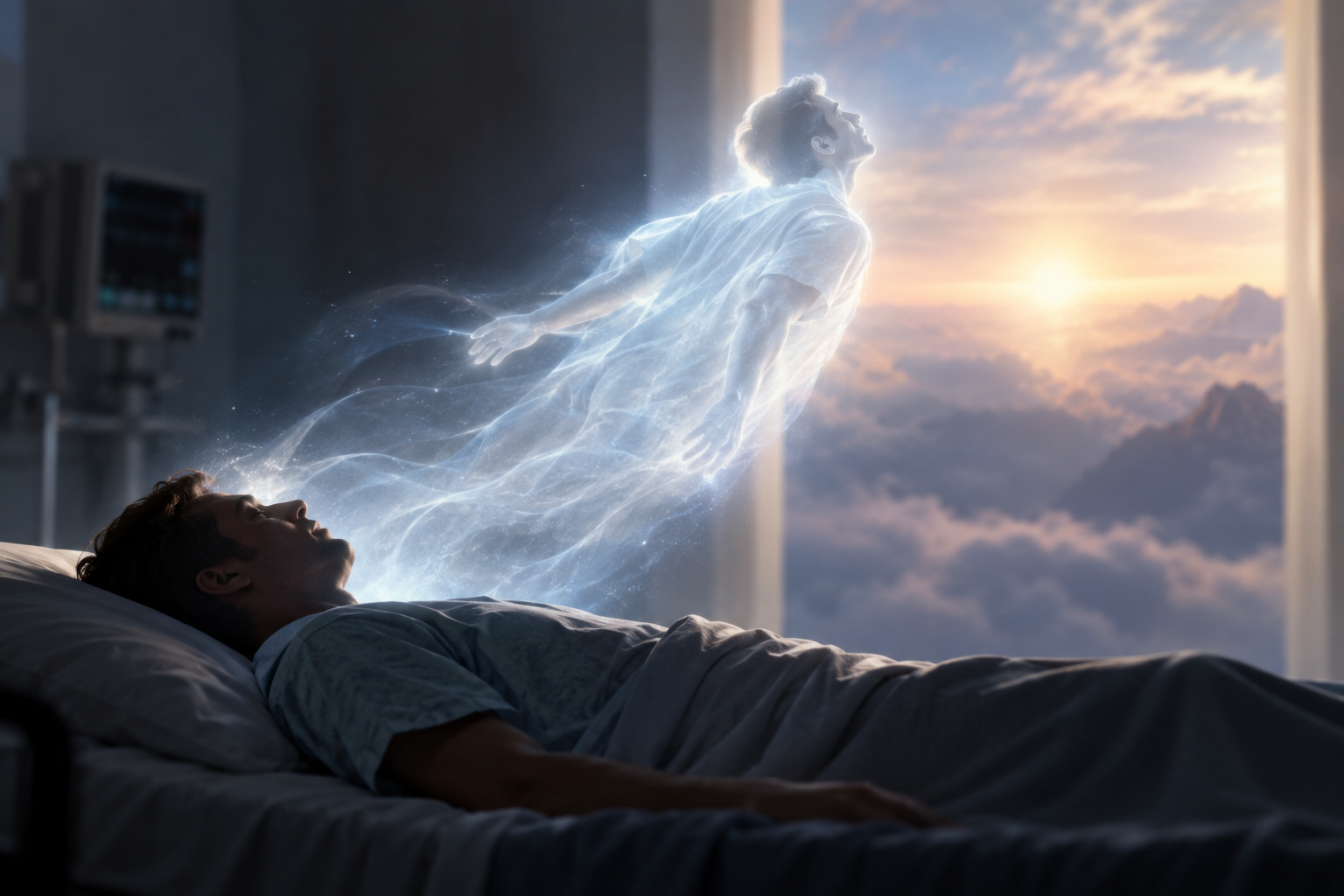

A dying man meets his grandmother, who tells him that his sister has died. He did not know it yet. A woman is greeted by a man she later identifies in a family photograph as an uncle who died before she was born. These are not decorative details added to a comforting story. They are the reason why NDEs feature deceased relatives deserves an evidential answer, not a reflexive psychological one.
Across near-death experience reports, deceased relatives commonly appear as greeters, guides, or simply recognizable presences at the threshold of another reality. Skeptics call this wish fulfillment. That explanation sounds tidy until it meets the actual pattern: unexpected visitors, relatives the experiencer never knew, accurate information learned later, and repeated reports from cultures that disagree about almost everything else.
The question is not whether grief can produce vivid mental imagery. Of course it can. The question is whether grief explains an encounter that contains information unavailable to the person at the time. It does not.
Why NDEs Feature Deceased Relatives: The Pattern
Authentic NDEs are reported during clinical death, when the person has left the body behind. Their content is not random. Again and again, experiencers describe a transition into an ordered environment, encounters with beings or loved ones, an overwhelming sense of recognition, and a powerful reluctance to return.
Deceased relatives fit this pattern because they are often reported as the first familiar faces encountered. Their role is practical as much as emotional. They calm the newcomer, communicate that death has not erased identity, and make clear that the person is entering a place where relationship continues.
That does not mean every NDE unfolds like a family reunion. Some experiencers report a luminous presence rather than a particular person. Some meet friends, spouses, or people who seem known without being immediately identifiable. Others report no deceased relatives at all. Serious investigation does not force every account into one script.
But variation is not the same as chaos. The recurring appearance of deceased relatives is one of the most stable features in a massive body of reports. The people differ. The larger message does not: death is not experienced as abandonment into nothingness.
Recognition Is Often More Than Visual
Many experiencers say they recognized a deceased relative instantly, even when the person appeared younger, healthier, or unlike the last physical version they remembered. A grandfather who died frail may appear vigorous. A parent may look decades younger. In some accounts, there is little conventional seeing at all, yet the identity is unmistakable.
That feature frustrates simplistic explanations. If the event were merely the replay of a stored memory, why would identity remain certain while the appearance changes? The reports suggest that recognition in an NDE is direct. The experiencer does not work through a facial-recognition problem. They know.
This is also why arguments about expectation routinely miss the target. An experiencer may expect to see one person and encounter another. They may be greeted by someone whose death was unknown to them. They may meet a relative whose existence was concealed by family history. Wish fulfillment does not usually surprise the person doing the wishing.
The Cases Skeptics Cannot File Away
The strongest NDE evidence is verified veridical perception. This is the load-bearing discriminator: accurate perception or information acquired while the person is out of the body, which the dying body could not have supplied. It is the fingerprint that timestamps genuine NDE content.
When deceased-relative encounters carry independently confirmed information, the hallucination claim fails at the point of contact with evidence. A hallucination can be emotional, elaborate, and sincere. It cannot reliably report facts the experiencer did not possess.
There are several recurring forms of this anomaly. An experiencer may learn during the NDE that a loved one has just died, then return to find the news confirmed. Another may identify a previously unknown relative through a later photograph or family conversation. A child may describe a deceased family member whose name and role were not part of the child’s available knowledge.
Each case requires investigation. Family stories mutate. Memories are reconstructed. Dates matter. Who knew what, and when? Was the identification recorded before the information was revealed? Could the detail have been acquired normally? These are not hostile questions. They are the questions that separate evidence from sentiment.
Yet skeptics often demand perfection from every individual report while granting extraordinary flexibility to their own explanation. If a case is accurate, it is coincidence. If the relative was unknown, it was cryptomnesia. If the timing is striking, it was unconscious inference. If the witness is clear and consistent, memory must have changed later. A theory that can absorb every possible outcome predicts nothing.
An investigator should do the opposite: follow the facts that resist easy disposal.
Why Familiar Faces Matter
The appearance of deceased relatives carries a deeper implication than comfort alone. It preserves personhood. The experiencer is not told, in abstract language, that survival is possible. They encounter someone whose continuing identity appears intact.
That is a direct challenge to the materialist claim that a person is only a temporary output of living tissue. If the dead appear as recognizable people, retain relationship, and sometimes convey verifiable information, then the survival question is no longer philosophical decoration. It becomes an evidential problem.
The family-centered character of many reports also makes human sense. Death terrifies people partly because it seems to rupture every bond at once. NDE accounts repeatedly counter that fear with a particular image: the dead are not erased, and love is not treated as a chemical residue that expires with a body.
This should not be reduced to a sales pitch for any religious system. NDE reports do not reliably mirror denominational expectations. People from different backgrounds report deceased relatives, acceptance, communication without speech, and a reality that feels more vivid and coherent than ordinary life. The overlap is too persistent to dismiss as borrowed theology.
The Wish-Fulfillment Argument Has a Fatal Weakness
The skeptic’s preferred explanation has emotional appeal because it sounds humane: facing death, the mind gives people what they most want. But the evidence does not consistently behave that way.
Experiencers do not always meet the person they most miss. Some encounter relatives they disliked, distant ancestors, or unknown family members. Some are told it is not their time and are sent back against their wishes. Some return with difficult moral insight, not uncomplicated reassurance. Authentic NDEs can be loving without being sentimental.
More importantly, wish fulfillment explains desire, not knowledge. It cannot explain a later-confirmed death, an unknown relative correctly identified, or veridical information gathered outside the body. Those cases do not merely add color to the subject. They expose the weakness of the reductionist account.
None of this requires pretending every story on the internet is equally probative. It is not. The field needs careful timelines, medical documentation, contemporaneous notes, corroborating witnesses, and a willingness to exclude weak claims. That standard strengthens the case. It does not weaken it.
What This Means for Grief
For someone grieving a parent, spouse, child, or friend, no article can substitute for the person who is gone. Evidence should never be used to rush grief, silence pain, or demand that someone feel reassured on schedule.
But the recurring testimony matters. Thousands of people who expected oblivion report continuity. Many report being met. And the best cases include details that cannot be honestly waved away as a private dream inside a failing body.
The deceased relatives in NDEs may be telling us something both radical and deeply familiar: the people we love are not reduced to photographs, ashes, and memories. Grief remains real because love remains real. But the evidence gives us reason to believe that death does not get the final word.
Want to go deeper? Don Winner brings decades of intelligence and investigative experience to the biggest question there is: what happens when we die.
In You’re Going to Die Someday, Right? Near-Death Experiences Reveal What Happens Next, he examines the evidence from thousands of near-death experiences to find out what they actually tell us about consciousness, the soul, God, and the afterlife.
In Hell Exists, But Only for the Living, he investigates where our idea of hell came from and who built it, tracing the doctrine back to its human sources.
Get your copy of You’re Going to Die Someday, Right? or Hell Exists, But Only for the Living.