
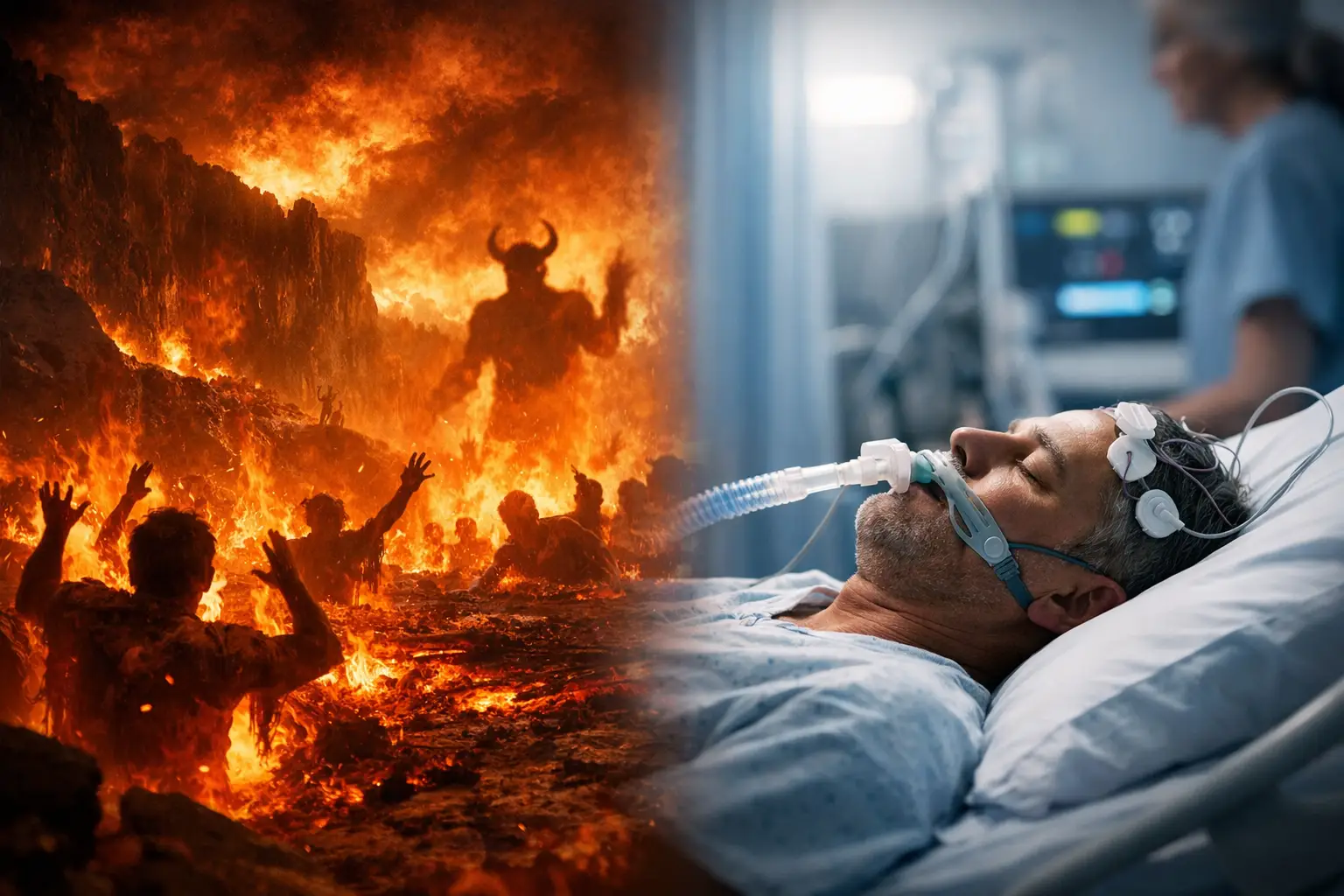
A person wakes from a catastrophic illness convinced they were tortured, judged, imprisoned, or dragged through a landscape of fire. Another person is clinically dead, later reports peace, clarity, separation from the body, and details that should have been impossible to know. Religious hell versus coma terror becomes terrifying only when those two radically different events are shoved into the same category.
They do not belong together. The first can be a Fear Coma Experience, or FCE: a living brain under extreme threat, generating terror with the force of total reality. The second is an authentic NDE: an experience during genuine clinical death, sometimes carrying verified veridical perception that survives serious investigation. Calling both events “near-death experiences” has created decades of needless fear and a major research error.
The correction matters personally. If you were raised to fear eternal punishment, a horrifying account from an ICU or coma can sound like confirmation. But terror is not proof of theology. It is evidence that human beings in catastrophe can experience terror.
Religious Hell Versus Coma Terror Is a Category Error
Religious doctrine presents hell as an enduring destination after death, ordinarily tied to judgment, sin, or divine punishment. It makes a sweeping claim about the fate of the person once bodily life has ended.
An FCE makes a different claim entirely. The witness was alive, though perhaps deeply unconscious, delirious, medically unstable, sedated, deprived of ordinary orientation, or close to death. The experience may be hideous and unforgettable. The witness is not lying, exaggerating, or spiritually inferior. But the event occurred in a brain and body under catastrophe, not after death.
That distinction is not semantic cleanup. It is the whole case.
A living person can experience a nightmare so convincing that it reorganizes a lifetime of belief. Extreme fear has always recruited familiar images: prisons, monsters, darkness, accusing figures, torture, filth, falling, pursuit, and fire. In a religious culture, hell language supplies ready-made imagery. In another setting, the imagery may be political imprisonment, military attack, predatory animals, hostile spirits, or an endless medical nightmare. The terror is real. The interpretation is the disputed layer.
Religious readers often make an understandable leap: “It felt eternal, therefore it was eternal.” But duration inside a terror state is not a stopwatch. Catastrophic consciousness does not report time cleanly. A brief interval can feel endless. That is precisely why intensity cannot establish location, metaphysical status, or permanent destiny.
What Separates an FCE From an Authentic NDE
Winner NDE uses three terms because vague language has failed readers.
An authentic NDE occurs during verified clinical death. Its evidential core is not a pleasant feeling. It is the recurring pattern of lucid awareness, separation from the body, and, in the strongest cases, veridical perception – accurate information later confirmed that the experiencer could not have obtained through normal bodily senses. That is the load-bearing anomaly. It is why reductionist explanations repeatedly come up short.
A Fear Coma Experience is different by definition. There is no death. The individual is living through a crisis state, and the content is fear-dominated: menace, punishment, helplessness, attack, confinement, grotesque transformations, or damnation. Older discussions often call these reports “distressing NDEs.” That label is wrong because it quietly assumes the terrifying segment occurred in death. It may have occurred near death, but near is not the same as during.
Then there is the rare Welded NDE. This occurs when one person undergoes both events in the same overall medical emergency: an FCE while alive and a genuine NDE during clinical death. With no ordinary clock and with memory reconstructed after a crisis, the two can fuse into a single remembered ordeal. That fusion explains why some accounts contain sharply incompatible material: terror imagery from a living brain alongside the evidential markers of an authentic NDE.
A Welded NDE is not a compromise theory. It does not say that an NDE is partly brain terror. It says two distinct events happened to the same person and were later welded in memory. Investigators must separate the strands instead of declaring the whole account either heavenly or hellish.
The Questions That Actually Matter
The responsible questions are concrete. Was there verified clinical death? What does the medical record establish about timing? Did the report include perceptions later independently confirmed? Were terror images reported during coma, sedation, delirium, or fluctuating consciousness? Is the account a unified event, or does it show evidence of a Welded NDE?
These questions may feel less dramatic than a story of demons or flames. They are also more useful. Fear spreads fast because it needs no evidence standard. A frightening narrative, repeated often enough, becomes a weapon against vulnerable people. Investigation must be tougher than that.
Why Hell Imagery Is So Persuasive
Hell imagery has unusual psychological power because it seems to explain its own vividness. A person says, “I saw flames and punishment,” and listeners assume that flames and punishment prove hell. Yet this is circular reasoning. The imagery is treated as proof of the conclusion already supplied by the imagery.
Human cultures have long given suffering a geography. Under fever, injury, grief, intoxication, isolation, and medical crisis, the mind does not produce random scenes alone. It produces scenes shaped by danger, memory, expectation, and the oldest human language of threat. That does not make an FCE trivial. It makes it intelligible.
The hard truth is also the reassuring one: an FCE can be emotionally devastating without being a report from an eternal realm. A survivor may need trauma-informed care, patience, and permission to talk about what happened without being told it was divine sentencing. Religious shame can deepen the wound when the event is framed as deserved punishment.
No investigator should insult a witness by saying, “It was only in your head,” as though that ends the matter. An FCE happened to that person. It can leave real scars. The proper conclusion is narrower and more humane: the terror was experienced by a living person under catastrophe, and it does not establish that they were condemned after death.
The Evidence Does Not Support a Hell Afterlife
The claim that hell is real but only for the living is provocative because it rejects two easy answers at once. It rejects the materialist habit of flattening every extraordinary report into meaningless neural noise. It also rejects the religious shortcut of labeling every terror report a glimpse of eternal punishment.
Evidence demands discrimination. Authentic NDEs deserve serious attention because verified perception during clinical death is not explained away by calling it a hallucination. FCEs deserve serious attention because terror under medical catastrophe is real, medically relevant, historically persistent, and capable of borrowing religious language. Treating them as one phenomenon serves neither truth nor the people who lived through them.
This is the central argument of Don Winner’s Hell Exists, But Only for the Living: hell did not begin as reliable knowledge of the dead. It began in the terror capacities of the living human mind, especially under conditions of catastrophe. That conclusion does not minimize suffering. It removes a burden that countless people were taught to carry.
Fear Is Not a Verdict
If a story of coma terror has lodged in your mind, do not let its emotional force do the work of evidence. Ask whether death was established, whether the account contains independently verified perception, and whether its frightening content fits an FCE instead. Those questions will not erase someone else’s pain. They may keep you from borrowing someone else’s terror as a prophecy about your own death.
The most useful response to fear is not blind reassurance. It is a clean distinction: hellish terror belongs to the living brain in crisis; an authentic NDE belongs to verified death. Once those categories are no longer confused, the old threat loses much of its power.
Want to go deeper? Don Winner brings decades of intelligence and investigative experience to the biggest question there is: what happens when we die.
In You’re Going to Die Someday, Right? Near-Death Experiences Reveal What Happens Next, he examines the evidence from thousands of near-death experiences to find out what they actually tell us about consciousness, the soul, God, and the afterlife.
In Hell Exists, But Only for the Living, he investigates where our idea of hell came from and who built it, tracing the doctrine back to its human sources.
Get your copy of You’re Going to Die Someday, Right? or Hell Exists, But Only for the Living.