
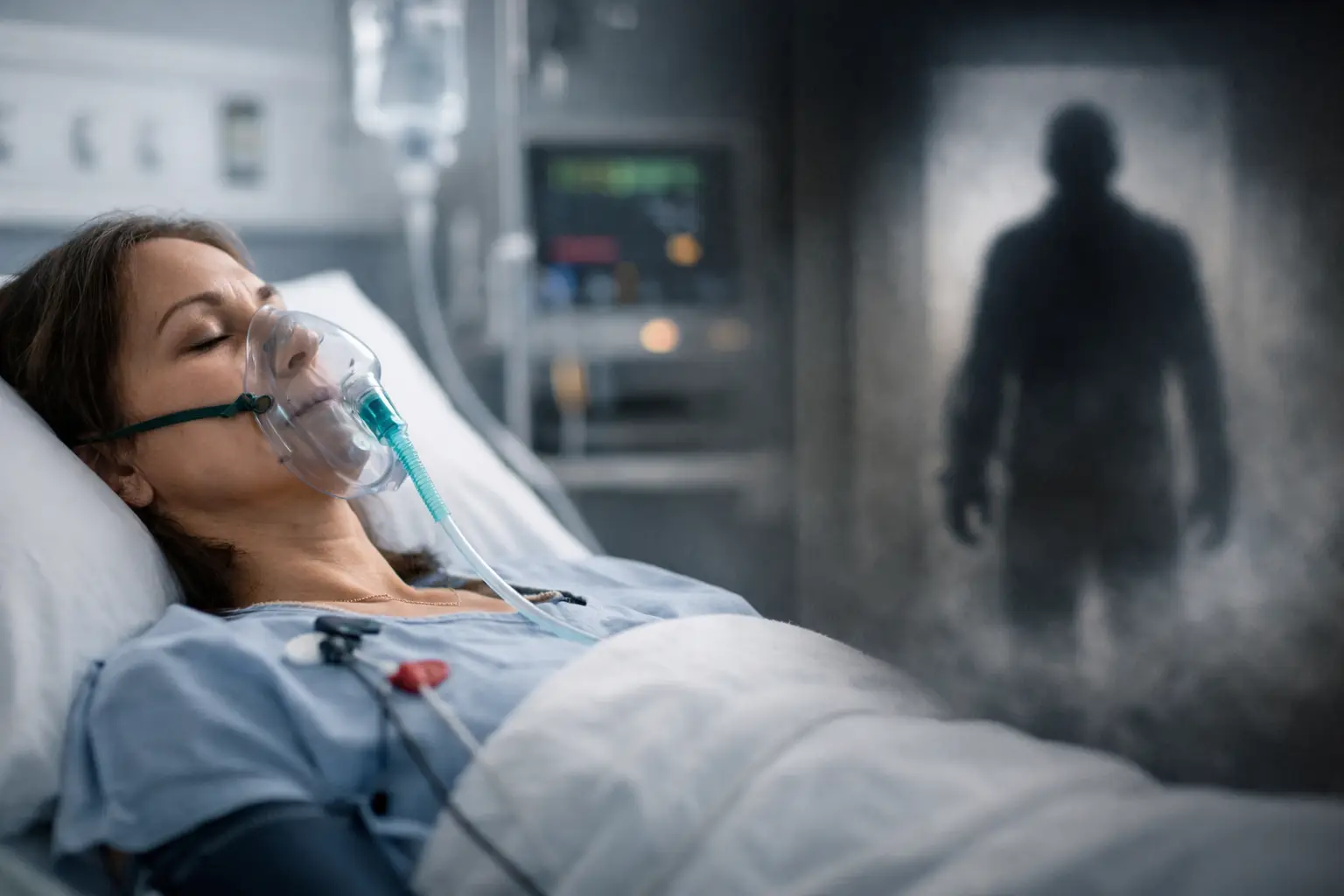
A person wakes from a medical catastrophe convinced they have been in hell. They may remember prisons, hostile beings, endless punishment, suffocation, abandonment, or a terrifying certainty that they will never escape. The question, what causes coma terror, is not academic for that survivor. It can shape every sleepless night that follows – and it has been badly answered for far too long.
The old catch-all label, “distressing NDE,” creates the central error. It places a fear-generated experience in the same category as an authentic near-death experience. It should not. Hellish coma imagery is a Fear Coma Experience (FCE): an ordeal generated by a living brain under catastrophe. An NDE is something else entirely – an experience during genuine clinical death, often peaceful and sometimes supported by verified perception that should have been impossible from the body.
That distinction is not semantic housekeeping. It removes a loaded and cruel conclusion: that a person’s worst medical hallucination is evidence that death itself leads to torture.
What Causes Coma Terror in a Fear Coma Experience?
Coma terror does not arise from one neat switch in the brain. It usually emerges when several forms of physiological and psychological disruption collide. Severe illness, traumatic injury, infection, surgery, respiratory distress, organ failure, medication effects, pain, fever, and prolonged sleep disruption can all destabilize perception. The person is alive, but their ordinary ability to locate themselves in time, space, and reality has been badly compromised.
A terrified mind does not produce neutral stories. Under threat, it tries to explain danger. With little reliable sensory information and no stable timeline, it can build an entire world around the body’s alarm signals. Difficulty breathing becomes drowning, burial, strangulation, or a sealed chamber. Restraints, tubes, voices in a hallway, and clinical procedures can be transformed into captivity, attack, interrogation, or torture.
This is why FCE imagery can feel more real than a normal dream. It is not casual imagination. It is a frightened, disoriented brain trying to impose a narrative on overwhelming internal signals.
Delirium supplies the setting
Delirium is one major operational clue. It can involve confusion, paranoia, fragmented memory, altered awareness, agitation, and vivid hallucinations. Intensive care settings can be especially fertile ground: artificial light, alarms, unfamiliar voices, interrupted sleep, isolation, powerful drugs, and repeated invasive procedures strip away the cues that ordinarily keep a person oriented.
A patient may hear staff discussing another case and believe the words concern them. A shadow becomes a pursuer. A routine intervention becomes a deliberate assault. Later, memory stitches fragments together with terrifying confidence.
This does not mean the witness is lying, exaggerating, weak, or spiritually defective. The witness is reporting what was experienced. The investigative question is what kind of event produced it. Honest testimony and mistaken interpretation can coexist.
Fear gives the imagery its force
The brain’s threat machinery is designed to prioritize survival, not philosophical accuracy. When fear is extreme, the mind tends toward hostile agents, punishment, pursuit, confinement, contamination, and doom. Those themes are not random. They are ancient human fear patterns, intensified by vulnerability and loss of control.
Culture may help furnish the scenery. One person sees demons, another sees soldiers, machinery, faceless captors, insects, or a ruined landscape. The emotional structure is often the same: terror, helplessness, isolation, and no apparent exit. That recurring structure points toward a shared biology of fear, not a map of an afterlife punishment system.
The historical record matters here. Long before modern ICUs, people in fever, injury, intoxication, famine, imprisonment, and illness described underworlds and terrifying other realms. Human beings did not need a modern monitor or a particular religion to generate visions of catastrophe. They needed a living nervous system in crisis.
Coma is not always the precise medical term
People commonly say “coma” for any period of missing time, sedation, unconsciousness, or confused recovery. Clinically, those states differ. A deeply sedated patient, a person in ICU delirium, someone recovering from anesthesia, and someone with a severe brain injury may all report terrifying inner episodes, but they are not necessarily in the same neurological condition.
That is why an investigator should not begin with labels supplied years later. Start with the medical timeline. Was there documented cardiac arrest? How long was circulation absent? Was the person responsive? What medications were administered? Was there infection, fever, low oxygen, ventilation, or delirium? What did nurses and family observe? These facts do not diminish the survivor’s experience. They identify the event accurately.
The Critical Divide: FCE Versus NDE
An authentic NDE occurs during verified clinical death. Its evidential center is not a mood or a beautiful story. It is veridical perception: accurate observations made while the person was clinically dead and could not have obtained the information through normal bodily senses. That is the evidence materialist explanations cannot carry away with a hand wave.
An FCE has a different profile. The person remains alive in a catastrophic medical state. The experience is usually fear-saturated, fragmented, and tied to the conditions of bodily distress. It may be unforgettable. It may alter a life. But intensity is not proof that the event happened after death.
This is the correction the field has resisted. Calling an FCE a “distressing NDE” quietly suggests that NDEs can be hellish and that hell is waiting on the far side of death. The data do not require that conclusion. In fact, the two categories point in opposite directions. The FCE belongs to the living brain in terror. The NDE belongs to verified death, where reports repeatedly show separation from the body, coherence, peace, and in the strongest cases, confirmed perception.
There is one rare complication: the Welded NDE. A person can undergo an FCE during a medical crisis and also have a genuine NDE during a documented period of clinical death. With no ordinary clock separating the episodes, memory can fuse them into one apparent journey. That does not turn terror into an NDE or reduce an NDE to chemistry. It means two distinct events were welded together in recall and must be separated by timeline, medical facts, and evidential content.
Why the Distinction Is Personally Urgent
For a survivor, the wrong label can deepen trauma. If someone is told their FCE was a glimpse of eternal punishment, every recurrence of panic can feel like confirmation. A person may become convinced that illness revealed a verdict on their character. That is not compassionate, and it is not disciplined analysis.
The better question is not, “Why did I deserve to see this?” It is, “What was my body and mind enduring at that moment?” Medical trauma deserves care. Nightmares, panic, intrusive memories, and fear of sleep are real consequences, and professional trauma support can be a practical part of recovery. Investigating the experience does not replace treatment when treatment is needed.
It also matters to families facing death. They should not have to carry internet horror stories as though they were intelligence reports from the afterlife. A frightening account may reveal the brutality of a living medical crisis, not the destination of a soul.
Don Winner’s Hell Exists, But Only for the Living takes this evidence where many NDE discussions refuse to go: hell is real as an experience of human terror, but it is not the fate revealed by death. That conclusion is both tougher and more humane than the old label.
If coma terror has frightened you, do not let its vividness bully you into a false interpretation. Ask for the timeline. Separate fear from evidence. A living brain can create a convincing hellscape under catastrophe. That says something grave about suffering on Earth – and nothing final about where you, or anyone you love, goes after death.
Want to go deeper? Don Winner brings decades of intelligence and investigative experience to the biggest question there is: what happens when we die.
In You’re Going to Die Someday, Right? Near-Death Experiences Reveal What Happens Next, he examines the evidence from thousands of near-death experiences to find out what they actually tell us about consciousness, the soul, God, and the afterlife.
In Hell Exists, But Only for the Living, he investigates where our idea of hell came from and who built it, tracing the doctrine back to its human sources.
Get your copy of You’re Going to Die Someday, Right? or Hell Exists, But Only for the Living.